APAH Unit 3 Pt. 2
 Call Kai
 Learn
Learn Practice Test
 Spaced Repetition
 Match
Match Flashcards
 Knowt Play
1/26

There's no tags or description
Looks like no tags are added yet.
Name | Mastery | Learn | Test | Matching | Spaced | Call with Kai | Chat |
|---|
No analytics yet
Send a link to your students to track their progress
27 Terms

Annunciation Triptych
FORM: Oil on wood, emphasizes weight and volume FUNCTION: portable triptych (work of art) for intimate personal prayer CONTENT: Left-wealthy merchant and wife kneeling in prayer; Center- Annunciation; Right- Joseph the Carpenter in his workshop; Symbolism- Lillies= Virginity Fireplace= entrance to hell Towel and Water= purity CONTEXT: Patrons donated after artist began began; produced in Tournai; female added after marriage
The Arnolfini Portrait
FORM: Oil on oak panel; dark, neutral colors except on right side FUNCTION: represents wealth and marital union; seen as wedding certificate CONTENT: Arnolfini and wife; mirror features 10 roundels depicting passion of Christ; signature above mirror; Symbolism- dog= fidelity; couple's hands suggest vows; chandelier= light of God CONTEXT: Painted by Jan Van Eyck who was celebrated for revolutionary glaze technique
Adam and Eve
FORM: engraving on copper plate; contrapposto Apollo and Venus pose FUNCTION: Depicts the biblical story of creation and the fall of man; portable print for commercial sale CONTENT: Adam and Eve in the Garden of Eden, surrounded by various animals (sins) and the Tree of Knowledge; Symbolism- Apple= temptation; serpent= sin; landscape= paradise. CONTEXT: inspired by classical sculptures and Renaissance humanism; created by Albrecht Dürer.
Isenheim Altarpiece
FORM: Oil on wood; multi-panelled altarpiece FUNCTION: Displayed in a hospital for spiritual healing; provides comfort to sufferers CONTENT: Depicts scenes of Christ's life, crucifixion, and resurrection; shows Saint Anthony and the Annunciation; legs severed by seam; Symbolism- Christ’s suffering= empathy for patients; the lamb= sacrifice; vibrant colors= hope CONTEXT: Created by Matthias Grünewald before protestant reformation
Allegory of Law and Grace
FORM: Woodcut; contrasting images of law and grace FUNCTION: commissioned to show Martin Luther’s key doctrine CONTENT: Depicts scenes of the Last Judgment; Christ and Moses juxtaposed; Symbolism- the law reveals sin, while grace offers salvation, left shows old ways, right shows new, just ways CONTEXT: Created by Lucas Cranach the Elder during height of religious upheval
Hunters in the Snow
FORM: Oil on wood; landscape painting FUNCTION: created for wealthy merchant banker, elevating peasant life and the changing seasons CONTENT: 3 tired and defeated hunters, with only 1 fox; inn workers build fire and skaters skate over frozen pond; Symbolism- represents the cycle of life and the harshness of winter CONTEXT: Created by Pieter Bruegel the Elder during the Northern Renaissance; renowned painting made during one of the coldest winters

Pazzi Chapel
FORM: Smooth white masonry walls accented with dark grey tuscan limetone; umbrella like ribbed dome; cross-shaped floor plan FUNCTION: Built as official meeting area of monks and a burial chapel for the Pazzi family CONTENT: 12 glazed roundels of 12 apostles and 4 evangelists; Pazzi family crest; small barrel vault on either side CONTEXT: Designed by Filippo Brunelleschi to deliberately reject gothic height, point, and asymmetry; classicism is brought back

Palazzo Rucellai
FORM: smooth sandstone ashlar masonry facade; three stories with pilasters; round arches on the ground floor and rectangular windows above FUNCTION: Built as a private residence for the Rucellai family CONTENT: decorative frieze and medici ring motif top 4th floor hidden (servants) CONTEXT: Designed by Leon Battista Alberti; similar to colosseum; wanted to make peace with medici family
David
FORM: cast bronze; life-size representation of a biblical hero. FUNCTION: originally in medici courtyard; made to give medici family divine favor CONTENT: Depicts a youthful David after his battle with Goliath, standing on his helmet/head (depicts cupid riding chariot) and holding his sword; poet’s hat and leather boots CONTEXT: Sculpted by Michelangelo during the High Renaissance; a landmark work demonstrating mastery of form and composition.
Madonna and Child with 2 angels
FORM: tempera on panel; replaces stiff with soft naturalism; soft lines and warm colors FUNCTION: Created as a devotional piece for private worship and emotional connection with worshipper CONTENT: Depicts the Virgin Mary holding the Christ child surrounded by two angels in a serene setting; intricate details in clothing and halo; modernizing biblical figures CONTEXT: Painted by Fra Filippo Lippi; patroned by medici, woman might be based off love interest
Birth of Venus
FORM: tempera on canvas; depicts a large female figure emerging from the sea FUNCTION: Created as a celebration of beauty and love, possibly for a private residence. CONTENT: Illustrates the goddess Venus arriving at shore, surrounded by mythological figures (blowing her to shore and waiting to cloak her); emphasizes beauty and idealized form, modestly covering nudity CONTEXT: Painted by Sandro Botticelli, favorite artist in medici circle; breaks taboos regarding female nudity outside of biblical art; soul after baptism
Last Supper
FORM: oil and tempura on dry plaster; orthogonal lines all lead to Christ’s eye, Leo used experimental materials FUNCTION: commissioned to let monks break bread and reflect Christ’s final meal CONTENT: Depicts Jesus and his disciples at the table after saying He will be betrayed, with intense emotional reactions; john slumped in grief CONTEXT: Painted by Leonardo da Vinci; commissioner’s coat of arms on top, less than 20% of original paint remains

Sistine Chapel
FORM: fresco on ceiling; worked standing on scaffolding FUNCTION: private chapel for pope and election of pope CONTENT: Features scenes from creation, Noah’s ark, 300 figures, no 2 poses the same (sibyl foreshadow coming of christ) CONTEXT: Painted by Michelangelo, commissioned by Pope Julius II, high renaissance masterpiece in Vatican City
School of Athens
FORM: fresco on the wall; focal point between Plato and Aristotle; inspired by roman baths FUNCTION: commissioned by Pope Julius II for private library CONTENT: Depicts various figures such as Socrates, Plato (heaven), and Aristotle(earth), showcasing their ideologies and contributions to Western thought; includes allegorical figures as well. CONTEXT: Painted by Raphael, worked on Vatican with Michelangelo; originally called “philosophy” reflects golden age
Venus of Urbino
FORM: oil on canvas; sensual and relaxed posture FUNCTION: intended as a wedding gift to instruct bride CONTENT: Depicts a nude woman reclining on a couch, symbolizing love and beauty, with a dog and a bouquet of flowers, forward gaze, servant rummaging behind; small feet and unproportional body CONTEXT: Painted by Titian in 1538 for the Duke of Urbino; used Venus for love instead of scandal
Entombment of Christ
FORM: oil on wood; dynamic composition with dramatic lighting; rejects high renaissance FUNCTION: center altarpiece for private funeral chapel; connecting Christ’s body to altar CONTENT: Features figures surrounding the body of Christ, expressing profound grief and emotion, with Mary Magdalene and St. John prominently displayed; use of diagonal lines enhances movement CONTEXT: Painted by Pontormo; reflects period of political instability

II Gesu
FORM: brick church with a facade emphasizing verticality FUNCTION: served as the mother church for the Jesuits; patron-Alexander Farnese CONTENT: features elaborate altarpieces, frescoes, and sculptures; jesuit monogram carved over whole main portal CONTEXT: Designed by Giacomo Barozzi da Vignola; model for catholic churches counter-reformation
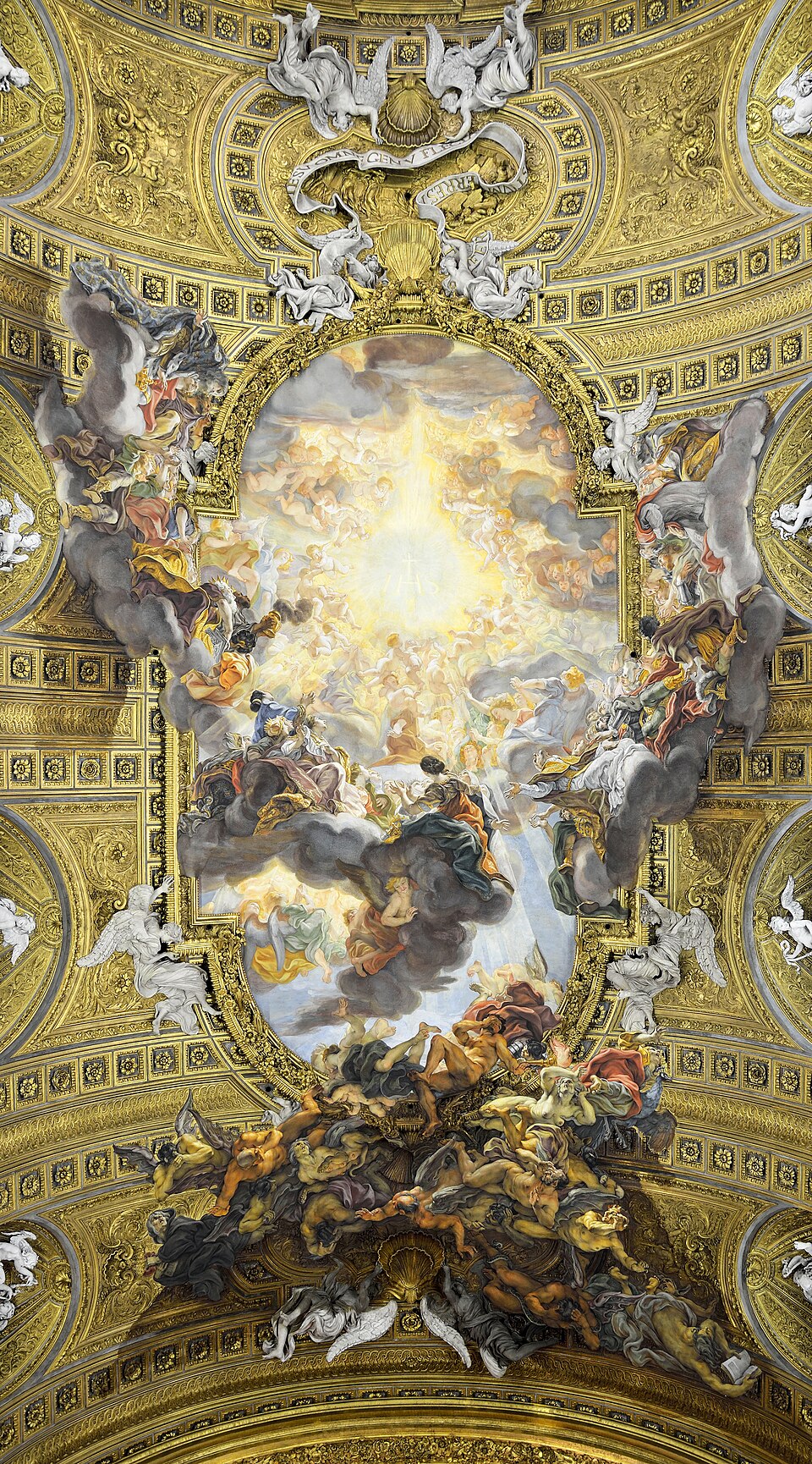
Triumph of the Name of Jesus
FORM: fresco, spills out from borders FUNCTION: represent heaven CONTENT: Christ’s name at center of light; damned falling to shadows CONTEXT: must listen to church reform; hundreds of christians killing each other; notion that you must take sides; art mirrors emotions
Calling of Saint Matthew
FORM: oil on canvas; dramatic use of light and shadow (chiaroscuro) and a sense of movement FUNCTION: commissioned by estate of cardinal matthieu cointrel to decorate private chapel and make holy scripture relatable CONTENT: features a gathering of figures with Matthew at a tax collector's table, Jesus extending hand and calling Matthew to be a disciple CONTEXT: Painted by Caravaggio; reflection of God’s hand to Adam; inspired by sistine chapel
Ecstasy of Saint Teresa
FORM: marble sculpture FUNCTION: depicted in chapel of Cornaro family; depicted scenes from her diary CONTENT: features an angel piercing Teresa's heart with a golden arrow, surrounded by theatrical drapery; sexual symbolism within spiritual experience; heavenly rays above CONTEXT: Created by Gian Lorenzo Bernini, dramatist (uses everything he has)
Las Meninas
FORM: oil on canvas; mirror reflects into our space; huge painting FUNCTION: created for King Phillip IV’s study; intimate group portrait CONTENT: features Infanta Margaret Theresa surrounded by attendants, with Velázquez painting in the background; king and queen in mirror CONTEXT: Painted by Diego Velázquez, first painter to the king; naturalism; Spanish golden age
Henri IV Receives the Portrait of Marie de’ Medici
FORM: oil on canvas; mellow intensity of colors FUNCTION: validates her as political marriage as a match made in heaven; depictions of her life CONTENT: shows Henri IV receiving the portrait of Marie de' Medici, forgot helmet bc he is smitten; Jupiter and Juno- marital harmony CONTEXT: Painted by Peter Paul Rubens; daughter of grand duke; king assassinated in 1610
Self-Portrait with Saskia
FORM: etching; intimate portrayal FUNCTION: depicts Rembrandt and his wife, Saskia, showcasing personal connection; private, not for sale CONTENT: features Rembrandt in costume, with Saskia featured beside him; represents love and partnership CONTEXT: Created by Rembrandt van in Amsterdam during economic prosperity; Saskia is his muse
Woman Holding a Balance
FORM: oil on canvas; strong diagonal lines lead to right pinky FUNCTION: symbolizes the weighing of souls and moral responsibility CONTENT: depicts a woman holding a balance with a suspended piece of jewelry; background features a closed window and painting of Last Judgment CONTEXT: Painted by Johannes Vermeer, works at slow pace
Fruit and Insects
FORM:oil on canvas; vibrant colors and detail FUNCTION: for wealthy merchant viewer’s to contemplate the fleeting nature of life CONTENT: features a still-life arrangement of fruits and insects, showcasing their beauty and transience CONTEXT: Created by Rachel Ruysch, a leading female still-life painter; father was famous scientist; sold for higher than Rembrandt ever made

San Carlo alle Quattro Fontane
FORM: travertine stone and stucco; unusually small site; facade higher than rest of building; oval hybrid central plan FUNCTION: serves as a church; built for free CONTENT: intricate facades, and elaborate interior; rosettes sculpted into coffers; corinthian columns; designed by Francesco Borromini CONTEXT: Bernini was a frenemy; name on square in Rome w 4 fountains; clients in rome followers of Holy trinity
Palace at Versailles
FORM: Masonry, stone, gold leaf, marble, etc.; large palace complex; incorporates classical elements and Baroque style; extensive gardens; 700 rooms FUNCTION: serves as a royal residence and symbol of absolute monarchy and capital of France CONTENT: features Hall of Mirrors, grand apartments, and vast gardens, military triumphs on ceiling, Apollo statues; reflects the power and influence of King Louis XIV CONTEXT: Located near Paris, transformed from a hunting lodge into a grand palace; glass smuggled from Venice; everything was watched; centerpiece of French culture and politics.