Day 4: Circadian Rhythms
 Call Kai
 Learn
Learn Practice Test
 Spaced Repetition
 Match
Match Flashcards
 Knowt Play
1/22

There's no tags or description
Looks like no tags are added yet.
Name | Mastery | Learn | Test | Matching | Spaced | Call with Kai | Chat |
|---|
No analytics yet
Send a link to your students to track their progress
23 Terms
Many living things have circadian rhythms
What does human have circadian rhythms for?
5 things
Humans have circadian rhythms of behavior, alertness, mood, body temperature, and hormone levels.
Circadian rhythms are endogenous
What does endogenous mean?
What does entrained mean?
They are not simply responses to changes in the environment; rather, they continue even when the environment is held constant, e.g. plants open and close their leaves on a 24-hour cycle even when light and temperature are constant.
Almost every cell in your body has its own internal clock that oscillates on a roughly 24-hour schedule, though these clocks can be entrained (i.e. kept in sync) by sensory signals acting through a master clock in your brain.
Studies in fruit flies have revealed a gene involved in circadian rhythms
What is the gene involved
the protein involed
Explain the clock of the gene and the protein times
Explain how the 24 hour clock work
A gene called period, or per, on the X-chromosome, shows a 24- hour cycle — it is transcribed mostly early in the night, so its mRNA is most abundant around 10 p.m. Its protein product, PER, is most abundant 6 hours later.
PER (with other factors) represses transcription of per (and in the absence of PER, mRNA levels do not cycle), i.e. PER and its mRNA drive each other’s cycling, in a transcription-translation feedback loop, or TTFL.
Another gene called timeless or tim is also crucial
How does it work with PER? explain the process and the timeline of the day at which it occurs
Why is it important to have both
Other studies in fruit flies have shown that tim mRNA and its protein product, TIM, oscillate much like per mRNA and PER.
TIM binds PER, and it is the dimer PER/TIM that represses transcription of tim and per.
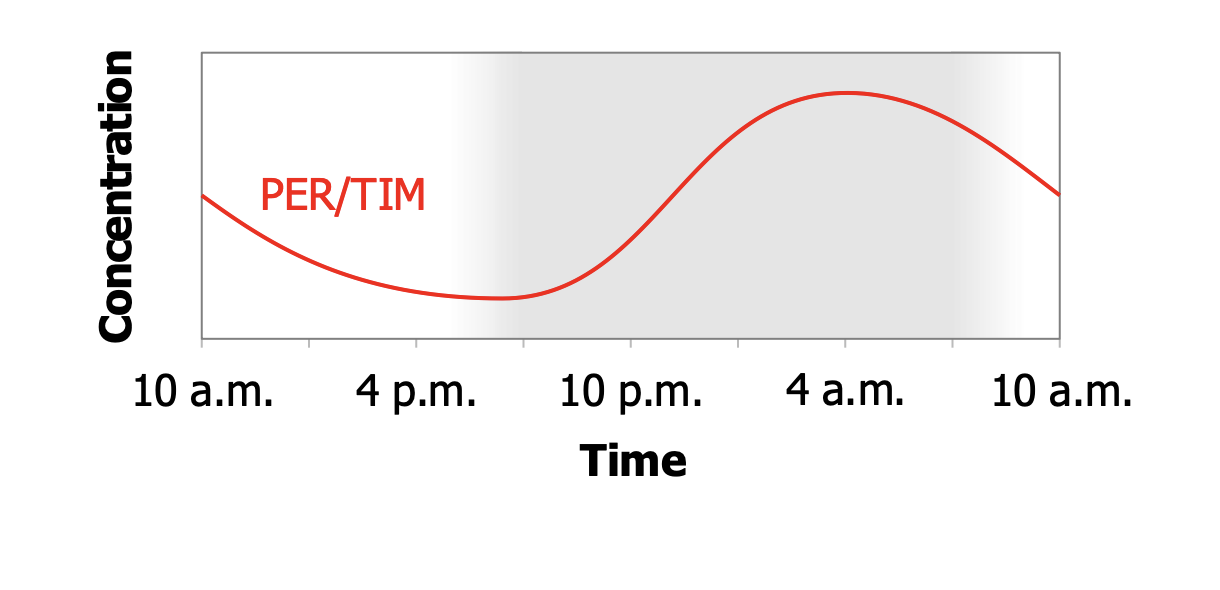
This self-repression drives a cycle. Around 4 a.m., high levels of PER/TIM shut off per and tim, so PER/TIM levels gradually fall. So per and tim, no longer repressed, rise to a peak in late evening, leading to another peak in PER/TIM next morning at 4 a.m.
If either TIM or PER is absent, neither one oscillates.
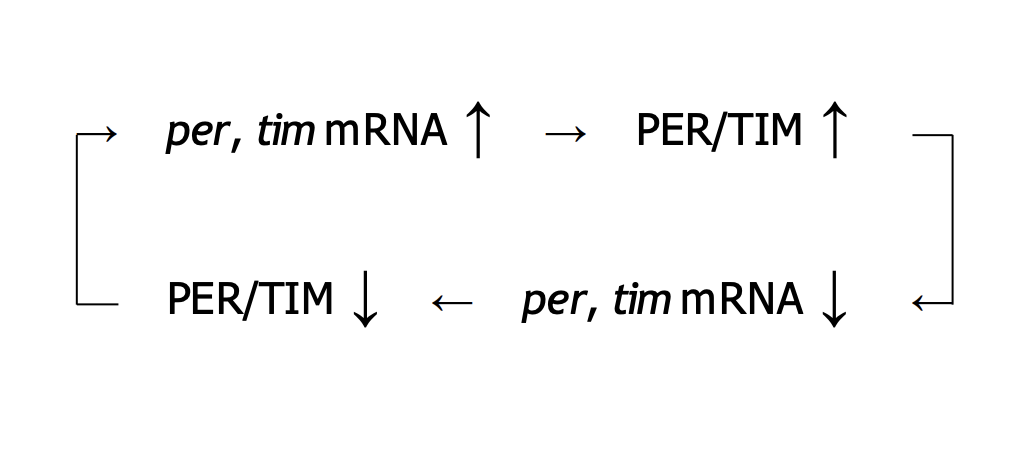
Draw a graph, with the timeline with PER/TIM amounts in the body
How does PER/TIM block transcription (what specifically does it block?)
A gene called clock (or clk) codes a protein CLK, and a gene called cycle (or cyc) codes CYC. In the daytime, the dimer CLK-CYC binds DNA and stimulates transcription of per and tim.
In the night, PER/TIM blocks CLK-CYC binding to DNA, and so represses transcription of per and tim.
Transcription
How long per kb of DNA
How long for one gene trascription
Translation
How many does the ribosome translate per second
How long does it take to translate small protein
How long does it take to translate large protein
Total time for gene expression
^what does this mean
Translation is a quick process.
Transcription (DNA → mRNA):
Takes ~20–60 seconds per kilobase (kb) of DNA.
Typical gene transcription time: ~1–10 minutes per gene.
Translation (mRNA → Protein):
Ribosome speed: ~5–10 amino acids per second (eukaryotes).
Small protein (~100 amino acids): ~10–20 seconds.
Large protein (~1,000 amino acids): several minutes.
Combined Time for Gene Expression:
For typical genes: ~5–15 minutes to produce proteins.
So, we might expect PER and TIM levels to lag per and tim by only a short interval, resulting in a cycle much shorter than 24 hours.
If transcription and translation are so efficient, why does the PER protein lag behind per mRNA by several hours?
What other gene involved?
Translation is a quick process, and so we might expect PER and TIM levels to lag per and tim by only a short interval, which would resultin a cycle much shorter than 24 hours.
But the protein DBT (doubletime) binds PER, causing itto break down, so levels of PER rise much more slowly than they otherwise would, and so they do not peak until 6 hours after per, resulting in an overall cycle length near 24 hours.
The human system is less well understood, but uses a similar TTFL
What is similar: what gene is stil involved
What gene is different?: what is it’s name
Mammals have homologs of per that play a similar role, though mammalian PER forms a dimer not with TIM but with a protein called CRY, from the cryptochrome or cry gene. Mammals have homologs of tim,but their functions are unclear.
Mammalian homologs of clk, cyc, and dbt are called clk, bmal1, and ck1ε.
In mice and likely other mammals, a CLK/BMAL1 dimer stimulates transcription of per and cry when not blocked by PER/CRY. CK1ε slows the rise of PER protein levels.
How are the cellular clocks kept in sync?
What is zeigeber
What is the suprachiasmatic nucleus responsible for
With a clock in almost every cell, the human body is like a clock shop with 10 trillion clocks. If they were left to run independently, they would come out of sync with each other and with the external rhythm of night and day.
But they are kept in sync by several external factors, e.g. light, temperature, feeding, exercise, and social interaction; all such cues are called zeitgeber.
The main zeitgeber is light sensed by melanopsin retinal ganglion cells, which project to the master clock: the suprachiasmatic nucleus (SCN) of the hypothalamus.
Where is the SCN located
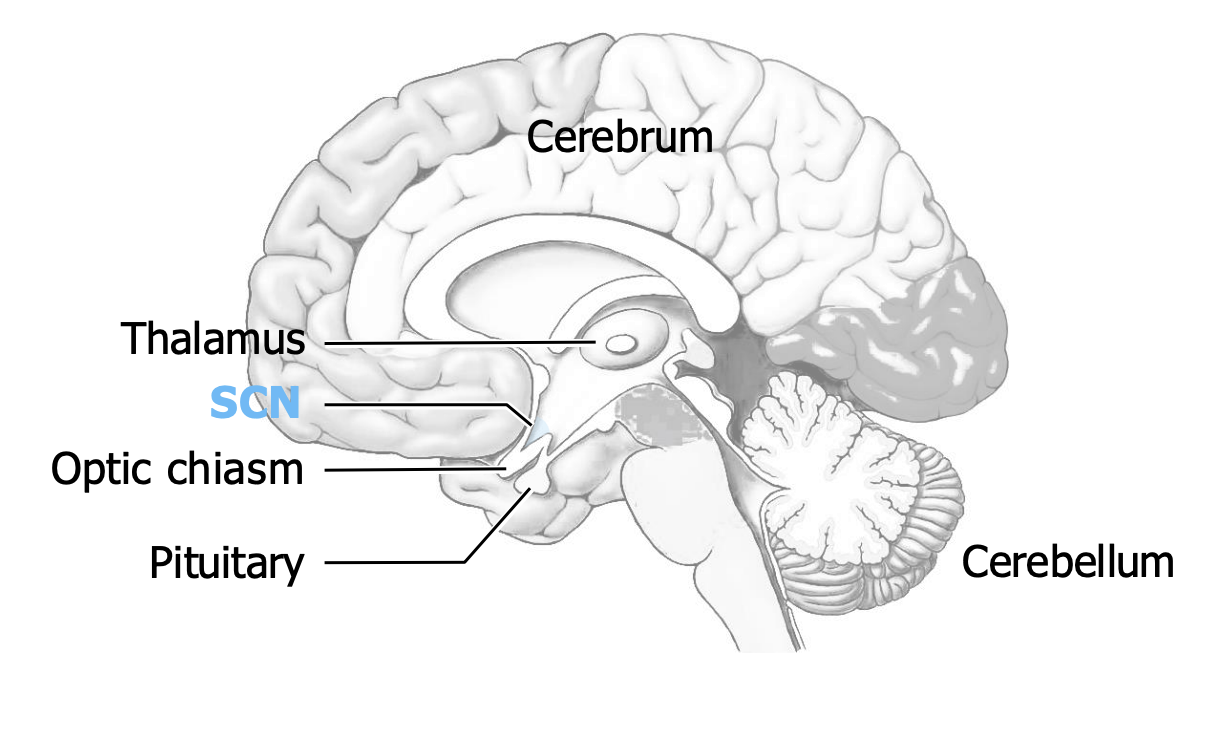
The cellular clocks in the SCN are reset by light
What does the SCN nucleus does in the presence of light, what proteins does it affect
Signals from melanopsin retinal ganglion cells reach certain neurons in the SCN, making them fire and resetting their clocks by a small amount,
i.e. the retinal signals cause chemical changes in these SCN cells that lead to a breakdown of PER/CRY;
if this drop in PER/CRY occurs after ~ 4 a.m., when PER/CRY levels are already falling, then it sets the clock forward a little; if it happens in the evening, when PER/CRY levels are rising, it sets the clock back.
From the SCN, information about light and dark spreads throughout the body
what is entrainment
The SCN neurons that receive retinal projections send signals onward to other neurons in the SCN, so their intracellular clocks are adjusted as well.
From there, neural signals pass to other brain areas, which in turn send neural and hormonal signals that adjust the intracellular clocks throughoutthe body.
This process of nudging a clock into synchrony with another rhythm is called entrainment. So the SCN becomes entrained to night and day, and other clocks are entrained to the SCN and through it to night and day.
In darkness, what releases melatonin
the pineal body
SCN → hypothalamus nuclei → sympathetic nervous system → pineal body
The pineal body secretes maltonin
Peaks at 2 am, falls by 8 am
Resets via the melatonin receptors in the SCN
Where is the pineal body located
diencephalon
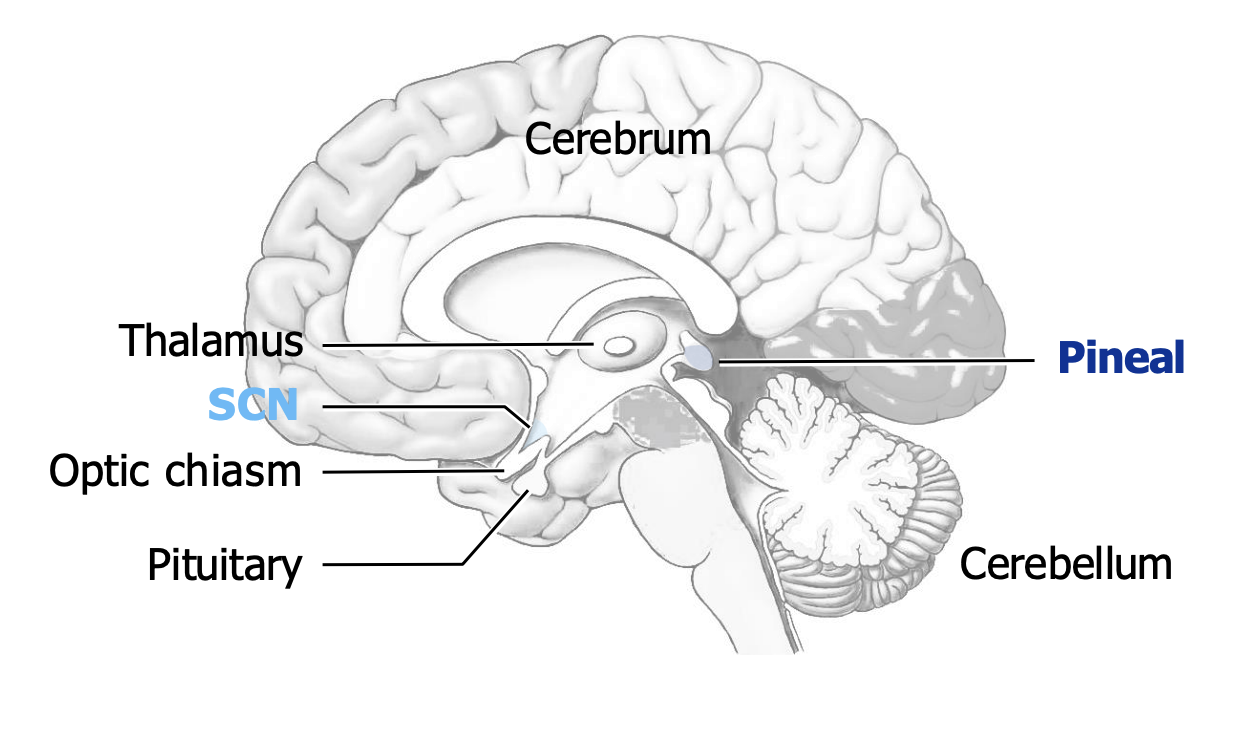
How do melatonin pills help with
helps with jet lag
SCN can only adjust by one hour per day
Very useful for destinations (in which clock is changed)
No benefits for taking it for issues with sleep
All animals sleep at different times
Diurnal and nocturnal animals
Explain what chronotypes are
Purpose of chronotypes
within a species there is chronotypes:
Early birds
Night owls
Chronotypes envolved for the security of the herd, for time when everyone is asleep you cannot be
Sleepiness depends partially on the master clock
Daylight: SCN excites lateral hypothalamus (LH) to release orexin
Darkness: other cells LH active to secrete MCH (melanin-concentrating hormone)
Both inhibits the other
Sleep pressure
Adenosine
Caffein: how it works with adenosine
Life of caffeine level in the blood
Adenosine buildup with ATP is broken down to make us sleepy
Sleep = decrease in adenosine buildup
4 stages of sleep
REM (dream with 30-40 Hz brain waves) with lack of muscle tone
Mammal and land animal have and aquatic animals have none of REM because of muscle importance
non-REM is no dreams, slower brain waves, stages 1-3
Stage 3 is with regular brain waves (2-4 Hz)
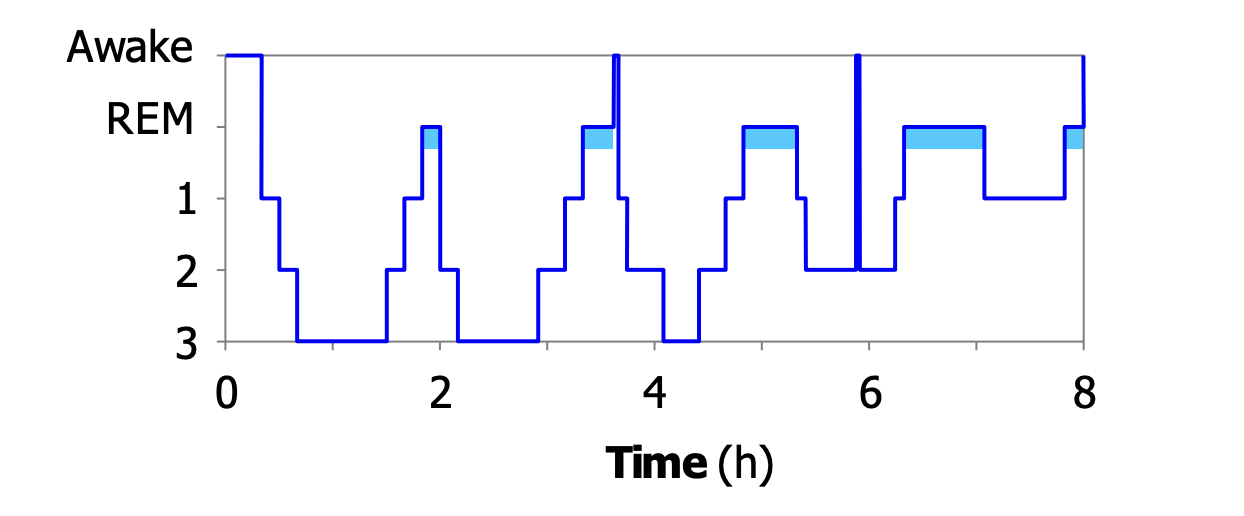
Stages follow each other in a 90 min cycle
The first REM stage occurs after about 90 minutes. As the night progresses, sleep gets shallower and REM stages longer, and you may wake up occasionally.
You need your sleep for good cognitive function
what happens with the lack of sleep
What happen if you sleep deprive: REM vs non-REM
Humans sleep less than other primate
But what are the pros
Deprivation of sleep, or even of just REM sleep, causes problems with cognitive function, learning, and memory.
After sleep deprivation, your first sleep will catch up on NREM, but the nextfew nights will have more REM than usual.
Humans sleep less than other primates, but with more REM, and on the ground rather than up a tree.