oat bio unit 21
 Call Kai
 Learn
Learn Practice Test
 Spaced Repetition
 Match
Match Flashcards
 Knowt Play
1/50

Earn XP
Description and Tags
The cows all started evolving and I don't know what this means for the beehive markets
Name | Mastery | Learn | Test | Matching | Spaced | Call with Kai | Chat |
|---|
No analytics yet
Send a link to your students to track their progress
51 Terms
1st line of defense
physical and chemical barriers
Skin: physical; oily/acidic secretions from sweat glands
Antimicrobial proteins: lysozyme in saliva and tears breaks down cell walls
Cilia: lines the lungs and sweeps invaders out
Gastric juice: I’M MMMEEEEELLLLLLTTTIIIIINNNNNGGGG
Symbiotic bacteria: outcompetes other organisms inside internal organs
leukocytes
name for all white blood cells
innate immune cells
more general response, activated quicker, and response is always the same regardless of previous encounters.
adaptive immune cells
B, T, and NK cells, more specific to individual pathogens.
phagocytes
cells that engulf pathogens or cellular debris via endocytosis, and then break them down into small particles.
Examples: neutrophils, monocytes, and dendritic cells.
neutrophils
most abundant WBC in the body, and destroys pathogens within infected tissues. They are drawn to infections via chemotaxis and enter tissues via diapedesis.
monocytes
circulate in the blood until they are needed to fight infections, where they move into cells via diapedesis and develop into macrophages.
macrophage
phagocytic cell that matures from monocytes and is used to phagocytize cell debris and pathogens.
antigen presenting cells
display fragments of pathogens on their own cells to activate T cells.
Examples: macrophages, dendritic cells, and B cells.
2nd line of defense
Eosinophils, mast cells, basophils, and NK cells
eosinophils
work collectively to surround and destroy pathogens.
mast cells
used for allergic response, inflammatory response, and anaphylaxis.
basophils
involved in inflammatory response and recruited to tissues when needed.
nk cells
attack abnormal body cells like tumors or pathogen infected cells.
Specifically infected cells with no MHC I receptors
Part of both the innate and adaptive immune response.
toll like receptors
receptors on immune cells that recognize molecular patterns on the surface of pathogens.
cytokines
chemical signaling molecules used in the immune response for cell to cell communication.
interleukins
specific type of cytokine
IL-1: inflammatory reaction
IL-2: triggers adaptive immune response.
interferons
secreted by infected cells that stimulate neighboring cells to produce proteins to defend against a virus.
compliment system
innate response where proteins are circulating in the inactive state, then are activated to cause lysis of a pathogen.
inflammatory response
Histamines secreted by mast cells cause vasodilation
Prostaglandins act locally, causing inflammation, fever, and pain
Increased blood flow + cytokines allows other immune cells to come to the rescue
diapedisis
When leukocytes enter tissues as a part of the inflammatory response by moving through gaps in blood vessel epithelium.
antigen
found on the surface of each pathogen and is unique to each pathogen.
antibody
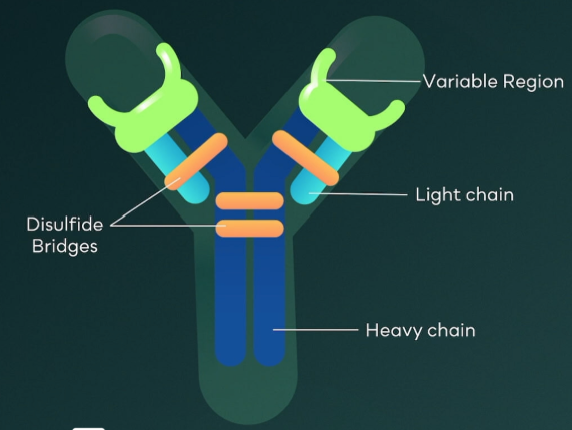
aka immunoglobulins, which are Y shaped molecules produced by B cells and have glycoproteins that are specific to only one epitope.
epitope
a unique part of an antigen that is recognized by the immune system.
IgG
most abundant antibody and can cross the placenta
IgA
antibody found in breast milk and mucosa
IgM
1st antibody produced after exposure to antigen
IgE
antibody related to allergies
IgD
apparently the scientists don’t know what this antibody actually does
antibody structure
MHC
aka major histocompatibility complex
Glycoproteins where the immune system can differentiate between self and nonself.
Two types: MHC I on all nucleated vertebrate cells, and MHC II, only on antigen presenting cells.
MHC I with normal cell
Regularly produced proteins and peptides in a cell are routinely broken down.
These broken down fragments are loaded into MHC I to check if it is “self”
No pathogens = no immune reaction.
MHC I with infected cell
Regularly produced proteins and peptides in a cell are routinely broken down.
These broken down fragments are loaded into MHC I to check if it is “self”
ERROR!!!! THIS CELL IS INFECTED!!!! DEPLOY THE TROOPS NOW!!!!
MHC II in phagocytic cells
Exogenous materials containing pathogens are ingested.
These particles are presented on MHC II receptors.
T cell receptors recognize the foreign particle and trigger a specific adaptive immune response.
MHC II in B cells
B cell receptors bind to foreign antigen and bring it into the cell.
These articles are presented on MHC II receptors.
T cells interact with loaded antigen on B cell.
T cell releases signaling molecules that trigger the B cell’s specific adaptive immune response.
2 branches of adaptive immunity
humoral response and cell mediated response.
humoral response
Controlled by B cells
B cells originate and mature in the bone marrow
They bind directly to pathogens (no antigen presenting cell)
B cell is activated and undergoes clonal selection
Clonal selection produces memory B cells and plasma cells
Upon a secondary infection, B cells rapidly proliferate
antibody functions
Opsonization: tag pathogens for elimination by phagocytosis.
Neutralization: Block the pathogen from interacting or being infective.
Agglutination: causes pathogens to clump together.
Enhancing other systems, like the compliment system.
cell mediated response
Controlled by T cells
T cells originate in bone marrow and mature in the thymus
T cell receptors bind antigen fragments presented on MHC
When a foreign antigen is encountered, T cells undergo clonal selection to produce four types.
4 types of T cells
Helper T cells
Cytotoxic/killer T cells
Memory T cells
Suppressor T cells
cytotoxic/killer T cells
Recognize antigens on MHC I and destroy by releasing perforins that trigger apoptosis.
Helper T cells
Stimulate activation of B cells, cytotoxic T cells, and recruit other immune cells.
Recognize antigens presented in MHC II.
Suppressor T cells
Play a negative feedback role in the immune system and prevent autoimmune responses.
T cell positive/negative selection
T cell travels to thymus to mature
Undergo positive selection in the thymic cortex if they can interact with MHC.
Undergo negative selection in the medulla to check if they can bind to self antigens presented on the MHC.
T cells that pass both types of selection are released from the thymus as mature T cells.
immune tolerance
The ability to prevent an immune response against an antigen, like self antigens.
Dysfunction of this ability can cause autoimmune disorders.
innate vs adaptive immunity overview
Innate | Adaptive | |
Target | Nonspecific | Specific to pathogen |
Speed | Fast/immediate | Slow |
Duration | Short (hours/days) | Long (months/years) |
Memory | No memory | Memory |
Cells | Neutrophil, eosinophil, basophil, dendritic cell, macrophage, NK cells | B cells, T cells, antibodies, NK cells |
acquired immunity
Active: Developed after direct pathogen exposure.
Natural: Antibodies made after pathogen exposure
Artificial: Antibodies made after receiving vaccine
Passive: Acquired from external sources.
Natural: Antibodies transferred from mom to baby
Artificial: Antibodies given via serum injection
vaccines
Use either dead or fragmented versions of pathogens to train the immune system to recognize the pathogen.
antibiotics
Chemicals derived from bacteria/fungi that are harmful to other microorganisms.
Overuse can cause selection for antibiotic resistant bacteria and killing of helpful bacteria.
immune cell abundance
Neutrophils > lymphocytes > Monocytes > Eosinophils > Basophils
Never Let Monkeys Eat Bananananas.
Natepipes Licked My Entire Butt
sprite can soda man