art history 1 - test 1
 Call Kai
 Learn
Learn Practice Test
 Spaced Repetition
 Match
Match Flashcards
 Knowt Play
1/106

Earn XP
Description and Tags
Name | Mastery | Learn | Test | Matching | Spaced | Call with Kai | Chat |
|---|
No analytics yet
Send a link to your students to track their progress
107 Terms

Ocher Stick from Blombos Cave
Paleolithic
c. 75,000 BCE

Hall of the Bulls in Lascaux Cave
Paleolithic
c. 15,000 BCE

Woman from Willendorf
Paleolithic
c. 24,000 BCE

Men Taunting a Deer
Neolithic
c. 6000 BCE

Stonehenge
Neolithic
c. 3000-2500 BCE
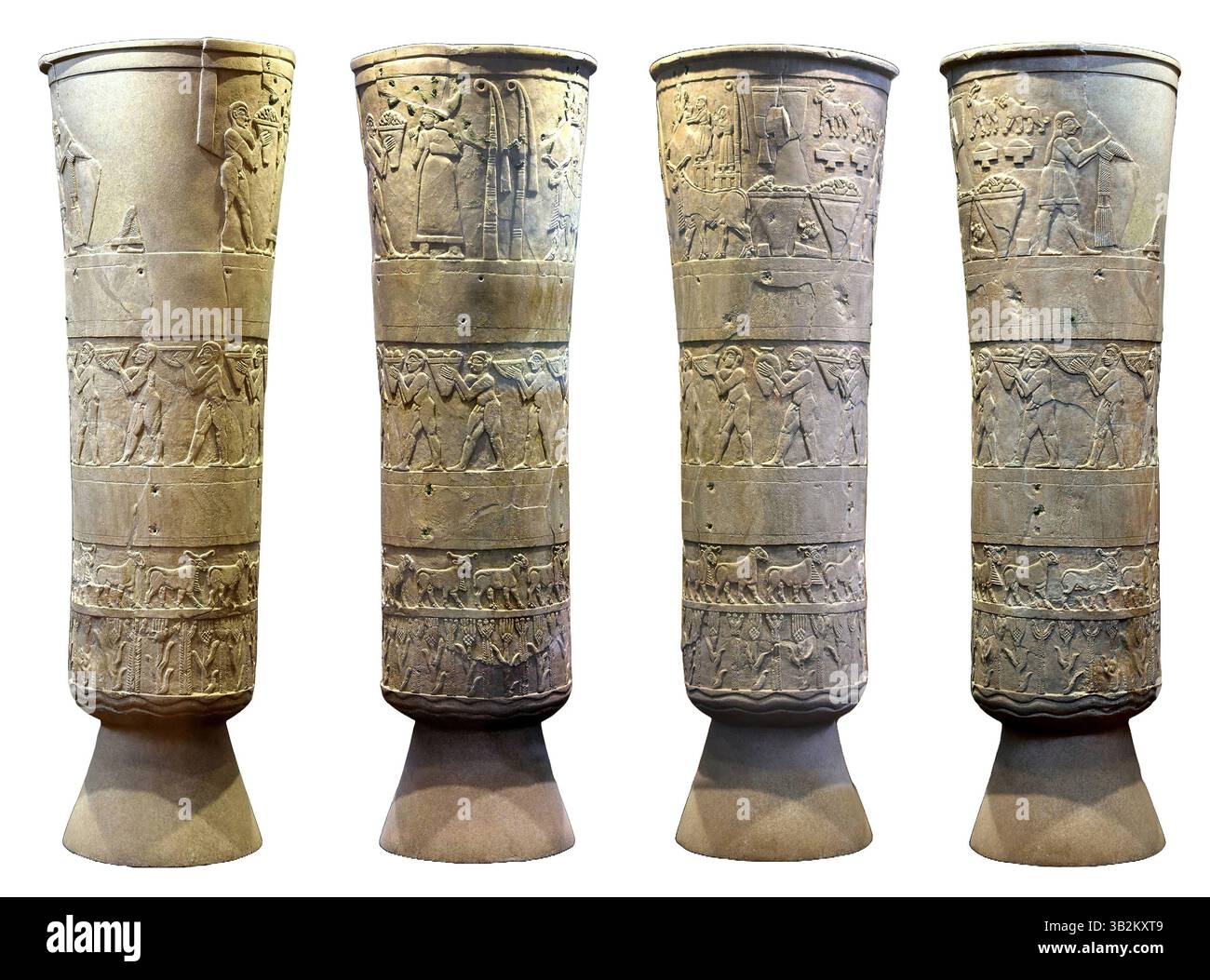
Uruk Vase
Ancient Near East/Mesopotamian/Sumerian
c. 3200 BCE

Head of an Akkadian Ruler
Ancient Near East/Akkadian
c. 2200 BCE
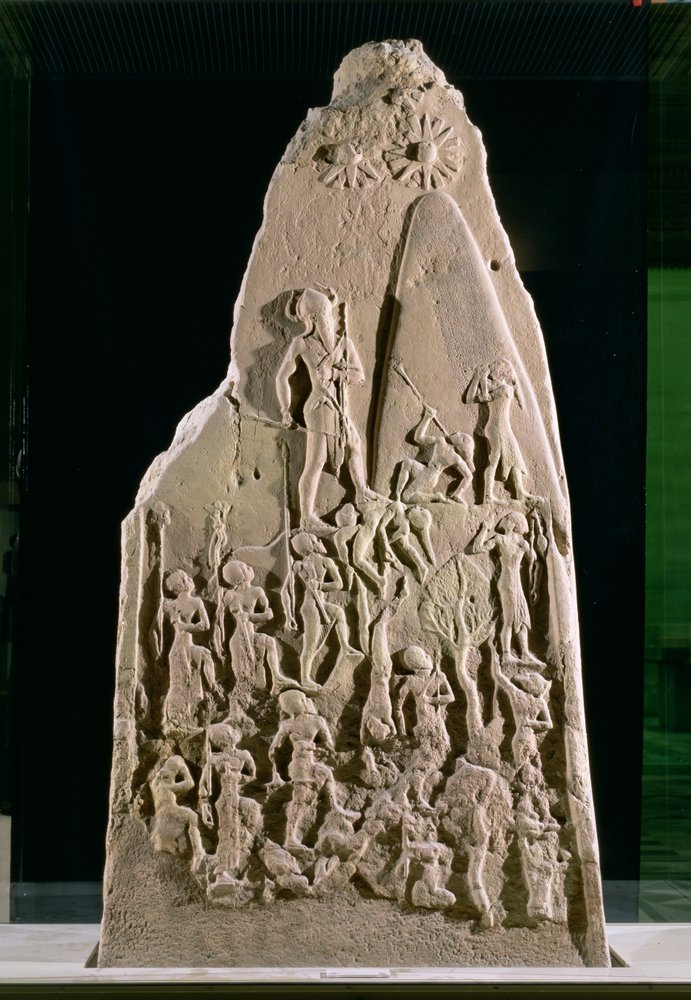
Victory Stele of Naram-Sin
Ancient Near East/Akkadian
c. 2222 BCE

Palette of Narmer
Egyptian/Early Dynastic Egyp
c. 2950 BCE

Ti Hunting Hippos
Egyptian/Old Kingdom Egypt
c. 2450 BCE

Funerary Temple of Hatshepsut
Egyptian/New Kingdom Egypt
c. 1473-1458 BCE

Stele of Akhenaten and his Family
Egyptian/New Kingdom Egypt
c. 1353-1336 BCE

Girls Gathering Saffron fresco
Minoan
c. 1630 BCE

Lion Gate at Mycenae
Mycenaean
c. 1250 BCE

Sculpture In The Round
Three-dimensional sculpture that is carved free of any background or block. Compare relief sculpture.

Relief Sculpture
A three-dimensional image or design whose flat background surface is carved away to a certain depth, setting off the figure. Called high or low (bas-) relief depending upon the extent of projection of the image from the background. Called sunken relief when the image is carved below the original surface of the background, which is not cut away.
Abstract
Of art that does not attempt to describe the appearance of visible forms but rather to transform them into stylized patterns or to alter them in conformity to ideals.
Relative Dating
Archaeological process of determining relative chronological relationships among excavated objects. Compare absolute dating.
Absolute Dating
A method, especially in archaeology, of assigning a precise historical date at which, or span of years during which, an object was made. Based on known and recorded events in the region, as well as technically extracted physical evidence (such as carbon-14 disintegration). See also radiometric dating, relative dating.
Radiometric Dating
Archaeological method of absolute dating by measuring the degree to which radioactive materials have degenerated over time. For dating organic (plant or animal) materials, one radiometric method measures a carbon isotope called radiocarbon, or carbon-14.
Potassium-Aragon Dating
Archaeological method of radiometric dating that measures the decay of a radioactive potassium isotope into a stable isotope of argon, an inert gas.
Uranium-Thorium Dating
Technique used to date prehistoric cave paintings by measuring the decay of uranium into thorium in the deposits of calcium carbonate that cover the surfaces of cave walls, to determine the minimum age of the paintings under the crust.
Thermo-Luminescence Dating
A method of radiometric dating that measures the irradiation of the crystal structure of material, such as flint or pottery, and the soil in which it is found, determined by how much a sample glows when it is heated.
Electric Spin Resonance
Method that uses magnetic field and microwave irradiation to date material such as tooth enamel and its surrounding soil.
Ridgepole
A longitudinal timber at the apex of a roof that supports the upper ends of the rafters.
Wattle and Daub
A wall construction method combining upright branches, woven with twigs (wattles) and plastered or filled with clay or mud (daub).
Thatch
Plant material such as reeds or straw tied over a framework of poles to make a roof, shelter, or small building.
Megalithic
A large stone used in some prehistoric architecture.
Post-and-Lintel
An architectural system of construction with two or more vertical elements supporting a horizontal element.
Capstones
The final, topmost stone in a corbeled arch or vault, which joins the sides and completes the structure.
Cairn
A pile of stones or earth and stones that served both as a prehistoric burial site and as a marker for underground tombs.
Passage Grave
A prehistoric tomb under a cairn, reached by a long, narrow, slab-lined access passageway or passageways.
Corbled Vault
An early roofing and arching technique in which each course of stone projects slightly beyond the previous layer (a corbel) until the uppermost corbels meet; see also under arch. Also: brackets that project from a wall.
Henge
A circular area enclosed by stones or wood posts set up by Neolithic peoples. It is usually bounded by a ditch and raised embankment.
Lintel
A horizontal element of any material carried by two or more vertical supports to form an opening.
Mortise-and-Tenon
A method of joining two elements. A projecting pin on one element fits snugly into a hole designed for it on the other.
Ceramics
A general term covering all types of wares made from fired clay.
Porcelain
A type of extremely hard and fine white ceramic first made by Chinese potters in the eighth century CE. Made from a mixture of kaolin and petuntse, it is fired at a very high temperature, and the final product has a translucent surface.
Kiln
An oven designed to produce enough heat for the baking, or firing, of clay, for the melting of the glass used in enamel work, and for the fixing of vitreous paint on stained glass.
Earthenware
A low-fired, opaque ceramic ware, employing humble clays that are naturally heat-resistant and remain porous after firing unless glazed. Earthenware occurs in a range of earth-toned colors, from white and tan to gray and black, with tan predominating.
Stoneware
A high-fired, vitrified, but opaque ceramic ware that is fired in the range of 1,200° to 1,400° Celsius. At that temperature, particles of silica in the clay bodies fuse together so that the finished vessels are impervious to liquids, even without glaze. Stoneware pieces are glazed to enhance their aesthetic appeal and to aid in keeping them clean. Stoneware occurs in a range of earth-toned colors, from white and tan to gray and black, with light gray predominating. Chinese potters were the first in the world to produce stoneware, which they were able to make as early as the Shang dynasty.
Potsherds
A broken piece of ceramic ware.
Hierarchic Scale
The use of differences in size to indicate relative importance. For example, with human figures, the larger the figure, the greater her or his importance.
Stylus
An instrument with a pointed end (used for writing and printmaking), which makes a delicate line or scratch. Also: a special writing tool for cuneiform writing with one pointed end and one triangular.
Cuneiform
An early form of writing with wedge-shaped marks impressed into wet clay with a stylus, primarily used by ancient Mesopotamians.
Ziggurat
In ancient Mesopotamia, a tall stepped tower of earthen materials, often supporting a shrine.
Inlay
To set pieces of a material or materials into a surface to form a design. Also: material used in or decoration formed by this technique.
Registers
A device used in systems of spatial definition. In painting, a register indicates the use of differing ground-lines to differentiate layers of space within an image. In relief sculpture, the placement of self-contained bands of reliefs in a vertical arrangement.
Votive Figures
An image created as a devotional offering to a deity.
Conventions
A traditional way of representing forms.
Cylinder Seals
A small cylindrical stone decorated with incised patterns. When rolled across soft clay or wax, the resulting raised pattern or design served in Mesopotamian and Indus Valley cultures as an identifying signature.
Lost-Wax Casting
A method of casting metal, such as bronze. A wax model is covered with clay and plaster, then fired, thus melting the model and leaving a hollow form. Molten metal is then poured into the hollow space and slowly cooled. When the hardened clay and plaster exterior shell is removed, a solid metal form remains to be smoothed and polished.
Lamassus
Supernatural guardian-protector of ancient Near Eastern palaces and throne rooms, often represented sculpturally as a combination of the bearded head of a man, powerful body of a lion or bull, wings of an eagle, and the horned headdress of a god, usually possessing five legs.
Portals
A grand entrance, door, or gate, usually to an important public building, often decorated with sculpture.
Low Relief
Relief sculpture is a three-dimensional image or design whose flat background surface is carved away to a certain depth, setting off the figure. Called high or low (bas-) relief depending upon the extent of projection of the image from the background. Called sunken relief when the image is carved below the original surface of the background, which is not cut away.
Palace Complex
A group of buildings used for living and governing by a ruler and his or her supporters, usually fortified.
Crenellated
Alternating high and low sections of a wall, giving a notched appearance and creating permanent defensive shields on top of fortified buildings.
Sarcophagus
A stone coffin. Often rectangular and decorated with relief sculpture.
Nemes Headdress
The royal headdress of ancient Egypt.
Ankh
A looped cross signifying life, used by ancient Egyptians.
Scarab
In ancient Egypt, a stylized dung beetle associated with the sun and the god Amun.
Canon of Proportions
A set of ideal mathematical ratios in art based on measurements, as in the proportional relationships between the basic elements of the human body.
Canopic Jars
In ancient Egyptian culture, a special container used to store the major organs of a body before embalming.
Mastaba
A flat-topped, one-story structure with slanted walls built over an ancient Egyptian underground tomb.
Necropolis
A large cemetery or burial area; literally a "city of the dead."
Clerestory
In a basilica, the topmost zone of a wall with windows, extending above the aisle roofs. Provides direct light into the nave.
Portico
In architecture, a projecting roof or porch supported by columns, often marking an entrance. See also porch.
Pylon
In architecture, a projecting roof or porch supported by columns, often marking an entrance. See also porch.
Peristyle
In Greek architecture, a surrounding colonnade. A building of this type is surrounded on the exterior by a colonnade. Also: a court of this type is an open colonnaded courtyard, often having a pool and garden.
Hypostyle Hall
A large interior room characterized by many closely spaced columns that support its roof.
Capitals
The sculpted block that tops a column. According to the conventions of the orders, capitals include different decorative elements (see order). A historiated capital is one displaying a figural composition and/or narrative scenes.
Colonnade
A row of columns supporting a straight lintel (as in a porch or portico) or a series of arches (an arcade).
Stucco
A mixture of lime, sand, and other ingredients made into a material that can easily be molded or modeled. When dry, it produces a durable surface used for covering walls or for architectural sculpture and decoration.
Hue
Pure color. Its saturation or intensity depends on the purity of the color. Its value depends on its lightness or darkness.
Fresco
A painting technique in which water-based pigments are applied to a plaster surface. If the plaster is painted when wet, the color is absorbed by the plaster, becoming a permanent part of the wall (buon fresco). Fresco secco is created by painting on dried plaster, and the color may eventually flake off. Murals made by both these techniques are called frescos.
Paleolithic Period
c. 40,000 to 10,000 BCE
Cave paintings and portable figurines.
Lascaux cave paintings, Woman of Willendorf, Ocher Stick from Blombos.
Animals, profile usage.
Neolithic Period
c. 10,000 BCE to 3,000 BCE
Wall paintings and stone formations.
Stonehenge, Men Taunting Deer.
Shift to permanent settlement and farming.
Ancient Near East
c. 3500 BCE to 2000 BCE
Sculptures and reliefs.
Uruk vase, Head of Akkadian Ruler, Victory Stele of Naram-Sin.
Leaning into political art/religious art.
Ancient Egypt
c. 3100 BCE to 1300 BCE
Ceremonial palettes, buildings/tombs, statues, paintings.
Palette of Narmar, Ti Hunting Hippos, Funerary Temple of Hatshepsut, Stele of Akhenaten and his Family.
Frontal profile, forced proportions, registers, reliefs. Focus on kings/gods.
Minoan
c. 2000 BCE to 1500 BCE
Frescos.
Girls Gathering Saffron.
Bright colors, marine life, curvy lines, small waists.
Mycenaean
c. 1600 BCE to 1100 BCE
Frescos and architecture.
Lions Gate at Mycenae.
Animals, battles/warriors.
Paleolithic-
What kinds of art did people make?
What did their art look like?
In what contexts did they use art?
What cultural priorities influenced their art?
What are the most important examples?
What are the current/recent circumstances of this cultures art?
Sculptures and paintings.
Animals, female figures, hands.
Unsure.
Unsure.
Woman from Willendorf, Hall of The Bulls, Ocher Stick from Blombos Cave.
Unsure.
Neolithic-
What kinds of art did people make?
What did their art look like?
In what contexts did they use art?
What cultural priorities influenced their art?
What are the most important examples?
What are the current/recent circumstances of this cultures art?
Houses, wall paintings, textiles.
Animals in profile, scale, people interacting with animals.
Villages.
Animals.
Men Taunting A Deer, Stonehenge.
Unsure.
Ancient Near East-
What kinds of art did people make?
What did their art look like?
In what contexts did they use art?
What cultural priorities influenced their art?
What are the most important examples?
What are the current/recent circumstances of this cultures art?
Buildings, ceramics, steles.
Starting to focus on political and religious leaders. Hieratic scale, animals (symbolic and not).
Temples, ziggurats and villages.
Religion and politics.
Uruk vase, Head of an Akkadian Ruler, Victory Stele of Naram-Sin.
Unsure.
Ancient Egypt-
What kinds of art did people make?
What did their art look like?
In what contexts did they use art?
What cultural priorities influenced their art?
What are the most important examples?
What are the current/recent circumstances of this cultures art?
Palettes, sculptures, paintings.
Strict adherence to proportions, use of scale, color, hieratic scale.
Temples, pyramids, tombs.
Kings, gods.
Palette of Narmer, Ti Hunting Hippos, Funerary Temple of Hatshepsut, Stele of Akhenaten and his Family.
Unsure.
Minoan-
What kinds of art did people make?
What did their art look like?
In what contexts did they use art?
What cultural priorities influenced their art?
What are the most important examples?
What are the current/recent circumstances of this cultures art?
Frescos.
Colorful, curvy lines, small waists, focuses on nature, abstract patterns in frames.
Wall and floor decorations in villages.
Nature appreciation.
Girls Gathering Saffron.
Unsure.
Mycenaean-
What kinds of art did people make?
What did their art look like?
In what contexts did they use art?
What cultural priorities influenced their art?
What are the most important examples?
What are the current/recent circumstances of this cultures art?
Frescoes, buildings.
Rigid, schematic, and abstract representations.
Funeral displays, villages.
War/fighting.
Lion Gate at Mycenae.
Unsure.
When is Paleolithic art from?
c. 40,000 to 10,000 BCE
When is Neolithic art from?
c. 10,000 BCE to 3,000 BCE
When is Ancient Near East art from?
c. 3500 BCE to 2000 BCE
When is Ancient Egyptian art from?
c. 3100 BCE to 1300 BCE
When is Minoan art from?
c. 2000 BCE to 1500 BCE
When is Mycenaean art from?
c. 1600 BCE to 1100 BCE

When is “Ocher Stick From Blombos Cave” from?
c. 75,000 BCE

When is “The Hall of Bulls in Lascaux Cave” from?
c. 15,000 BCE

When is “Woman From Willendorf” from?
c. 24,000 BCE

When is “Men Taunting a Deer” from?
c. 6000 BCE
When is “Stonehenge” from?
c. 3000-2500 BCE

When is “Uruk Vase” from?
c. 3200 BCE

When is “Head of an Akkadian Ruler” from?
c. 2200 BCE