Chap. 1 [Theory]
 Call Kai
 Learn
Learn Practice Test
 Spaced Repetition
 Match
Match Flashcards
 Knowt Play
1/24

There's no tags or description
Looks like no tags are added yet.
Name | Mastery | Learn | Test | Matching | Spaced | Call with Kai | Chat |
|---|
No analytics yet
Send a link to your students to track their progress
25 Terms
Can instantaneous velocity be defined as a ratio, and why or why not?
No, because it involves a division by zero in many cases. Instantaneous velocity is a limit.
Give an informal definition of a limit.
We say that the limit of f(x) as x approaches C is equal to L if |f(x) - L| can be made arbitrarily small by taking x sufficently close (but not equal) to c.
[T/F]: A limit that goes to infinity exists.
F
When do the limit laws not apply?
They do not apply if the limit of either f(x) or g(x) don’t exist.
What is the limit definition of continuity and one-sided continuity?
f is continuous at x = c if lim(f(x)) as x approaches c is equal to f(c).
f is continuous at x = c from the left or the right if lim(f(x) as x approaches c from the left or the right is equal to f(c).
Explain removable discontinuities and explain how they are “mild.
These are when lim(f(x)) as x approaches c exists, but it is not equal to f(c).
Redefining f(x) (e.g. by factoring something out) can turn it into a continuous function, hence why removable discontinuities are deemed “mild.”
Explain jump discontinuities.
These are when the one-sided limits exist but are not equal (i.e. the lim(f(x)) straight-up does not exist).
These cannot be redefined so as to be made continuous.
Explain what an infinite discontinuity is.
An infinite discontinuity is when one or both of the one-sided limits are infinite, in which case the limit of f(x) would not exist.
Explain the basic laws of continuity (Theorem 1).
If f and g are both continuous at x = c, then these functions are also continuous at x = c:
f + g and f - g
kf for any constant k
fg
f/g if g(c) is not equal to zero
Explain the continuity of polynomial and rational functions (Theorem 2).
Let P and Q be polynomials. Then:
P and Q are continuous on the real line.
P/Q is continuous on its domain (at all values x = c such that Q(c) is not equal to zero).
Explain the continuity of inverse functions (Theorem 4), composite functions (Theorem 5), and elementary functions
If f is continuous on an interval I with range R and the inverse of f exists, then the inverse of f is continuous with domain R.
If g is continuous at x = c, and f is continuous at x = g(c), then the composite function F(x) = f(g(x)) is continuous at x = c.
Elementary functions are always continuous along their domains.
Is it possible to determine f(7) if f(x) = 3 for all x < 7 and f is right-continuous at x = 7? What if f is left-continuous? What if right continuity is omitted altogether? Explain.
If f is right-continuous, then no, we cannot determine f(7) because even though we know that the left-handed limit is 3 at f(7), we know nothing about the function’s right continuity.
If it is left-continuous, then yes, we will know that f(7) is three because continuity from the left will entail, by definition, that the left-handed limit is f(3) and that f(7) = 3, and as such, the right continuity will support this.
If right continuity is omitted and we only knew that it is left-continuous and f(7) = 3, that would be enough for us to know what f(7) is.
[T/F]: f is continuous at x = a if the left and right-handed limits of f(x) as x → a exist and are equal.
False, because the presence of a limit is not enough. We must also know that the limit at x = a is equal to f(a).
[T/F]: f is continuous at x = a if the left and right-handed limits of f(x) as x → a exist and equal f(a).
True.
[T/F]: If the left and right-hand limits of f(x) as x → a exist, then f has a removable discontinuity at x = a.
False. It is missing one important requirement for removable discontinuity: The limit must exist but not be equal to f(a).
[T/F]: If f and g are continuous at x = a, then f + g is continuous at x = a.
True.
[T/F]: If f and g are continuous at x = a, then f/g is continuous at x = a.
False. It is missing a requirement: g cannot be equal to zero.
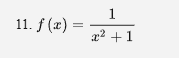
By which “theorem” is this continuous everywhere?
This takes on the form f/g and g is never equal to 0, and as such, it is continuous since both f and g are continuous. (Theorem 1)

By which theorem is this continuous everywhere?
This is continuous because the top takes on the form f - g in which both f and g are continuous, and the same is true for the bottom (Theorem 1). As such, the quotient of two continuous functions, as long as the bottom never equals zero, is continuous (Theorem 2).
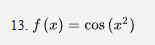
By which theorem is this continuous everywhere?
Compositions of continuous functions are continuous.
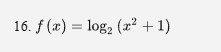
Explain how we know this is continuous.
Compositions of continous functions are continuous, and we know the continuity of the logarithm function due to its property of being the inverse of an exponential function, which are continuous everywhere. We know the continuity of the inner function due to its being a polynomial.
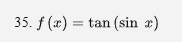
Evaluate the continuity of this and explain.
It is continuous everywhere because by a rewrite of the tangent identity, the only way for it to be undefined is when cos(sin(x)) is equal to 0, which can only happen when sin(x) = pi/2; however, this is outside of the range of sin(x), thus making this function continuous everywhere.
Harder Problem Strategies
Harder Problems

The key points are x = a,, H(x) = 0 when x - a < 0, and H(x) = 1 when x - a >= 0; since that is the break in H(x); if f(a) = 0, then g(x) would be continuous since H(x) would no longer cause any break in the graph.
When you are given a piecewise function with a constant in both formulas and asked how to make the piecewise function continuous, what do you do?
Plug in the x point of discontinuity into both formulas, set them equal to each other, and solve for the constant.