BMS2062 - W2: Genomic Variation & Diseease
 Call Kai
 Learn
Learn Practice Test
 Spaced Repetition
 Match
Match Flashcards
 Knowt Play
1/17

There's no tags or description
Looks like no tags are added yet.
Name | Mastery | Learn | Test | Matching | Spaced | Call with Kai | Chat |
|---|
No analytics yet
Send a link to your students to track their progress
18 Terms
Repetitive genome regions
make up ~52% of human DNA
Transposons
capable of moving from one region of the genome to another
can cause problems/ mutations/ alter gene expression depending on where it inserts itself into
Retrotransposons
must first be reverse transcribed into DNA before inserting into a new genome region
Single sequence repeats
same sequence of nucleotides repeat over and over again
may have a structural purpose (not much is known about them)
these regions have high mutation rate - can be indicated in disease (e.g. huntington’s disease)
Which strand is used to transcribe DNA to mRNA? Template strand or coding strand?
Template strand is used
RNA transcript will be the same as the coding strand (except T is changed to U)
What are open reading frames?
regions between a start codon and a stop codon within a gene
How can we locate genes?
Identify presence of:
open reading frames
transcription/ translation control points (promoters e.g. TATA box promoter, terminators, ribosome binding sites, UTRs, enhancers, etc.)
Reading frames
there are 6 potential reading frames in DNA
What is redundancy?
Multiple codons code for the same protein. So if there is a mutation, it can still result in the same amino acid being encoded for.
Microarray vs RNA sequencing
Microarray:
if you’re working with RNA (but not too many of them bc of limited number of probes)
RNA → cDNA → expose cDNA to transcript probes → see which ones bind
RNA sequencing:
can be used for many/ all RNA in a particular cell/ group of cell
RNA → cDNA → sequencing → alignment
How can we identify the sequence of proteins?
Mass spectrometry - can be used for a single protein or a group of/ all proteins in a cell/ group of cells
Reading frame vs Open reading frame vs real open reading frames
Reading frame: Nomenclature for designating how the codons within a nucleotide sequence are read
the set of possible codons that could code for a protein
Open reading frame: A DNA sequence that occurs between a start and a stop codon
may or may not code for a protein
introns need to be removed to produce the open reading frame
Real open reading frame: An open reading frame that produces a real protein (or sometimes RNA)
Bioinformatic tools
Expasy: identify reading frame
shows all possible open reading frames
determine reading frame
where the open reading frame is within the reading frame
most likely to code for a protein
protein blast: identify real reading frame
contains all known proteins
access if there is a match between predicted protein and proteins in the match database
How to identify open reading frame in prokaryotic DNA sequence
Bioinformatics tools discussed previously
many stop codons = unlikely to be a prokaryotic protein coding gene region
few stop codons + an initiation codon = likely to be a prokaryotic protein coding gene region
How to identify open reading frame in eukaryotic DNA sequence
Bioinformatic tools previously discussed
has exon regions and intron regions - intron regions likely to have stop codons (interrupt open reading frame)
so need to find the borders for introns and exons then find open reading frame
What is the boundary between an intron and an exon called?
Splice site
How can splice sites be detected?
There are consensus sequences for major class introns
extract all mRNA produced by cell of a particular organism → reverse transcribe to cDNA → establish sequence of cDNA fragments → see which regions these match to in the genome → shows where exons are
design pcr primers to bind to confirm exon/ intron boundary
What do these intron exon boundaries allow for?
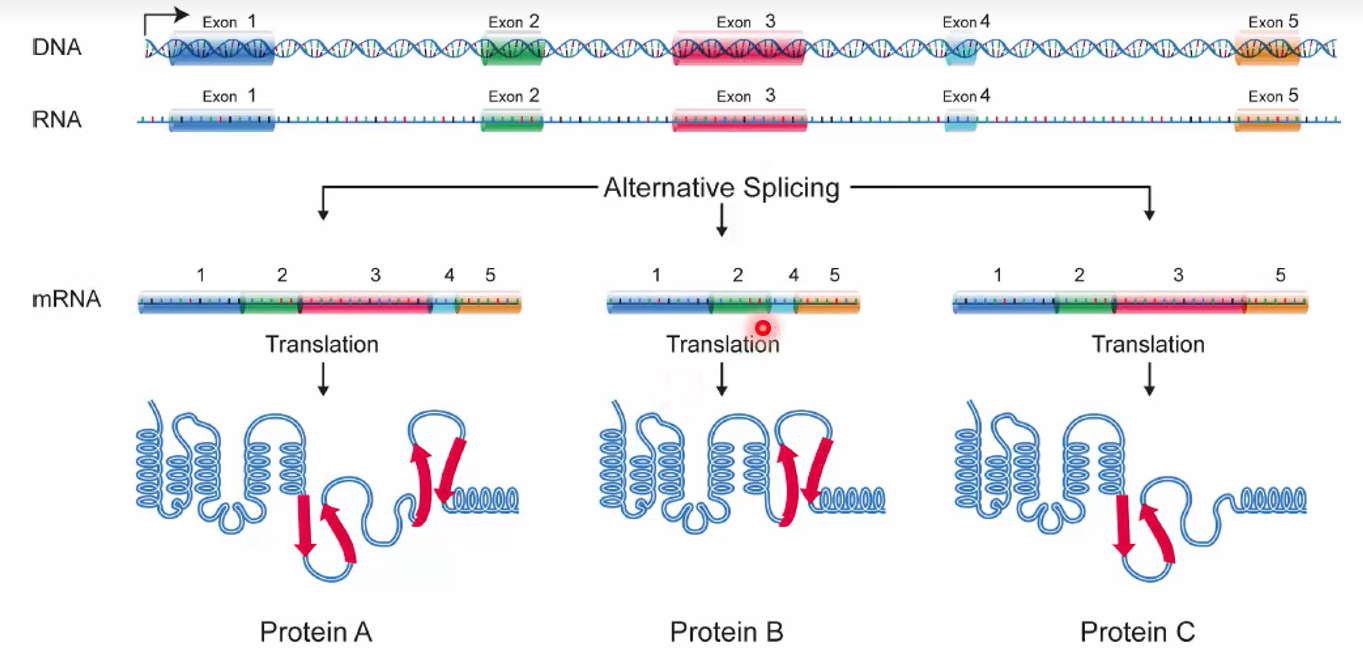
multiple mRNA transcripts can be produced from a single gene (transcript variants/ isoforms) via alterative splicing
basically different exons are incorporated to make different variants
this increases functional capacity of genes
Homology searching
Paralogue: same species
Orthologue: different species
can gives clues about exon intron boundaries
What is the ultimate way to validate identified regions as real genes?
Find the corresponding mRNA or protein
Transcriptomics:
reverse transcriptase - PCR
design primers based on predicted sequences
if the mRNA corresponding to the predicted sequence is real, it will bind to the RNA and cDNA will extend to match mRNA sequence
detection of cDNA validates that predicted gene is real
Proteomics:
extract the protein from cells, denature, cut them with protease
run mas spectrometry to confirm identity of proteins
map those back onto database
cross check which ones are present with our predicted reading frame
]Homology modelling:
match predicted sequence against database
Western blot
create antibody that can recognise a specific part of protein sequence
extract protein, denature, add antibody, add second antibody that emits light