Molecular Symmetry and Group Theory
 Call Kai
 Learn
Learn Practice Test
 Spaced Repetition
 Match
Match Flashcards
 Knowt Play
1/13

There's no tags or description
Looks like no tags are added yet.
Name | Mastery | Learn | Test | Matching | Spaced | Call with Kai | Chat |
|---|
No analytics yet
Send a link to your students to track their progress
14 Terms
symmetry elements and operations
symmetry element eg. C3 - an example of a proper rotation axis - a line through the centre it was rotated about
C = proper rotation axis
Cn = rotation through 360º/n where n is the order of rotation
a symmetry element can generate more than one symmetry operation
when you do the symmetry operation enough times that the molecule returns to its starting position this is called the identity operation - any operation or repeated symmetry operation that brings the molecule back to where it started
all objects possess the identity element E
other symmetry elements
mirror plane
symmetry element σ generates a single operation
σ2 = E
inversion centre
a centre of symmetry i also generates a single operation
i2 = E
improper rotation axis S
rotation though 360º/n then reflect in plane perpendicular to the rotation axis
a rotation-reflection axis
5 types of symmetry elements
E
σ
i
Cn
Sn
each can generate one or more symmetry operations
if two symmetry operations are performed successively on a molecule, the result is always the same as the application of a single different operation
what is a point group?
the symmetry operations of a molecule form a mathematical group
there are only a limited number of combinations of operations that are possible
each of these combinations is known as a point group
if two molecules have all the same symmetry elements then that are in the same point group
chirality
a molecule may be chiral if it does not possess an improper rotation axis i.e. it possesses no symmetry other than proper rotation axes
only in point groups Cn or Dn
polarity
a molecule may not have a dipole moment either perpendicular to an axis of rotation or perpendicular to a mirror plane or if the molecule possesses an inversion centre
dipole moments are only seen in Cn, Cnv including low symmetry group Cs
point group determination
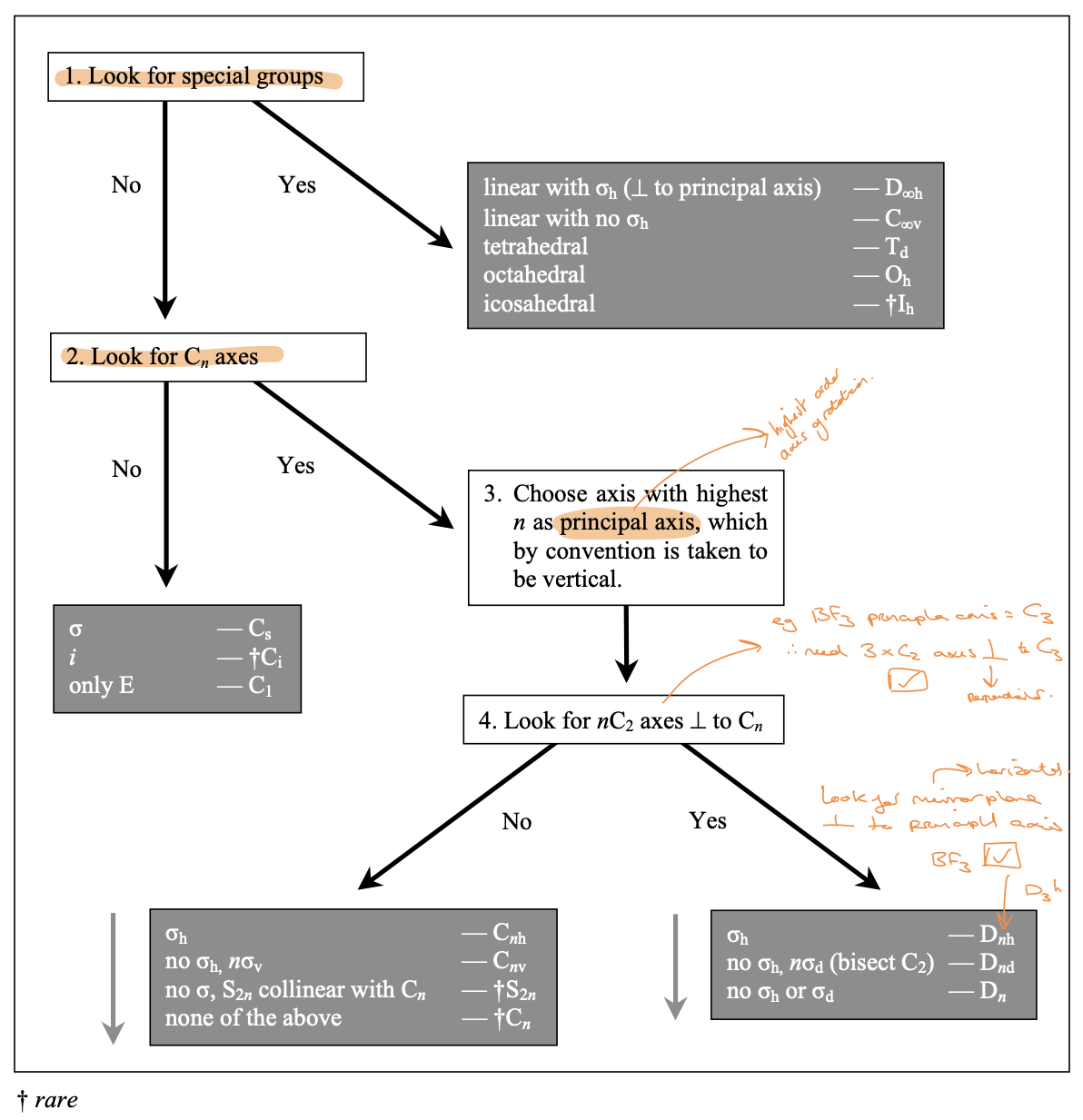
rules for symmetry operations of a molecule to constitute a mathematical group
the product of any 2 members (and the square of any one) must also be a group member
there must be an identity element E
for any three operations done successively (a, b, c) the associative law is obeyed (ab)c = a(bc)
every member (a) also has an inverse a-1 in the group so that aa-1 = E
character tables
irreducible representations represent the symmetry operations of the point group ie. how performing them effects the orbitals
al of the irreducible representations make up the character table
character tables contain all the information required to apply group theory to chemical problems
using character tables
generate a set of numbers to represent the effect of the symmetry operations on molecular properties - this is known as a reducible representation- a linear combination (the sum) of some or all of the irreducible representations in the character table
find the component irreducible representations - this is known as reduction
interpret the results
interpreting Γ (reducible representations)
reducible representations are the sum of a number of the irreducible representations in the character table
use the acronym MAD
M) multiply down the table eg. number of E x gamma for that operation x number of A1 etc etc
A) add the numbers calculated above for each of the operations
D) divide by the order of the group - the total number of symmetry operations in the group
degenerate representations