MLS 2213 Unit 10 exam
 Call Kai
 Learn
Learn Practice Test
 Spaced Repetition
 Match
Match Flashcards
 Knowt Play
1/155

Earn XP
Description and Tags
Clinical Enzymology
Name | Mastery | Learn | Test | Matching | Spaced | Call with Kai | Chat |
|---|
No analytics yet
Send a link to your students to track their progress
156 Terms
Define Enzyme
Biochemical catalysts that accelerate chemical reaction.
Enzymes participate in, but are not consumed or altered in the reaction.
Enzymes are Proteins.
Define coenzyme (Cofactor)
Some Enzymes require a Coenzyme or an Activator.
Coenzymes are sometimes Hydrogen acceptors or donors
Sometimes they are Vitamins
ALP is higher in hepatobiliary obstruction than ________.
hepatic disease
With regard to bone, alkaline phosphatase is produced by:
osteoblasts during bone formation.
ALP elevates in this physiological condition:
pregnancy, think making bones
The only bone disease which does not affect ALP is:
MM
The placental isoenzyme is very similar to this isoenzyme, which is a cancer marker:
regan isoenzyme
Both the placental and Regan isoenzymes can be distinguished by:
high heat stability
Define activator
Activators are usually Metal Cations that form ionic bonds with the enzyme and change it’s shape
Define isoenzyme
Some Enzymes have Quaternary (4o) structure. Composed of 2 (or more) sub-units
This allows for more variability in the enzyme structure.
They catalyze the same reaction.
Isoenzymes can be distinguished by
electrophoresis, use of alternate substrates, or immunologically.
Explain why measuring blood enzyme levels has diagnostic value.
Enzymes are made with cells for use within that cell.
Assuming normal cell turnover and no disease, there are normal ranges of serum enzyme levels.
Disease processes alter the blood levels of enzymes (usually raise the levels).
Some enzymes are specific to one organ, or perhaps only 2 or 3 organs. This allows identification of the diseased organ.
What are the 4 ways in which cellular enzymes appear in someones blood?
Increased cell membrane leakage
Cellular necrosis
Increased proliferation
Increased cellular synthesis
What is cellular necrosis
cells die, rupture and release their cellular contents – these end up in the blood.
What is induction of synthesis
more cells leaking normal amounts = an overall increase in blood enzyme levels.
What is proliferation of cells
normal % leak out = an overall increase in blood enzyme levels.
Why do we measure activity of enzymes and not the exact measurement
The vast majority have to be quantitated based on their activity (rate that they catalyze their reactions under controlled laboratory conditions).
Their levels are way too low to allow mass quantitation (pg/mL – ng/mL).
What are international units?
One International Unit is the amount of enzyme activity that will catalyze the conversion of one micromole of substrate into product per minute.
How does enzyme concentration of the specimen influence the rate of the reaction?
The rate of the reaction is proportional to the concentration of Enzyme in the specimen.
If one specimen has twice the enzyme level as another specimen, it will cause twice the activity (rate) of the reaction.
This is the basis of Enzyme measurements.
How does substrate concentration of the specimen influence the rate of the reaction?
When Substrate concentration is low, the rate of the reaction is dependent upon the Substrate. A 10% increase in Substrate will cause a 10% increase in the rate.
When the Substrate concentration is very High, the rate of the reaction is not influenced by the Substrate. A 10% increase in Substrate will not affect the rate. We call that Zero Order Kinetics
The bottom line is that you have to make sure you have a significant excess of Substrate, so that as the reaction continues, the decrease in substrate will not slow the reaction down.
You must have at least 100 times more substrate than the Km. (Except for LDH, where you must have 20 times more substrate than the Km.).
How does coenzyme concentration of the specimen influence the rate of the reaction?
At very low levels, the Coenzyme does affect the reaction rate. At very high levels it doesn’t.
You want to start the reaction with at least 100 times more Coenzyme than would give ½ VMax.
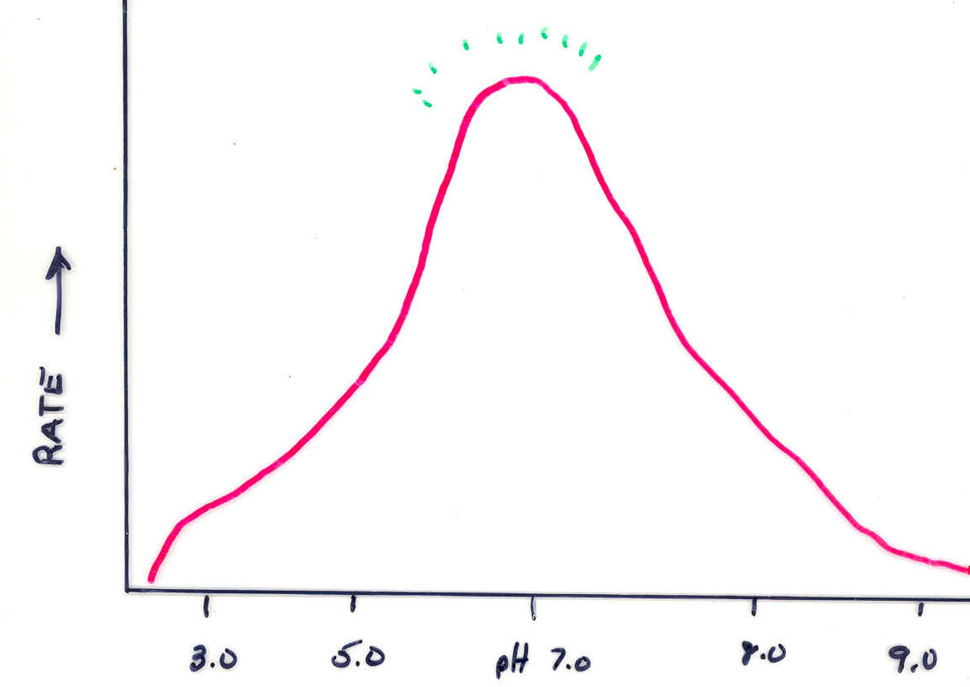
How does the pH of the reaction mixture influence the rate of the reaction?
Every enzyme has an optimal pH that will give the enzyme it’s greatest activity.
If the pH is different from the pH Optimum, the rate is slowed down.
Generally the Substrate reagent is buffered at the enzyme’s pH optimum.
How does the temperature of the reaction mixture influence the rate of the reaction?
Every enzyme has a Optimal Temperature. If the temperature is not at the Optimal Temperature, the reaction rate is slowed down.
Rarely are the assays performed at the optimal temperature. They are usually performed below it, at 30oC or 37oC.
What is the Q-10 Rule?
A 10C increase in temperature will Double the reaction rate. Each 1C increase gives 10% increase in the rate.
A 10C decrease in temperature will cut the reaction rate in half.
How does the presence of inhibitors influence the rate of the reaction?
Inhibitors always decrease the enzyme reaction rates.
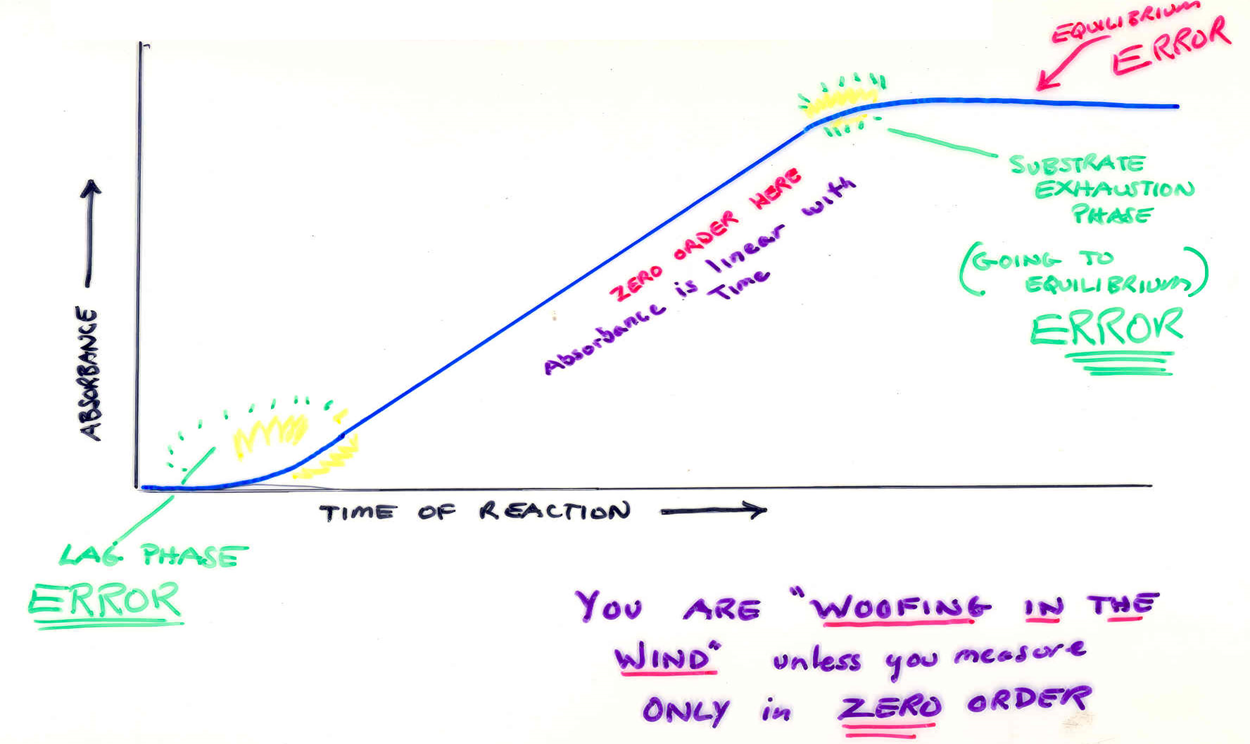
What is meant by zero order enzyme kinetics?
The rate of the reaction is constant with respect to the substrate
When the Substrate concentration is very High, the rate of the reaction is not influenced by the Substrate. A 10% increase in Substrate will not affect the rate. We call that Zero Order Kinetics.
What is meant by first order kinetics
When the rate of reaction is directly proportional to the concentration of the substrate. A percentage increase in substrate concentration will result in an equal percentage increase in reaction rate.
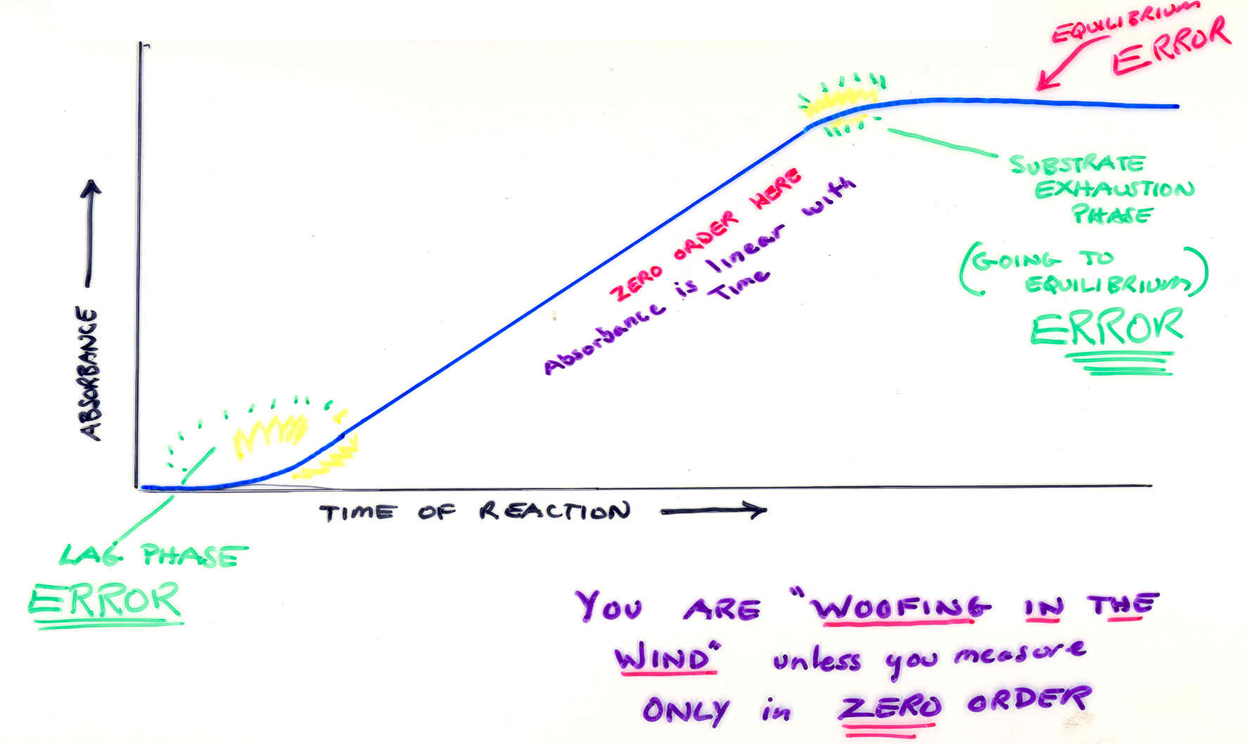
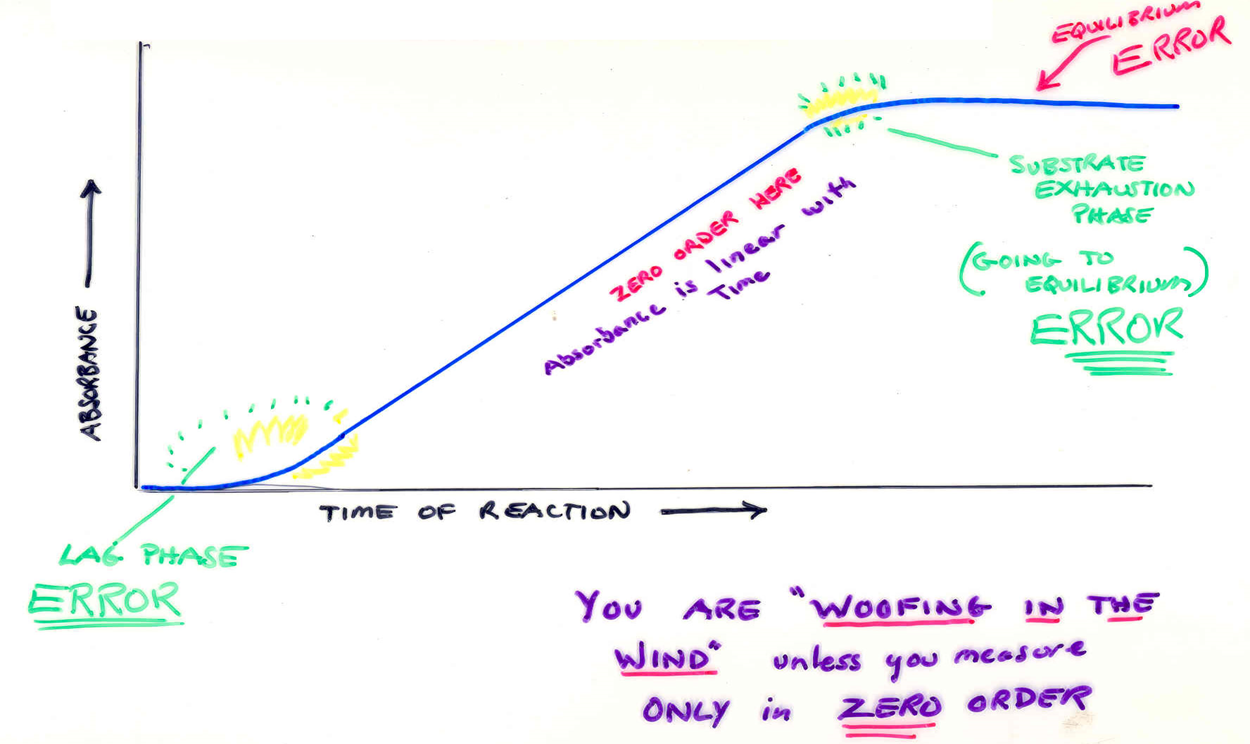
Where on an enzyme activity graph is the lag phase?
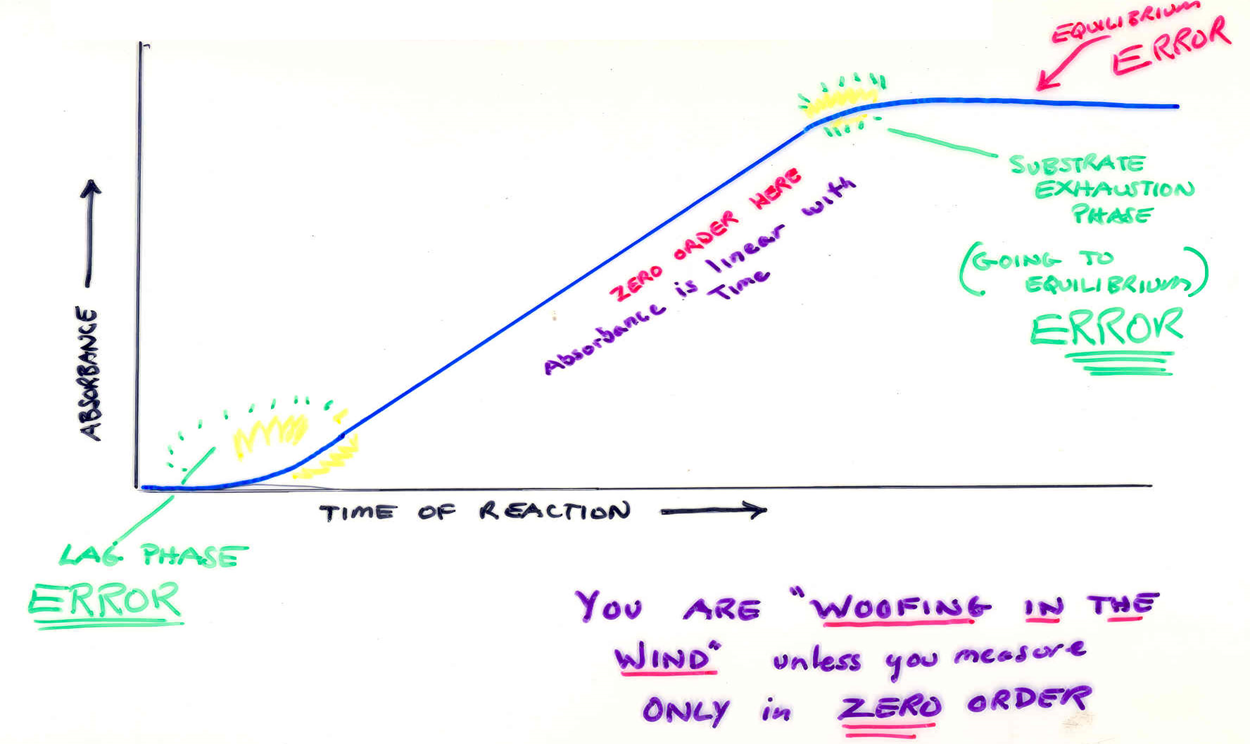
Where on an enzyme activity graph is the zero order kinetics phase?
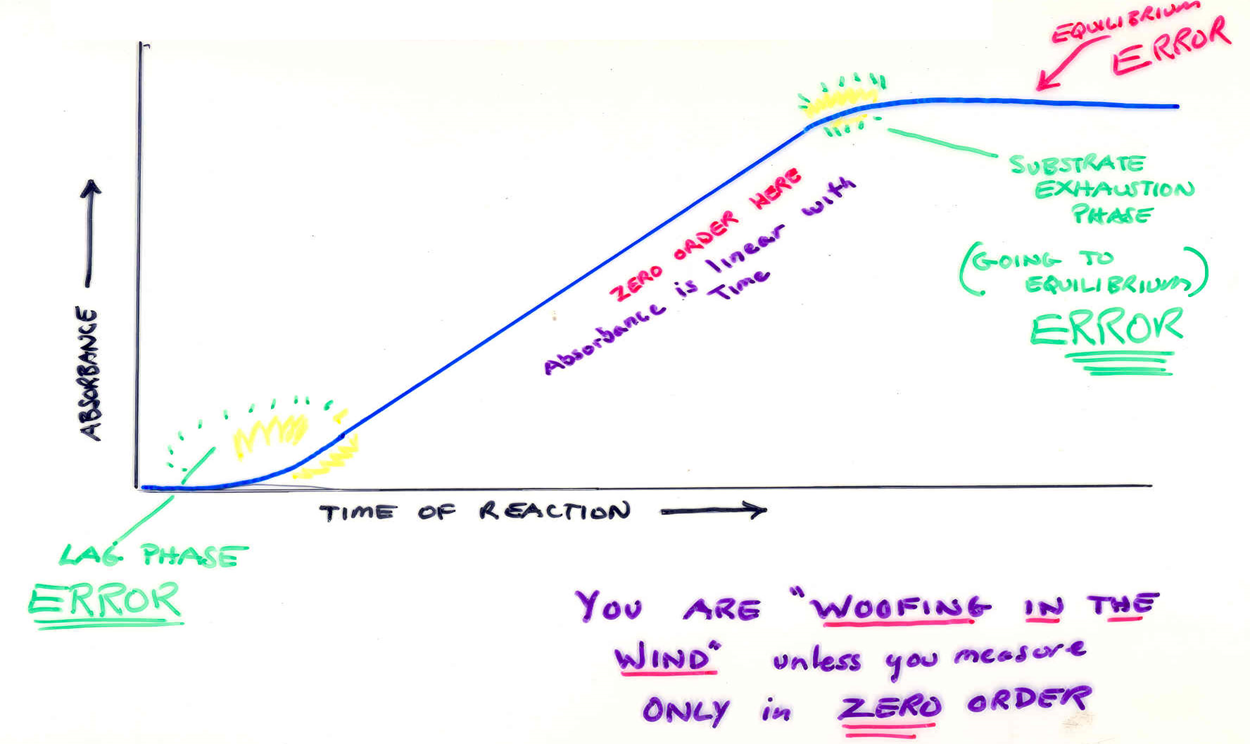
Where on an enzyme activity graph is the substrate exhaustion phase?
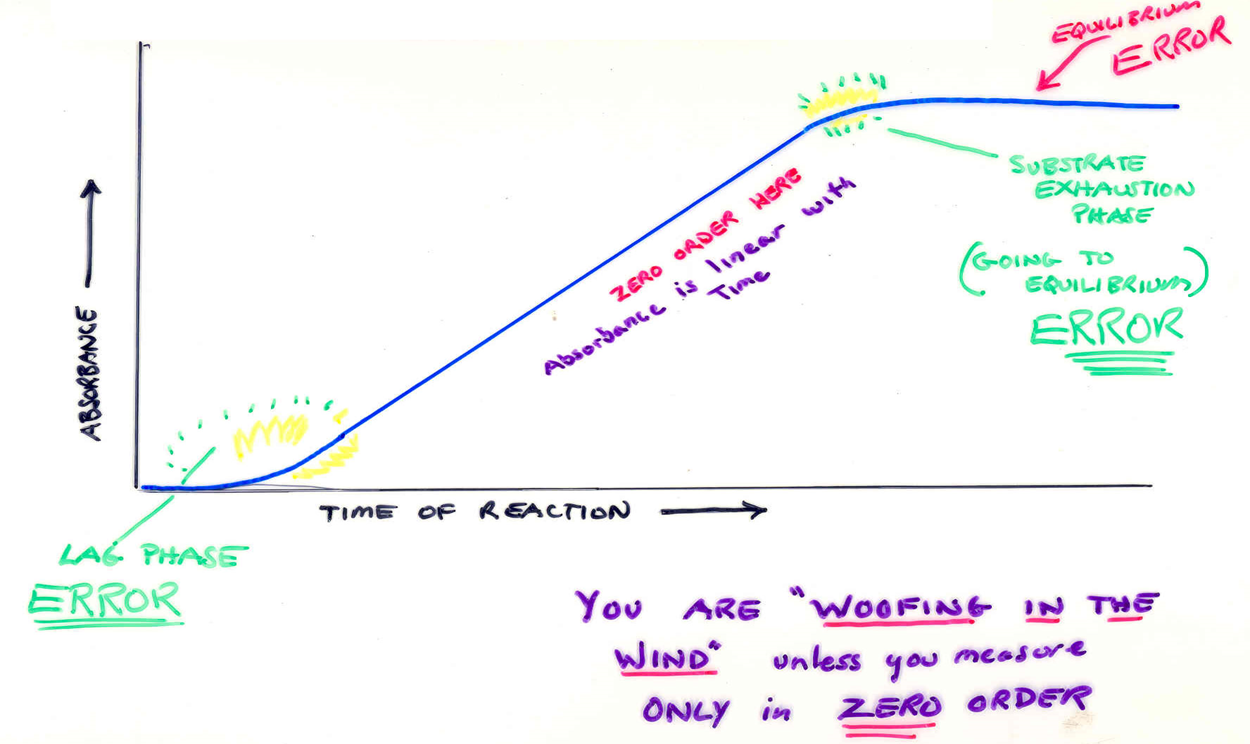
Where on an enzyme activity graph is equilibrium
What are the 6 lab variables that can cause error in enzyme testing?
a. Wrong temperature
b. Wrong pH
c. Inhibitors or unacceptable specimens (anticoagulants, hemolyzed specimens, etc.)
d. Substrate exhaustion
e. Improper specimen transport/handling
f. Non-specific substrate breakdown
What are the disadvantages of a single point enzyme assay?
Single point enzyme assays may not accurately reflect the overall enzyme activity, as they do not account for variations over time. This can lead to misleading results and may overlook crucial kinetics information.
How can a Lineweaver-burke plot help differentiate between a competitive and non-competitive inhibitors?
If an inhibitor is non-competitive, you cannot add enough substrate to make the vmax the same as if there wasnt an inhibitor
if an inhibitor is competitive, you can add enough substrate to make the vmax the same with a different Km
What is a reversable or competitive inhibitor?
Can be overcome by increasing the substrate concentration
What is a irreversible or non-competitive inhibitor?
Cannot be overcome by increasing substrate concentration and permanently inactivates the enzyme, altering its activity.
What is Km?
The Km is the amount of substrate that will give you ½ of the Maximum Velocity (rate) that is possible, given a specific amount of sample
The Km is the amount of substrate that will saturate ½ of the enzymes with substrate.
What is Vmax?
Vmax is the maximum rate of reaction achieved by an enzyme, at which point all active sites are saturated with substrate.
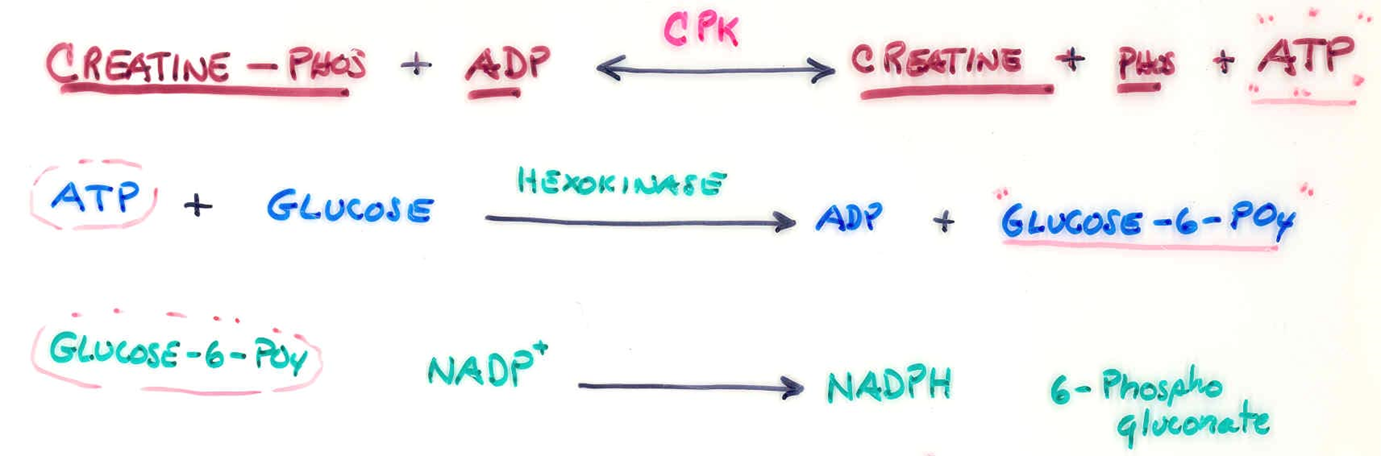
What is the reaction for CK?
Catalased by hexokinase
NADPH is measured
What is the reaction for LDH
LDH turns lactate into pyruvate OR
LDH turns pyruvate into lactate
What is the Wacker reaction
Lactate turns into pyruvate with NAD becoming NADH
Most common way of testing
What is the wroblewski reaction
NADH to NAD+ while converting pyruvate to lactate
Preferred method of testing
What is the reaction for AST (SGOT or GOT)
Aspartic acid + Keto glutamate <—-B6—→ oxaloacetatic acid + glutamic acid
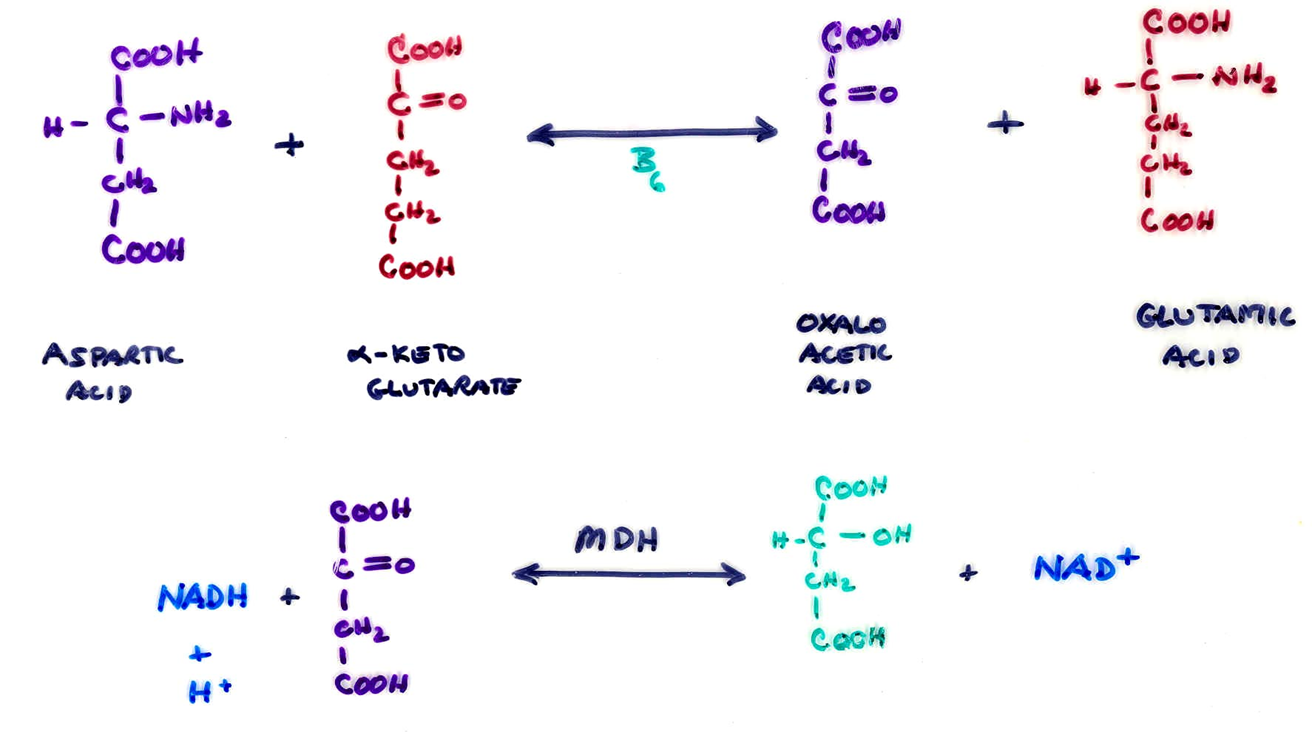
What is the reaction for ALT? (SGPT or GPT) and what type of reaction is it?
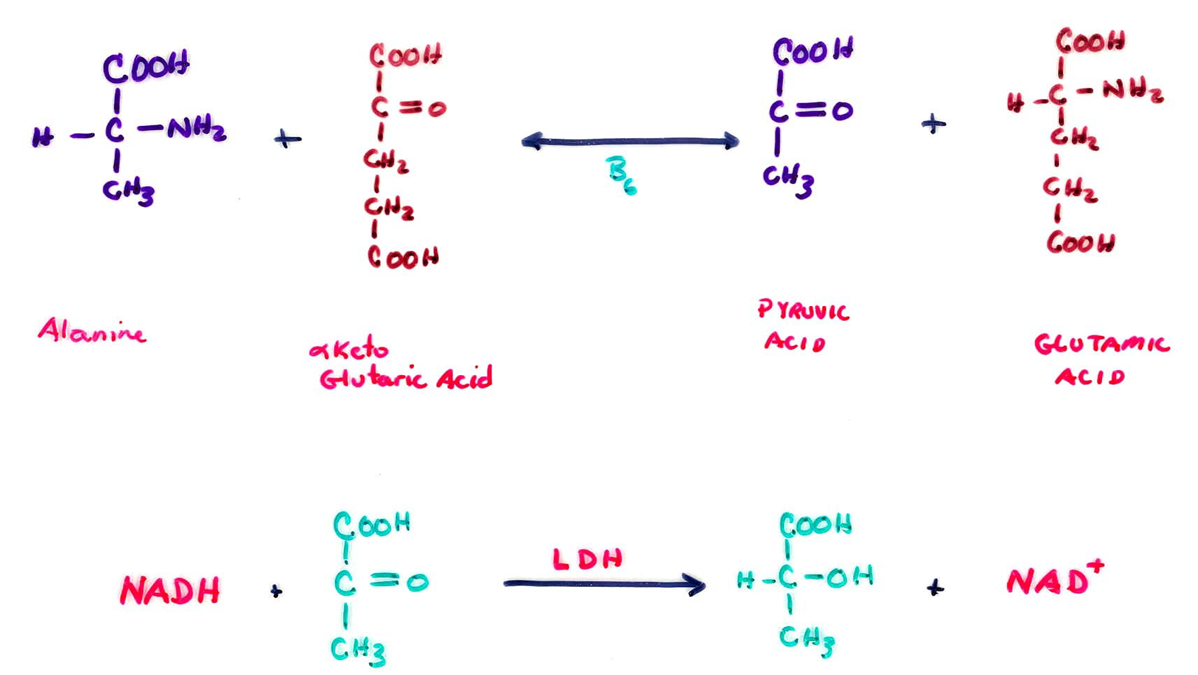
Alanine + Alpha-ketoglutarate <---B6---> Pyruvate + Glutamate
Decreasing absorbance reaction
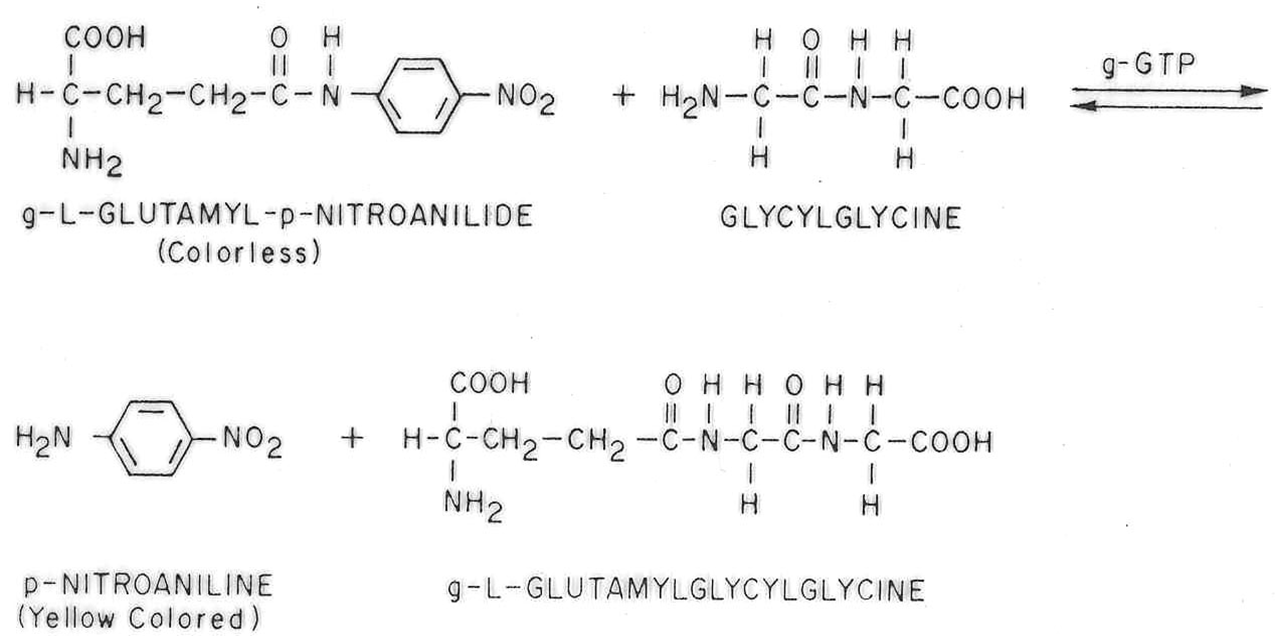
What is the reaction for GGT?
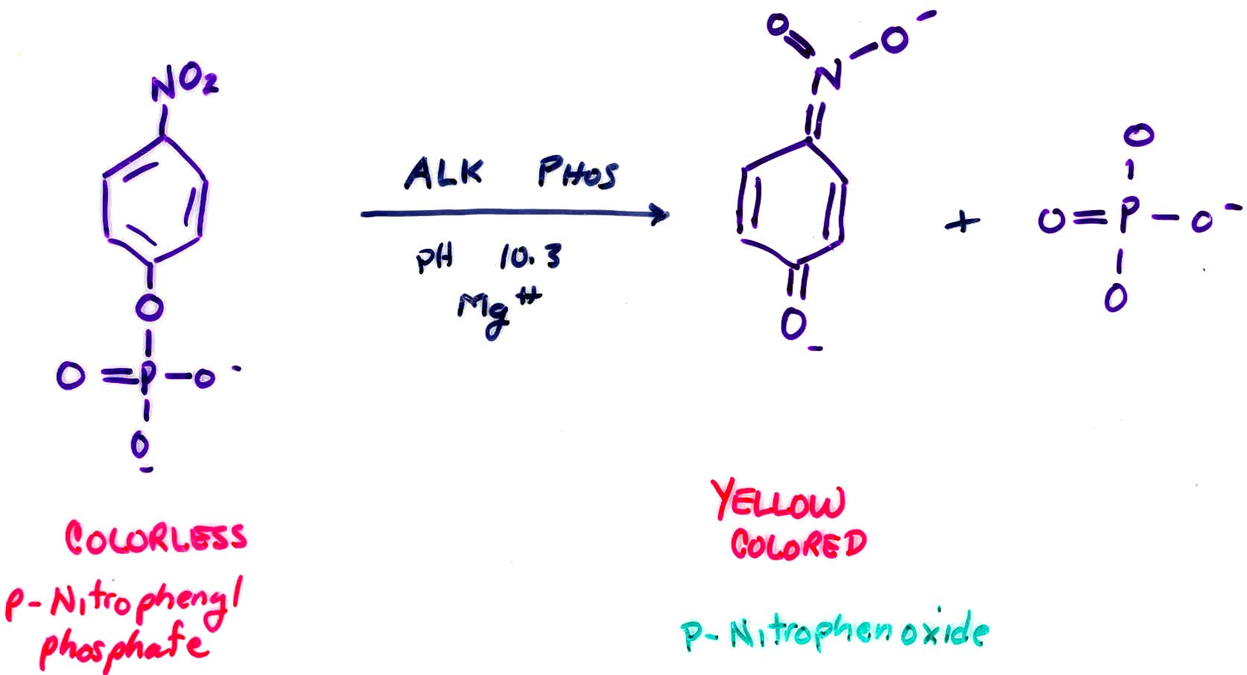
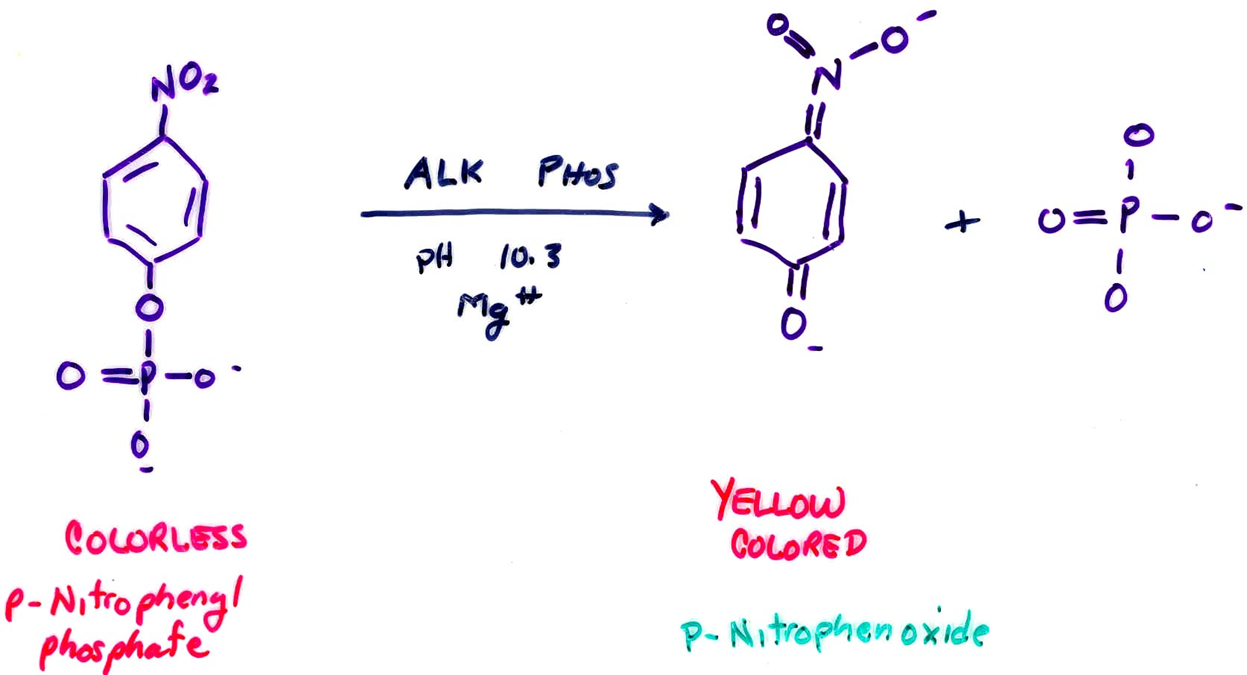
What is the reaction for ALP?
Nitrophenyl phosphate ←—Alk phos—→ P-nitro phenoxide
What does the Bessie-Lowry Brock method test for
Alk phos
What is the reaction for ACP?
But a lower pH
What is the reaction for Amylase?
Starch is always the substrate.
Saccrogenic – measures the amount of Glucose formed in the reaction. Uses a baseline glucose.
Amyloclastic – based on the rate of reduction of starch.
Chromolytic – best methods. Dye-labeled starch is the substrate, and has little color. Glucose-dye products are Blue chromophores.
What is the reaction for Lipase ?
The best Lipase method is similar to the Trinder TG assay which measures Glycerol.
What tissue has the most CK?
Muscle tissue
What tissue has the most LDH?
All tissue
RBCs, WBCs, heart, skeletal and smooth muscle
What tissue has the most AST?
Cytoplasmic enzyme found mostly in the heart, skeletal and smooth muscle, liver, RBCs, and WBCs
What tissue has the most ALT?
Mitochondrial enzyme found in all tissues but mostly the liver
What is the DeRitis Ratio?
The ratio of AST to ALT can distinguish between milder Hepatic Stress from the more serious Hepatic Necrosis. The ratio is used to assess the severity of hepatic disease.
AST is cytoplasmic – ALT is mitochondrial.
In hepatic stress we expect the cytoplasmic enzymes to leak out faster than the mitochondrial enzymes.
What tissue has the most GGT?
Liver and pancreas
What tissue has the most ALP?
Bone and liver
What tissue has the most ACP?
Prostate and liver
What tissue has the most PSA?
Prostate gland.
What tissue has the most Amylase?
Pancreas and salivary glands.
What amylase/creatinine clearance ratio indicated acute panreatitis?
A ratio greater than 5.
What amylase/creatinine clearance ratio indicated macroamylasemia and renal disease?
Less than 2
What tissue has the most Lipase?
The pancreas
What tissue has the most Cholinesterase?
The liver.
What does an abnormal CK indicate?
Muscle or heart damage
What does an abnormal AST indicate?
Cytoplasmic damage to heart, skeletal muscle, or liver
What does an abnormal ALT indicate?
Any significant increase comes from the liver
What does an abnormal GGT indicate?
Hepatitis, hepatobiliary obstructions or acute pancreatitis
What does an abnormal ALP indicate?
Liver disease, bone disorders, or bile duct obstruction
What does an abnormal ACP indicate?
Prostate disease, bone disorders, or Paget's disease.
What does an abnormal PSA indicate?
Prostate cancer, benign prostatic hyperplasia, or prostatitis.
What does an abnormal Amylase indicate?
Pancreatitis, pancreatic cancer, or gallbladder disease, macroamylasemia
What are some common sources of error with CK?
CK-MB isnt specific to the heart
Hemolysis can inhibit the enzyme
Should be frozen if not tested
What are some common sources of error with LDH?
Hemolysis = no
Do not freeze
What are some common sources of error with AST and ALT?
Hemolysis = no
What are some common sources of error with GGT?
Hemolysis = ok
no anticoagulant inhibits it
What are some common sources of error with ALP?
All anticoagulants inhibit it except heparin
Hemolysis = no
Unless refrigerated ALP will increase in the sample
What are some common sources of error with ACP?
Very heat and pH sensitive
Collect on ice and acidify
hemolysis = no
What are some common sources of error with lipase?
Hemolysis will lower lipase
inhibited by all anticoagulants
What percentage of CK isoenzymes can you expect to find in skeletal and smooth muscle
MM = 96%
MB = >4%
What percentage of CK isoenzymes can you expect to find in heart muscle
MM = 80%
MB = 20%
What percentage of CK isoenzymes can you expect to find in brain tissue
BB = 99%
MM = 1%
What are the 3 isoenzymes of CK
CK-MM
CK-MB
CK-BB
What LD isoenzyme can you expect to see in heart tissue, RBCs, and WBCs
LDH1 and LDH2
What LD isoenzyme can you expect to see in lung tissue
ld-3
What LD isoenzyme can you expect to see in smooth and skeletal muscle, liver and kidney tissue?
LDH4 and LDH5
What tissue does LD-1 and LD-2 come from?
Heart, RBC, and WBCs
What tissue does LD-3 come from?
lung tissue.
What tissue does LD-4 and LD-5 come from?
Smooth and skeletal muscle, liver, and kidney
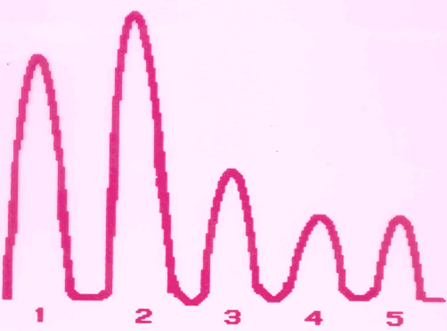
What tissue caused this?
WBC and RBC
Increased LD-1 and 2, but not LD flip
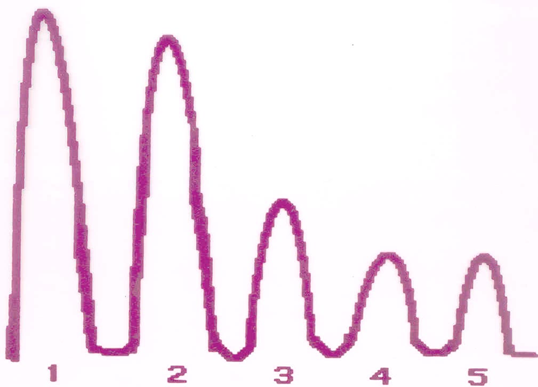
What tissue caused this?
Heart
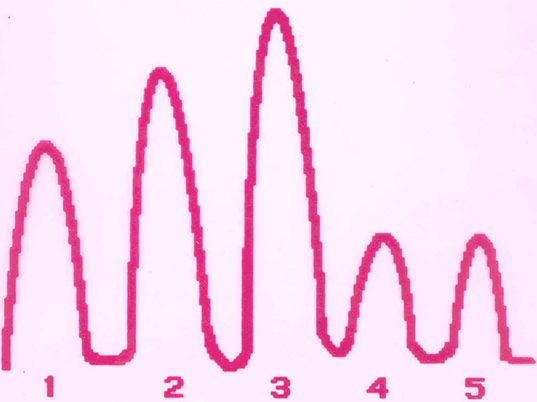
What tissue caused this
Lung
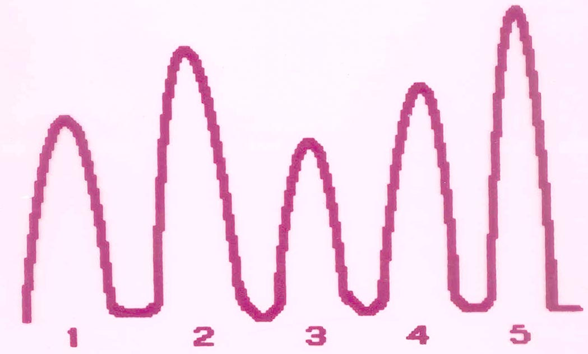
What tissue caused this?
Smooth and skeletal muscle, liver, or kidney
Why is an amylase/ creatinine clearance ratio done?
Can distinguish a Pancreatic increase of Amylase from that from Renal Dysfunction or Macroamylasemia.
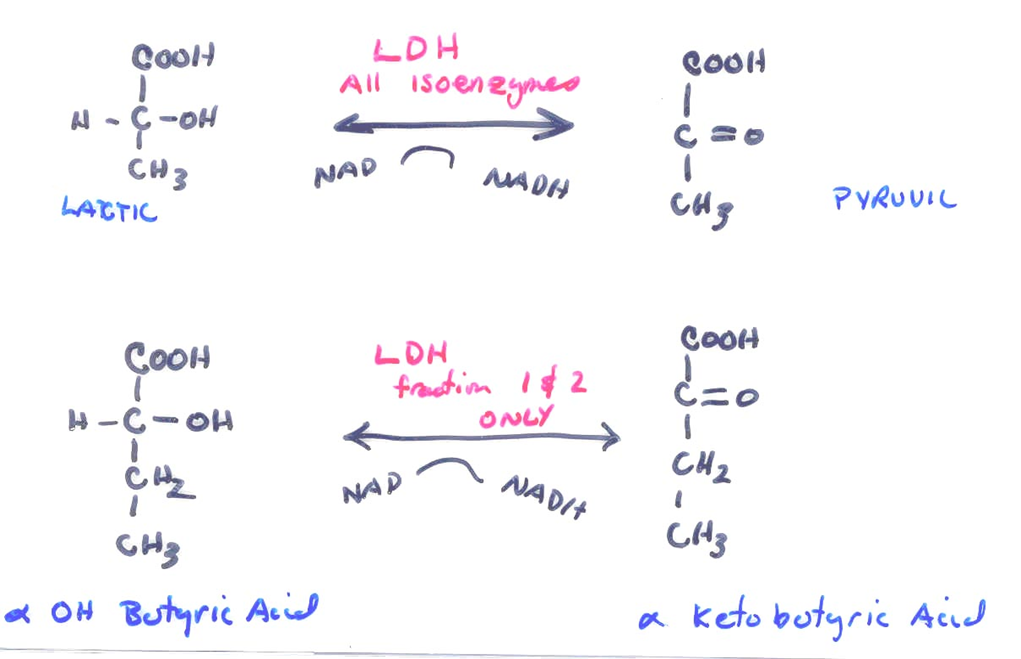
What is a-HBD
Not a different enzyme from LD, it is really LD-1 and LD-2 utilizing an alternate substrate that LD-3, 4, and 5 won’t use.
a-Hydroxybutyric Acid is substrate, and NAD+ is the coenzyme. The Keto acid is the product, and NADH is formed.
An AST/ALT ratio of >1 indicates?
Hepatic necrosis
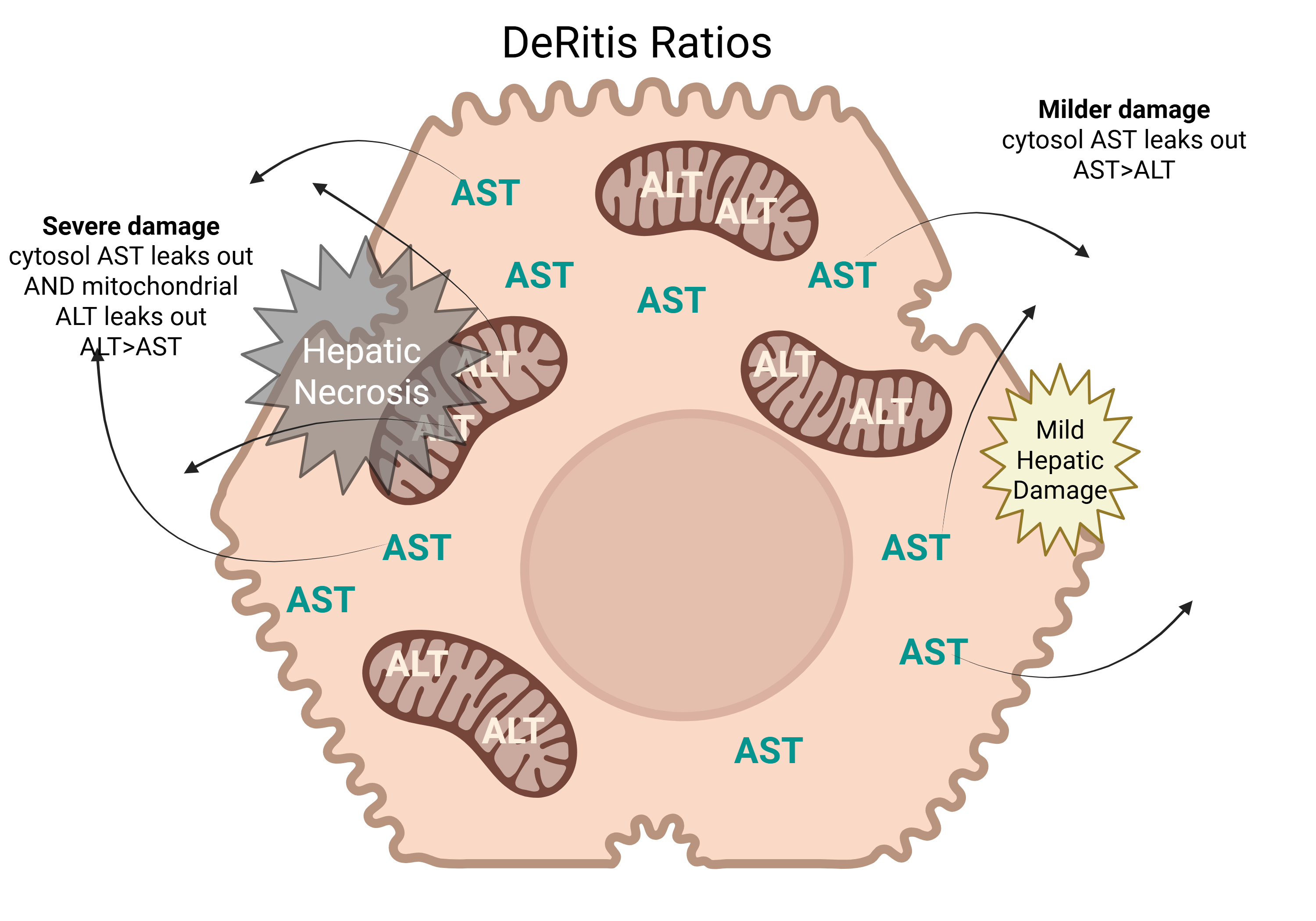
What does it mean if AST>ALT?
Hepatic stress
What does it mean if ALT>AST
Hepatic necrosis
An AST/ALT ratio of <1 indicates?
Hepatic stress
What cell does AST mainly come from?
Cytoplasm
What cell does ALT mainly come from?
Mitochondrial