Abiotic and Biotic factors
 Call Kai
 Learn
Learn Practice Test
 Spaced Repetition
 Match
Match Flashcards
 Knowt Play
1/40

There's no tags or description
Looks like no tags are added yet.
Name | Mastery | Learn | Test | Matching | Spaced | Call with Kai | Chat |
|---|
No analytics yet
Send a link to your students to track their progress
41 Terms
Organisation within ecosystems - Biosphere
Part of the earth that contains living things. Every living thing exists within a framework that includes both living (biotic) and non-living (abiotic factors).
Organisation within ecosystems - Biotic factors
Include plants and amimals that an organism interacts with.
Organisation within ecosystems - Abiotic factors
Include physical and chemical factors in the enviornment, such as air temperature, humidity, sunglight and rainfall.
Organisms within ecosystems - Environment
All the abiotic factors that affect an ecoystem.
Organisms within ecosystems - Ecosystem
Ecosystem: An organism’s living and non-living surroundings. Has different species living together within the same environment.
Organisms within ecosystems - Population
Each group of organisms of the same species living together, in an area at the same time.
Organistion within ecosystems - Effect of abiotic factors
Abiotic factors are unevenly distributed throughout an ecoystem
This affects the abundance and distribution of living things throughout the ecoystem - needs of each species
Organisation within ecosystems - Ecology
Is the study of interrelationships of organisms with each other and the environment
These relationships determine their distribution and abundance.
Terms to know - Biodiversity
The variety of all living things; the different plants, animals and microorganisms, the genetic information they contain and the ecosystems they form.
Terms to know - Abundance
The number of individuals in a given area.
Terms to know - Distribution
The geographic area where individuals of a population are found.
Terms to know - Niche
Role of an organism in an ecosystem.
Impacts of abiotic factors in an ecosystem: Conditions on earth determine the variety of living organisms that can exist
Earth’s atmosphree and climate have changed greatly over time. E.g. ice ages, glacial episodes and hot,dry periods
These affect the earth’s climate by changing sea levels and affecting air and water circulation, leading to migration, shifts in vegetation zones and extinction
Impacts of abiotic factors in an ecosystem: Movement of large tectonic plates shape environmental conditions.
The changing position of land masses and oceans through Earth’s history impacts ocean circulation patterns, climatic conditions and many abiotic and biotic factors.
Oceans are also barriers to the migration of terrestrial species and influence the distribution of marine organisms.
Ocean systems are especially affected by plate tectonics as mid ocean ridges (underwater mountian ranges formed when two tectonic plates meet) are responsible for the spread and depth of oceans, and the development of ocean climates.
Impacts of abiotic factors in an ecosystem: Differences in climate
Have created many varied terrestrial and aquatic ecosystems.
Range from the frozen soil of the tundra landscape, home to polar bears, to the tropical waters of the coral reef.
Impacts of abiotic factors in an ecosystem: Latitude and climate are linked to high biodiversity.
The abundance of species per unit area (species richness) increases from the poles to the equator, with the highest biodiversity at the tropics near the equator.
Over 50% of species on earth live in the tropics.
Abiotic factors in tropical regions strongly contribute to their high species diversity e.g. more stable climate, warm temperatures, high levels of rainfall and a higher level of primary productivity (plant growth), which supports more consumers (animals, fungi and bacteria)
Impacts of biotic factors in an ecosystem
Interactions between biotic factors (the living components in ecosystems) affect growth, abundance and distribution of communities in an ecosystem.
Organisms interact and depend upon one another for survival in an ecosystem - influence each other by being part of each other’s environment.
Can be harmful, neutral or beneficial.
Interations between species are called interspecific interactions.
Interactions within species are called intraspecific interactions.
Includes: predation (predator-prey), competition (inter and intraspecific), symbiosis (mutualism, commensalism, allelopathy and parasitism)
What is a niche (from Biology in Focus):
The role of an organism in an ecosystem, including the part of the ecosystem it occupies.
Refers to the resources that species uses - including both biotic and abiotic factors.
No two species can occupy the same niche.
Habitat is the location the species is found in, the niche is its role.
Organisms can occupy the same habitat but not the same niche. Can occupy different niches in the same habitat.
Fundamental niche is the whole area/role, realised niche is specific.
Competition causes organisms to not be able to occupy their ideal niche but occupy a space with restrictions - different times, space or heights occupied/used by species in same space
Ecological niches and impacts of abiotic/biotic factors:
A species niche encompasses both the physical and environmental conditions it requires (e.g. temperature or terrain) and the interactions it has with other species (like preadaiton or competition)
Because of competition, organisms are not always able to occupy their ideal or fundamental niche (this would be occupied if there were no competitors, predators or parasites). These factors result in organisms occupying a realised niche, due to restrictions plcaced on them by other organisms.
A variety of niches is possible if there is a diversity of biotic and abiotic factors in an area.

Niche example
Abiotic factors are suitable for the koala to have a widespread distribution along the east coast of Australia, but this distribution is not realised due to predation by dogs and cats, and the impacts of disease, fires and drought.
Often species will partition their resources based on time and location. For example, different bird species in a forest may hunt for insects at different times of night or day, or simply hunt at different heights in the canopy.
Competitive exclusion principle
No two species can occupy the same niche.
Biotic factors - Predation defintion
A predator-prey relationship is a type fo feeding relationship where the predator obtains its food by killing and eating another animal (the prey).
Predators are found in aquatic and terrestrial ecosystems.
Biotic factors - Predation examples
A blue-tonged lizard kills and eats beetles and snails.
Carnivorous plants such as the Venus flytrap and the pitcher plant supplement their diet with invertebrates such as insects - can be an adaptation to existsnce in poorly structured soils with low nutrient loads.
Australian bluebottle captures prey with long stinging tentacles.
Biotic factors - Competition definition
Competition is when two or more organisms use one or more resources in common, such as food, shelter, nest sites and mates.
The competition is usually for a resource in the environment that is limited in supply but valuable to survival.
All competition involves resik to the competitors and the rewards must outweight this inherent risk.
Species may compete by aggression or physical interaction, or may do so indirectly through vocalisation or leaving a scent on an object in their territory.
Animals possess various defence mechanisms that may be used in competition e.g. teeth, claws, stingers, chemical means, camouflage, mimicry of dangerous species. Noxious or unpalatable species, such as some frogs and butterflies, advertise the fact with warning colouration such as spots or stripes in bright colours (like the monarch butterfly).
Biotic factors - Types of competition
Organisms may compete with: members of their own species (intraspecific competition), or members of another species (interspecific competition).
Intraspecific competition is more intense - organisms have more resource needs in common and thier niches overlap.
Interspecific competition may lead to the evolution of one of the species in response to the selection pressure exerted by the other species that alters its niche.
Individual plants can compete for resources including soil nutrients, water, space and access to sunlight. Some are better able to compete in certain parts of ecosystems. These species try to exclude their competitors from that part
Allelopathy is the production of specific biomolecules by one plant tha can be beneficial or detrimental to anoterh plant. Allelochemicals produced by a plant escape into the environment, influencing the growth and development of other, surrounding plants.
Allelopathy is used to keep other plants out of its space, inhibit growth or seed germination, slow down respiration or photosynthesis, inhibit nutrient uptake and achange amount of chloropyll in a plant, maximising the availability of resources needed,
Biotic factors - Intraspecific competition examples
Two male stag beetles compete for territory and mating opportunities
Sea anemones fight for their ideal space on the ocean floor by using their stinging tentacles against non-clones members to expand their territory.
Biotic factors - Interspecific competition examples
Redwoods maximise their intake of soil nutrients and water by growing massive root systems that monopolise these resources, leaving little for understory plants growing in their shade.
Example of allelopathy - black walnut plant releases a chemical that inhibits respiration, which is concentrated in the buds and roots. Plants exposed to this chemical exibit symptons such as wilting, yellowing of foliage and eventually death.
Biotic factors - Symbiosis definiton
Interactions in which two organisms live together in a close relationship that is beneficial to at least one of them.
Usually involves providing protection, food, cleaning or transportation.
When one or both species entirely rely on the other for survival, this relationship is obligate.
When the organisms that can live independently of each other interact for benefit anyway, this is faculative.
There are three types of symbiotic interactions: mutualism (both benefit), commensalism (one benefits, one neutral effect) and parasitism (one benefits and other suffers).
Biotic factors - Mutualism defintion and example
Interspecific interaction where both species benefit from the association.
E.g. corals have a symbiotic relationship with algae. The algae live, reproduce and photosynthesises in the host, and use its waste products. The coral uses the oxygen and food produced to grow, reproduce and form its hard skeleton.
Biotic factors - Commensalism definition and example
Refers to a situation where one species benefits and the other is neither harmed nor helped.
E.g. epiphytes such as mosses, small ferns and orchids can be seen on tree trunks in moist forests. They benefit from living on the trunk of the host tree by catching rainwater to dissolve nutrients and be closer to sunlight, while not negatively affecting the host tree.
Biotic factors - Parasitism definition and example
Is a relationship in which one species benefits and the other is harmed.
A parasite obtains shelter from the host organism while it feeds upon its tissues or fluids.
The parasite is often smaller than its host and may live on the surface or internally. Some may always kill their host, but most do not as this would destroy their food supply.
E.g.Tapeworms are segmented flatworms that live inside the intestines of animals, absorbing the host’s partially digested food, taking vital nutrients.
Impacts of abiotic factors in an ecosystem and example
Abiotic factors are unevenly distributed throughout an ecosystem.
E.g. light availability decreases as depth of water increases. The availability of phytoplankton is affected by the availability of sunlight, as they use photosynthesis.
Aquatic ecosystems are mainly affected by salinity, light availability, gas concentrations and water temperature.
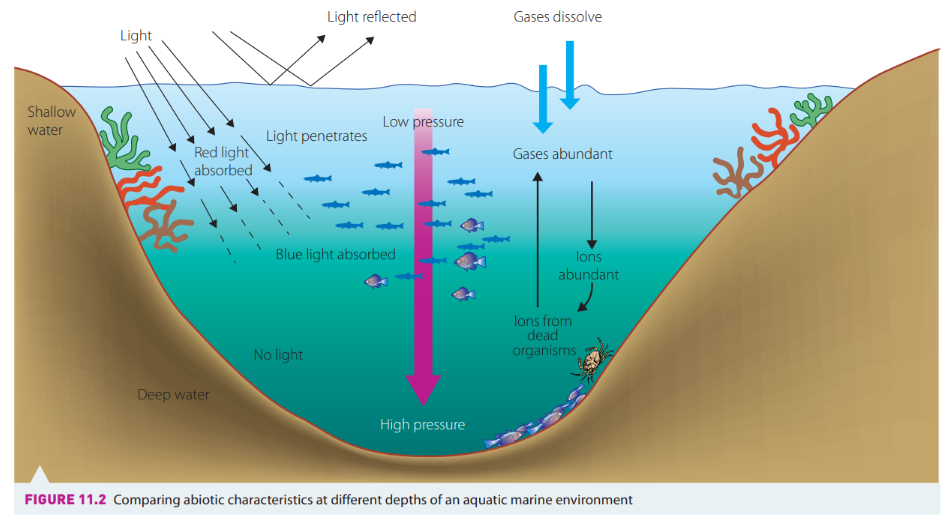
Abiotic factors - Temperature variation
Organisms must maintain stable internal conditions fluctuations in temperatures and between seasons.
Animals have adaptations such as:
Fur or feathers for insulation.
Sweating, shivering, or panting to regulate body temperature.
Behavioural responses such as seeking shade or basking in the sun.
Water temperatures are much more stable than temperatures on land.
Aquatic organisms generally do not require as many temperature-regulating adaptations.
Aquatic mammals (e.g. seals and whales) have thick layers of blubber that provide insulation and energy storage in cold water.
Abiotic factors - Availability of gases
Oxygen makes up about 20% of the atmosphere and is readily available for respiration.
Carbon dioxide, required for photosynthesis, makes up only about 0.04% of the atmosphere and can be a limiting factor for plants.
Oxygen and carbon dioxide do not dissolve well in water.
Gas concentrations are much lower in water than in air.
Dissolved oxygen levels decrease as water temperature increases.
Fish have highly efficient gills that extract oxygen from water more effectively than human lungs could.
Abiotic factors - viscosity
Air has very low viscosity ("stickiness").
Organisms can move through air relatively easily with little resistance.
Water has a much higher viscosity than air.
Movement through water requires more energy because of greater resistance.
Many aquatic animals are streamlined and possess powerful tails for propulsion through water.
Abiotic factors - buoyancy
Gravity has a greater effect because air provides very little support.
Plants require strong stems or woody trunks for support.
Animals need strong skeletons to support their bodies against gravity.
Water is highly buoyant and supports organisms against gravity.
Aquatic plants and animals do not require strong support structures to remain upright.
Abiotic factors - availability of water
Water can be lost through evaporation.
Organisms must conserve water using adaptations such as:
Waterproof skin or coverings.
Minimising water loss during excretion.
Water conservation is especially important in arid environments such as deserts.
Marine organisms are constantly surrounded by water and generally do not need special water-conservation mechanisms.
However, osmosis can create challenges:
Saltwater fish lose water by osmosis and must drink constantly to replace losses.
Freshwater fish gain water by osmosis and must continuously excrete excess water through their kidneys.
Abiotic factors - availability of light
Light is essential for photosynthesis and food production.
Air allows light to pass through easily, so most terrestrial ecosystems receive abundant light.
Rainforests are an exception because dense canopies block light from reaching the forest floor.
Adaptations of rainforest plants include:
Epiphytes (e.g. staghorn ferns and bird's nest ferns) that grow high in trees.
Large, broad leaves with extra chlorophyll to maximise light absorption.
Water absorbs light much more readily than air.
Light intensity decreases rapidly with depth:
Much light is absorbed within the first 10 metres.
At around 100 metres depth, conditions are almost completely dark.
Different wavelengths penetrate to different depths:
Red and orange light are absorbed near the surface.
Blue and green light penetrate much deeper.
Many seaweeds contain specialised pigments that absorb the wavelengths available at their depth.
Deep ocean ecosystems receive no sunlight and depend on dead organic matter sinking from surface waters as a food source.
Abiotic factors - soil characteristics and nutrient availability
Includes texture, pH and organic matter.
Impact water retention and evaporation.
Proportion of sand, silt and clay sized particles in the soil affect biodiversity.
Soil texture influences the availability of nutrients and the rate of water movement throughout the soil.
Soil moisture affects the types of plants that will grow in the ara, due to water availability, as this varies in its composition - limits the types of plants that can survive.
Abiotic factors - aspect/direction of the slope
Impacts the light availability because of the sunlight the slope receives.
Influences water availability due to the evaporation of the water, and runoff increases with the slope.
Impacts the change of erosion.
Abiotic factors - Percentage of canopy cover
Influences the amount of light passing through the canopy, the species of understory vegetation present and the rate of evaporation, therefore soil moisture, influencing biodiversity and the survival of the plants in these conditions.