TCP Week 1 (Breast Conditions)
 Call Kai
 Learn
Learn Practice Test
 Spaced Repetition
 Match
Match Flashcards
 Knowt Play
1/63

There's no tags or description
Looks like no tags are added yet.
Name | Mastery | Learn | Test | Matching | Spaced | Call with Kai | Chat |
|---|
No analytics yet
Send a link to your students to track their progress
64 Terms
lymphatic drainage of the breast
Lateral breast (mostly upper outer quadrant) --> axillary LN (75%)
Medial breast --> internal mammary/Parasternal LN and or posterior intercostal LN
Lymphatic Drainage of the Breast - why it matters?
Primary route for breast cancer metastasis
Determines clinical staging (N stage)
Guides sentinel lymph node biopsy (SLNB) and axillary lymph node dissection (ALND)
m/c LN drainage in the breast? levels 1-3?
Axillary Nodes (≈75%) (Most common drainage)
- Level 1 : lateral/inferior to pectoralis minor
- Level 2: posterior to pectoralis
- Level 3: medical/superior to pectorals minor
other LN drainage of the breast (aside from axillary)?
Internal Mammary Nodes (≈20%)
Along the internal mammary vessels More common with medial breast tumors
Supraclavicular/Infraclavicular Nodes
Secondary drainage pathway Involvement indicates more advanced nodal disease
Contralateral Breast & Abdominal Nodes (
Upper outer quadrant tumors most commonly metastasize to?
Medial tumors have greater likelihood of?
-Upper outer quadrant tumors most commonly metastasize to axillary lymph nodes
-Medial tumors have greater likelihood of internal mammary node involvement
Positive lymph nodes are one of the strongest predictors of?
Positive lymph nodes are one of the strongest predictors of prognosis and adjuvant therapy
Mastitis
define and patho
Inflammation of the breast, usually in breastfeeding/ lactating woman.
PATHOGENESIS: Unknown/poorly understood. Milk stasis, ductal narrowing, nipple trauma
INFECTIOUS mastitis
etiology? presentation?
• S.Aureus (MC)
• Unilateral breast pain, warmth, erythema, tenderness, swelling +/- flu like symptoms
infectious mastitis treatment
Supportive (warm compresses), continue to breastfeed/pump
+/- antibiotic (dicloxacillin)
CONGESTIVE mastitis
sx? tx?
• Bilateral breast pain & swelling.
• Tx: Supportive, NSAIDS, Tylenol
• Lactation specialist consult
Breast Abscess
define and RF
Helps with differentiation mastitis from breast abscess. Usually, a complication of lactation mastitis
RF: first pregnancy, smoking, >30
(also, non-lactating breast abscess)
Breast Abscess... If no improvement in 48-72 hours consider ?
ultrasound!
tx of breast abscess
I&D, needle aspiration
ABX: dicloxacillin or clindamycin
fibroadenoma epi
MC in late teen/early 20's
Benign solid tumors containing glandular/fibrous tissues
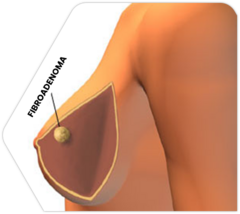
fibroadenoma presentation
CM: smooth, non-tender, mobile lump in breast
Can grow over time
Doesn't get bigger nor smaller with menstruation
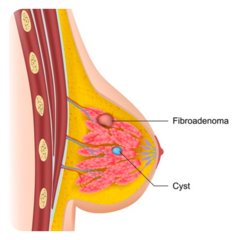
dx of fibroadenoma
Usually clinical, can biopsy or u/s
If confirmed fibroadenoma then leave it alone
tx of fibroadenoma
Observation, can reabsorb
fibrocystic changes
what is it? s/sx?
Cyst in breast tissues that response to hormones
Change in size with menstrual cycles
Multiple tiny lumps, tender
dx of fibrocystic changes
U/S
FNA (Straw-colored fluid)
tx of fibrocystic changes
Observation
NIPPLE DISCHARGE/GALACTORRHEA
types and workup
Lactation (pregnancy)
Physiologic
Pathologic
physiologic nipple discharge
Galactorrhea, usually bilateral
Clear, yellow, green but no bloody
R/O endocrine disorder (hyperprolactinemia)
pathologic nipple discharge
Usually unilateral, clear, yellow/green, bloody discharge
Benign: papilloma, duct ectasia, mastitis
Cancer
nipple discharge color
WHITE, CLEAR, OR CLOUDY
Breastfeeding, Galactorrhoea, Hypothyroidism, Prolactinoma
nipple discharge color
yellow
YELLOW: Hormonal Fluctuations, Infection
nipple discharge color
GREEN, BROWN, OR BLACK
Duct Ectasia, Intraductal Papilloma
nipple discharge color
RED, PINK, OR BLOODY
Intraductal Papilloma, Breast Cancer
gynecomastia
A non-cancerous condition that causes abnormal breast tissue growth in boys and men, resulting in enlarged breasts. It's caused by an imbalance of estrogen and androgen hormones, and can affect one or both breasts, sometimes unevenly
causes of gynecomastia
Drug Induced
• Anti-androgens: spironolactone, finasteride
Hormonal imbalance
gynecomastia tx
Stop causing agent
Hormonal therapy (referral to endocrine)
Surgery
fat necrosis of the breast
Benign
Usually from breast trauma or surgical
dx of fat necrosis
Mammo & U/S (Oil cyst) or biopsy
tx of fat necrosis
Observation
- Excision is not recommended
- No increased risk of cancer
disorders of augmented breats: breast implant illness (BII)
- Anecdotal reports suggest a potential link between silicone gel implants & systemic illnesses, known as BII.
- Consider periodic breast imaging for symptomatic patients, & explanation if desired.
- no significant evidence supporting a link between breast implants & systemic illness
- may be related to allergies, but further research needed.
- Studies on sx relief post-explantation are inconclusive
anaplastic large cell lymphoma (BIA-ALCL)
- FDA reports from 2011-2019 highlight the association with textured implants.
- In 2019, the FDA recalled certain textured implants due to increased BIA ALCL risk
- No recommendation for removal in ASX women with these implants.
squamous cell carcinoma (BIA-SCC)
- Reported in capsule surrounding breast implants (textured or smooth).
- Limited experience suggests it's an aggressive pathology.
- Mortality rate is high compared to BIA-ALCL
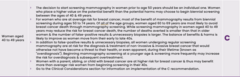
MAMMOGRAM 2016 USPSTF (2023 IN PROGRESS)
Women ages 50-74: Biennial (every 2 years) screening mammography is recommended (Grade B).
Women ages 40-49: The decision to begin screening before age 50 should be individualized based on patient values, risk factors, and potential benefits/harms (Grade C)... more on this in slides
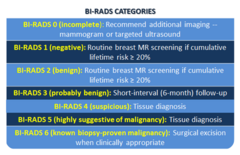
BI-RADS categories
FNA
biopsy - helps us identify things like straw colored fluid (fibrocystic changes)
BREAST CANCER
types
Ductal Carcinoma
Lobular Carcinoma
Paget's-Inflammatory
presentation of breast CA
Breast Mass Hard, fixed usually painless, non-mobile lump +/- lymphadenopathy
Unilateral nipple discharge
MC found in the upper outer quadrant
ductal carcinoma types
Infiltrative ductal carcinoma
Ductal carcinoma in situ (DCIS)
Infiltrative ductal carcinoma
IDC is the most common type of breast cancer!
Arises from the milk ducts within the breast tissue.
Can infiltrate nearby tissues and potentially spread to other parts of the body.
Ductal carcinoma in situ (DCIS)
DCIS is a non- invasive form of breast cancer where abnormal cells are found in the lining of a breast duct but have not spread outside the duct. No invasion of the basement membrane Considered stage
Lobular carcinoma in situ (LCIS)
Not a cancer it's a proliferation of cells limited to the breast ducts and lobules
Not associated with increased density or lump, usually diagnosed incidentally on biopsy.
Increases risk of becoming a cancer.
Infiltrative lobular carcinoma
type of lobular carcinoma
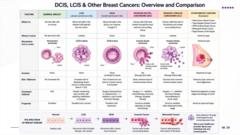
DCIS, LCIS, & other breast cancers (chart overview)
Paget carcinoma
Paget's disease of the Breast (PDB) is rare form of breast cancer that affects the skin of the nipple and areola
presentation of Paget's disease of the Breast (PDB)
persistent itching, burning, or pain in the nipple area
eczematous, flaking, or crusting of the skin on the nipple or areola
inflammatory breast carcinoma (IBC)
rare, aggressive breast cancer
rapid onset and distinct clinical features
presentation of IBC
- redness, swelling, warmth, and "peau d'orange" (orange peel) appearance of skin from lymphatic destruction
- lacks palpable lump, difficult to detect
treatment of breast cancer
chemo/radiation: pending staging and patho
hormone tx:
- tamoxifen (ER positive): blocks estrogen receptors in breast tissues, increase risk of endometrial cancer
- aromatase inhibitor: letrozole (ER positive) reduces estrogen
- monoclonal Ab tx: herceptin (HER positive), can cause cardiotoxicity, need ECHOs
mastectomy
surgical removal of the breast
treatment and prevention
reconstruction can be done - expanders
genetic mutation
BRCA1 mutation carriers - risk of?
breast CA - 72%
ovarian CA - 44%
genetic mutation
BRCA2 mutation carriers - risk of?
breast CA - 69%
ovarian CA - 17%
genetic mutation
Li-Fraumeni/TP3
lifetime CA risk approaching 100%
breast 50% by the age of 60 y/o
genetic mutation
PTEN/Cowden
increased risk of uterine, breast (40-50%), kidney, thyroid, and GI
BRCA gene mutation increases risk of which types of cancer?
pancreatic, breast, and ovarian cancer
A 35-year-old woman presents with a milky discharge from both breasts that has been occurring for the past six months. She is not pregnant and is not currently breastfeeding. What is the most appropriate next step in her management?
A) Initiate hormonal therapy
B) Order a prolactin level
C) Refer to a breast surgeon
D) Perform a mammogram
B) Order a prolactin level
if positive = brain MRI for adenoma
A 22-year-old male presents with bilateral breast enlargement & tenderness that has been present for past 3 months. His physical examination reveals no other abnormalities. Which of the following is the most common cause of gynecomastia in this age group?
Medication side effect
Hormonal imbalance related to puberty
Testicular cancer
Liver disease
Medication side effect
A 32-year-old breastfeeding woman presents with a painful, swollen area on her left breast. Examination reveals a fluctuant mass with overlying erythema. What is the most appropriate initial treatment for this condition?
a. Oral antibiotics alone
b. Needle aspiration of the abscess
c. Immediate surgical intervention
d. Observation & supportive care
b. Needle aspiration of the abscess
bc it is fluctuant (movable).... sign of abscess
A 28-year-old woman who has been breastfeeding for the past 2 weeks presents with a fever, chills, and localized redness and warmth in her right breast. What is the most appropriate treatment for acute mastitis?
a. Antifungal therapy
b. Oral antibiotics & cont. breastfeeding
c. Surgical incision and drainage
d. High-dose corticosteroids
b. Oral antibiotics & cont. breastfeeding
A 52-year-old woman presents with a painless, firm, immobile breast mass in the upper outer quadrant. What is the most appropriate initial diagnostic step?
Breast MRI
Mammo w/ u/s
Surgery
FNA
Mammo w/ u/s
Which receptor status is associated with the worst prognosis?
A) ER-positive, PR-positive, HER2- negative
B) Triple-negative
C) HER2-positive only
D) ER-positive, PR-negative, HER2- positive
B) Triple-negative