[AMECON] Chapter 3: SUPPLY & ELASTICITY | Supply, Demand, and Elasticity
 Call Kai
 Learn
Learn Practice Test
 Spaced Repetition
 Match
Match Flashcards
 Knowt Play
1/20

There's no tags or description
Looks like no tags are added yet.
Name | Mastery | Learn | Test | Matching | Spaced | Call with Kai | Chat |
|---|
No analytics yet
Send a link to your students to track their progress
21 Terms
Supply
is the ability and willingness of producers to offer goods or services for sale at various prices during a given period, assuming all other factors remain constant (ceteris paribus). Unlike demand, this focuses on the producer's side of the market. In aviation, this refers to the number of flights or seats that airlines are willing and able to provide at different ticket prices.
Law of Supply
states that at higher prices, producers are willing and able to produce more products. The quantity supplied increases as prices increase and decreases as prices decrease, assuming everything else remains constant.
Important Notes
Airlines are encouraged to offer more flights when ticket prices are high because higher prices increase potential revenue.
When ticket prices are low, airlines may reduce flights or aircraft capacity to minimize losses.
Supply Curve
is the graphical representation of the relationship between price and quantity supplied.
Important Notes
The curve slopes upward because producers supply more as prices increase.
Movement along the curve occurs only because of a change in price.
A shift in the curve occurs when factors other than price change.
Determinants of Supply
are factors other than price that influence the quantity producers are willing and able to supply.Changes in these factors shift the entire supply curve.
Cost of Production
Technology
Government Policies
Number of Producers
Expectations
Random or External Events
Rigidity
Airline supply is relatively ___ because:
Aircraft cannot be added immediately.
Flight schedules are prepared months in advance.
Airport slots are limited.
Fleet size cannot change quickly.
As a result, airlines cannot instantly respond to sudden changes in demand.
Market Equilibrium
is a market condition in which the quantity of a good demanded in a given time period equals the quantity supplied. At the ______ price, there is no shortage or surplus. The quantity of the good that buyers are willing to buy equals the quantity that sellers are willing to sell.
This price is called the Equilibrium Price, while the quantity traded is called the Equilibrium Quantity.
Market Disequilibrium
occurs when quantity demanded and quantity supplied are not equal. Two situations may occur: Shortage and Surplus
Shortage (Excess Demand)
occurs when:
Quantity Demanded > Quantity Supplied
This usually happens when the market price is below the equilibrium price.
Effects:
Consumers compete for limited goods or services.
Prices tend to increase until equilibrium is restored.
Surplus (Excess Supply)
occurs when:
Quantity Supplied > Quantity Demanded
This usually happens when the market price is above the equilibrium price.
Effects:
Producers cannot sell all of their products.
Prices tend to decrease until equilibrium is reached.
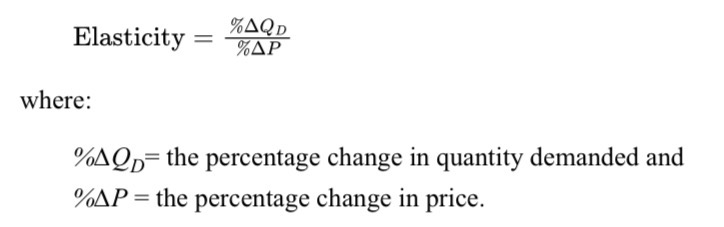
Elasticity
is an important economic principle that can aid airline and airport managers in their economic decision-making process. is the percentage change in the dependent variable (quantity demanded) resulting from a 1% change in an independent variable (factor of demand). It measures the responsiveness of one variable to changes in another
Price Elasticity of Demand (PED)
is the percentage change in the quantity demanded resulting from a 1% change in price. Therefore, _________ enables managers to perform “what-if” scenarios to understand the effects of price changes on the quantity demanded.
Formula
PED = % Change in Quantity Demanded ÷ % Change in Price
The coefficient is usually negative because price and quantity demanded move in opposite directions.
Elastic Demand (PED > 1)
[Types of Price Elasticity of Demand]
Demand is _____ when the percentage change in quantity demanded is greater than the percentage change in price.
Characteristics
Consumers are highly responsive to price changes.
Small price changes result in large changes in demand.
Airline Example
Leisure travelers usually have _________ because they can postpone trips or choose another airline when fares increase.
Inelastic Demand (PED < 1)
[Types of Price Elasticity of Demand]
Demand is ______ when the percentage change in quantity demanded is less than the percentage change in price.
Characteristics
Consumers are less responsive to price changes.
Demand changes only slightly when prices change.
Airline Example
Business travelers usually have inelastic demand because they often need to travel regardless of airfare.
Unitary Elastic Demand (PED = 1)
[Types of Price Elasticity of Demand]
Demand is ________ when the percentage change in quantity demanded is equal to the percentage change in price.
A price change causes the same percentage change in quantity demanded.
Perfectly Elastic Demand
[Types of Price Elasticity of Demand]
Demand is ________ when consumers are willing to buy only at one specific price.
Even a very small increase in price causes quantity demanded to fall to zero.
Perfectly Inelastic Demand
[Types of Price Elasticity of Demand]
Demand is _________ when consumers purchase the same quantity regardless of price changes.
Business, Leisure
Airline Applications of Price Elasticity
Airlines divide passengers into different market segments.
_______ Travelers
Less sensitive to price.
Usually have inelastic demand.
More concerned with convenience, flexibility, and travel schedules.
______ Travelers
More sensitive to price.
Usually have elastic demand.
More likely to compare fares and choose lower-priced options.
This difference explains why airlines charge different fares for passengers on the same flight.

Cross-Price Elasticity of Demand (XED)
which measures the responsiveness of demand for one product or a service following a change in the price of another product or service. This helps determine if the related firm is either a substitute (competitor) or a complement.
Substitute Goods, Complementary Goods
[Cross-Price Elasticity of Demand (XED)]
_______ Goods
Cross-price elasticity is positive (+).
Example:
If Airline A increases its fares, demand for Airline B may increase.
_________ Goods
Cross-price elasticity is negative (−).
Income Elasticity of Demand (YED)
which determines the sensitivity that changes in the consumers’ annual income to variations in the quantity demanded for a product. Measures how quantity demanded changes when consumer income changes.
Formula
YED = % Change in Quantity Demanded ÷ % Change in Income
Normal Goods, Inferior Goods
[Income Elasticity of Demand (YED)]
______ Goods
Demand increases when consumer income increases. Most airline travel is considered this,
______ Goods
Demand decreases as income increases because consumers switch to better alternatives.