class 1
 Call Kai
 Learn
Learn Practice Test
 Spaced Repetition
 Match
Match Flashcards
 Knowt Play
1/55

There's no tags or description
Looks like no tags are added yet.
Name | Mastery | Learn | Test | Matching | Spaced | Call with Kai | Chat |
|---|
No analytics yet
Send a link to your students to track their progress
56 Terms
what are teratogens? what are some examples?
any agent that can harm an embryo or fetus
due to exposure of teratogenic agents during fetal development, appearance abnormalities or developmental defects can occur
very serous when structures are forming
examples:
ETOH, tobacco, marijuana, methamphetamines, infectious agents, physical agents, metabolic agents
what can the teratogen alcohol cause?
fetal alcohol spectrum disorders (FASD) → cause by prenatal alcohol exposure
what can the teratogen recreational drugs cause?
tobacco → very low birth weight (VLBW)
marijuana → VLBW, attention defects
methamphetamines → cardiac defects
opioid withdrawal → neonatal abstinence syndrome (irritability, seizures, poor feeding, vomit-dehydration, difficult sleep, tachypnea, excoriations (skin abrasion), temp instability)
what can the teratogen infectious agents cause? what are the two infections?
rubella & cytomegalovirus (CMV)
can impact the fetus
what are the teratogen physical agents?
radiation
what can the teratogen retinoids cause? what is a med example?
disrupts liver development
ex. accutance (acne med) → disformed liver
what can the teratogen antihypertensive drugs cause?
if BP drops too much after taking med, not enough pressure to push blood into umbilical cord arteries & baby won’t get enough blood for formation
what can the teratogen psych drugs cause?
disrupts brain development
what can the teratogen seizure meds cause? what is an example drug?
disrupts brain development
ex. dilantin
what are the 8 problems with prematurity?
poor thermal regulation → not enough fat to keep them warm
immature CNS (apnea & bradycardia) → can cause breathing & HR problems
immature immunity (infection)
intraventricular hemorrhage (trauma, asphyxia)
immature cardiopulmonary system
immature GI system (NEC)
jaundice → immature liver not processing bilirubin
glucose instability → b/c very tiny
what is intraventricular hemorrhage (IVH)? what are the s/sx?
rupture of vessels leads to bleeding around or into ventricles → change depends on amount of bleeding
s/sx:
tense to bulging fontanel
twitching, decreased LOC, apnea, seizures,
what are the risk factors for IVH?
extreme prematurity → vessels are fragile (</=30wk gestation)
presence of labor (head pushed against pelvic bone)
birth asphyxia & need for vigorous resuscitation (low O2 often means poor blood flow → resuscitation can cause bp to rise quickly → stress on vessels)
mechanical ventilation
sudden change in BP as a result of rapid hypertonic volume expansion (rapid fluid admin → fragile vessels to rupture)
what is the management for IVH?
respiration support → oxygenation
regulate fluids & electrolytes
suppress/control seizures
OR for drain/shunt placement (fluid drains from brain to abd)
postop:
HOB 30 degrees
check head circumference
decrease events that increase or decrease cerebral blood flow: pain, hypoxia, rapid volume expansion, excessive stimulation
why do premature newborns have trouble with thermoregulation?
immature vasculature tone
disproportional body surface to body weight
immature, gelatinous skin w/ decreased subcutaneous fat
thin skin → increases heat loss & transdermal water loss up to 5x
decreased fat → poor insulation & heat conversion
who is more likely to have a lower body temp: preterm vs term? what is the body temp?
preterm is more likely (36.3-36.9)
term (36.5-37.5)
what can cold stress lead to? what are the 3 methods temp can be maintained by?
cold stress → hypoxia, metabolic acidosis, hypoglycemia → increases O2 demand & caloric consumption
baby tries to make more heat → uses more O2 & caloric demand
3 ways: incubator, radiant warming panel, open bassinet with cotton blankets
what are the potential problems in the respiratory system for premature babies?
surfactant deficiency
respiratory distress syndrome
immature neurological control center or immature respiratory system
what is surfactant deficiency? when does surfactant production begin & for full levels?
not making enough surfactant to keep alveoli open → collapses & hard to breathe
production begins at 24 wks & full levels of surfactant at 37 wks gestation (anything less than 37wks is premature)
what is respiratory distress syndrome (RDS)? what are the s/sx? if feeding causes increase in O2, what is the tx?
delayed lung maturation → not ready for gas exchange
s/sx:
increased RR, retractions, crackles, grunting, flaring, cyanosis
if feeding causes increase in O2 → do parenteral feeds w/ minimum PO to help with GI maturation
what is immature neurological control center= secondary apnea/ immature respiratory system =apnea of prematurity?
not full formed respiratory system → increased compliance (easily collapses) → poor oxygenation → apnea (not breathing for >20 secs) → increased acidosis & vasoconstriction → blood shunts away from lungs → more apnea & can be accompanied w/ bradycardia
baby stops breathing for >20 seconds accompanied by bradycardia
what are the tx managements for surfactant deficiency, RDS, apnea of immaturity (6)?
intubation & CPAP
prevents alveoli from collapsing but it can damage wall, so use least amount of pressure
oxygen
surfactant replacement therapay
Extracorpeal membrane oxygenation (ECMO)
serial chest xrays
continuous monitoring: cardiorespiratory status, pulse ox, BP, ABG
what is necrotizing enterocolitis? what can it lead to?
most common GI disorder in premature infants & surgical emergency in neonatal period
inflammatory disease d/t vascular compromise where the portion of the bowel undergoes necrosis
can lead to short bowel syndrome
explain pathophysio of necrotizing enterocolitis (NEC). how to diagnose?
decreased blood to intestines → damages of mucosal cells lining intestine → decreased protective lubricating mucus → bowel wall unprotected against proteolytic enzymes → gas forming bacteria invades area → inflammation, abd distention
dx
xray → sausage shaped intestine w/ soapsuds appearance
what are the s/sx of NEC?
abd distention
visible bowel loops (can be seen through the skin)
bloody stool/ heme positive stool
feeding intolerance (don’t feed or they will vomit and aspirate)
increased residual (amount of liquid left in stomach)
± bilious vomiting
lethargy (no nutrition for energy)
apnea, bradycardia, oxygen desaturation
blood glucose instability (hypoglycemia d/t lack of glucose)
temp instability (d/t no fuel for body)
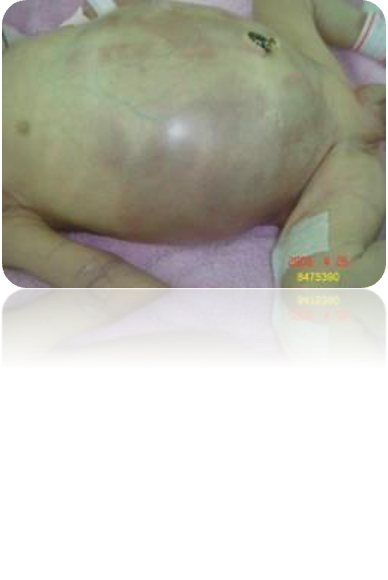
what is the management for necrotizing enterocolitis (8)?
STOP FEEDINGS
NPO 24-48 for infants after birth asphyxia
aggressive IV fluid/electrolyte replacement
ventilation by endotracheal tube (ETT) if in resp failure
NG decompression (critical) & early TPN
break milk is preferred bc of IgA, macrophages, lysozymes
broad spectrum abx (ampicillin, gentamycin, clindamycin → combo taken for rest of life bc liver is immature & can’t metabolize other abx)
pain control & minimal handling
serial abd xrays, frequent labs
surgery → if perforation to do resection and anastomosis (surgically connecting)
what are the 3 abx for necrotizing enterocolitis?
ampicillin, gentamycin, clindamycin → combo taken for rest of life bc liver is immature & can’t metabolize other abx)
what are the 4 diseases tested in newborn screening?
phenylketonuria (PKU)
congenital hypothyroidism
galactosemia
hemoglobin defects (sickle cell disease)
why do we do new born screening? when & how is this screening done?
screening helps identify newborns who appear health but could be at risk of having conditions w/ severe complications if left untreated (early identification & initiation of tx → prevents complications)
done before discharge, 1-3 days of life
heel stick (blood test)
poke heel with lancet → place a drop of blood in each piece of testing paper
what is phenylketonuria (PKU)?