L6 - Glycolysis
 Call Kai
 Learn
Learn Practice Test
 Spaced Repetition
 Match
Match Flashcards
 Knowt Play
1/16

There's no tags or description
Looks like no tags are added yet.
Name | Mastery | Learn | Test | Matching | Spaced | Call with Kai | Chat |
|---|
No analytics yet
Send a link to your students to track their progress
17 Terms
Catabolism is the _____ phase of metabolism and _____ energy
degrative; releases
Anabolism (biosynthesis) is the ____ phase of metabolism and _____ energy
building; requires
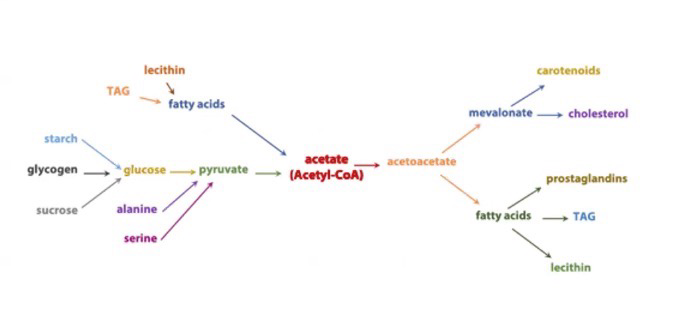
_______ is the crossroad between catabolic and anabolic pathways
Acetate (Acetyl-CoA)
In the first step of glycolysis, the phosphorylation of glucose
traps glucose in the cell. ATP is a phosphoryl donor. Irreversible; Creates Glucose 6-phosphate
Hexokinase and Glucokinase
All phosphorylates glucose; Hexokinase is in all cells but glucokinase is only in liver calls
Glucose and fructose are
isomers
Reaction coupling
A thermodynamically unfavorable reaction can be driven in the forward direction by coupling it to a highly exergonic reaction
Substrate level phosphorylation - ATP formed by direct transfer of a phosphoryl group from a high energy compound to
ADP
Net ATP made from glycolysis
2
Total ATP made from glycolysis
4
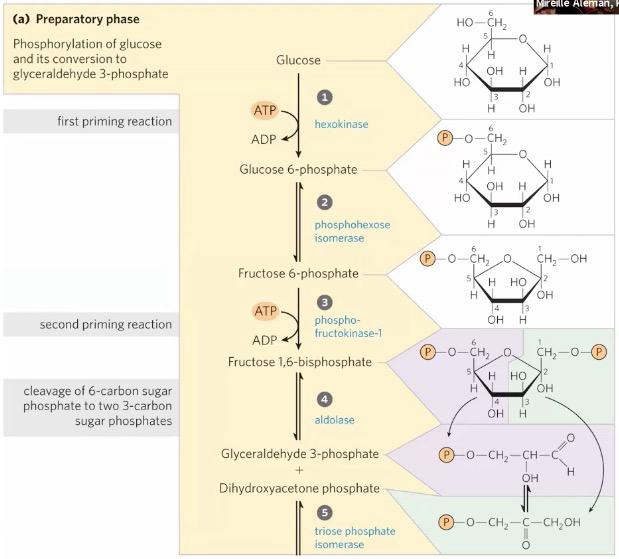
Steps of the preparatory phase of glycolysis (1-5); Which is and isn’t reversible
Phosphorylation of Glucose to Glucose 6-phosphate (G6P) via hexokinase (Needs ATP and Mg2+); Irreversible
Phosphohexose isomerase (Needs Mg2+) opens the G6P and turns it into Fructose 6-phosphate (F6P); Reversible
F6P is converted into Fructose 1,6-bisphosphate (F16BP) via phosphofructokinase-1 (PFK-1) (Needs ATP and Mg2+); “commitment step” glycolysis MUST continue from this point; rate-limiting; irreversible
F16BP is cleaved via aldolase to create Dihydroxyacetone phosphate (DHAP) and Glyceraldehyde 3-phosphate (GA3P); Reversible
DHAP is converted to GA3P via triose phosphate isomerase; reversible
You end up with two GA3P
Steps of the payoff stage of glycolysis (6-10)
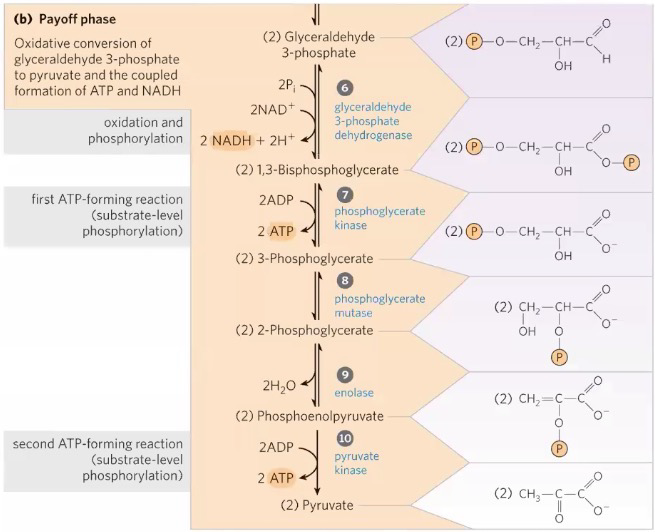
Remember: Each step results in two products for every one input of D-glucose (Basically, the steps happen twice)
GA3P + inorganic phosphate (HPO4-2) makes 1,3-Bisphosphoglycerate (13-BPG) via glyceraldehyde 3-phosphate dehydrogenase (GAPDH). A reduction reaction that uses NAD+ (Converted to NADH + H+). Note: This reaction does not use ATP like the other phosphorylation reactions previously in this pathway.
12-BPG is used to phosphorilate ADP via phosphoglycerate kinase (Needs Mg2+), which creates 3-Phosphoglycerate (3PG) and ATP
3PG is converted into 2-phosphoglycerate (2PG) via phosphoglycerate mutase (Needs Mg2+)
2PG is converted to phosphoenolpyruvate (PEP) via enolase (Dehydration reaction)
PEP is used to phosphorylate ADP via pyruvate kinase (Needs Mg2+ and K+), which creates pyruvate and ATP; Irreversible
Mnemonic for Glycolysis Products
Gross - glucose
Guys - glucose-6-phosphate
Favor - fructose-6-phosphate
Fat Butts - fructose-1,6-bisphosphate
Good - glyceraldehyde-3-phosphate
Boys - 1,3-bisphosphoglycerate
Prefer - 3-phosphoglycerate
Pretty - 2-phosphoglycerate
Pink - phosphoenol pyruvate
Pussies - pyruvate
Mnemonic for Glycolysis Enzymes
Honestly: Hexokinase
Ignoring: Isomerase (Phosphohexose)
Penis: Phosphofructokinase-1
And: Adolase
Instead: Isomerase (Triose phosphate)
Getting: Glyceraldehyde 3-phosphate dehydrogenase
Pussy: Phosphoglycerate Kinase
Makes: Mutase
Everything: Enolase
Perfect: Pyruvate Kinase
Substrate level phosphorylation
A direct metabolic reaction that produces ATP (or GTP) by transferring a high-energy phosphate group from a phosphorylated intermediate molecule (High phosphoryl group transfer potential) to ADP
Mutase enzyme
Catalyzes the movement of one functional group to another spot on the same molecule
Net equation of glycolysis
Glucose + 2 NAD+ + 2 ADP + 2 Pi → 2 Pyruvate + 2 NADH + 2 H+ + 2 ATP + 2 H2O
