Geology - Test 1 (Chapter 1)
 Call Kai
 Learn
Learn Practice Test
 Spaced Repetition
 Match
Match Flashcards
 Knowt Play
1/95

Earn XP
Description and Tags
Chapters 1
Name | Mastery | Learn | Test | Matching | Spaced | Call with Kai | Chat |
|---|
No analytics yet
Send a link to your students to track their progress
96 Terms
The Big Band occurred ______ years ago forming the universe
14 billion
Which of the following sets of 4 correctly identifies the four innermost planets?
Mercury, Venus, Earth, and Mars
Early Earth had expansive oceans
False - it was barren
Inner Layer of Earth - Core
Composed of nickel (Ni), and iron (Fe).
Secondary Layer of the Earth - Mantle
Composed of ultramafic and mafic rocks and m
Outer Layer of Earth - Crust
Oceanic (mafic) and Crustal (felsic).
Which of the following groups colonized land first?
Plants
Which of the following is not found in an atom?
Element
What is found inside an atom?
Electrons, Protons, and Neutrons
If the atomic number of Carbon is 6, how many electrons does an atom of Carbon have?
6
The two fundamental characteristics of a mineral are its ______ and its ______.
Chemical composition and crystal structure
Which form of rock is formed by the solidification and crystallization of a cooling magma?
Igneous
Metamorphic rock showing directed stress have _________.
Foliation
Who was the first to postulate continental drift?
Alfred Wegener
Which of the following is not evidence of drift?
Sea Floor Mapping, Fossils, and Sedimentary rocks showing similar records of climate from different continents. (All of the above are evidence for drift)
Which of the following rock stress types is associated with pulling or stretching?
Tensile
Rift valleys form at _________ plate boundaries.
Divergent
You are standing on the lithosphere
True
The Big Bang…
the instantaneous and violent expansion of
all energy and matter in the universe.
Stars…
large and dense collections of mass of energy-
releasing atomic reactions
Planets…
condensed dust from the gases formed
protoplanets and then planets.
In the solar system, most of the mass formed the ___.
Sun
In the solar system, this occurred ___ billion years ago.
4.5
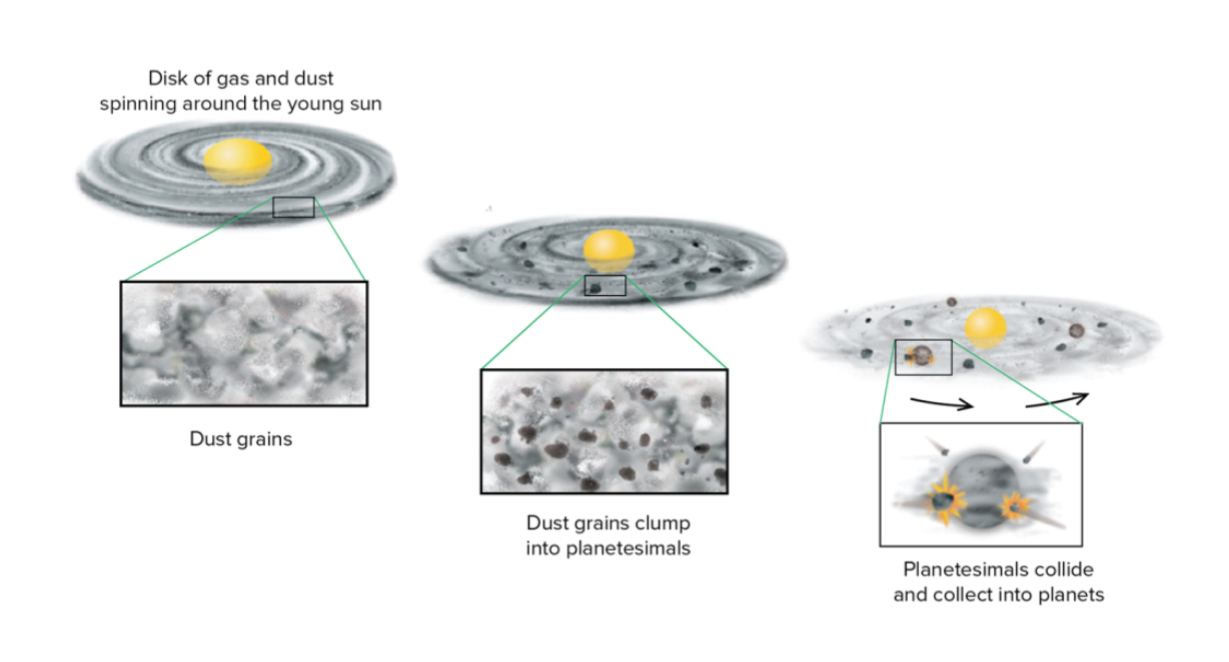
Inner Planets:
Mercury, Venus, Earth, and Mars.
• Rocky and metallic.
• Very hot (nearest the Sun).
Four Outer Planets:
Jupiter, Saturn, Uranus, Neptune.
• Gas giants: Jupiter and Saturn.
• Ice giants: Uranus and Neptune.
• Very cold (farthest from the Sun).
Dwarf Planets:
Pluto
Rocky, metallic innermost planets.
Contain mainly metallic iron, a few very high temperature
minerals, and little water or gas
Gaseous outer planets.
Incorporated much larger amounts of low temperature
minerals, liquid water, and condensed gases.
Planet compositions determined by _________.
proximity to the Sun
Earthquakes represent a(n)
release of built-up stress in the lithosphere
Differentiate between seismic and aseismic
Seismic refers to ground displacement and energy release associated with sudden motion of rocks along a fault, while aseismic does not
The actual site of the first movement along a fault at the surface is known as the ___________.
epicenter
A fault with predominantly horizontal displacement is known as a strike-slip fault.
True
Which of the following is a measure of the amount of ground motion related to an earthquake?
Magnitude
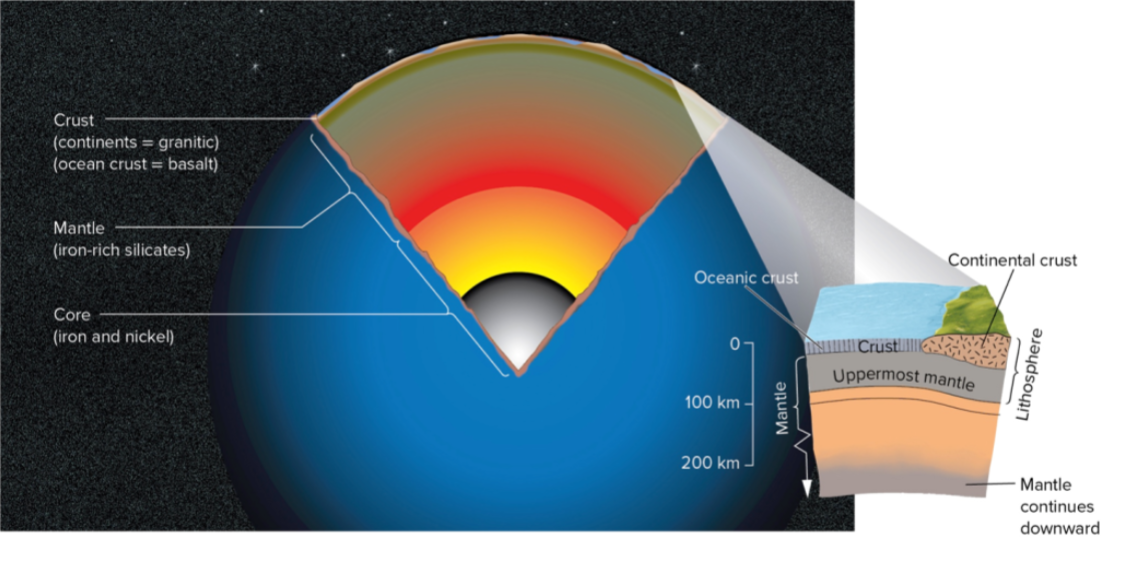
Label the Area
Where is which part
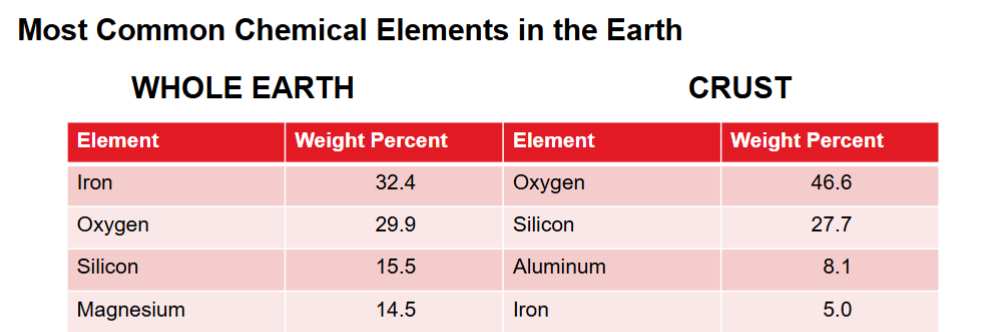
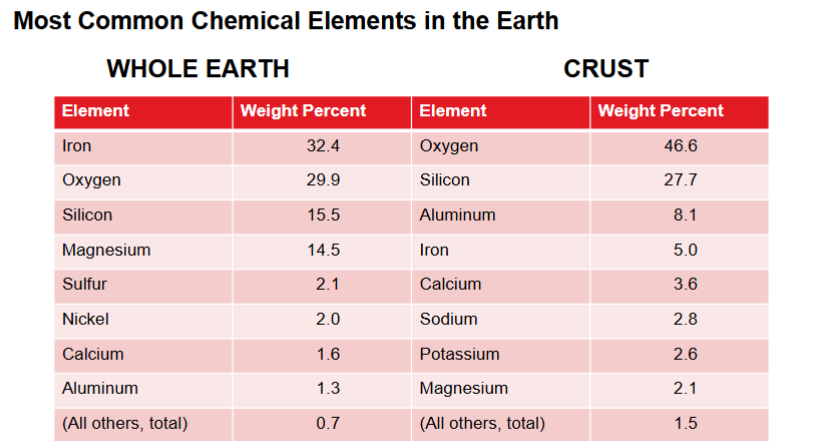
Memorize the top four elements and percentage
Formation of universe
Galaxy spreading apart / proof in the sky
The amount of time humans have been on this earth is..
insignificant amount compared to the things around us
Earth is located in the _______.
Goldy Lock Zone
Rocky, metallic innermost planets contain
metallic iron, a few very high temperature minerals, and little water or gas
Gaseous outer planets contain
larger amounts of low-temperature minerals, liquid water, and condensed gases
Select Physical Properties of the Planets
The Planetary densities are consistent with a higher metal and rock content in the four planets closest to the Sun and a much larger proportion of ice and gas in the planets farther from the sun
Early Earth consisted of _____
Barren, cratered surface, rock, hot lava
No oceans, no atmosphere
impacted by asteroids, dust, meteors, comets → often
Formation of Earth as we know it was from
Heating and differentiation of materials helped create
the atmosphere and oceans
Earths Atmosphere was chemically different than today because
No modern pollution.
Lacked free oxygen
Dominated by nitrogen (N) and carbon dioxide
What gases where in the earth atmosphere at the beginning?
Minor amounts of other gases:
• Methane
• Ammonia
• Sulfur gases.
Barren of oxygen-breathing life
Earth Chemical Composition
Iron (32.4%), Oxygen (29.9%), Silicon (15.5%), Magnesium (14.5%)
Crust was dominated by:
Oxygen (46.6%), Silicon (27.7%), Aluminum (8.1%)
Early Life on earth started with?
Single-celled blue-green algae (cyanobacteria)
What helped create oxygen in the atmosphere so breathing organisms could evolve?
Sunlight energized a chemical reaction in algae. (photosynthesis)
• Food was produced from C02
• Oxygen given off as a by-product.
Take carbon dioxide and make three sugars into oxygen
Early life forms consisted of?
no hard parts (no teeth, bones, shells, or claws).
Earliest rocks
limited life forms, single-celled organisms.
Earliest Rocks 2 billion years ago had evidence of?
blue-green algae
What developed appear 1 billion years ago because an oxygenated atmosphere developed?
Multi-celled creatures
Timeline of Life over 541 million years
Marine animals with shells widespread around what time?
541 million years ago
Evolving into humans
Vertebrates appear about 530 million years ago
Land plants appear about 465 million years ago
Insects develop about 400 million years ago
Dinosaurs appear about 230 million years ago
Birds appear about 150 million years ago
Mammals and birds well established by 100 million years
ago
Primitive human beings appear by 1.5 to 2.5 million years
ago
Modern humans (Homo sapiens) appear during last 300,000
years
First Plant to change the surface of the planet
Moss

Label each planet
1. Mercury
2. Venus
3. Earth
4. Mars
5. Jupiter
6. Saturn
7. Uranus
8. Neptune
9. Dwarf planet - Pluto
Why is it hard to find fossils?
Crust gets sucked underneath repeatedly over time
Archean
Time before life
What started Geology?
people being curious and wanting to describe geographic things
Geology is….
the student of rocks and the earth
Geology started off as a __________ science and turned into a __________ science.
Observational, Analytical
Modern geology combines
observation and laboratory activities (measurements and calculations) to explain natural phenomena
Geology’s rapid change over time consists of..
Experiments must consider changes in temperature, pressure, stress,
chemical parameters, and time.
• Not just a descriptive science, but a more quantitative and more
interdisciplinary science through time.
• Starting materials that form rocks and minerals often are completely
changed over time
Geology is an
environmental science
Geology is the _______ of 4 major sciences
youngest
Rocks record how Earth has changed over time.
Like the Climate and environment engraved in the rocks
Recognition and mitigation of natural hazards.
Earthquakes, volcanic eruptions.
Landslides and ground failures.
Flood damage, soil erosion
Supports resource exploration to sustain human populations
mining, petroleum exploration
The Scientific Method is…
A set of observations and/or a body of data from measurements of phenomena
and/or experiments
Rocks are ________ which in turn helps to show when the Poles change because of the direction they face
Magnetic
A hypothesis is
formed to explain the observations or data
Hypothesis tested repeatedly becomes a ______ only after extensive testing
Theory
Theory is
formed as accepted explanation for an observation or set of data
A Hypothesis must be
Conceptual framework or model is developed.
Multiple explanations or equations developed.
Must be testable and test must be reproducible.
Proof of a hypothesis is sought as well as evidence to disprove it.
You can or can’t prove something true?
CAN’T
You can or can’t prove something false
CAN
What challenges does geology face?
Size(earth scale), time(over billions of years), and resolution(increase in technology challenges old theories) limitations
What hazards does environmental geology study?
Earthquakes, volcanoes, floods, mass wasting, soil erosion
What resource issues does it address?
Mining, petroleum, water, energy, pollution, remediation
Challenges Unique to Geology (SIZE)
A volcano is big.
A river is not easily contained within a laboratory.
Plate Tectonics involves the whole Earth.
Challenges Unique to Geology (Time)
Geologic processes take millions of years to complete.
Geologists are limited by human time (years to decades).
Challenges to Geology (Resolution)
New technology and procedures often impact, or challenge, old
theories.
We can see more details now than a century ago.
Scientific Method
1. Observe 2. Hypothesize 3. Experiment 4. Conclusion 5. Rinse + Repeat
Scientific Method Explained
1. Observe: Notice a phenomenon, pattern, or problem in the world around you and ask a question about it.
2. Hypothesize: Formulate a testable explanation or an educated guess to answer your question.
3. Experiment: Design and run a test to gather data and see if your hypothesis holds up.
4. Conclusion: Analyze the results of your experiment to determine if your guess was right, wrong, or inconclusive.
5. Rinse + Repeat: Use your new knowledge to refine your idea, fix errors, ask new questions, and start the process over again
Why does Geology Matter?
The Earth is a Dangerous Place
Environmental geology…
explores the many and varied interactions
between humans and geologic environments
Earth is a dangerous place why?
• Earthquakes and Volcanoes.
• Floods, Mass wasting, and Soil erosion.
• Global Warming.
• Quest for more energy.
• Pollution and Storage of toxic waste.
• Find and manage fresh water.
• Find new resources (they are limited).
• Remediate sites of mineral extraction.
What is the projected world population for 2050?
9.7 billion.
What drives population growth?
Increased life expectancy, high birth rates, mobility.
Which region has the fastest growth rate?
Africa (2.5%/yr)
What is carrying capacity?
The ability to sustain a population at a healthy, comfortable standard of living.
What major issues arise from exceeding carrying capacity?
Loss of farmland, water shortages, energy/mineral depletion, waste disposal challenges, global warming.