Biolchem Exam 1 Lecs 6-10
 Call Kai
 Learn
Learn Practice Test
 Spaced Repetition
 Match
Match Flashcards
 Knowt Play
1/70

There's no tags or description
Looks like no tags are added yet.
Name | Mastery | Learn | Test | Matching | Spaced | Call with Kai | Chat |
|---|
No analytics yet
Send a link to your students to track their progress
71 Terms
Lipids: Hydrophobic or hydrophilic, soluble or water-insoluble?
Are Lipids polymers?
Functional groups?
Lipids: Hydrophobic & water-insoluble
Not polymers
Lipids — Have many fully-reduced C (-CH2-), also have polar “head group” (amphipathic)
Many fully-reduced C (-CH2-), also have polar “head group” (amphipathic)
6 major classes of lipids

Functions: Energy storage, protective coating, cell membrane, signaling
Fatty acids
In humans, branched/unbranched, # of carbons, double bonds in cis/trans config?
Building blocks for what?
Carboxylic acid “fatty“ w/ long chain
In humans, fatty acids are unbranched, have an even number of carbons (usually 12-24), and can have double bonds in cis
Building blocks for most lipids (except sterols)

Fatty Acids Naming:
18:1(Δ9) meaning
Which carbon is ⍺?
ω-3
By length of carbon chain and location of double bonds
18 Carbons (length), 1 double bond, Δ9 position of double bond
C2 carbon is ⍺ (next to carboxyl carbon)
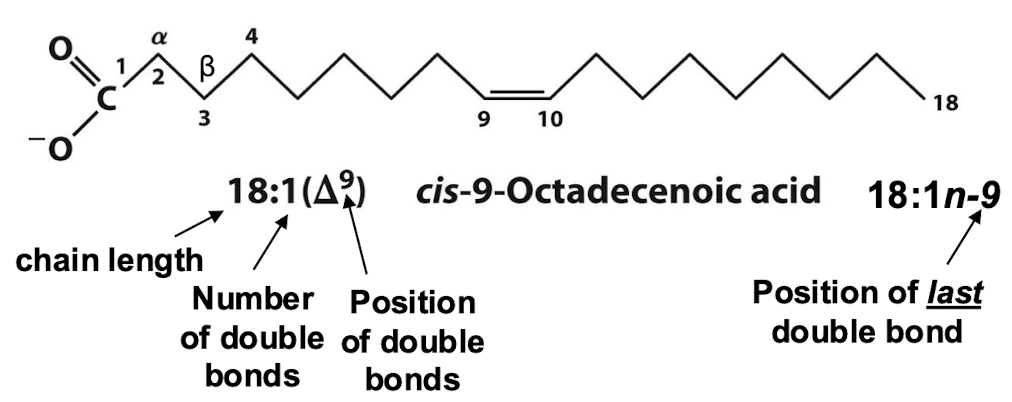
ω-3, double bond is 3C from the end
ω-3 & ω-6 polyunsaturated fatty acids (PUFAs) are ____ in the human diet
essential

Lipid, Fatty Acid Nomenclature
20 carbons, 5 double bonds, double bonds on C5, C8, C11, C14, C17
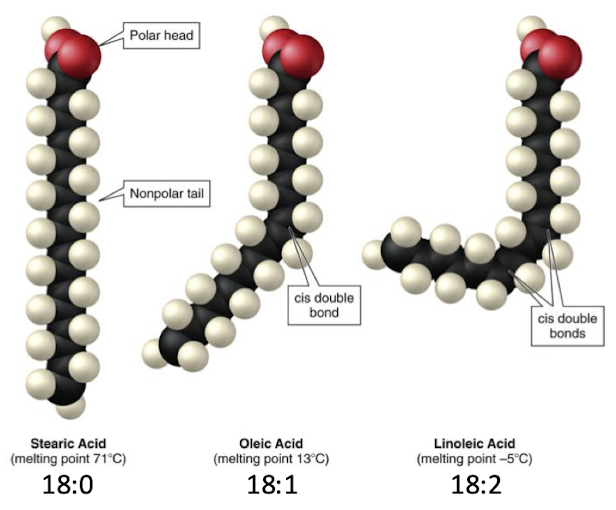
Longer chain, less/more soluble
More saturated (w/ H), less double bonds, less/more soluble
Less soluble
Less soluble (can pack tighter together)
Fatty acid (lipid) MP ↓ as chain length ____.
Fatty acid (lipid) MP ↓ as saturation ____.
Increasing surface area ____ dispersion forces between hydrophobic chains.
Saturated fatty acids packing
MP ↓ as chain length decreases and saturation decreases (less H, more double bonds)
Increased dispersion forces
Can pack more tightly, (more SA contact), w/ stronger dispersion forces & higher melting point
Remember unit of unsaturation (UU) is a double bond

Triacylglycerols (triglycerides):
What type of lipid
Charge?
Triacylglycerols (triglycerides): Simple lipids w/ 3 fatty acids esterified to 3 alcohol groups of glycerol
Storage lipid
Neutral
Energy store and reduced carbons
Saponification: Hydrolysis of lipids in basic conditions, make glycerol


Longest C chain, highest MP
Least double bonds, most tight packing, most LDFs, highest MP
Saponification
Hydrolysis of triacylglycerols (storage lipid) into carboxyl salt, produce soap & disrupts membrane

“Fats” solid at RT; have ____ fatty acids
“oils” liquid at RT; have more ____ fatty acids
Wax:
“Fats” solid at RT; saturated fatty acids
“oils” liquid at RT; unsaturated fatty acids
Wax: Esters of fatty acids and a long chain alcohol


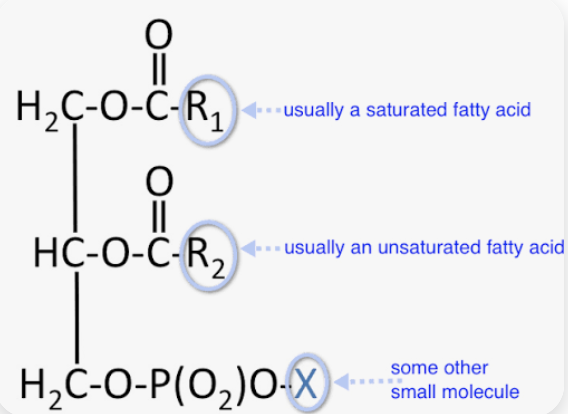
Glycerophospholipid
Membrane lipids (amphipathic), glycerol esterified to 2 fatty acid chains & phosphate head
Usually one saturated and one unsaturated fatty acid


Sphingolipid:
Phosphosphingolipids:
Glycosphingolipid:
Sphingolipid: Sphingosine backbone w/ long carbon chain, amide-linked saturated fatty acid, & head group.
Phosphosphingolipids: Has phosphate-alcohol head group
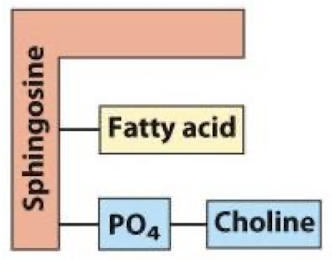
Glycosphingolipid: Has carbohydrate group

Sterol
Structure of sterols → 4-fused-ring (type of lipid), core rigid & planar.
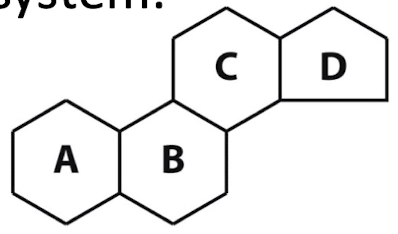
Isoprenoid
5-carbon isoprene unit

Double bond on each end
Cholesterol, where is it usually found
Sterol, w/ isoprene tail
Major sterol in animals’ membrane
1 OH group, precursor for other steroid lipids

Steroid Hormones
Hydrophobic signaling molecule, small, diffuses across cell membrane
Cholesterol derivative
What are Cholesterol derivatives
Steroid Hormones, Vit D, Bile Acids & Salts
How to identify/group these

Steroid hormones, Vit D, and Bile Acids are cholesterol derivatives (4-fused-ring + isoprene tail)
vs.
Fat soluble vitamins are iso-prenoids
Eicosanoids (based on what)
NSAIDS do what?
Based on arachidonate fatty acid (20:4)
Local (paracrine) hormones
Inflammation, fever, disease

NSAIDs inhibit eicosanoids (no prostaglandin & thromboxanes) production
Plasma vs. Endomembrane
Is plasma membrane stationary or fluid
Plasma membrane: External boundary of cell
Endomembrane: Internal compartments of cell
Plasma membrane is fluid, self-repairing, & selectively permeable
Membrane lipids have ____ shape
Micelle
Cylindrical, allows for bilayer
Micelle: 1 layer, formed by single chain conical lipids (fatty acids). Hydrophobic inner core

Bilayer how long?
Impermeable to what?
Fluid Mosaic Model:
30 Angstrom
Impermeable to polar and charged molecules
Fluid Mosaic Model: Lipids free to move laterally in membrane (seen by fluorescent labeling)
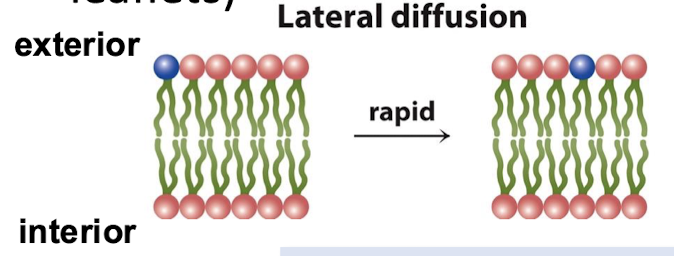
Lipid movement in bilayer membrane
Lateral diffusion: Stay within leaflet (2D), FAST
Transverse diffusion: Move between leaflets
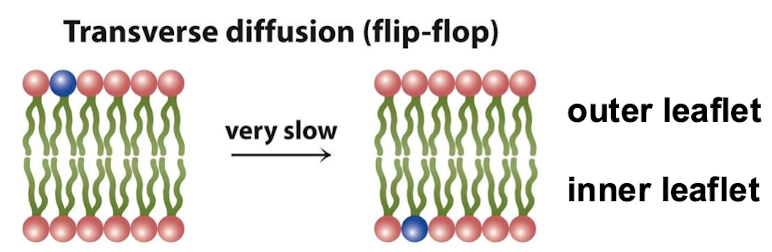
Slow and needs to be catalyzed
Asymmetric distribution
How is membrane fluidity defined?
Membrane fluidity: How easily lipids undergo lateral diffusion
Temp dependent
Membrane alternates between disordered liquid-state & ordered solid state (transition temp between)

What is membrane transition temp dependent on?
Composition
Longer fatty acid chains → ordered state, ↑ transition temp
More cis-double bonds → disordered state, ↓ transition temp
What regulates membrane fluidity
Cholesterol:
↑ Temp, unsat. fatty acids compact (↓ fluid)
↓ Temp, Sat fatty acids reduce packing (↑ fluid)
Less severe change than transition temp


Lipid Raft (Lipid Microdomain)
Location
How does cholesterol pack
Is this thicker thicker/thinner than surrounding membrane?
Microdomains of sphingolipids & cholesterol (like a wrap of both)
Outer leaflet
Packs w/ long, saturated fatty acid chains of sphingolipids
Thicker than surrounding membrane
Stable in membrane
How are lipid rafts enriched?
w/ long helical segments, two long acyl chain modifications, or GPI-anchors
What are the 3 ways proteins associated with membrane?
Integral membrane proteins
Peripheral membrane proteins
Lipid-linked proteins
Integral membrane proteins
How to remove them?
Fully embedded in the membrane
Transmembrane domain (hydrophobic region in middle)
Detergent to disrupt hydrophobic region, destroys the protein

Peripheral membrane proteins
How to remove?
On surface of the membrane
Since only interacting w/ polar heads, remove w/ salt

Lipid-linked proteins:
How to remove?
What can be the chain?
W/ long hydrocarbon chains covalently attached to lipid linking it to membrane
Some detergent required to release lipid chain from membrane
Chain: fatty acids, isoprenoids, or GPI-anchored

Integral membrane proteins (single & multi-pass) form what?
Hydropathy plot?
Form α-helices or β-sheets within the membrane
H bonding inside and shields polar peptide bond
Hydropathy plot shows hydrophobic region in transmembrane protein
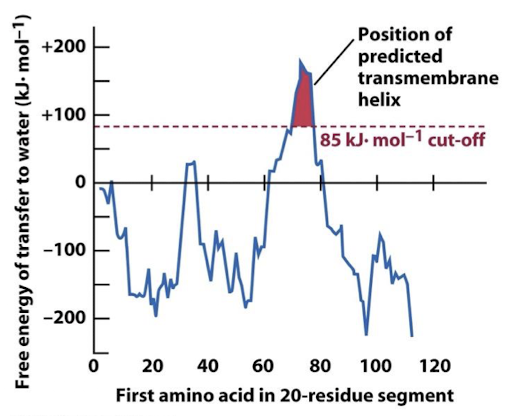
Top region have hydrophobic domain (or alpha helix)
Membrane fusion needs what?
Change in curvature of membrane
What changes lipid shape & membrane curvature (to allow for membrane fusion)?
Lysophospholipids & phospholipase (hydrolyze fatty acid)
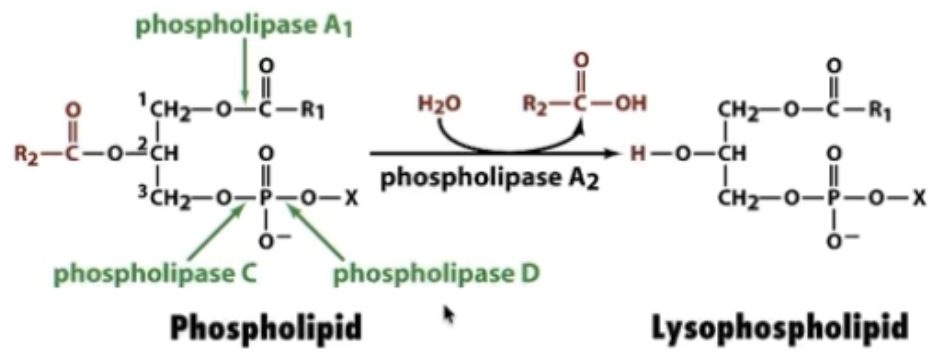
What creates lysophospholipids? What impacts head groups?
(For changing lipid shape for membrane curvature)
Phospholipase A1 & A2 creates lysophospholipids
Phospholipase C & D Affects the head groups
Lipid bilayer ____ to molecules that are large, polar, and/or charged.
Impermeable
What passes through lipid bilayer w/o help?
Hydration shell?
Nonpolar gas & small, uncharged slightly polar molecules pass by simple diffusion (NO IONS). (Larger require transporter)
Lose & regain hydration shell as pass through membrane


Simple diffusion
Facilitated diffusion
Active transport
Secondary Active Transport
Passive vs. Active transport (which requires energy)?
Simple diffusion: Molecules move ↓ conc. grad w/o energy or transporter.
Facilitated diffusion: Passive transport, w/ membrane protein
Non specific channel (porin), specific carrier protein, or aquaporin (osmosis)
Active transport: Also uses carrier protein moves molecules against conc. gradient, needs energy
Energy source ATP or downhill transport of another molecule (secondary active transport)

Transport proteins - Non-specific example
Porins (size limited channels always open)
Gated ion channels
Are they saturable?
Open and close at a specific event, for specific group of molecules (ligand binding, voltage)
No
Transporters
For specific molecule (saturable)
Conformationally-gated (only open @ one side at time)
Affinity based on conformation

3 Types of Transporters
Uniporter: Moves molecule in 1 direction (passive)
Cotransporter: Moves 2 molecules simultaneously
Symporter: Moves 2 molecules same direction (active)
Antiporter: Moves 2 molecules opposite direction (active)

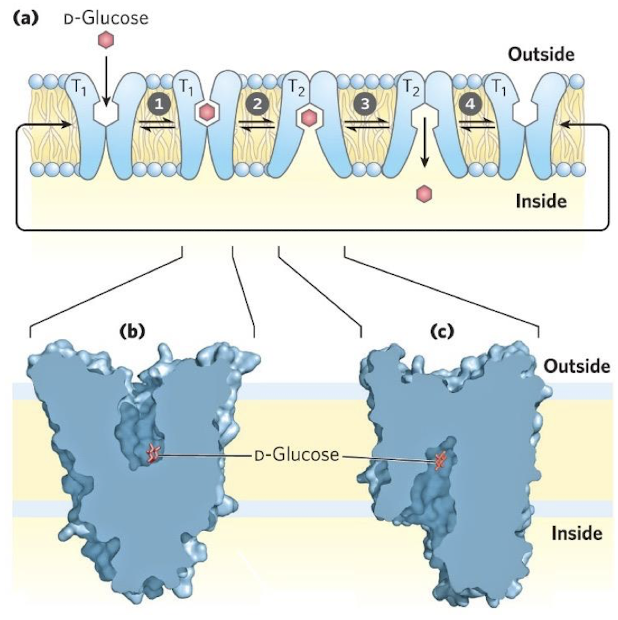
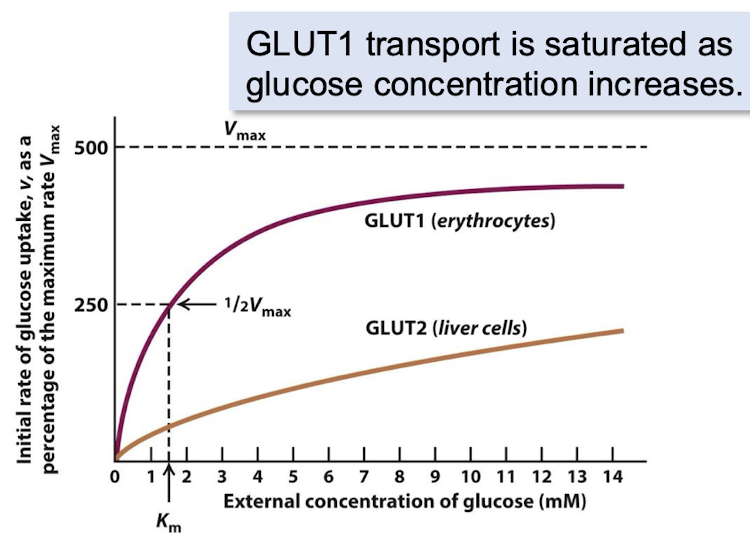
Glucose Transporter (GLUT1)
Passive uniporter, facilitative diffusion of glucose down conc. grad
High rate of transport
Saturable (as glucose conc increases, transport is saturated)
Stereospecfic
P-type ATPases
Ca2+-ATPase:
Na+-K+-ATPase:
P-type ATPases: Active cation transporters use ATP hydrolysis to transport ions up a gradient (primary active transport)
Ca2+-ATPase: Transports 2 Ca2+ out for each cycle of ATP hydrolysis, maintains low cytosolic calcium conc.
Na+-K+-ATPase: 3 Na+ out, 2 K+ in for each cycle of ATP hydrolysis (essential for neuron action potentials)


Transport Coupling
Symporter Na (w/ conc. grad, favorable) & Glucose (against conc. grad, unfavorable) in
Glucose absorption (from intestinal space to cells)
Unfavorable transport coupled to favorable transport

Make this card better
Lec 7 Catalysts & Example
Increase reaction rates w/o being consumed
Faster reaction rates
Milder reaction conditions (narrow temperature/pH range)
Greater rxn specificity (avoid side products, stereospecificity)
Chymotrypsin 20 yrs uncatalyzed, half a sec catalyzed
Carbonic Anhydrase 5 sec uncatalyzed, .000001 sec catalyzed

Usually globular proteins (enzymes), small % are RNA ribozymes
Enzymes Stereospecificity
Enzymes are chiral, rxns produce molecules w/ absolute stereospecificity (no racemic mix)
Geometric specificity
Enzymes vary in degree of geometric specificity, some select for one molecule, & some allow for larger range
Active Site
Enzyme-catalyzed reaction takes place in active site
Has AA residues bind substrate and catalyze breaking/forming of bonds
Bind through multiple, weak interactions; complementarity and flexibility depend on the residues in the active site

Lock and Key vs. Induced Fit
Lock & Key: Must be exact fit, very selective
Induced Fit: Binding of the substrate induces a conformational change in the enzyme’s active site that promotes association; substrate-induced conformation; more flexibility

Oxidoreductase:
Transferase:
Hydrolase:
Isomerase:
Ligase:
Lyase:
Oxidoreductase: Oxidation-reduction (OH to aldehyde)
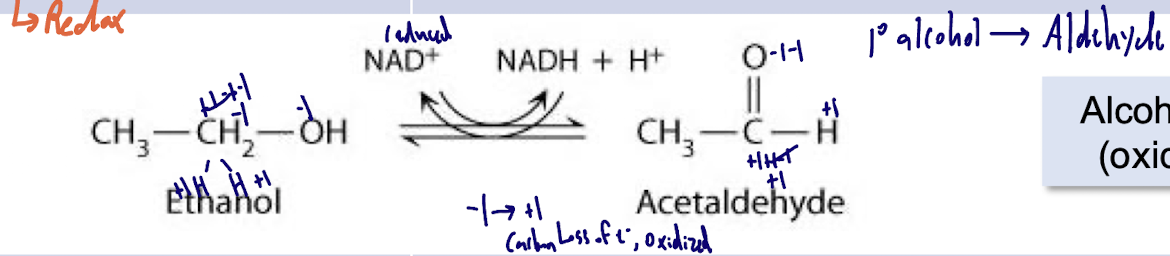
Transferase: Complete transfer of functional group from one molecule to next

Hydrolase: Cleave bond (break bond) by adding water

Isomerase: Make structural isomer, transfer functional group within molecule

Ligase: Glue, join two molecules, coupled with ATP hydrolysis

Lyase: Form/break double bond w/o without hydrolysis or oxidation

Cofactors
Metal ions
Coenzymes
Cosubstrates
Prosthetic Groups
Ezymes chemically modified by rxn, then undo chemical change
Cofactor: Enhance enzyme activity
Metals: Cu²⁺, Zn²⁺, Mg²⁺, Ni²⁺, Mn²⁺, Fe²⁺, etc
Coenzymes: Complex organic or metalloorganic molecules
Prosthetic Group: Permanently binds to enzyme, does not leave
Cosubstrates: Cofactor that associates for rxn then dissociates

Increases chemical diversity beyond 20 AA
Humans cannot synthesize coenzymes: true or false?
Coenzymes are derivatives of ______
True, cannot synthesize essential coenzymes from scratch
B Vitamins (from diet)
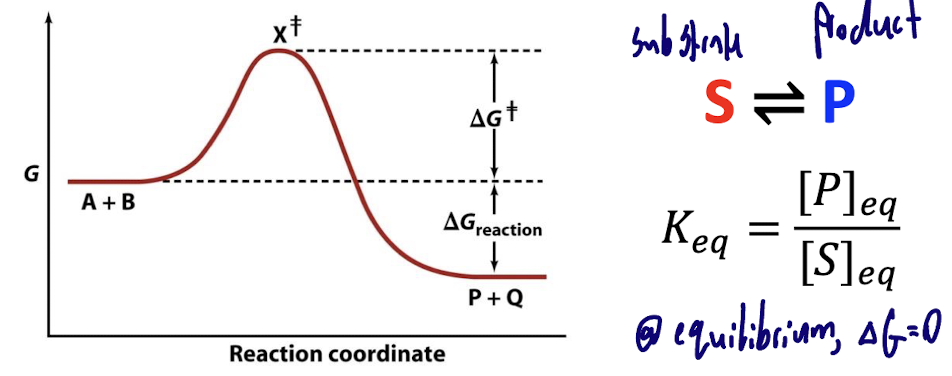
For a reaction to occur, products G must be _____ than substrates G
As reaction proceeds, [P]/[S] increases until ΔG: ____
Lower (ΔG < 0)
As reaction proceeds, [P]/[S] increases until ΔG: 0 (chemical equilibrium)
ΔG°′
[P]eq/[S]eq , inherent property of rxn
Keq @ equilibrium for rxn
Biological standard free-energy change
@ stnd cond. (25°C, 1 atm, 1 M), pH 7.0 & water


Unfavorable reaction (ΔG°′ > 0), or near equilibrium reaction (ΔG°′ ≅ 0), can made favorable (ΔG < 0) by ____________________________.
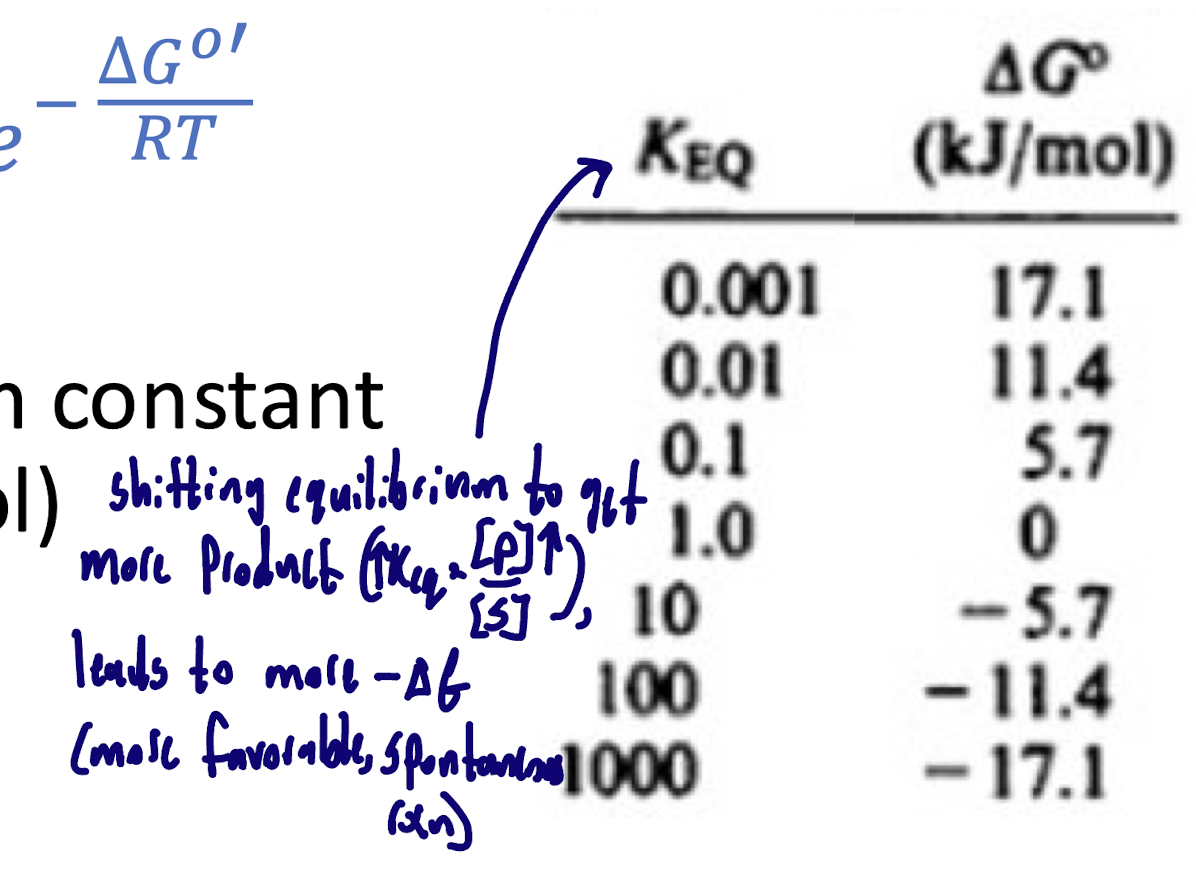
A ___-fold increase in the equilibrium constant results in a 5.7 kJ/mol (1.36 kcal/mol) decrease in ____
changing the concentrations of substrate and product (Le Chatlier’s Principle)
A 10-fold increase in the equilibrium constant (Keq) results in a 5.7 kJ/mol (1.36 kcal/mol) decrease in ΔG°′
Do enzymes shift equilibrium?
Does ΔG indicate rxn energy feasibility or reasonable time scale
No, but arrive faster
ΔG is if a reaction is energetically feasible; regardless of reasonable time scale (rxn rate)
Enzymes accelerate attainment of _____, do not change rxn’s _____ and _____.
Enzymes decrease the _______
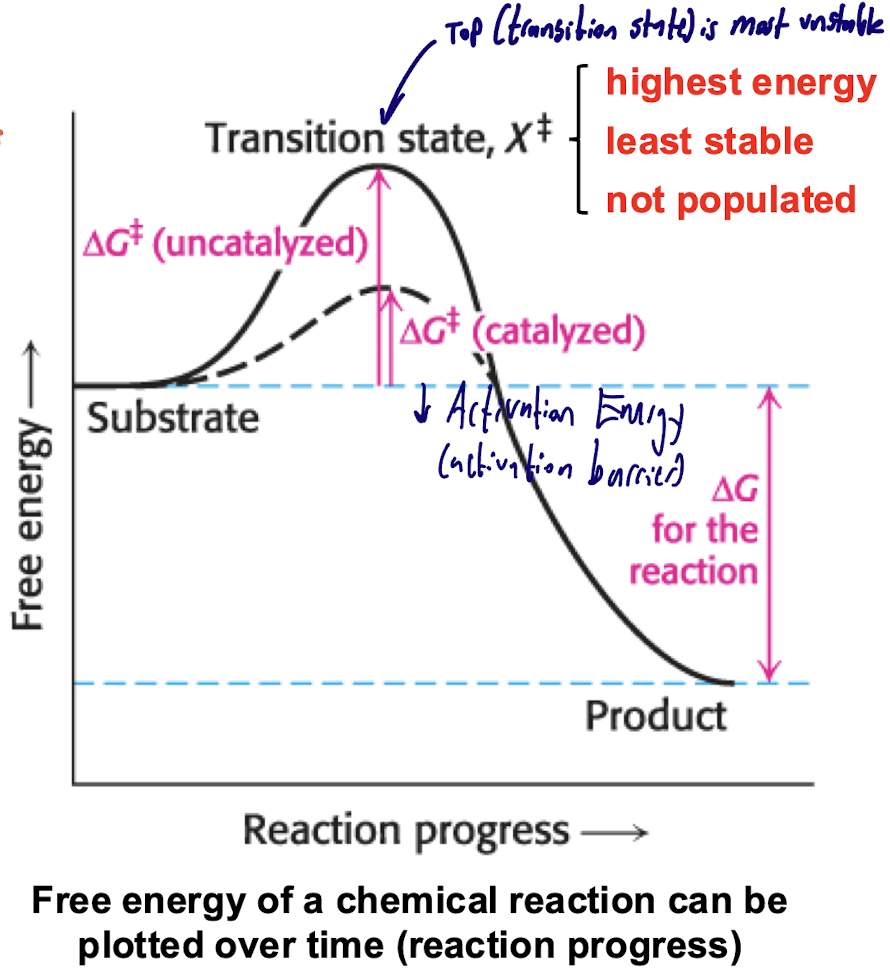
Enzymes accelerate attainment of equilibrium, do not change rxn’s ΔG and Keq.
Enzymes decrease the activation energy ΔGt


Highest point of rxn is _____
Enzymes facilitate formation of _______
Energy to form transition state is _____
What determines rate of rxn?
How do enzymes increase rxn rate?
transition state (X‡)
transition state (X‡)
Activation barrier (Activation energy)
Activation barrier (Activation energy)
Increase rxn rate by decreasing ΔG‡.
S to X‡ to P
What is rate enhancement
What is ΔΔG‡
What is the stabilization to rate increase ratio
How much can 1 H-bond increase rate by?
Fold change in rate from uncatalyzed to catalyzed rxn.;
ΔΔG‡: Energy saved by using catalyst (vs. no catalyst), energetic stabilization of the transition state by the enzyme
Stabilization of 5.7 kJ/mol (1.36 kcal/mol) increases rate by 10-fold;
By > 100-fold

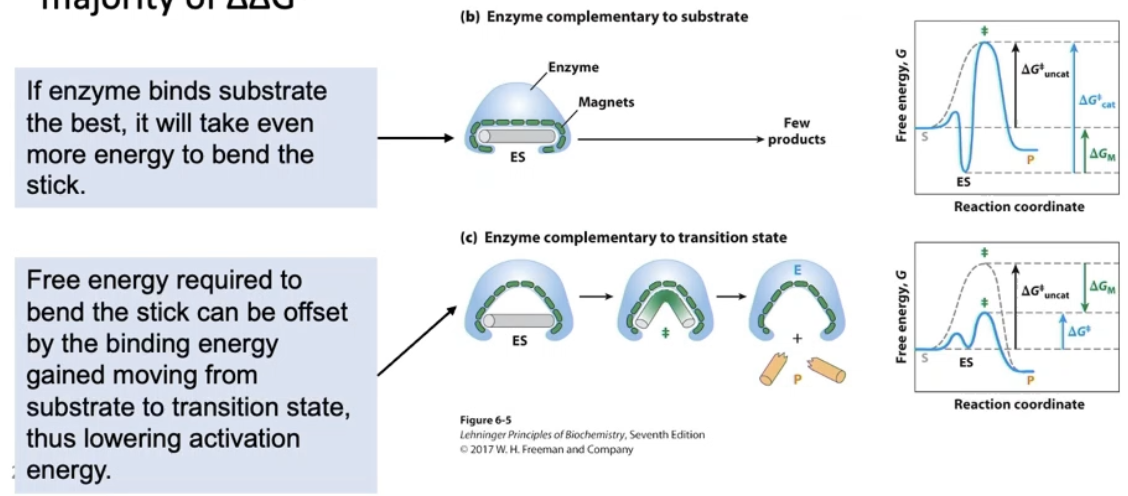
Enzymes bind to what the best?
Bind transition states best
Binding to X‡ (transition state) is the majority of ΔΔG‡ (energy saved)
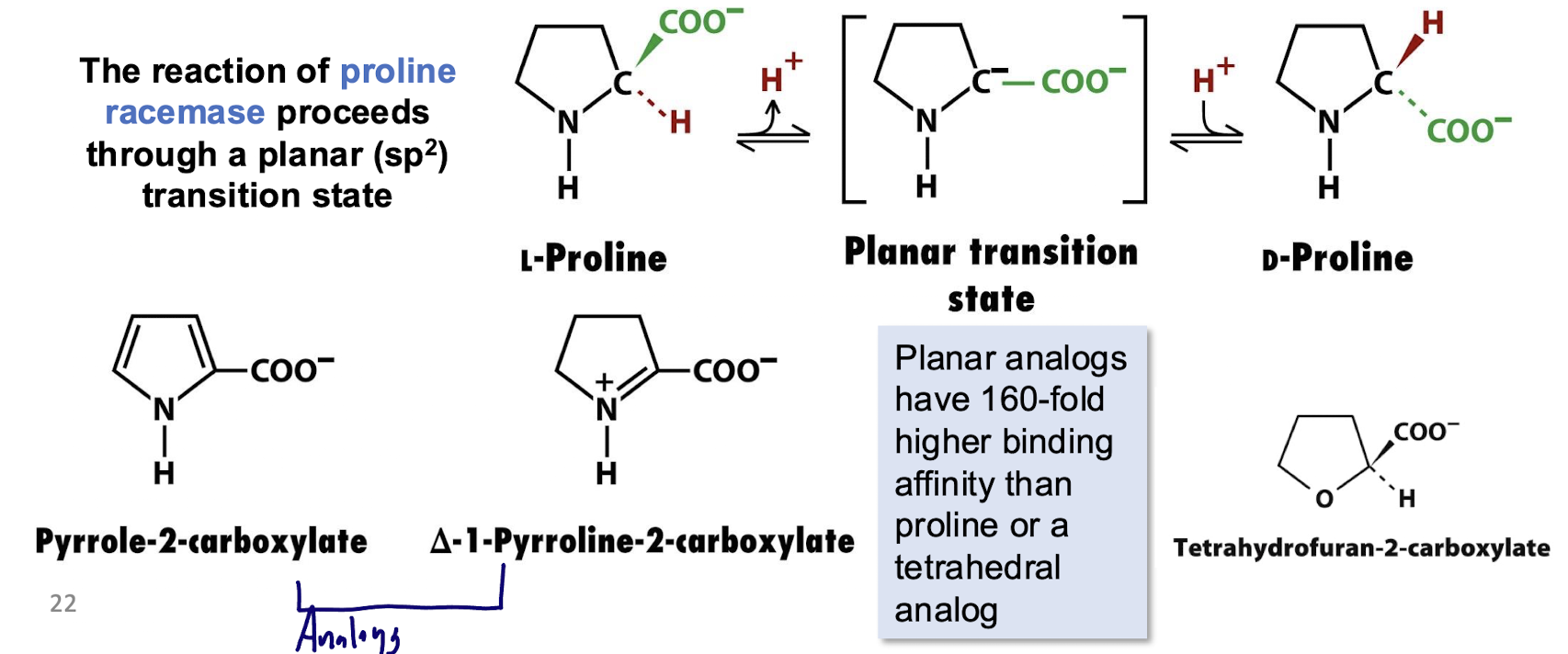
Transition state analogs (look alikes) are potent ______. Explain why.
Planar analogs have _____ fold higher binding affinity than proline or tetrahedral analog
Inhibitors
Stable molecules resembling T.S. of rxn; bc enzymes binds best to T.S., molecules mimicking T.S. also bind tightly to enzyme and inhibit activity.
160 fold
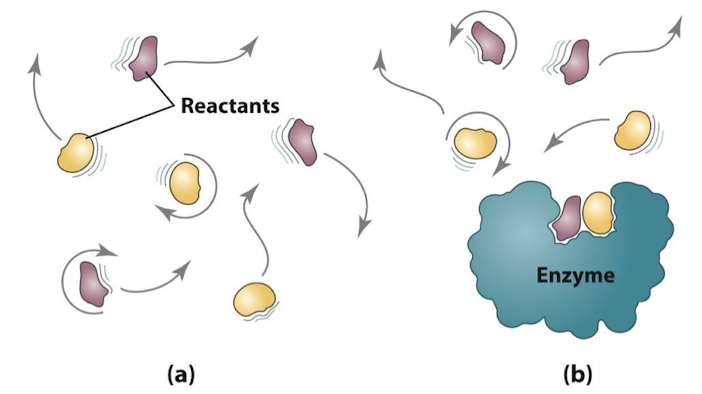
What are the 4 catalytic stratgeies
Approximation and orientation
General acid-base catalysis
Covalent catalysis
Metal ion catalysis
Approximation and orientation (Catalytic Stratgey)
Brings 2 substrates into proximity and orients them for rxn
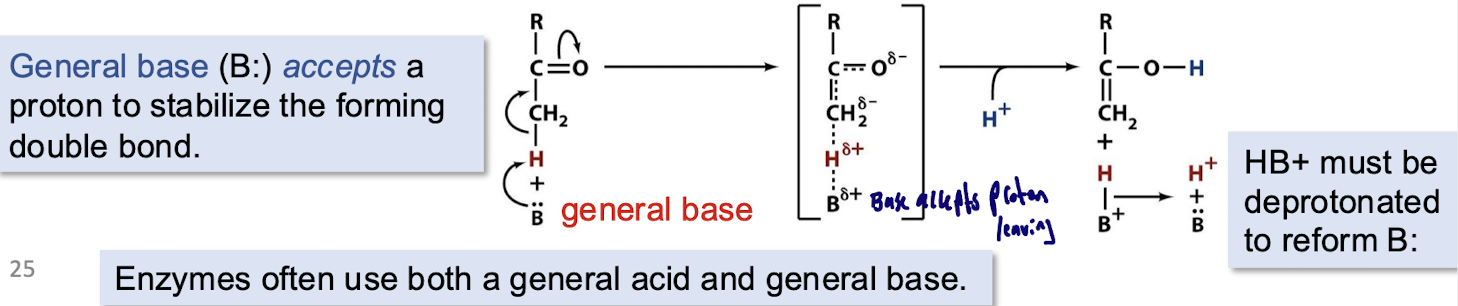
General acid-base catalysis (catalytic strat)
General Base accepts H to stabilize _______
General Acid donates H to stabilize _____
What groups act as general acids & bases?
Are they pH dependent?
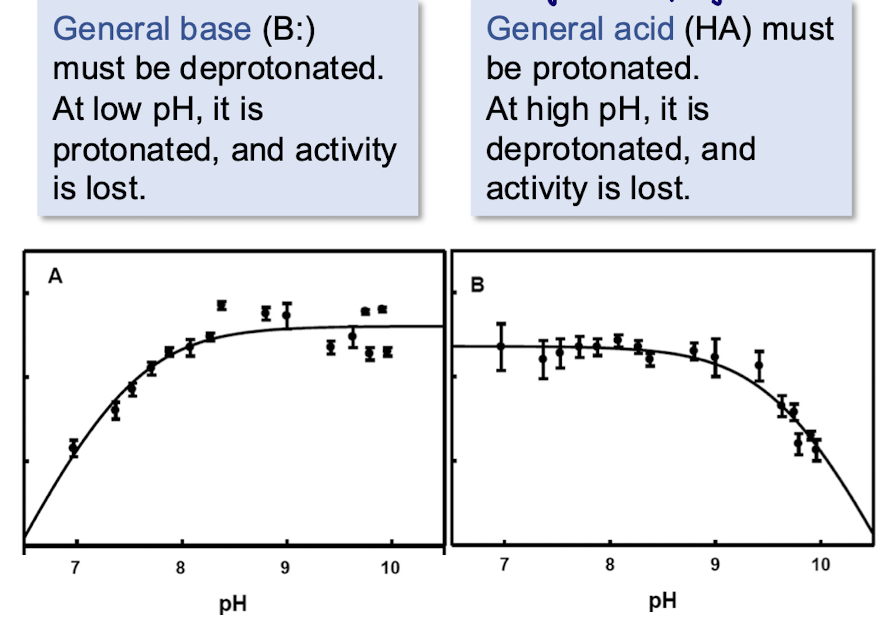
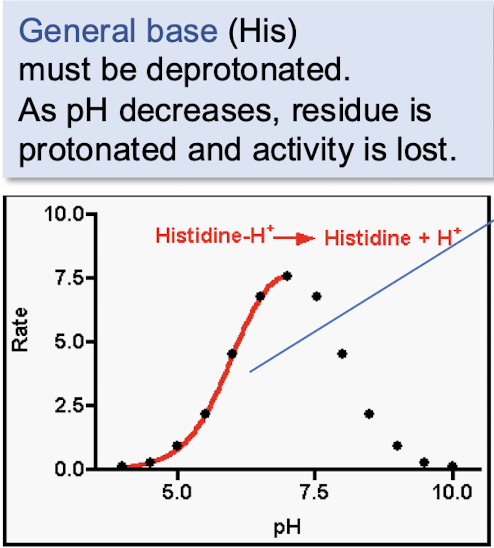
General Base accepts H to stabilize forming double bond
General Acid donates H to stabilize - charge in T.S.

Must reform to do again
Ionizable AA side chains with PKA near 7
(General base must be deproted, Acid proted, otherwise activity lost: pH dependence)

Covalent Catalysis (catalytic strat)
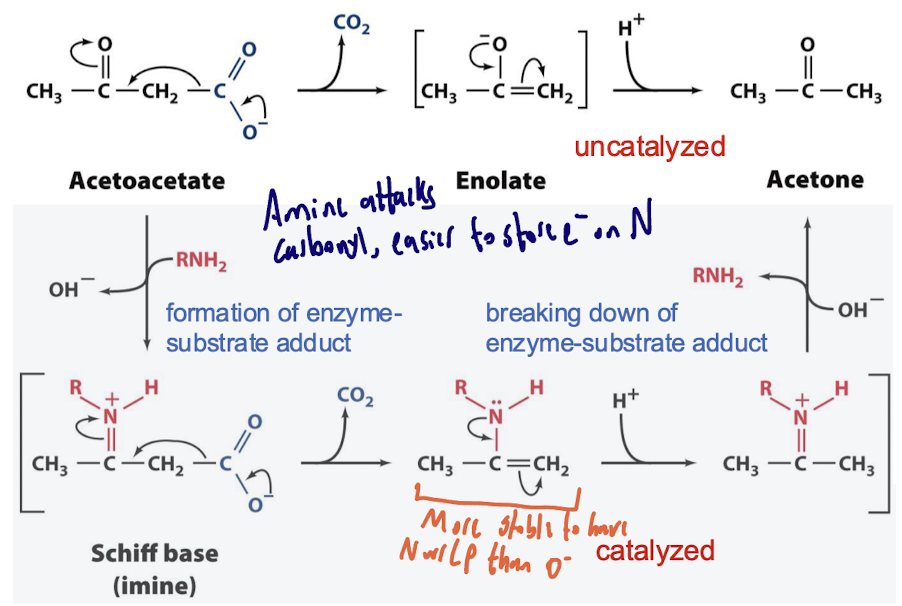
Schiff Base
Active site’s reactive group forms covalent bond w/ substrate (Stable covalent intermediate); enzyme nuc attacks substrate electrophile.
Schiff base: Amine attacks carbonyl, easier to store e- density on N than C. Forms between enzyme amine & substrate carbonyl. “Electron sink” to stabilize negative charge
Enzyme forms stable covalent intermediate with substrate.
What type of intermediate is produced in covalent catalysis?
Stable covalent intermediate, follows diff rxn pathway than uncatalyzed rxn, schiff base acting as “electron sink“ to stabilize - charge in uncatalyzed rxn

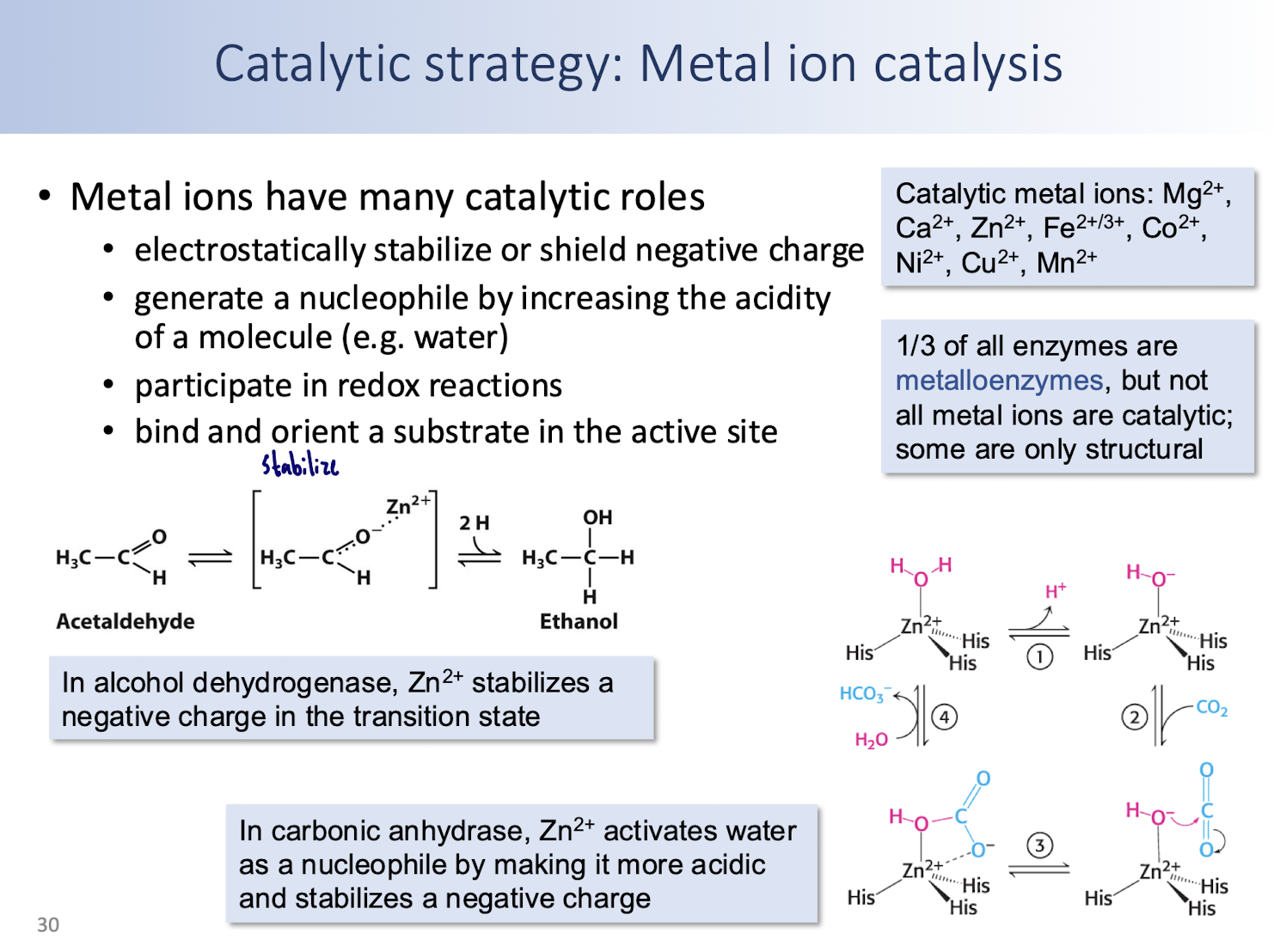
Metal Ion Catalysis
Catalytic role, electrostatic stability, generate nuc by increasing the acidity of molecule, redox rxns, bind & orient substrate in active site
Include Mg²⁺, Ca²⁺, Zn²⁺, Fe²⁺/³⁺, Co²⁺, Ni²⁺, Cu²⁺, Mn²⁺
In alcohol dehydrogenase, Zn²⁺ stabilizes a negative charge in T.S.
In carbonic anhydrase, Zn²⁺ activates water as nuc by making it more acidic & stabilizes - charge.
1/3 of all enzymes are metalloenzymes, but not all metal ions are catalytic; some are only structural