lecture 9 (copy)
 Call Kai
 Learn
Learn Practice Test
 Spaced Repetition
 Match
Match Flashcards
 Knowt Play
1/15

There's no tags or description
Looks like no tags are added yet.
Name | Mastery | Learn | Test | Matching | Spaced | Call with Kai | Chat |
|---|
No analytics yet
Send a link to your students to track their progress
16 Terms
What are the key properties of metals in their solid state?
Aggregate state
Solid state properties
Crystallization
Solid state crystals
Melting point and melting range
Diffusion
Processes related to diffusion:
Annealing
Recrystallisation
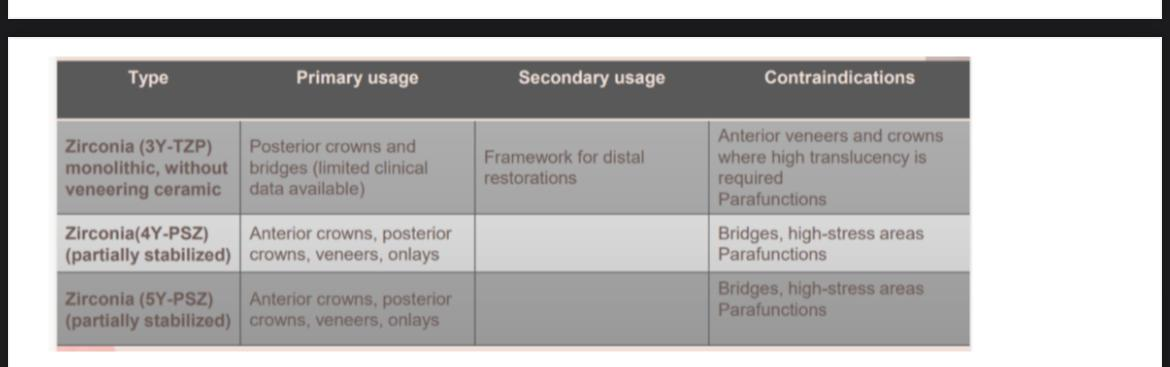
zirconia 3/4/5 - what is each type
what is their primary usage? (each of them)
secondary usage of zirconia 3?
contraindications of each - (reasons no to have this treatment)
How is an alloy defined?
When two or more metals form a solution in the liquid state where their atoms mix randomly.
The type of mixing of the atoms in the solid state determines the presence of a solid solution or mechanical mixture.
When two elements are mixed, the alloy is defined as a binary alloy.
Alloys are named by ordering the elements of which they are composed according to their percentage ratio.
How are alloys classified based on noble metal content?
High noble metal content: At least 40% gold and 60% noble metals.
Noble alloys: Contain more than 25% precious metals.
Non-noble alloys: Contain less than 25% noble metals.
What are the four types of alloys based on mechanical properties?
Type 1 alloys: Soft, used for restorations subjected to low loads (e.g., inlays).
Type 2 alloys: Medium-hard, used for restorations that handle higher loads (e.g., onlays, overlays, crowns).
Type 3 alloys: Hard, used for restorations enduring greater loads (e.g., crowns, bridges up to three units).
Type 4 alloys: Extremely hard or rigid, used for restorations facing high masticatory loads (e.g., multi-unit bridges, partial dentures).
What are the classifications of alloys based on their use?
Alloys for all-metal restorations:
Used when restoration requires full-metal composition.
Chosen for strength and durability.
Alloys for metal-ceramic restorations:
Designed for use with both metal and ceramic materials.
Metal provides strength, ceramic offers aesthetic appeal.
Alloys for partial denture substructures:
Used for the framework supporting artificial teeth.
Selected for strength and compatibility with the oral environment.
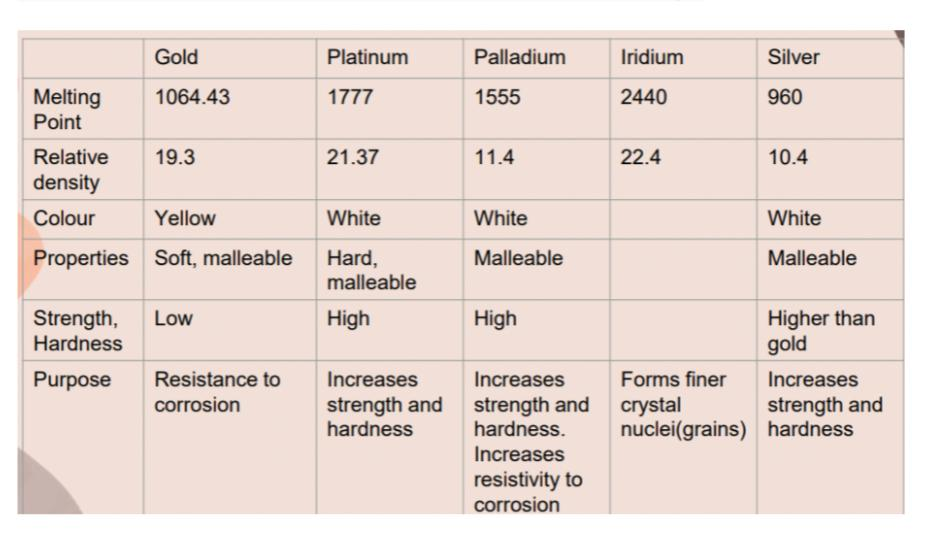
noble alloys - gold, platinum, palladium, iridium and silver melting point
their relative density?
their colour?
properties?
strength/hardness?
purpose?
What is the carat scale and how does it express gold content in an alloy?
Carat scale: Expresses the relative amount of gold in an alloy.
Examples:
24 carat: pure gold
21 carat: 21 parts gold and 3 parts other metals
12 carat: 50% gold
18 carat: 75% gold
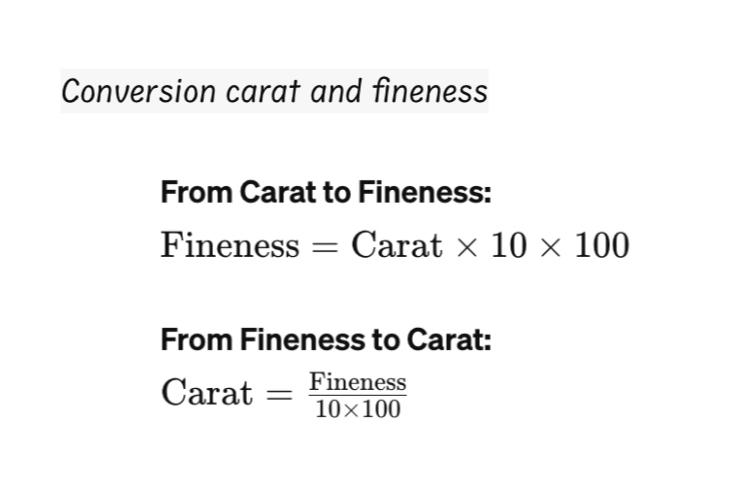
conversion from carat to fineness and vice versa
What is the fineness of gold and how is it represented?
Fineness: Represents the percentage of gold content multiplied by a factor of 10.
Example:
18 carat gold is 75% pure gold, so its fineness is 750.
Usage:
Carat scale: specifies gold content.
Fineness: used with dental gold solders (carat scale not used in dentistry).
How are gold alloys classified based on hardness?
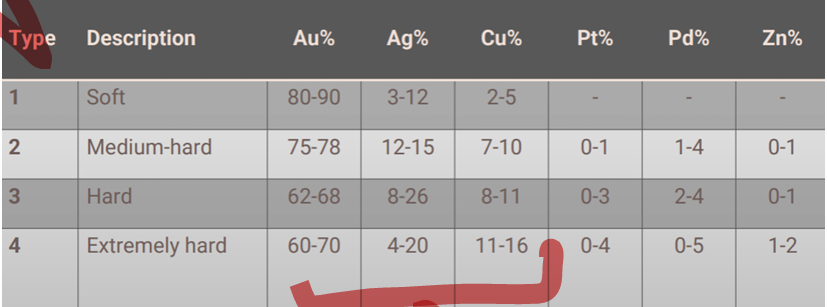
How are gold alloys classified based on color?
yellow gold alloys: Contain insufficient palladium to hide gold color.
White gold alloys: Palladium content above 5%, turning the alloy white; gold remains the main ingredient.
soft, medium hard, hard, extremely hard composostion of gold, silver, copper etc
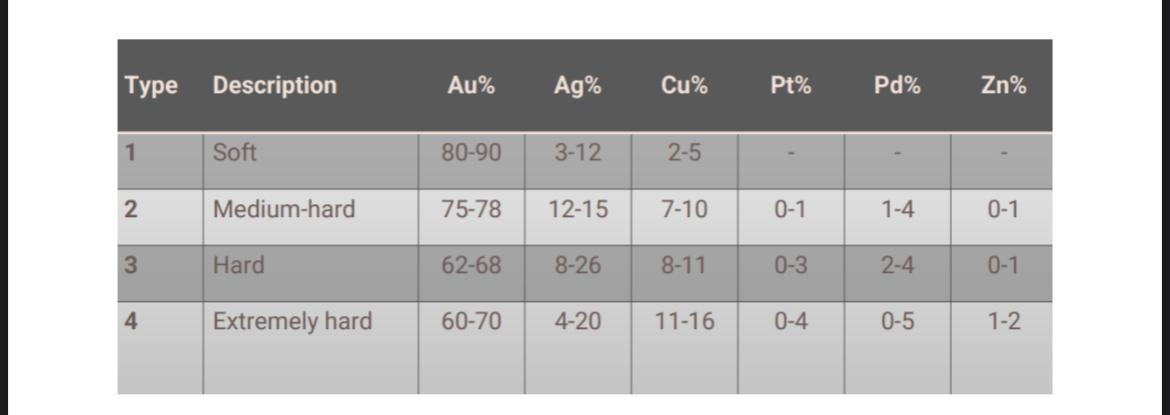
What are the characteristics of pale gold or economic gold alloys?
Gold content: 42-58% - cheaper
Gold replacement: Usually replaced by silver.
Silver-palladium ratio: 3:1 to reduce alloy corrosion.
Mechanical properties: Comparable to Type 3 and 4 gold alloys.
What are the features of precious alloys with minimal or no gold content?
Cost: Cheaper than gold alloys.
Density: Lower, making casting process more difficult.
Silver-palladium alloys: More silver than palladium, 10-15% or no gold, mechanical properties similar to Type 3 and 4 gold alloys.
Palladium-silver alloys: More palladium than silver, 60-80%, some with no gold.
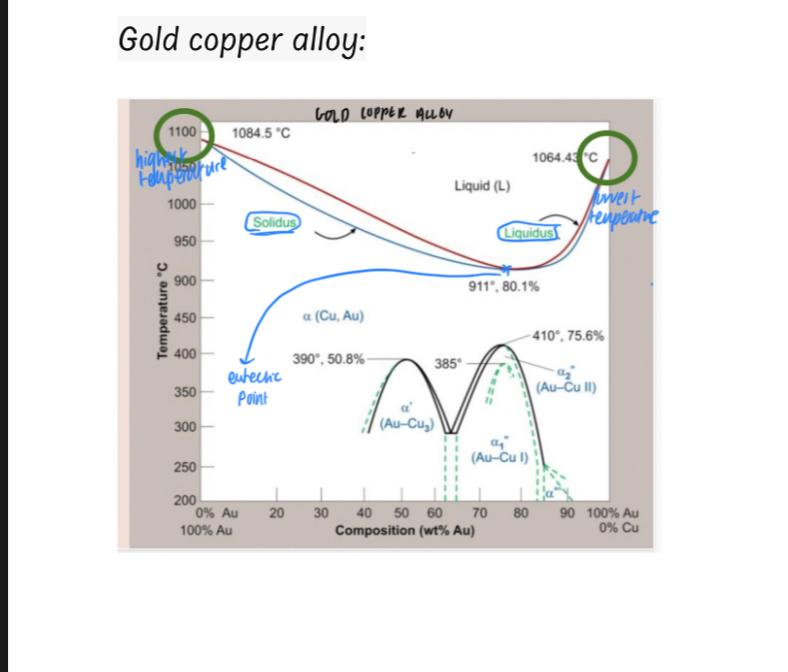
gold copper alloy