Basic Neuro-Muscular Physiology: Muscle Types, Contraction, and Adaptations
 Call Kai
 Learn
Learn Practice Test
 Spaced Repetition
 Match
Match Flashcards
 Knowt Play
1/25

There's no tags or description
Looks like no tags are added yet.
Name | Mastery | Learn | Test | Matching | Spaced | Call with Kai | Chat |
|---|
No analytics yet
Send a link to your students to track their progress
26 Terms
What are the three types of muscle in the body?
Skeletal, Cardiac, and Smooth muscles.

What is the primary function of skeletal muscle?
Allows movement and physical activity.
What type of muscle is responsible for pumping blood?
Cardiac muscle.
Where is smooth muscle primarily found?
In the gastrointestinal tract and blood vessels.
What is the functional unit of muscle contraction?
The sarcomere.

What initiates voluntary muscle movement?
The cerebral cortex, specifically the primary motor cortex (M1).

What is an action potential?
A signal carried by α-motor neurons to the muscle.
What neurotransmitter is released to transmit signals from nerve to muscle?
Acetylcholine (ACh).

What is a motor unit?
A motor neuron and all the muscle fibers it innervates.
What role does calcium (Ca2+) play in muscle contraction?
It causes proteins on actin to move, allowing myosin to bind for contraction.

What are the three types of muscle contraction?
Concentric, Eccentric, and Isometric.
Define concentric contraction.
Muscle shortens while lifting an external resistance.
Define eccentric contraction.
Muscle lengthens while trying to shorten against an external resistance.
What is isometric contraction?
Muscle attempts to shorten but no joint movement occurs.
What is the length-tension relationship?
It describes how active and passive forces relate to sarcomere length.

What does the sliding filament theory explain?
It explains the mechanism of muscle contraction through the interaction of actin and myosin.
What happens during the eccentric phase of the stretch shortening cycle?
Energy is stored as the muscle lengthens.
What is the role of ATP in muscle contraction?
ATP is required for myosin to release from actin after contraction.
What are Type I muscle fibers known for?
They are slow-twitch, more oxidative, and generally smaller.

What are Type II muscle fibers known for?
They are fast-twitch, more glycolytic, and generally larger.
What is muscle hypertrophy?
The radial growth of muscle fibers, making the muscle appear larger.

What is hyperplasia?
The formation of new muscle fibers, which is not common in humans.
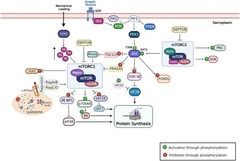
What is the master regulator of muscle growth?
mTORC1.
What is the difference between anabolism and catabolism?
Anabolism is the building of complex molecules, while catabolism is the breakdown of complex molecules.
What adaptations occur in muscles when lifting weights?
Increased motor unit firing rates, recruitment, synchronization, and decreased antagonist co-activation.
What is the significance of muscle protein synthesis (MPS) and muscle protein breakdown (MPB)?
Muscle hypertrophy occurs when MPS exceeds MPB.