Intro to the Skeletal System
 Call Kai
 Learn
Learn Practice Test
 Spaced Repetition
 Match
Match Flashcards
 Knowt Play
1/38

Earn XP
Description and Tags
Anatomy lab exam 1
Name | Mastery | Learn | Test | Matching | Spaced | Call with Kai | Chat |
|---|
No analytics yet
Send a link to your students to track their progress
39 Terms
Functions of the skeletal system
Physical support
Site of attachment for muscles
Protects vital organs
Store red and yellow marrow
Energy metabolism
Mineral and element reservoir
What is the skeleton made up of?
Bones, cartilage joints, and ligaments. It is moved by skeletal muscle attached by tendons
How many bones are in the adult skeleton?
206

Subdivisions of the skeleton
Axial and appendicular

Axial skeleton
Cranium, ribs, vertebra, and midline structures

Appendicular skeleton
Associated with the limbs
Cartilage
Flexible, resilient, mostly water
Resists tension and compression
Three types depending on fibers
Bone
Strong and stiff
Support skeletal system
Protects organs
Store and metabolize minerals
Store red and yellow marrow
Cartilage structre
Made of chondrocytes (cartilage cells) in an extracellular matrix of collagen and fibers

Hyaline cartilage
Costal cartilages, articular joint cartilage, larynx, and trachea

Fibrocartilage
Pubic symphysis, menisci, and intervertebral discs

Elastic cartilage
Epiglottis and ears
Microstructure of bone
Osteocytes
Osteoblasts
Osteoclasts
Osteocytes
90-95% of bone cells
Bone maintainers (trapped in osteoblasts)
Sit in lacunae of osteons
Osteoblasts
Bone builders
Osteoclasts
Bone destroyers
Bone remodeling
Bone is alive and continually undergoes remodeling
Resorption of old and less essential bone is done by osteoclasts
Deposition of new bone in critical areas is done by osteoblasts
New bone replaces old bone with a complete cycle every 7-10 years
Same process allows for healing after injury

Osteon (haversian system)
Structural unit of compact bone
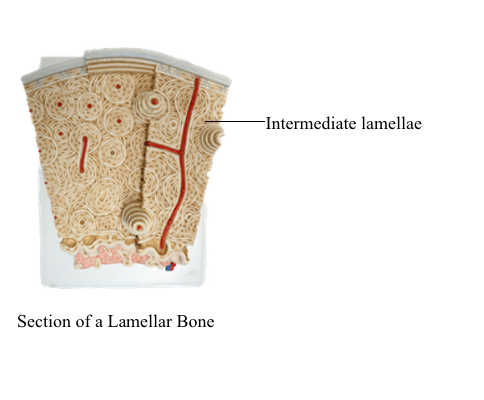
Lamellae
Concentric rings/layers that make up osteons

Central (haversian) canal
Runs through the core of each osteon and provides blood supply

Lacunae
Small spaces between adjacent lamellae where osteocytes live
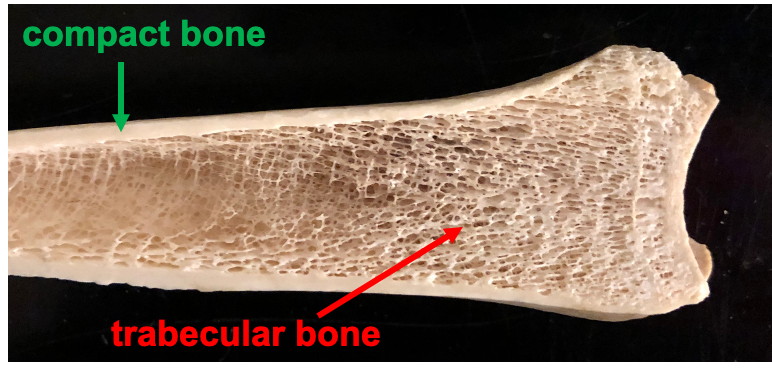
Cortical (compact) bone
Smooth, dense outer layer
Thickest in the diaphysis of long bones

Trabecular (spongy, cancellous) bone
Network of beams of bone
Deep to cortical bone
Spaces filled in by marrow

Parts of a long bone
Epiphysis
Epiphyseal plate (growth plate) > Epiphyseal line
Diaphysis
Articular cartilage
Periosteum
Endosteum
Marrow (medullary) cavity
Articular cartilage
Ossification
Biological process of bone formation or growth
Intramembranous ossification
Most cranial bones and medial parts of the clavicles
Develops in a membrane
Endochondral ossification
Most postcranial bones
Develops from cartilage
Primary center of ossification
Diaphysis
Secondary centers of ossification
Epiphyses
Growth termination of bones
When the centers of ossification in the diaphysis and epiphyses meet (at the epiphyseal plate), longitudinal growth stops.
Foramen
A hole in a bone
Fossa
A flat area or depression in a bone
Process
Projection from bone, narrow or wide
Styloid
An especially long and skinny process
Meatus
A hole or tube like structure
Canal
A groove or tube like structure, a tunnel
Condyle
A knuckle like joint surface of a bone
Head
Round articular end of a bone
Tuber(cle/osity)
Roughened area for muscle attachment