Bio 4A ch 3
 Call Kai
 Learn
Learn Practice Test
 Spaced Repetition
 Match
Match Flashcards
 Knowt Play
1/63

There's no tags or description
Looks like no tags are added yet.
Name | Mastery | Learn | Test | Matching | Spaced | Call with Kai | Chat |
|---|
No analytics yet
Send a link to your students to track their progress
64 Terms
Functional groups are all
all hydrophilic and reactive except methyl
what are the 4 major macromolecules
carbohydrates
lipids
protiens
nucleic acids
monomers
subunits of macromolecules
polymers
monomers linked together via covalent bonds
dehydration synthesis
2 molecules of glucose are linked to form the disaccharide maltose
process of forming polymers from monomers
water molecule is formed since the 2 monosaccharides are covalently bonded
hydrolosis
process of breaking polymers down into individual monomers
add water molecules to break down polymers into their monomeric subunit
whats the difference between dehydration sysnthesis and hydrolisis
dehydration
BUILDS larger molecules from smaller building blocks
require energy for forming bonds
byproduct is water
hydrolosis
BREAKS down larger molecules into monomers
releases energy from breaking bonds
reactant is water + molecule you’re breaking down
enzymes
biological molecules that catalyze or “speed up” reactions like dehydration and hydrolysis
specific ones exist for each macromolecule
end in “-ASE”
carbohydrates
provide energy to the body in the form of glucose
found in grains, fruits, and vegatbles
what are the three main subtypes of carbohydrates
monosaccharides
disaccharides
polysaccharides
monosaccharides
can be linear or ring
alpha or beta positions
What are the bonds between monocaccharides called?
glycosidic bond
what are the three structural isomers of a hexose monosaccharide
glucose - important source of energy
galactose -milk/sugar
fructose - fruit
glucose, galactose, and fructose are all geometrical isomers T/F
False → they are structural isomers
disaccharide
form when 2 monosaccharides are linked in a dehydration reaction
two monomers joined by glycosidic bond
water is released
EX: maltose, lactose, sucrose
polysaccharides
long chain of monosaccharides joined by glycosidic linkages
branched or unbranched
EX: starch, glycogen, cellulose, chitin
chitin
exoskeleton of arthropods is composed of the polysaccharide chitin
nitrogen is foiund in it that’s not found in the other types of carbohydrates
Ribose are also known as
pentose
lipids
diverse groups of nonpolar hydrocarbons (hydrophobic)
what are 4 funcitons of lipids
long-term energy stores
provide insulation ffrom enviornemnt for plants and animals
building blocks for some hormones
important component of cellular membranes
what are some types of lipids
fats
oils
waxes
phospholipids
steroids
what are 2 main components of fats
glycerol
fatty acids
Triacylglycerol
formed by joining 3 fatty acids to a glycerol backbone through an ester linkage
What are the components of triglycerides?
1 glycerol + 3 fatty acids
saturated fatty acid
no double bonds
tightly packed at room temperature
butter
unsaturated fatty acid
1+ double bonds
monosaturated fat = 1 double bond
polysaturated fat = 1+ double bond
Not tightly packed because double bonds cause a kink
oils
Cis fats
H on same side
kink in chain
can’t be packed tightly → liquid
trans fats
H on opposide side
no kink
essential fatty acids
required but not synthesized from body so has to come from diet
waxes
long fatty acid chains linked to long chain alcohols
hydrophobic
phospholipids
molecule with 2 fatty acids and modified phosphate group attached to a glycerol backbone
head = hydrophilic
1 glycerol group
1phosphate group
tail = hydrophobic
one tail has kink (unsaturated)
one tail is straight (saturated)

phospholipids are major constituents in what
plasma membrane
steroids
ring structure
hydrophobic (nonpolar)
cholesterol is the most common one
synthesized is liver
what are 4 functions of steroids
Plasma membrane fluidity
Precursor to hormones like estrogen and testosterone
Precursor to vitamin D
Precursor to bile salts
what are 6 functions of proteins
Regulatory functions
Structural functions
Protective functions
Transport
Enzymes
Toxins
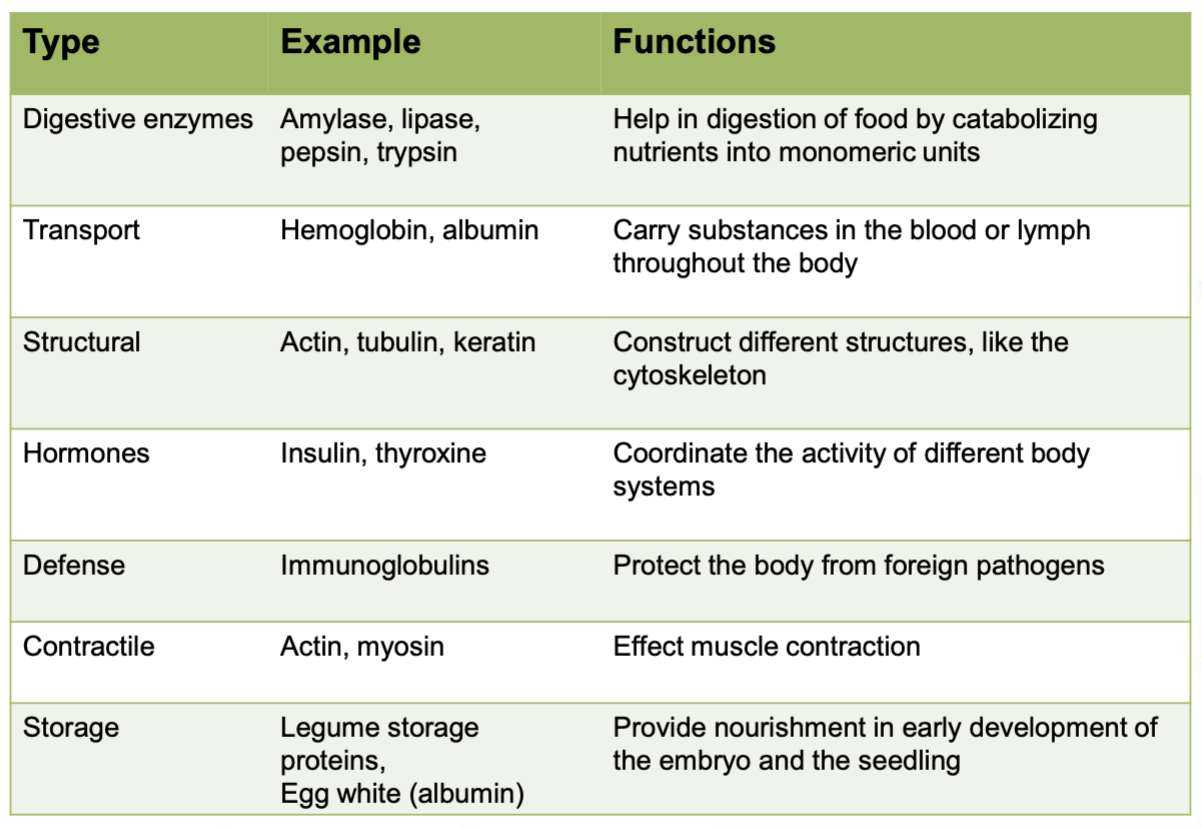
what are 3 types of enzymes and their function
catabolic → breakdown substrates
anabolic → build more complex molecules
catalytic → affect the rate of reaction
amino acids
monomers that make up proteins
represented by a single uppercase three letters or letter
EX: Valine = Val or V
whats the number of amino acids commonly found and how much of that are essential
20
9 are essential
What type of bonds link amino acids together to form polypeptide chains?
peptide bond (dehydration synthesis reaction)
polypeptide
chain of amino acids joined together in peptide linkages
protein
a polypeptide or multiple polypeptides
protein shape is based on what 4 levels of structure
primary structure → linear sequence of amino acids linked by peptide bonds
secondary structure → formation of alpha and beta-plated sheets
tertiary structure → 3D shape
quaternary structure → multiple polypeptide chains
primary structure
unique sequence of amino acids in a polypeptide
amino acid sequence is based upon gene encoding that protein
a change in nucleotide sequence of DNA could lead to a change in amino acid and lead to change in protein structure and function
EX: sickle cell anemia
secondary structure
local folding of the polypeptide; folding is a result of H bonds
alpha helix
beta-pleated sheet
tertiary structure
the unique 3D structure of polypeptide
due to interactions between R groups on amino acids
quaternary structure
interactions between several polypeptides that make up a protein
all 4 bonds are possible
denatureation
changes in protein structure that lead to changes in function
can be reversible or irreversible
can be due to changes in pH or temperature
nucleic acids
constitute the genetic material of living organisms
what are the 2 types of nucleic acids
DNA
RNA
what are 4 locations of nucleic acids
Nucleus of eukaryotic cells
Mitochondria
Chloroplasts
Prokaryotic cells (not membrane enclosed)
Prokaryotes keep their DNA inside the nucleolus T/F
false
chromosomes
unit of DNA
contains chromatin
chromatin
complex of DNA and histone proteins (in eukaryotic cells)
what is the main role of RNA
protein synthesis
what are the 4 types of RNA
Messenger RNA (mRNA) – a nucleic acid that leaves the nucleus and contains blueprint for protein synthesis (transcription)
Transfer RNA (tRNA) – a bridge between nucleotides and amino acids (translation)
Ribosomal RNA (rRNA) – assists in protein synthesis
microRNA (miRNA) -
FIRST 3 ARE USED IN PROTEIN SYNTHESIS
DNA and RNA consist of monomers known as what
nucleotides
what are the 3 parts of nucleotides (familiarize)
nitrogenous base
pentose sugar
1+ phosphate group
what are the 2 types of nitrogenous bases
pyrimidines (CUT)
cytosine, thymine, uracil
purines (AG)
adenine, guanine
what are the 2 types of pentose sugars
deoxyribose (found in DNA)
ribose (found in RNA)
what are the bases in DNA and RNA
DNA → A, T, G, C
RNA → A, U, G, C
Example of transcription in DNA
5’ C G A T 3’
3’ G C T A 5’
what 2 things make up ribosomes
proteins
rRna
key features of DNA and RNA

DNA → RNA → Protein
DNA → RNA (TRANSCRIPTION)
RNA → Protein (TRANSLATION)