CH 4 Purdue University BCHM 307 Biochemistry
 Call Kai
 Learn
Learn Practice Test
 Spaced Repetition
 Match
Match Flashcards
 Knowt Play
1/29

There's no tags or description
Looks like no tags are added yet.
Name | Mastery | Learn | Test | Matching | Spaced | Call with Kai | Chat |
|---|
No analytics yet
Send a link to your students to track their progress
30 Terms
Amino and carboxyl
Two functional groups of an amino acid that are ionizable
Nonpolar, polar charged, polar uncharged
Three categories for amino acid R groups
Nonpolar
Hydrophobic amino acid R groups
Polar
Hydrophilic amino acid R groups
Glycine
Smallest amino acid
Functional moieties
Amino acid R group that is isomerized to another molecule, but behaves the same
Protein
What can be determined by UV light absorption of tryptophan
Proline
Only amino acid whose side chain loops back onto its own backbone. Induces non-rotational kinds in a polypeptide sequence

Polar
Polar/nonpolar amino acids are found on active sites of enzymes as catalysts
Disulfide bonds
Bonds between sulfur groups that link methionine and cystine residues
Serine and threonine
Two amino acids that have hydroxyl groups that assist in hydrogen bonding and are prominent nucleophiles
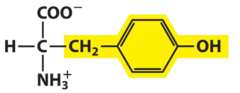
Tyrosine
Amino acid derivative of phenylalanine that has a polar uncharged R group. Common in neurotransmitters
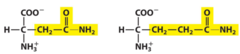
Asparagine and glutamine
Two amino acids that contain polar uncharged R groups
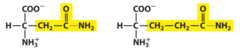
Histidine
Amino acid with a polar uncharged R group. Has a five membered ring system that can be charged at certain pH values

Lysine and arginine
Two amino acids with positively charge polar R groups and long side chains with a positively charged amino group

Aspartate and glutamate
Two amino acids with negatively charged polar R groups that have carboxylate groups

Condensation reaction
Chemical reaction that links amino acids via peptide bonds to create amino acid residues
Polypeptide
Chain of amino acids that has not reached it fully functional form to become a protein
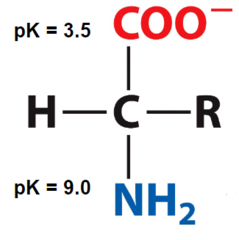
Protonated
Protonated/deprotonated/neutral at pH < 3.5
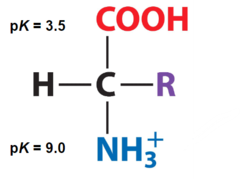
Neutral
Protonated/deprotonated/neutral at pH > 3.5 and < 9.0

Deprotonated
Protonated/deprotonated/neutral at pH < 3.5
Primary
Protein structure: Sequence of amino acids
Secondary
Protein structure: Localized conformation of polypeptide backbone
Tertiary
Protein structure: Three dimensional structure of an entire polypeptide, including all its side chains
Quaternary
Protein structure: Spatial arrangement of polypeptide chains in a protein with multiple chains/subunits
Alpha helix
Secondary structure that forms from hydrogen bonding between carbonyl O and amino H in the same molecule
Beta sheet
Secondary structure that forms from hydrogen bonding between carbonyl O and amino H in molecules that are adjacent
Parallel
Beta sheet formation that has amino groups all pointing in the same direction
Antiparallel
Beta sheet formation that has amino groups pointing in different directions
Hydrophobic effect
What primarily drives the formation of tertiary structures