special senses
 Call Kai
 Learn
Learn Practice Test
 Spaced Repetition
 Match
Match Flashcards
 Knowt Play
1/69

There's no tags or description
Looks like no tags are added yet.
Name | Mastery | Learn | Test | Matching | Spaced | Call with Kai | Chat |
|---|
No analytics yet
Send a link to your students to track their progress
70 Terms
what comprises the outer fibrous layer of the eye?
the sclera, the cornea, and the aqueous humor
what is the function of the sclera
helps keep the eye anchored inside of skull
what is the structure of the sclera?
on the posterior portion of the eye, also known as the white of the eye
what is the structure of the cornea
on the anterior portion of the eye, transparent
what is the function of the cornea?
light enters through the cornea
what is the structure of the aqueous humor?
fills the space between the cornea and the lens
what comprises the middle layer of the eye?
choroid, ciliary body, iris, pupil, lens
what is the structure of the choroid
wraps around to the posterior portion of the eye, darkly colored, highly vascular
what is the function of the choroid?
supplies blood to the eye
what is the structure of the ciliary body?
on anterior surface of the eye, attaches to lens
what is the function of the ciliary body?
allows shape of lens to change, allows for focus
what is the structure of the iris?
colored part of the eye!
what is the function of the iris?
controls the amount of light that enters the pupil, contracts and dilates based on environmental light
what is the structure of the lens?
posterior to the iris and pupil, ciliary body attaches all around lens
what comprises the inner sensory layer?
the retina!
what is the structure of the retina?
on the posterior of the eye, directly behind ciliary body. contains photoreceptors called rods and cones.
what is the function of the retina?
contains rods and cones that allow for images to be seen!
what is the function of a rod?
sensitive to dim light, does not generate sharp or color images
what is the function of a cone?
operate in bright light, help detect color images
what is the structure of the vitreous body?
deep to the retina, posterior to the lens. chamber filled with vitreous fluid
what is the function of the vitreous body?
hold retina firm and flush to the choroid
what is the nasal visual field?
overlapping left and right visual fields closest to the nose that allows for 3d vision
what is the peripheral visual field?
the lateral side of each eye
what is the left visual field?
the left side of the visual field from each individual eye, interpreted by the right side of the brain
what is the right visual field?
the right side of the visual field from each individual eye, interpreted by the left side of the brain
what would damage to the right occipital lobe result in?
visual impairment of left visual fields of both eyes!
what would damage to the right optic nerve result in?
damage to both visual fields of the right eye
what is the visual pathway, from environment to brain?
cornea, posterior surface of retina, photoreceptors detect light, optic nerve, optic chiasm, optic tracts, LGN, optic radiations, occipital lobe!
what is the function of the medial rectus?
turns eye medially
what nerve innervates the medial rectus?
CN III (oculomotor nerve)
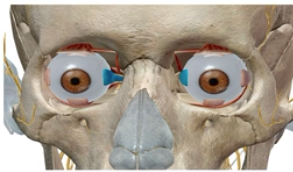
medial rectus
what is the function of the inferior rectus?
depresses eye, moves eye medially
what nerve innervates the inferior rectus?
CN III (oculomotor nerve)
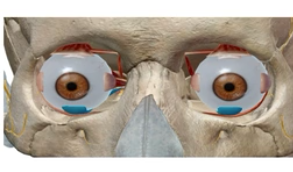
inferior rectus
what is the function of the superior rectus?
elevates eye, moves eye medially
what nerve innervates the superior rectus?
CN III (oculomotor nerve)

superior rectus
what is the function of the superior oblique?
internal rotation, depresses eye, moves eye laterally
what nerve innervates the superior oblique?
CN IV (trochlear nerve)
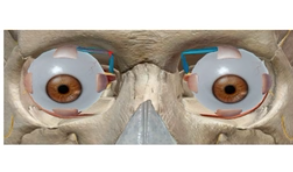
superior oblique
what is the function of the inferior oblique?
elevates eye, moves eye laterally, external rotation
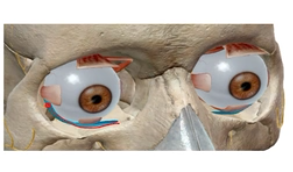
inferior oblique
what is the function of the lateral rectus?
turns eye laterally
what nerve innervates the lateral rectus?
CN VI (abducens nerve)
what nerve innervates the inferior oblique?
CN III (oculomotor nerve)
What is cataracts?
lenses slowly harden and become cloudy over time. vision is blurry
what is an example of abducens nerve damage?
double vision!
what is diplopia?
double vision
true or false: if a patient’s abducens nerve is damaged, the eye will be able to rotate laterally
false!
what is the function of the external ear?
to funnel sound waves into the ear
what is the structure of the external ear?
composed of elastic cartilage and covered with skin
what is unique about the lobule on the external ear?
lacks cartilage
what is the structure of the external acoustic meatus?
tunnel between auricle and the tympanic membrane, lined with hairs and ear wax
what is the structure of the tympanic membrane?
thin membrane of connective tissue, ear canal terminates here
what is the function of the tympanic membrane?
transmits sound energy to the middle ear
what is the structure of the middle ear?
air filled chamber with three bones
what is the function of the middle ear?
the malleus receives vibration from the tympanic membrane and conducts them to the inner ear
what is the structure of the inner ear?
two fluid filled labyrinths, one bony and one membranous
what does the bony labyrinth contain?
the cochlea, and the membranous labyrinths
what does the membranous labyrinth contain
the utricle and saccule, tiny bones that help with balance
what cranial nerve is found in the inner ear?
CN VII, facial nerve
what is the function of the facial nerve in the inner ear?
innervates stepedius, controls intensity of sounds
what is the structure of the vestibular system
three fluid filled semicircular canals
what is the function of the vestibular system
fluid filled canals have equilibrium receptors that have action potentials in response to different head rotations or movements
what is the structure of the cochlea?
spiral bony chamber, houses organ of corti, ends at the cochlear nerve
what is the structure of the organ of corti?
contains a tectorial membrane, which stereocilia attach to, vibrations move the stereocilia, which initiates an action potential which is carried through the cochlear portin of CN VIII
what are the steps of the hearing pathway?
cochlear nerve, primary auditory cortex of the temporal lobe
true or false → sound pathways cross to opposite side of the brain only
false! sound is duplicated and send to the left and right sides of the brain
what is conduction deafness?
damage to outer or middle ears, which causes partial deafness
what is nerve deafness?
damage to the nervous pathway, can be partial or complete