NCSU ANS 150 Final Exam
 Studied by 0 people
 Call Kai
 Learn
Learn Practice Test
 Spaced Repetition
 Match
Match Flashcards
 Knowt Play
1/568

There's no tags or description
Looks like no tags are added yet.
Name | Mastery | Learn | Test | Matching | Spaced |
|---|
No study sessions yet.
569 Terms
importance of animals (to humans)
nourishment, companionship, human health, and income
developed country
they are meeting the daily nutritional requirements for both calories and protein
developing country
they are only meeting one of the daily nutritional requirements (calories or protein)
underdeveloped countries
they are not meeting either of the daily nutritional requirements (calories or protein) and are therefore malnourished
food desert
a person's access to unprocessed food. people are described as living in one of these if they live more than a mile away from a grocery store/supermarket and do not have access to a car/transportation
companionship
approximately 62% of family units in the US have at least one "pet"; pets were once considered "property" by owners, but now they are viewed as companions.
homeopathy
natural or alternative treatment of medical problems. animals can be used to aid in rehabilitation and therapy of people.
retrospective data
data based upon people's reports of past experiences and events; NEVER establishes cause and effect
prospective data
information collected by following the participant's behavior or reaction forward in time; determines cause and effect
gross income generated
the selling of animals or animal products (measurable)
economic impact factor
estimates economic value of businesses that are needed to support production; i.e. veterinarians, feed manufacturers
total economic contributions
(gross income) + (gross income x economic impact factors) =
US
leader in animal science
importance of animal behavior
provides important signals/cues related to animal well-being, biological changes, and management conditions
behavioral mechanism
how an animal knows or learns to perform a specific behavior
biological need
what the animal gains from the behavior
instinct
(mechanism) behaviors that are inherently present at birth; the animal does not have to learn them; usually controlled by biological changes within the animal
imprinting
(mechanism) poorly understood mechanism by which young animals bond to their caretakers - usually their mother
habituation
(mechanism) lack of a response to a repeated stimulus; learned behavior; NOT a habit
conditioning
(mechanism) association between a behavioral response and a given stimulus; given stimulus can be positive (reward) or negative (punishment); there is a third party
trial and error
(mechanism) trying various responses to a stimulus until a reward is received; animal initiates responses or trials
reasoning
(mechanism) ability to respond correctly to a stimulus the first time it is applied; not common
sexual behaviors
(need) propagation of species; broadcast sexual receptivity; preparation for birth and lactation; pheromones
pheromones
chemicals that both males and females omit to notify the other when there is a female/male around
care-giving behaviors
(need) originate from mother and father; protection, nourishment, and "training" young
care-soliciting behaviors
originate from young mostly; can originate from injured or disabled mature animals; used by young to signify they need assistance
agonistic/social behaviors
behaviors associated with "fight or flight" syndrome or behaviors associated with established social hierarchy within a group of animals; any type of social behavior that is not sexual
feeding behaviors
behaviors associated with obtaining food; mostly associated with animals that require predation or foraging in order to meet nutrient needs; for animals that graze or hunt in packs (feeding naturally)
ways to determine animal intelligence
anatomical approach, vocalizations, comparison of learning rates
anatomical approach
correlation between brain size and intelligence; correlation between intelligence and brain weight to body weight ratio
vocalizations
number and type of vocalizations correlated with animal's intelligence; more vocalizations = smarter; complex vocalizations = smarter
simple vocalizations
one sound (similar to a word)
complex vocalizations
putting multiple sounds together and changing amplification (similar to putting multiple words together to form a sentence)
learning rates
compare --- of species exposed to the same task or test; the test is referred to as Maze Learning
acquisition
you are taught to do something
extinction
you are not asked to do it for a period of time
recovery
test period
behavioral science
attempts to classify how animals respond to various situations; tries to establish or link behaviors with animal well-being
anthropomorphism
giving animal behaviors human-like qualities; a way that humans are biased when determining animal intelligence
monogastrics
stomach has one compartment; humans, pigs, rabbits, horses, birds, etc.
ruminant
stomach has four compartments; cattle, sheep, goats, deer, etc.
carnivore
primarily consumes meat (flesh)
omnivore
normally consumes both meat and plants
herbivore
primarily consumes plants
cereals (kernels)
usually the seed portion of plants (seed portion = grains); corn, oats, wheat, barley, etc.; usually high energy (due to oil content in the grain) with low fiber and no cellulose
roughages or forages
usually the leaves and/or stems of the plant; grass in pastures, hays, silages, many by-products of the milling process; usually low energy/high fiber and contain cellulose and/or lignin
digestion
the process by which feed particles are reduced to molecules so they can enter the body
mechanical action
chewing and gut motility
chemical action
acidic breakdown of food
enzymatic action
biological cleavage of food
absorption
the processes by which molecules are transported from the digestive tract, through intestinal cells; and enter the vascular or lymphatic system
passive diffusion
molecules enter the body without expenditure of energy/goes with the concentration gradient (high to low concentration)
active transport
molecules are transported into body against the concentration gradient which requires energy/concentration is higher in vascular/lymphatic system so it spends energy trying to enter body against the concentration gradient
mouth
mechanical reduction of feed/particle size by chewing; saliva of some species contain amylase (which breaks down starch to simple sugars)
esophagus
transports food from mouth to stomach via peristalsis
peristalsis
wave-like muscle contractions that move food along the digestive tract
stomach
HCl secretion assists with protein breakdown (chemical); gastrin and pepsin are two enzymes that breaks proteins into polypeptides (enzymatic); mechanical activity and anatomical folds help increase surface area of chyme (mechanical)
chyme
mixture of partially digested food with secretions of the stomach; increased surface area of chyme facilitates enzyme action and digestion
small intestines
major site of enzymatic digestion in monogastric animals that are not herbivores; most efficient site of ABSORPTION of nutrients in all animals
cecum
blind pouch between junction of small and large intestines; in monogastrics, it contains microbes and protozoa which break down complex sugars and cellulose (digests forages - leafy portion of plants and grasses)
large intestine
major site of water reabsorption; little digestion and nutrient absorption; "concentrates" undigested feed
rectum and anal sphincter
thick muscular tube (rectumZ); excretion of solid undigested feed
ruminant stomach
4 parts: rumen, reticulum, omasum, abomasum
reticulum
assists with fermentation; contracts to push food back up esophagus to mouth (chewing cud); one unique characteristics is that its inner lining has a "honeycomb" pattern
rumen
contains microbes that digest feed enzymatically and convert it into the products they need
omasum
has many folds (plies) that assist with mechanical digestion
abomasum
same functions as stomach in non-ruminants
poultry and other fowl
very unique modifications of digestive tract; no teeth, thus feed must be finely ground or birds will reduce particle size by pecking with their beaks or scratching with their feet
crop
modification of the esophagus where feed can be stored and limited enzymatic digestion by microbes takes place
proventriculus
HCl and gastric enzymes digest feed but there is limited mixing due to gastric movements
gizzard
reduces the particle size of the feed
cloaca
common exit of the urinary, digestive, and reproductive systems
monogastric herbivores
digestive tract and functions identical to other monogastrics;
cecum is usually much larger and more active than those found in carnivores and omnivores; cecum contains same micro-organisms as found in rumen
practical aspects of nutrition
nutrient requirements, diet content, and nutrient intake (feeding levels)
History of Dogs
• Bones of wolves and humans were found together in North China (300,000 years old) and in Kent, England (400,000 years old)
• Domesticated about 12,000 years
ago (~10,000 B.C.) near Germany
• Wolves or Jackals were "precursors" to the modern dogs
• Domesticated for companionship •Distinctive breeds of dogs probably
were not present until 3,000 to 4,000
years ago
• By the Roman Empire, it is believed
that most of the main breeds of dogs
were intact and well defined
Dog Terminology
• Bitch - female
• Stud - intact male
• Puppy - young dog of either sex
• Whelping - parturition (birth process)
• Spaying - ovariohysterectomy
Estrus & Estrous Cycle Dogs
• Duration of estrus
average - 9 days
range - 3 to 21 days
• Estrous cycle length
average - 183 days, but
extremely variable
• Influenced by breed
Breeding For Dogs
• Stud has an os penis
• Os penis is a small bone is the bulbus
glandis (head of penis)
• Because of the os penis, penetration
is achieved without erection
• Once the penis is inside of the vagina, erection occurs which results in the "tie"
• The tie occurs when the portion of the penis with the os penis engourges with blood and swells to a size so large that it is firmly locked within the vagina
Canine Breeding Myths
• The tie is not essential for pregnancy.
• Ties break spontaneously.
• Throwing water on either dog doesn't really help.
Abnormalities Dogs
• Pseudopregnancy (False Pregnancy)
• It has been estimated that 50 to 75%
of intact bitches will show signs of
pseudopregnancy at some point in
their life.
• It is believed that pseudopregnancy is a "normal abnormality" left over from canine ancestors.
• In wild herds of canines,
pseudopregnant bitches nurse
puppies from the alpha female or
from bitches that died during whelping
History of Cats
• Pre-historic ancestors of cats were
the saber-tooth tigers.
• 35 million years ago Saber-tooths
were widespread in Europe, Asia,
Africa and North America.
• Oldest fossils that show similarities
to today's modern small cats are 12
million years old.
• Domestication of cats probably
started in ancient Egypt 6000 years
ago (~ 4000 B.C.) for religious
reasons and companionship.
History of Cats pt 2
• African bush cat probably was the
wild ancestor of modern cats
• Around the middle of the 19th
century (mid 1800's), the concept
of breeds was born and owners
began to keep ancestry records
(pedigrees).
Cat Terminology
• Kittens - young cats or either sex
• Queen - female cat
• Tom - male cat
• Queening - birth process
• Calling - sound queen makes that
is associated with mating
Estrous Cycles Cats
• Cats are induced ovulators.
• They will not ovulate during estrus
unless they are bred by a tom.
• Estrous cycles of unmated queens
are 13 to 15 days on the average,
but can range from 10 to 22 days.
Breeding for Cats
• Tom has spurs on his penis
• The spurs help stimulate the vagina
and cervix during mating which is
critical for induced ovulators.
Induced Ovulators
• Most have nerves that run directly form the vagina and cervix to the brain.
• Once the vagina and/or cervix is
stimulated, then nerves send signals to the brain that result in the release of LH
• Ovulation in most can be induced at
any time.
• However, they do have periods in
which mating will likely not result in a
pregnancy and periods in which it will.
Auditions - Dogs
Bark
• Territorial call for most dogs
• Dogs will alter tone and amplitude
of bark to mean different things
- a trait that has been selected for by humans during domestication
Whine
• Care-soliciting (signifies pain, fright, or mild frustration)
Growl
• Aggressive or distance-increasing call of dogs
Howling
• Has not been deciphered well
• It probably is how dogs really
communicate verbally with each other
Postures - Dogs
• Dogs use tail, face, ears, mouth and hair to convey moods and emotions
• They also use the position of their body (standing or lying)
Neutral
- tail down
- ears down
- standing upright
Aroused / Interested
- tail up
- ears up
- standing upright on toes or with a front leg raised
Play Soliciting
- tail up and wagging slightly
- ears erect
- standing upright and moving or gesturing slightly with front paws
Active Greeting
- tail wagging over a wide range
- ears erect
- more exaggerated motion with front paws
Aggression
- tail up
- ears erect
- weight on front feet
- exposed teeth
Fear
- tail tucked
- ears back and down
- weight on rear feet
- exposed teeth
Submissive
- tail tucked
- ears back and turned down
- crouching on all four legs or rolled over to expose belly
Auditions - Cats
• Cats have a large vocabulary of
"pure sounds"
• These can be combined into a
large variety of "complex" calls
Pure Sounds
Murmur - soft noise when exhaling;
requesting or greeting
Purr - soft, buzzlike sound; most
commonly used in social situations
Growl - harsh, low-pitched; agonistic
encounters
Squeak - high pitched raspy sound;
playing, greeting, anticipation of
pleasant stimuli
Shriek - loud, harsh high pitched
sound; pain or aggressive situations
Hiss - agonistic sound produced when mouth is open and teeth are exposed; most often associated with defensive aggression
Spit - short, sound after or before a
hiss; agonistic situations
Complex Calls
Mew - high pitched, medium amplitude sound that sounds like a “long e”; mother/kitten interactions
Moan - low frequency and long
duration sound that sounds like an “o”
or “u”; begging to be released or is
used when the cat wants to do
something, but is being restrained.
Meow - characteristic feline sound;
usually used as a greeting
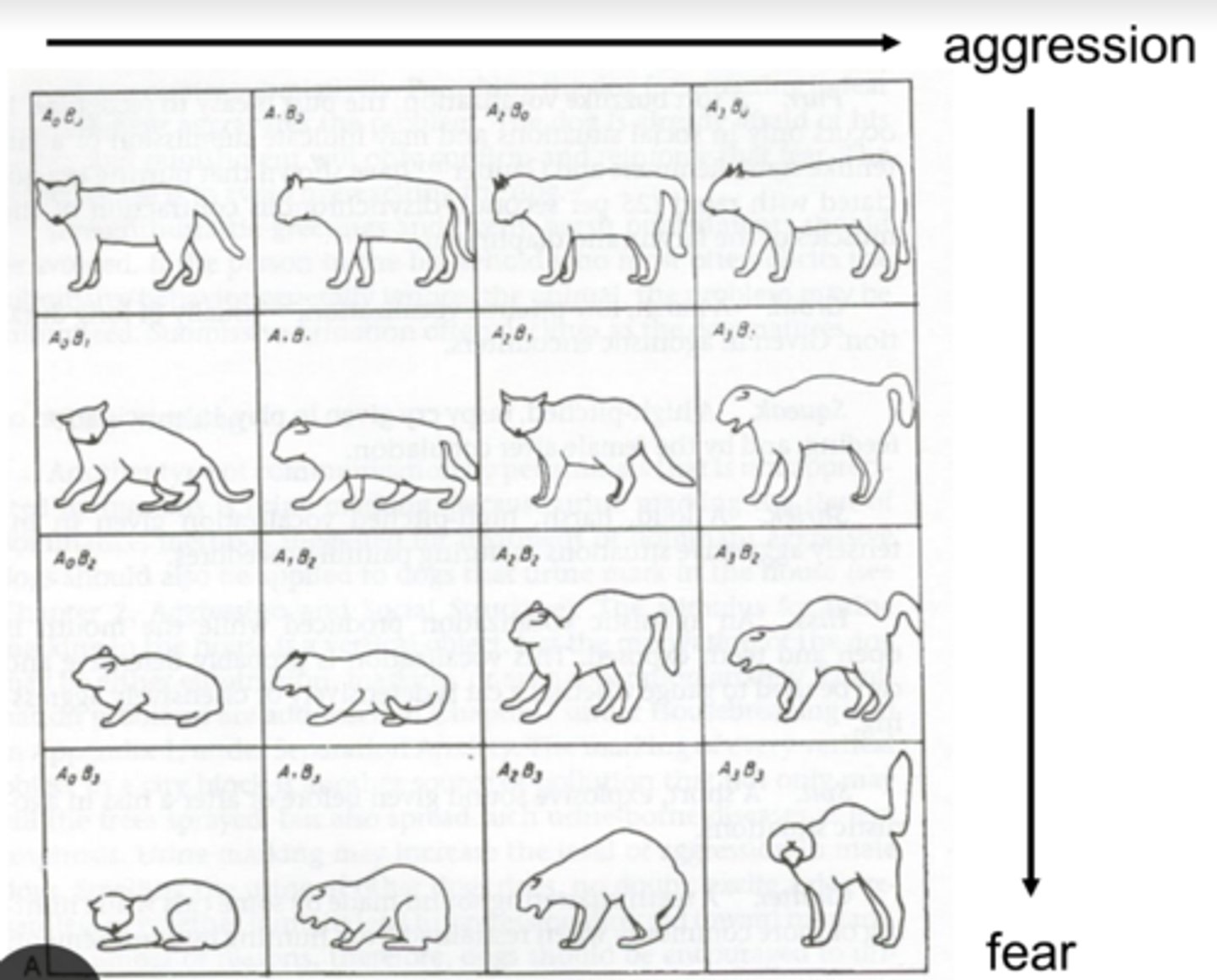
Postures Cats
• Cats use tail, face, ears, mouth and
hair to convey moods and emotions,
but have more variations than dog
• Instead of lying positions (that dogs
use), they use crouching positions
In general
• tail is high when greeting or investigating
• tail is low and the tip is wagging
when hunting
• walking on tiptoes;
• head lowered;
• back arched;
• hair raised; and
• mouth open with teeth exposed
are usually signs of aggression
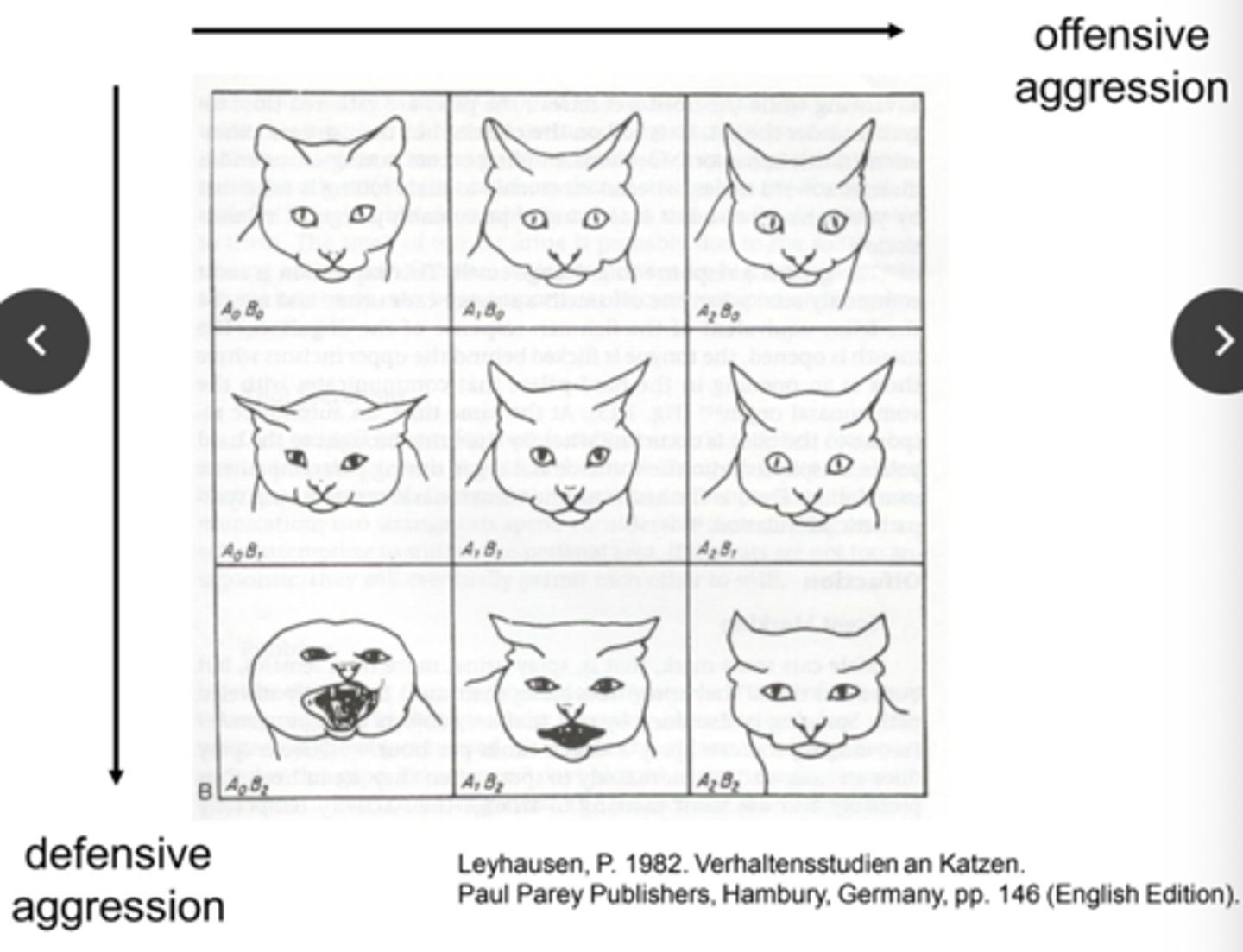
Facial Expressions Cats
Size of pupils also convey
information about a cats emotions
- small pupils (constricted)
signify aggression
- large pupils (dilated) signify that
the cat is becoming more
defensive (threatened)
Destructiveness - Dogs
Destructiveness in Dogs appears
to be increasing and may be
related to:
• increased number of young
owners; and
• decreased contact during the day
between dogs and owners.
Contributing Factors
• Breed
• Boredom
• Separation Anxiety
• Barrier Frustration
Destructiveness in Cats
Occurs at a much lower frequency
than in dogs and seems to be in
one of the following areas:
clawing
• Usually related to territorial
aggression
• Can be stimulated by the presence
of novel cats, novel pets, and novel
people
wool sucking (Long-haired cats)
• Poorly understood phenomenon,
but some people think that it may
be related to being weaned too
early
• Fasting seems to increase the
behavior and the presence of food
(dry bones, etc.) seems to
decrease the behavior
plant eating
• This is really poorly understood
• Most of the time the best solution is
to try and get the cat to eat plants
that aren’t toxic to it
Rabbits History
• Originally classified as Rodents (order = Rodentia)
• Presently, they are placed in their own order called Lagomorpha
• Rabbits have 4 upper incisor teeth (one pair is stacked behind the second), whereas rodents only have 2 upper incisor teeth.
• Fossil remains of rabbit-like animals
date back 30 to 37 million years.
• Fossils are very similar to skeletons of modern day wild rabbits and hares.
Rabbit History pt 2
• First recorded reports of rabbits were made
by Phoenician traders that visited Spain
around 1100 B.C. (~3000 years ago)
• Phoenicians probably were responsible for
transporting rabbits to most part of the world.
• Domestication of rabbits is credited to French Monks during the Middle Ages.
• The latter portion of the 19th century
was when rabbits were introduced into Australia and New Zealand.
Classifications of Breeds
• About 45 different breeds recognized by rabbit breeders.
• These are divided into 5 classifications based on size or weight.
• Dwarf (Miniature), Small, Medium,
Large, and Giant
Rabbit Terminology
• Buck - adult male
• Does - adult female
• Young - kits or bunnies
• Kindling - birth process in rabbits
• Neutering is recommended for all
females kept as pets due to high
incidence of uterine cancer.
Rabbit Lifestyle
• Lifespan - 5 to 12 years
• Puberty - 5 to 8 months
• Induced ovulators with no consistent
estrous cycle
• Gestation - 30 to 34 days