CHEM131 - Unit 1
 Call Kai
 Learn
Learn Practice Test
 Spaced Repetition
 Match
Match Flashcards
 Knowt Play
1/258

There's no tags or description
Looks like no tags are added yet.
Name | Mastery | Learn | Test | Matching | Spaced | Call with Kai | Chat |
|---|
No analytics yet
Send a link to your students to track their progress
259 Terms
What accurately describes the scientific method?
It guides discoveries; if you’ve ever seen something going on and asked yourself why + formulated own answers and found ways to verify them
What is the scientific method?
A series of steps applied to find answers to the questions about the world around us
What is true of the scientific method?
The order in which we apply the steps may vary, but it is important to apply all the steps to reduce the impact of personal bias, leading to results that are trustworthy
What are the six steps of the scientific method?
Observation, question, hypothesis, experiment, analysis, and conclusions and reporting
What accurately describes observation in the scientific method?
It can involve looking around and observing things as you note when you can’t readily explain something, such as observing a plant on a windowsill is taller than the plant in a bedroom
What accurately describes questioning in the scientific method?
Attempting to establish the how and why, such as asking, “Why do two plants have different growth rates?”
What accurately describes a hypothesis in the scientific method?
Background research on existing knowledge should be conducted, it should suggest a cause-and-effect relationship (testable), and it should fuel a prediction in the form of an if-then statement
As a formalized hypothesis has a tentative relationship stated, what is the relationship in this example: “If I play the lottery, then I will get rich”
the frequency of winning and frequency of buying lottery tickets
What is an example of a formalized hypothesis
“If I increase the number of tickets I buy, then my chances of winning will increase”
What accurately describes an experiment in the scientific method?
It involves procedures for testing a hypothesis (list step by step), identifying the dependent and independent variables, isolating the cause of the phenomenon, maintaining impeccable records, and running an experiment while gathering results
What is an experiment?
A controlled procedure designed to test a hypothesis, where on variable is changed (independent variable) and the response of another variable (dependent variable) is measured; they must be repeatable with detailed records
What are the procedures and material in an experiment?
The steps you take to complete the experiment, and the things you need to complete your experiment
What are the independent variables in an experiment?
The variable (or condition) that is changed during the experiment to test the hypothesis
What are the dependent variables in an experiment?
The variable that responds to the changes in the independent variable and is observed/measured during the experiments
What are the constants/controlled variables in an experiment?
Variables that are not changed in the experiment; these are those in addition to the independent and dependent variables
What is an experimental group?
The group that is exposed to the changes
What is a control group?
The group that is not exposed to changes and serves as a baseline
What is an inference?
A judgement based on observations; it is an opinion and must be avoided during data collection
What is data?
The information gathered during an experiment and may include drawings, written observations, photographs and measurements
What is true of analysis in the scientific method?
It involves examining and organizing the data collected to either confirm or fail to confirm the hypothesis; organizing the data into graphs or charts, using calculations to best estimate results, and analyzing results to determine how the independent variable affected the dependent
What is true of conclusions and reporting in the scientific hypothesis?
It involves accepting or refuting the hypothesis; utilizing statistical analysis to formulate conclusions, repeated experiments until hypothesis is fully accepted, and inconclusive results if it fails to either confirm or refute the initial hypothesis
What does it mean to report findings?
Reporting research to scientific journals or at conferences to contribute to the understanding of the world around us while allowing others to build upon conclusions
What are the two types of formats in which findings are reported depending on the venue?
In the form of a paper when in a scientific journal and in the form of a poster when in a science fair
When may parts of the scientific method be repeated to further research?
If data has failed to confirm the initial hypothesis or when there are various potential answers to the question
“If I take a vacation, then I will be happier” is a poor example of a hypothesis because:
Both B and C
Name a variable that is changing during the experiemnt
Independent variable
Name for a variable that stays exactly the same during the experiment
Controlled variable
Name for the variable that is measured during the experiment
Dependent variable
Which of the following is false about the scientific method?
Steps must be applied in order
A hypothesis:
All of the below
Robert wants to see how sunlight affects plant growth. He takes two different types of plants. He puts one of them in sunlight for six hours a day. After a week he measures the plants. What is the problem with Robert’s experiment?
His constants are inadequate
Maintaining good notes about the procedures and results during an experiment:
Both B and D are correct
Which of these should not be reworded as experimental data?
Inferences
Before a final conclusion may be reached:
All of the above
Reporting findings from research experiments allows others to build upon them.
True
The scientific method should only be used to solve problems related to science.
False
What are elements?
The simplest form of matter that cannot be broken down into smaller components physically or chemically
When is something called a substance?
When matter has a specific composition and specific properties, such as pure elements (graphite and diamond) and pure compounds (NaCl)
True/False: Everything in the entire universe is some form of matter
True
What accurately describes compounds?
Something made up of two or more different elements held together by chemical bonds in a way that allows them to function as a unit
What are some examples of states of matter?
(Mostly) liquid, liquid + solid, liquid + gas, and solid + gas
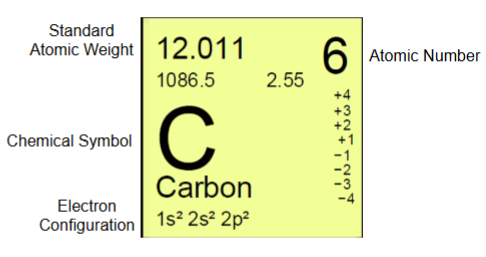
What does some of this information translate to?
The atomic number represents the number of protons and electrons in an uncharged atom
What is the octet rule?
Atoms tend to gain, lose, or share electrons until they are surrounded by 8 valence electrons (4 electron pairs) on their most outer shell with a few exceptions

What will happen to elements with more than 4 valance electrons?
They will gain electrons, such as F-

What will happen to elements with less than 4 valence electrons?
They will lose electrons, such as Na+
What is a chemical bond?
A lasting attraction between atoms, ions or molecules that enables the formation of chemical compounds
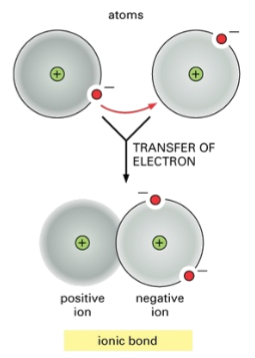
What is true of ionic bonds?
They are the result from the electrostatic force of attraction between oppositely charged ions; formed when one atom gives up (cation) one or more electrons to another atom (anion)

What is true of covalent bonds?
They are the result of two atoms sharing electrons; these bonds tend to occur with nonmetal elements of the periodic table
What occurs when ionic compounds are placed in water?
Their ions separate from one another in a process called dissociation; the water pulls the individual ions from the crystal and solvates them
What accurately describes inorganic compounds?
They are not based on carbon, have a simple structure, have a high boiling and melting point, engage in ionic bonding, and dissociate in polar solvents (water)
What accurately describes organic compounds?
They are based on carbon, have a complex structure, have a low boiling and melting point, engage in covalent bonding, and dissolve (but not dissociate) in polar solvents (water)
What describes water in foods?
Affects texture (dry and brittle versus moist and soft), enables the activity of enzymes and chemical reactions, acts as a solvent, supports the growth of microorganisms, makes it possible for large organic molecules to move about and interact, and conducts heat within food
What describes water in human health?
It can be as much as 70% of an adult’s body weight, it is contained both within the cells and between the cells, acts as a heat sink, and allows for all chemical reactions to occur; no water = no life
What describes the exceptions to inorganic compounds?
Many contain hydrogen atoms, such as water (H2O) and hydrochloric acid (HCl) but only a handful contain carbon atoms, like carbon dioxide (CO2)
What accurately describes NaCl in foods?
It adds and enhances flavor, preserves food—antimicrobial, and helps in the fermentation processes by eliminating undesirable microorganisms
What describes NaCl in human health?
It is an electrolyte that conducts electrical current in solution; critical to transmitting nerve impulses and prompting muscle contraction
What describes calcium phosphate in human health?
It forms the mineral portions of teeth and bones
With calcium phosphate in foods, what describes tricalcium phosphate?
An anti-caking agent
With calcium phosphate in foods, what describes dicalcium phosphate?
It is a dough conditioner that acts as a growth supplement for fermentations
With calcium phosphate in foods, what describes monocalcium phosphate?
It is a leavening agent and dough conditioner that can act as a firming agent that is a growth supplement for fermentations
What is a homogeneous mixture?
A mixture that has uniform composition and properties throughout
What is an orbit?
A circular path (n = 1, 2, 3…) at a definite distance from the nucleus in which electrons revolve
What is an orbital?
The region in three-dimensional space around the nucleus where the probability of finding electron is maximum
What describes orbital type s?
There is 1 number of orbitals with up to 2 electrons
What describes orbital type p?
There are 3 number or orbitals with up to 6 electrons
What describes orbital type d?
There are 5 number or orbitals with up to 10 electrons
What describes orbital type f?
There are 7 number or orbitals with up to 14 electrons
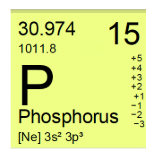
How many electrons does 15P (phosphorous) have in the outermost shell?
5
What is a cation?
A positively charged ion that forms when an atom loses one or more electrons
What is an anion?
A negatively charged ion formed when an atom or molecule gains one or more electrons
What are polar compounds?
Those with distinct regions of positive and negative
What is a peptide bond?
A chemical bond formed between two molecules when the carboxyl group of one molecule reacts with the amino group of the other molecule, releasing a molecule of water (H2O)
What are hydrogen bonds?
A weak bond between two molecules, or regions of a molecule, resulting from an electrostatic attraction between an electropositive atom (H) and an electronegative atom (N, O, and F)
What best describes an α helix in protein secondary structure
The carbonyl (C=O) group of one amino acid is hydrogen bonded to the amino (N-H) group of an amino acid that is four positions down the chain; The R groups of the amino acids stick outward from the α helix, where they are free to interact
What best describes a β pleated sheet in protein secondary structure?
Two or more segments of a polypeptide chain line up next to each other, forming a sheet-like structure held together by hydrogen bonds. The hydrogen bonds form between carbonyl and amino groups of backbone, while the R groups extend above and below the plane of the sheet
What are hydrophobic interactions?
Amino acids with nonpolar, hydrophobic R groups cluster together on the inside of the protein
What is a disulfite bond?
Covalent linkages between the sulfure-containing side chains of cysteines; these are much stronger than other types of tertiary structure bonds—they are like molecular “safety pins”
What is the primary protein structure?
The sequence of a chain of amino acids
What is the secondary protein structure?
Local folding of the polypeptide chain into helices or sheets
What is a tertiary protein structure?
A three-dimensional folding pattern of a protein due to side chain interactions
What is quaternary protein structure?
A protein consisting of more than one amino acid chain
What does the shape of a protein determine?
Its properties
What are the various properties and functions of a protein?
Add nutritional value, act as transport proteins, act as biological catalysts, and present functional properties (texture—gelation, foaming and elasticity, solubility, and emulsification)
What is true of the nutritional value of proteins?
It is based upon R group with either essential amino acids or non-essential amino acids
What are the essential amino acids?
Histidine, Isoleucine, leucine, lysine, methionine, phenylalanine, threonine, tryptophan, and valine
What describes enzymes?
They are proteins that speed up chemical reactions while breaking down compounds or bringing them together; (i.e., they can break, form, or transform bonds)
What best describes substrates?
The molecules upon which enzymes may act → broken down into different molecules known as products
What best describes the suffix -ase?
It is used in biochemistry to form names of enzymes
What are some sources of protein?
Grain and legumes (oats, rye, etc.) and meats (lean muscle tissue)
What are the cons of biological catalysts (enzymes)?
Enzymes degrade protein and fat leading to spoilage, degradation of polysaccharides and pectin lead to spoilage, and the browning of fruit
What are the conditionally non-essential amino acids?
Arginine, cystine, glutamine, glycine, proline, and tryosine
What are the non-essential amino acids?
Alanine, asparagine, aspartate, glutamate, and serine
What best describes the enzyme polyphenol oxidase (PPO) and polyphenols?
They are present in plant cells and come in contact when the cells are cut or mashed; brown pigments are then produced by PPO’s to potentially act as a defense mechanism against potential pathogens and herbivores
How may enzymatic browning be slowed or stopped?
By removing or changing the chemicals required for the browning reaction or changing the environment where the reaction is happening
What are three ways to reduce enzymatic activity in foods that brown?
Water immersion or vacuum packaging (reduces contact with oxygen), changing the pH (citric acid, acetic acid, or ascorbic acid), or temperature control (below 7 C PPO is inhibited and cooking/blanching leads to protein denaturation)
What is protein denaturation?
A change in conformation without breaking covalent peptide bonds
What are some characteristics of denatured proteins?
Decreased solubility, loss of biological activity, inability to crystallize, increased intrinsic viscosity, and increased susceptibility to proteases
What is the isoelectric point?
The pH at which the net charge of a protein is zero and the protein is at its minimum solubility (denatured)
What happens to pH of proteins when H+ is added?
Soluble proteins become negatively charged, insoluble proteins become neutrally charged, and soluble protein become positively charged
What are the four agents of denaturation for proteins?
pH, heat, pressure, and shear