ch 11/12 Early Homo and Archaic Homo
 Call Kai
 Learn
Learn Practice Test
 Spaced Repetition
 Match
Match Flashcards
 Knowt Play
1/44

There's no tags or description
Looks like no tags are added yet.
Name | Mastery | Learn | Test | Matching | Spaced | Call with Kai | Chat |
|---|
No analytics yet
Send a link to your students to track their progress
45 Terms
What anatomical feature did Homo habilis share with earlier australopithecine species?
short legs relative to arms
Where does Homo naledi most likely fit into the human lineage?
early taxon of genus Homo
Which of the following represents skeletal adaptation of Homo erectus contributed to its fully modern walking?
longer legs and short arms
Which of the following is not a H. erectus behavioral innovation?
production of symbolic material culture
The rapid increases in H. erectus body and brain size are most likely linked to which diets?
high-protein diet of cooked meat
Homo erectus (Eugene Dubois, 1891, Java, Indonesia, 1.8mya-250kya, "Upright Man")
-first species to migrate out of Africa, wide geological range Eurasia and SE Asia
-800-1000cc cranial capacity, long low "football" shaped skull, microdontia, nuchal torus, prominent supraorbital torus (passes pencil test), occipital torus, robust skull bones.
-some Asian specimens have sagittal keel
-efficient and obligate biped, longer legs than arms, narrow modern pelvis
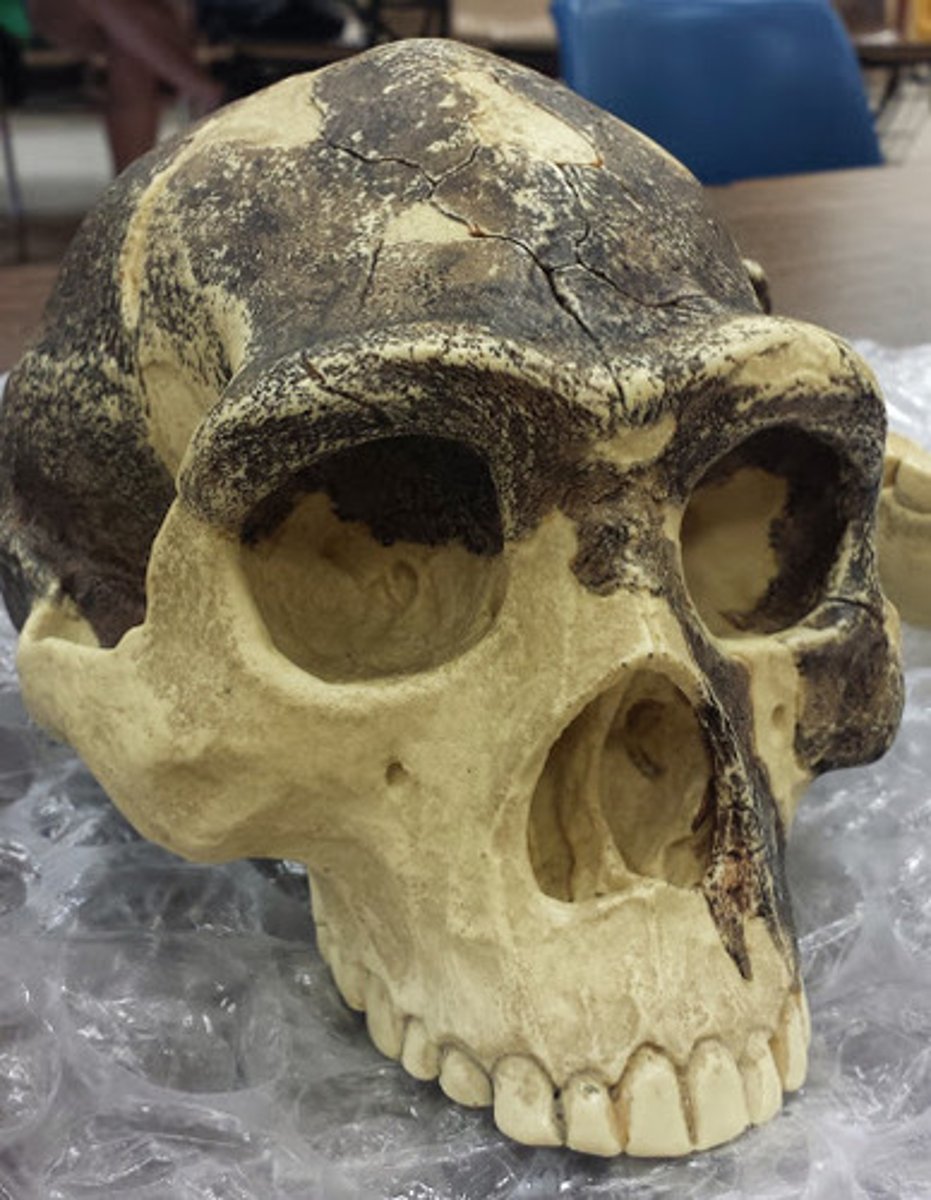
Homo habilis ("Handy Man," Leakey's, 1960, Lake Turkana, Kenya, 2.4-1.4mya)
-well known for KNMER-13 specimen and "Twiggy" OH 24 specimen
-650cc cranial capacity, relatively small molars, prominent browridge, small orthognathic face, no sagittal crest
-small body size, bipedal, relatively long arms
-associated
with Oldowan tool industry
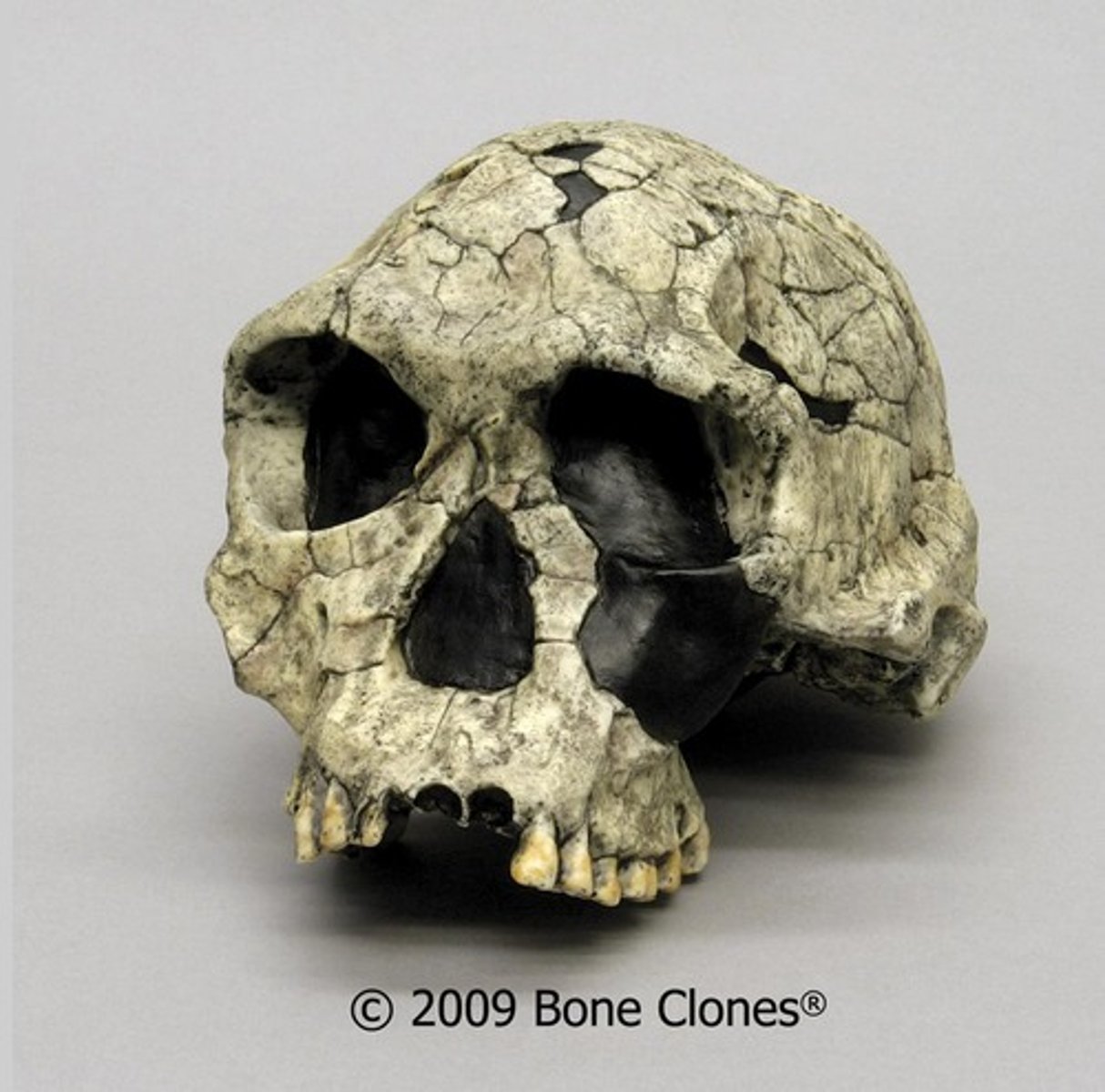
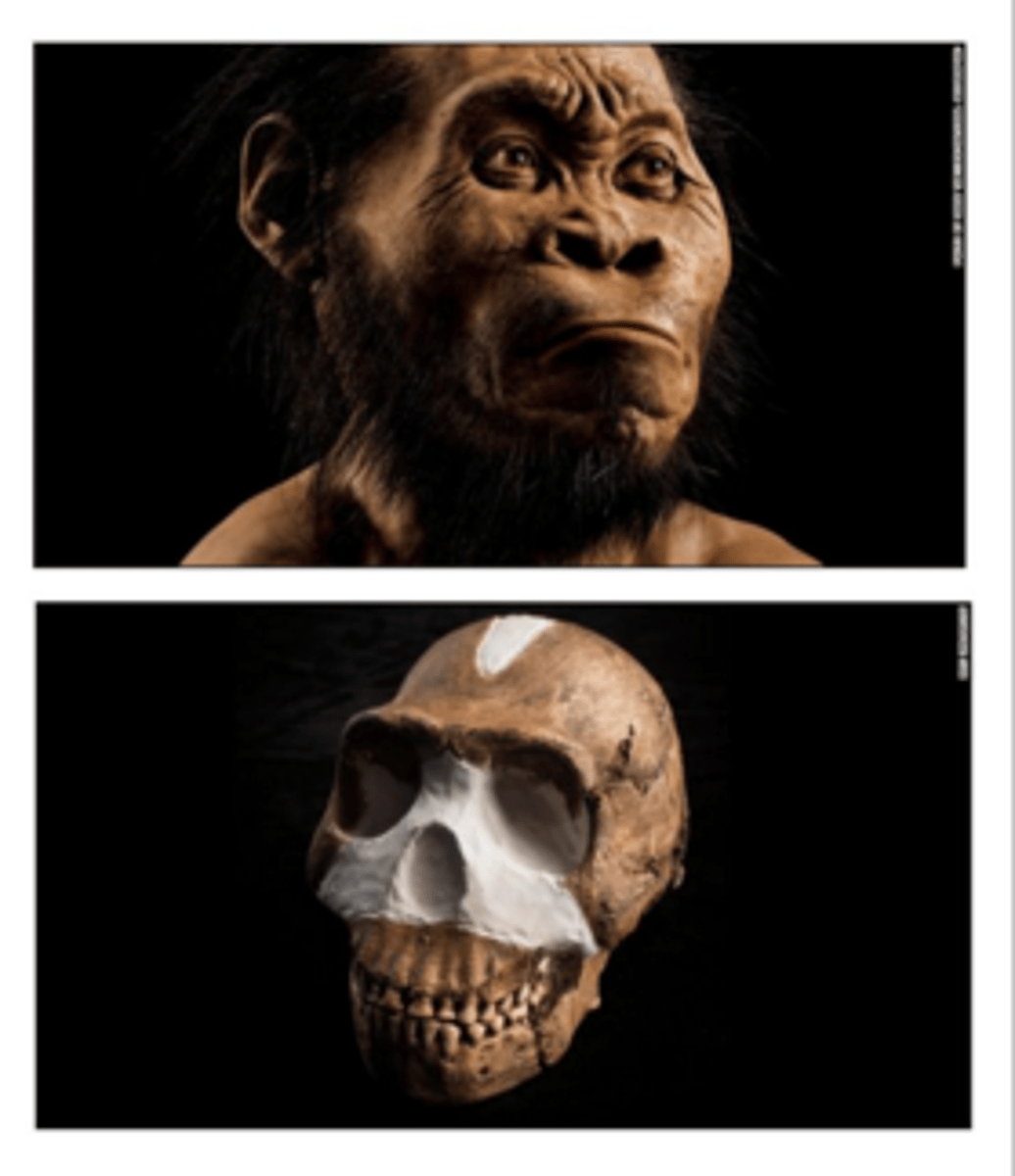
Homo naledi (Rising Star Cave S. Africa, Lee Berger, 2013, "Star Man," 330-230kya)
-skull close to H. erectus shape
-475-560cc cranial capacity
-males 5ft tall, females smaller
-bipedal
-mix of Au and H. erectus morphology
-unsure about dating
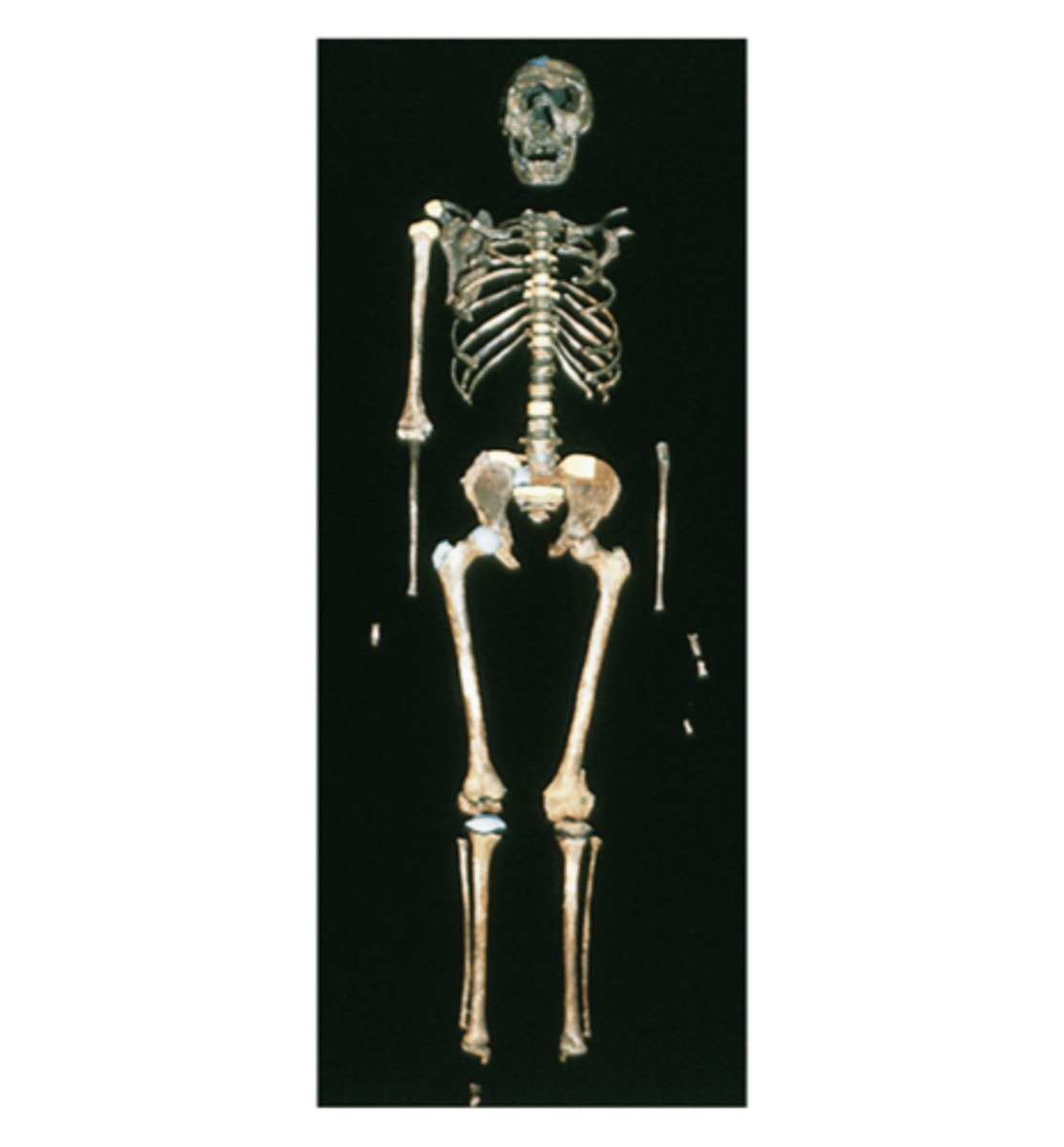
Nariokotome Boy/Turkana Boy (H. erectus, Lake Turkana, Kenya 1984)
-11 to 15yr old male specimen found with nearly complete skeleton, gave postcranial body plan of H. erectus
-shows huge increase in body size from late Au. and H. habilis
Bodo cranium (Middle Awash, Ethiopia, H. heidelbergensis, 600kya)
-specimen found with intentional cut marks on orbital bones, nearby Acheulian tools
-shows intentional human on human defleshing at 600kya
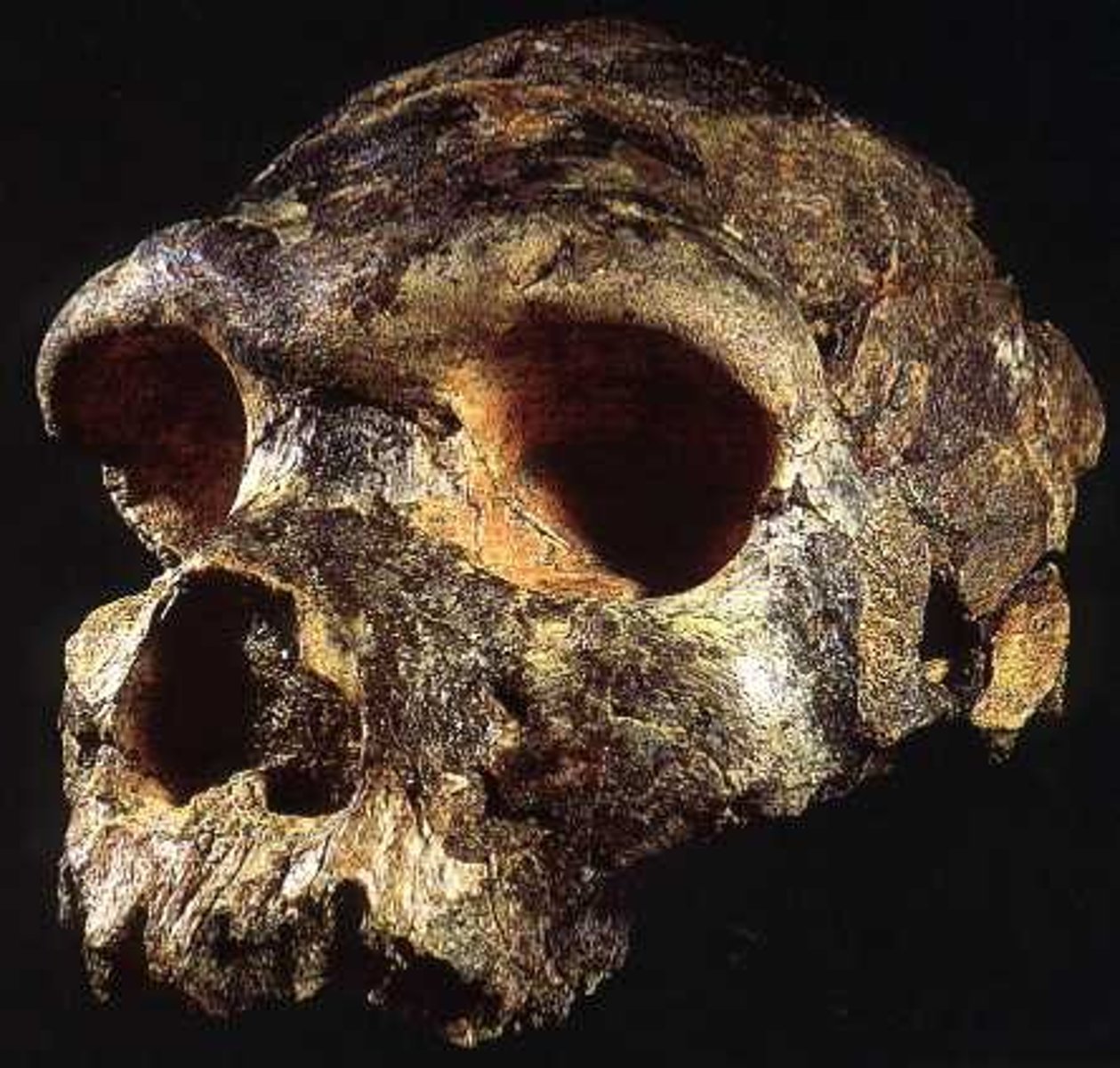
Dmanisi, Georgia
1.75mya, multiple primitive H. erectus specimens, small body size, first H. erectus to leave Africa and take Oldowan tools with them. dont know about fire use, may have been prey to saber tooth. associated with acheulean tool use, some still used oldowan. acheulean tools handaxes used for woodworking, plant processing and meat processing. handaxes efficient for butchering large animals (hippos, elephants)
-shows earlier H. erectus expansion out of Africa than previously thought
Zhoukoudian/Peking Man
Atapuerca 3
Acheulian Complex/Handaxes
1.76mya-300kya associated mostly with H. erectus
handaxes cont. - constraints, acheulean handaxe uniformity, mechanical properties, abundance of and distance to raw materials animals and water, size and shape of original blanks (river cobbles) and extent to which it was reworked/resharpened and modified (was it thrown away as soon as dull or used down to tiny size)
Homo floresiensis
franz weidenreichs regional continuity model and candelabra theory-parallelism
milfred wolpoff and thornes multiregional continuity evolution model
modern humans evolved from earlier archaic populations in their separate regions
throughout evolution there is always significant gene flow on the borders of populations
there is a continuity of morphology in all regions of the globe
Stringer's Out of Africa theory
modern biology, behavior and culture originated in Africa
modern humans spread from Africa to Eurasia 50kya
modern humans replaced all populations once arriving in Europe and no gene flow occurred
Assimilation Model (Smith, Trinkhaus)
modern humans first evolved in Africa, then spread to Europe and Asia. once in Eurasia, modern humans interbred with Neandertals and gene flow occured
Homo heidelbergensis (Mauer, Germany, 609kya,
-robust body and jaw
-wide and low ramus of mandible
-receding chin
-small molars,
-possible oldowan pebble fragments
midfacial prognathism nd large nasal aperature, and occipital bun are foreshadowed traits of neandertal morphology
direct anagenesis from H. heidelbergensis to neandertal
TD6 Gran Dolina site
780kya with 11 individuals found, 4 chilldren 0-4, 2 children 5-9, some teens also 15-20. few crania, but did find canine fossa (unique to H. sapiens) oldowan tools found and one cranium with 1000cc, high frequency of cut marks on hominin bones (yes cannibalism)
Sima de los Huesos
"pit of bones" sinkhole or chute where hominins would dump the bodies, no evidence of cannibalism but evidence of intentional burial, best preserved skulls from 430kya with midfacial prognathism (huge sinuses in maxillary) 17 crania, 6500 human remains, and 28 individuals from one stratigraphic level
Schoningen Spears
Germany- 400kya, oldest evidence of hunting wooden spears, up to 2m long, found with horse fossils (possible prey) fairly sophisticated because spears have been weighted for thrusting not throwing.
Lomekwi tools
3.3mya stone tools found in Lake Turkana, Kenya
Homo neanderthalensis
larger brain sizes, 1500cc,, long low cranial vault, prominent supraorbital torus (smaller than H. heidelbergensis), midfacial prognathism large nose and occipital bun. no chin, unique neandertal trait is retromolar gap, sweeping cheekbones and beaklike nose, size of nose hypothesized to warm air as its breathed in, taurodont molars (large pulp cavity inside tooth) and large heavily worn incisors, possile effects of population bottlenecks, ppossibly functional traits, capable of speech/language. postcranial anatomy- 5'2" to 5'7, 110-150lbs shorter and stouter than H. sapiens goal is to retain body heat and reduce heat loss (bergmann and allens rules), very robust bones, strong muscle attaachments, bowed long bones (suggests very physically active and hauling heavy material), distal limb sgmets short, barrel shaped chest, broad fingertis, wider pelvic inlet, have precision grip and modern human hand. long superior pubic ramus, bigger birth canal
tons of neandertal fossils in france, some in afghanistan, into even siberia
Bergmann and Allen's rule
populations living in cold climates tend to be large in size than those living in warm regions, and have shorter extremities
teeth as tool hypothesis
neadertals used teeth as tools similar to modern inuit populations who have top down wear patterns
mousterian tools/Levallois technique
associated mostly with neandertals and some early modern humans. more complex than achulean tools, levallois technique, greater variety of more standardized tool shapes, high quality materils sought, more varied uses for tool use, shaped bone sometimes used as a tool
Early Homo
Homo habilis and Homo rudolfensis (both now habilis)
Middle Homo
Homo erectus, Homo naledi, Homo floresiensis (hobbit
Archaic (Recent) Homo
Homo heidelbergensis, Homo neanderthalensis
Modern Homo
Homo sapien
sagittal keel
occipital bun
Kabwe/Broken Hill Man/Rhodesian Man
-rounded occipital, -reduced occipital torus
-orthognathic face, large braincase 1300cc,
-thought to be last common ancestor between H. sapiens and neandethals.
Atapuerca 5
fire
1mya, wonderwork cave, s. africa first evidence for controlling fire. importance of cooking meat book catching fire hypothesis make protein in meat more digestible by cooking. large brain = eating more meat, smaller gut, smaller teeth, improves chewing efficiency. campsites! hunt is brought back to the group. creating an archaeological site. (H. erectus)
what distinguishes early archaic H. sapiens from H erectus?
reduction in skeletal robusticity
what aspect of Neandertal culture supports their intelligence?
symbolic burial rituals
Modern H. sapiens most likely evolved....
in Africa and assimilated archaic H. sapiens in Asia and Europe
How did modern H. sapiens reach N. and S. America?
they migrated from northeastern Asia along the Bering land bridge
H. floresiensis has NOT been proposed to be
a descendent of modern humans
Simpson's Evolutionary Species Concept
a species is a lineage of ancestral-descendant populations of organisms which maintains its identity from other such lineages and which has its own evolutionary tendencies and historical fate
-recognizes that species evolve
-based on morphological similarity
Mayr's Biological Species concept
Species are groups of interbreeding populations reproductively isolated from other such groups
-recognizes importance of reproduction
-makes no reference to morphological similarity
reduced hybrid fertility
even if hybrids are vital they may be sterile e.g. mules are sterile