25.1 aromatic compounds
 Call Kai
 Learn
Learn Practice Test
 Spaced Repetition
 Match
Match Flashcards
 Knowt Play
1/54

There's no tags or description
Looks like no tags are added yet.
Name | Mastery | Learn | Test | Matching | Spaced | Call with Kai | Chat |
|---|
No analytics yet
Send a link to your students to track their progress
55 Terms
what is benzene?
naturally occurring aromatic hydrocarbon with a ring structure
liquid at room temperature
key ingredient added to gasoline
what were features when Benzene was first discovered?
colourless, sweet smelling, highly flammable liquid
naturally in crude oil, components of petrol, cigarette smoke
carcinogen
what is structure of benzene?
hexagonal ring of 6 carbons atoms
each carbon joined to 2 carbons and 1 hydrogen
how did Kekule come up with the kekule model?
he thought of the ring shape of benzene whilst day dreaming about a snake seizing its own tail
what is the kekule’s model?
structure of benzene is made up of 6 membered ring of carbon atoms joined by alternate single and double bonds
why has not all chemists accepted kekule model?
not able to explain all chemical and physical properties
what are the 3 reasons to disprove kekule’s model?
lack of reactivity of benzene
lengths of carbon-carbon bonds in benzene
hydrogenation enthalpies
explain the lack of reactivity as a way to disprove kekule’s model
if benzene contained C=C it should decolourise bromine in electrophilic addition reaction
but benzene doesn’t undergo electrophilic addiction reactions and it doesn’t decolourise bromine under normal conditions
led scientists to believe benzene has no C=C bonds
explain lengths of carbon-carbon bonds in benzene as a way to disprove kekule’s model
X-ray diffraction can measure bond lengths of a molecule
Lonsdale, a crystallographer examined benzene found all bonds were 0.139nm which was in-between single bond length of 0.153nm and double bond 0.134nm
explain hydrogenation enthalpies as a way to disprove kekule’s model
if benzene has kekule strucure expected to have a hydrogenation of x3 of cyclohexene
but cyclohexane required -120 and x3 would be -360
but benzene enthalpy change is only -208
what are features of delocalised model of Benzene?
planar, cyclic, hexagonal
canon uses ¾ electrons to bond
each carbon has 1 electron in p-orbital at right angles to plane of carbon and hydrogen atoms
addict p-orbitals overlap sideway in both directions above and believe the plane of carbon bonds to form a ring of electron density
6 electrons occupying pie-bonds are delocalised
when is benzene used as main parent chain?
when one substituent groups are monosubstitued like short alkyl chains, halogens and nitrogen groups
what is benzene ring considered if attached to alkyl chain with functional group, or alkyl group longer than 7 chains?
substituent with prefix phenyl
what are exceptions to naming rules of benzene?
benzoic acid
phenylamine
benzaldehyde
what happens in substation reactions with benzene?
hydrogen atom on benzene ring replaced by another atom/group of atoms usually with electrophile and so most of time electrophilic substituion
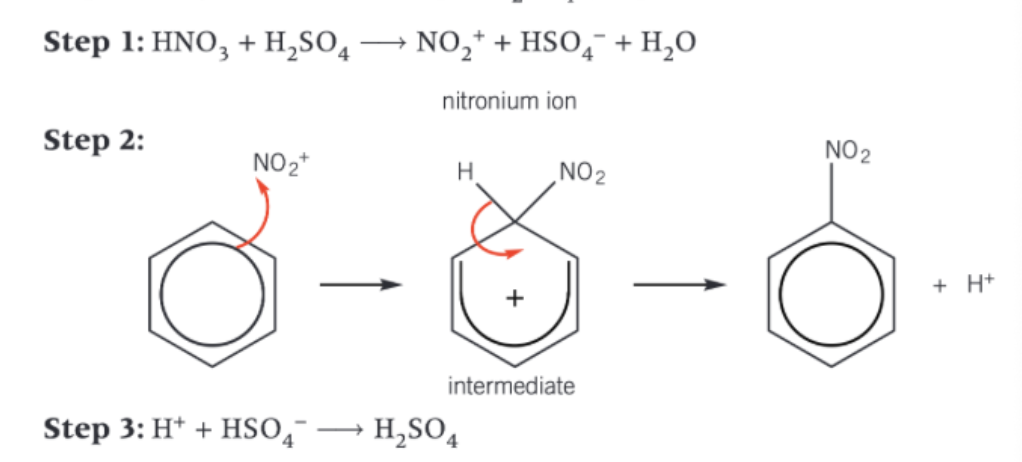
what happens during nitration of Benzene?
benzene reacts slowly with nitric acid to form nitrobenzene
reaction catalysed by sulphuric acid and heated to 50 degrees
water bath used to maintain steady temperature
1 hydrogen replaced by nitro group
why is temperature used in nitration of Benzene 50 degrees?
further substitution may occur leading to production of dinitrobenzene
what is nitrobenzene useful for?
starting material in preparation of dyes, pharmaceuticals and pesticides such s starting material to make paracetamol
what are the steps involved in nitration of Benzene?
what do halogens need to react with benzene?
a catalyst called a halogen carrier
what are common halogen carriers?
AlCl3
FeCl3
AlBr3
FeBr3
what are conditions for bromination of benzene?
RTP
halogen carrier
why do you need a electrophile Br+ instead of non-polar bromine molecule for bromination?
benzene is too stable to react with non-polar bromine molecule
what are the steps for bromination of benzene?

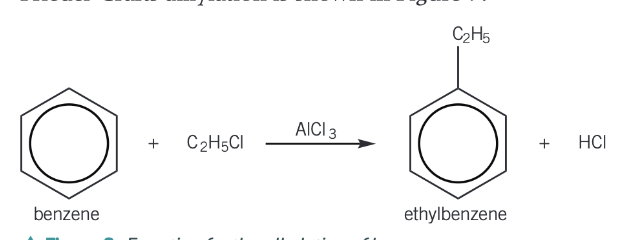
what is alkylation?
substation of hydrogen atom in benzene ring by an alkyl group
needs halogen carrier catalyst
what halogen carrier catalyst is in alkylation?
AlCl3
what is alkylation reaction of benzene with chloroethane?
what is acylation reaction?
benzene reacts with acyl chloride in presence of AlCl3 catalyst, an aromatic ketone formed
what is reaction between benzene and ethanol chloride?

what is an acyl?
Carbon double bonded to oxygen and single bonded to R group
what is differences between alkenes and benzene that leads to its difference in reactions with bromine?
alkene has localised n-electrons
benzene and delocalised n-electrons
so electric density around any 2 carbons in benzene ring is less than double bond
what are observations of bromination of benzene?
orange solution to colourless solution
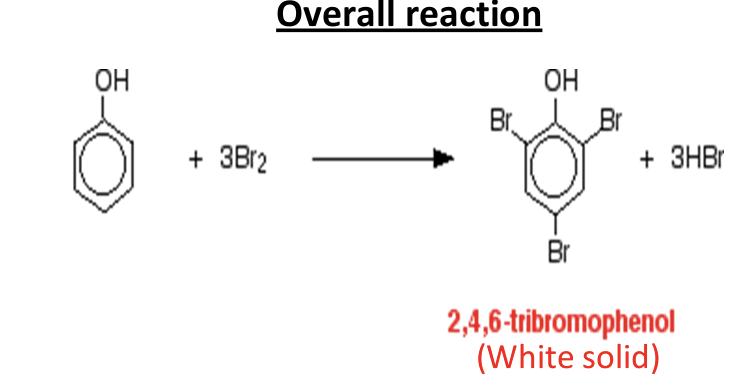
what are observations of bromination of phenol?
orange solution to a white precipitate in colourless solution
what are the reaction conditions of bromination of benzene?
RTP
halogen carrier required
what are reaction conditions of bromination of phenol?
RTP
halogen carrier not required
what is overall reaction Bromination of Benzene?

what is overall reaction of Bromination of Phenol?
why is halogen career required for benzene but not phenol bromination?
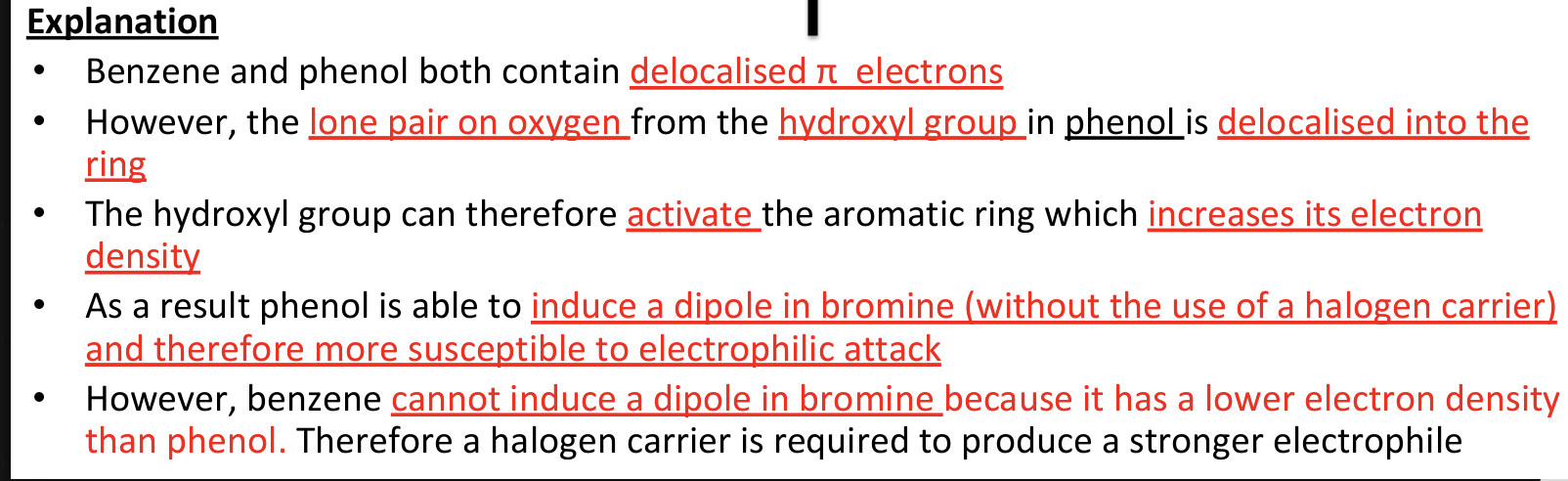
phenol more reactive than benzene during electrophilic substitution reactions
why is phenol more reactive than benzene?
what are reaction conditions for nitration of benzene?
conc sulphuric and nitric acid
reflect at 50 degrees
what are reaction conditions for nitration of phenol?
RTP
dilute nitric acid
no sulphuric acid
what is overall reaction for nitration of benzene?

what is overall reaction for nitration of phenol?

why does trisubstitution not take place when phenol nitrated?

why is phenol partially soluble in water?
hydroxyl group in phenol make hydrogen bonds with water molecules
but aromatic ring is non-polar so can’t form hydrogen bonds with water
how is penal acidity compared to alcohols and carboxylic acids?
more acidic than alcohols, less acidic than carboxylic acids
what don’t alcohols react with and why?
strong or weak bases as not acidic
what only do phenols react with?
strong bases
what do carboxylic acids react with?
strong and weak bases
what is directing effect?
how functional group that is attached directly to aromatic ring affects which aromatic hydrogen atoms are more likely to undergo electrophilic substitutions
what is directing group of -NH2
2 and 4 directing
what are some only go to 2,4 positions for phenol?
lone pair on oxygen atom of the hydroxyl group is delocalised into aromatic ring
this activates only 2,4 positions only
so hydroxyl is 2 and 4 directing group
what are deactivating groups called?
3 directing groups
what is a 3 directing group we need to know?
NO2
why are 3-directing groups activate ring at position 3 only?
resonance structures show that electrophiles will not attack aromatic ring at 2 or 4 because aromatic ingredients is least electron rich at these positions
this is due to electron withdrawing effect of the nitro group which withdraws n electron from aromatic ring towards itself which makes ring only electron rich at position 3