Cells of the Nervous System and Neurophysiology
 Call Kai
 Learn
Learn Practice Test
 Spaced Repetition
 Match
Match Flashcards
 Knowt Play
1/123

There's no tags or description
Looks like no tags are added yet.
Name | Mastery | Learn | Test | Matching | Spaced | Call with Kai | Chat |
|---|
No analytics yet
Send a link to your students to track their progress
124 Terms
What are the functions of neurons?
send signals along thin fibers (axons)
communicate with other cells by releasing NTs at synapses
What are the functions of neuroglial cells?
provide support and nutrition in the nervous system
maintain the electrochemical surroundings of neurons
How can neuroglial cells be describe?
metabolic; help neurons function well
What is grey matter?
dendrites, cell bodies, axon terminals and synapses
What can grey matter also be called?
nuclei
What is white matter?
bundles of myelinated axons
What the areas of White matter?
Fasciculus
funinculus
lemniscus
peduncle
tract
Myelin is …
fatty.
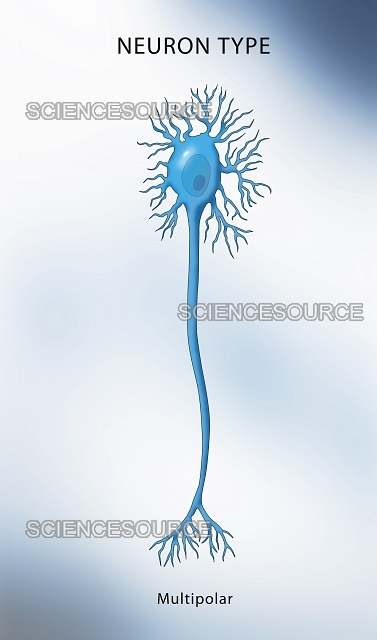
What are the 3 structural types of neurons?
multipolar
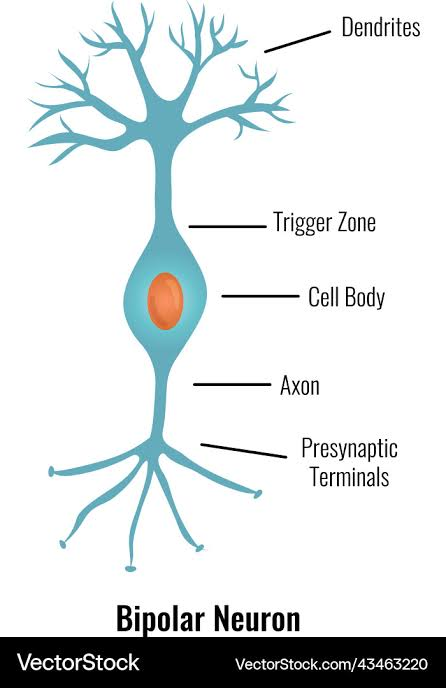
bipolar
unipolar
What are multipolar neurons?
motor neurons; most numerous in the CNS
What are bipolar neurons?
sensory neurons of the retina of eye and nose
What are unipolar neurons?
single process that divides into two branches; one branch extends to the CNS, the other extends to the periphery.
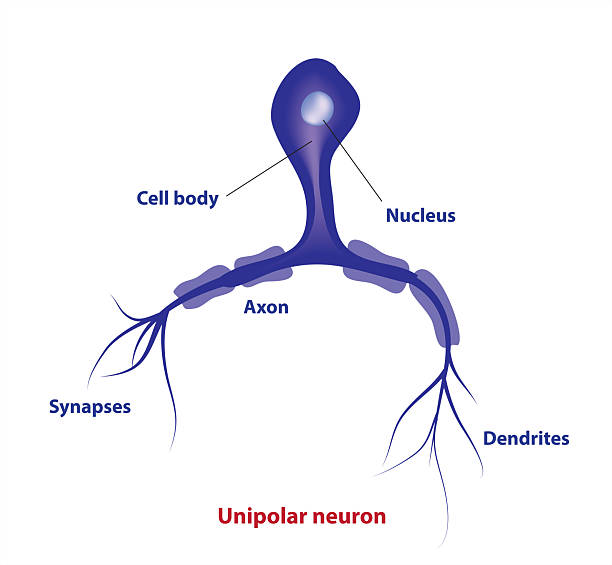
Where are unipolar neurons mostly found?
in sensory ganglia neurons
What are the 3 functional classifications of of neurons?
sensory or afferent
motor or efferent
interneurons (association neurons)
What are Sensory/Afferent neurons?
action potentials are towards the CNS
What are motor/efferent neurons?
action potentials are away from the CNS
What are interneurons?
within CNS from one neuron to another (99%)
Interneurons make … connections in the brain?
local
Sensory neurons are … in info.
taking
Motor neurons are … out info.
sending
What are neurons?
electrically excitable cells in the nervous system that function to process and transmit information
What is the function of dendrites?
to receive signals
What is the function of the soma or cell body?
to integrate signals
The soma is the … neuron.
skeleton
What is axon of a neuron?
long extension sends signals (starts at axon hillock)
what are the components of a synapse?
myelin sheath, nodes of ranvier
presynaptic
postsynaptic

structure of a neuron
What is the axon hillock?
the “trigger zone”; gathers incoming electrical signals and decides whether to fire an action potential.
Why is axonal transport necessary?
because axons can be 1,000-10,000x length of the cell body
What is antegrade transport?
transport away from the cell body, toward synapse
What is retrograde transport?
transport toward the cell body
What can retrograde transport be hijacked by and how?
viruses
taken up by axon terminals in peripheral nerves and transported back to cell bodies in CNS by rapid retrograde transport
which viruses can hijack axonal transport?
herpes simplex, polio, rabies and toxins - tetanus toxin
What is the synapse?
facilitates transmission of impulses from one neuron to another neuron
chemical synapses =
neurotransmitters
electrical synapses =
gap junctions in mammals
What are the majority of synapses in the body?
chemical synapses
What are the 6 types of neuroglial cells?
astrocytes
microglia
oligodendrocytes
ependymal cells
schwann cells
satellite cells
Which neuroglial cells are in the CNS?
astrocytes
microglia
oligodendrocytes
ependymal cells
How can you describe the look of astrocytes?
star-like
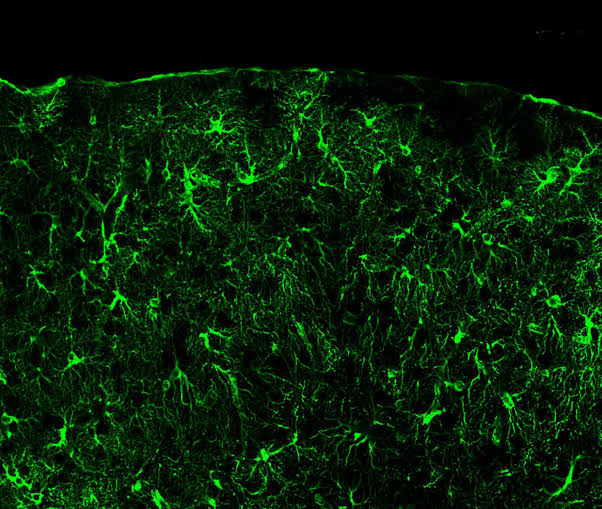
What is the most numerous and diverse neurological cells?
astrocytes
What are the 2 types of astrocytes?
fibrous
protoplasmic
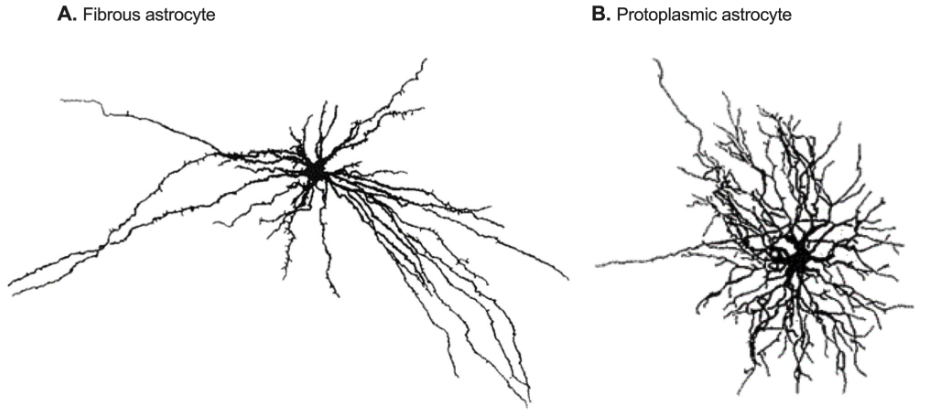
fibrous and protoplasmic astrocytes
What are the functions of astrocytes?
maintain brain homeostasis by regulating extracellular K and glutamate
Form the BBB; provides brain defense
regulate blood flow in CNS
Store and distribute energy substrates
eliminate neurons that are not useful
What are astrocytomas?
primary brain tumors in children and adults
What diseases do astrocytes play a role in?
neurodevelopment - rett syndrome, fragile X, mental retardation, Alexander disease
inflammation in neurodegenerative disease (AD, PD)
what are microglia?
macrophages of the brain and spinal cord
True or false. Microglia are derived from the same lineage as neurons and astrocytes.
false
What are the origins of microglia?
macrophages and other hematopoietic cells
What do “resting” microglia continuously do?
scan their environment

phases of microglia from resting to active
What are the functions of microglia?
main form of active immune defense in CNS
phagocytosis
promote repair following damage
What happens when microglia are chronically activated?
release of reactive oxygen species = BAD
What is the primary purpose of oligodendrocytes?
create myelin sheaths
What is the composition of myelin sheaths?
80% lipid and 20% protein
what is an example of a demyelinating disease?
multiple sclerosis
What happens cellularly during multiple sclerosis?
groups of oligodendrocytes and their myelin segments degenerate → replaced by astrocytic plaques
attack on myelin sheaths
In MS, the loss of myelin results in what?
interruption of the propagation of action potential down the axons.
What are ependymal cells?
cells that line the inner surfaces of the brain ventricles and the central canal of the spinal cord
What are functions of ependymal cells?
control production/flow of CSF
create barrier b/t brain tissue and CSF
controls brain metabolism
waste clearance
What structure produces CSF?
choroid plexus
What do satellite cells do?
surround cell bodies of neurons in sensory and autonomic ganglia
What do schwann cells do?
ensheath axons in PNS; wraps around the axons
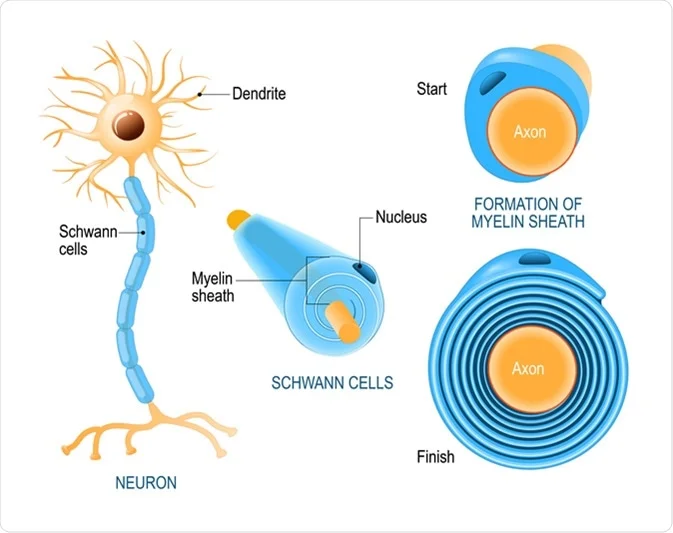
What are schwannomas?
nerve sheath tumors that develop from schwann cells
what is the most common type of schwannoma?
vestibular schwannoma
What do the electrical properties of neurons result from?
different concentrations of ions across plasma membrane
permeability characteristics of plasma membrane
What is excitability?
cells stimulated by appropriate mechanical, thermal, chemical, and electric stimula
What principle applies to excitability?
all or none law
the size of an AP is …. of the stimulus
independent
What is conductivity?
impulse if conducted similar to cable conduction - in one direction
What kind of periods do neurons have?
refractory
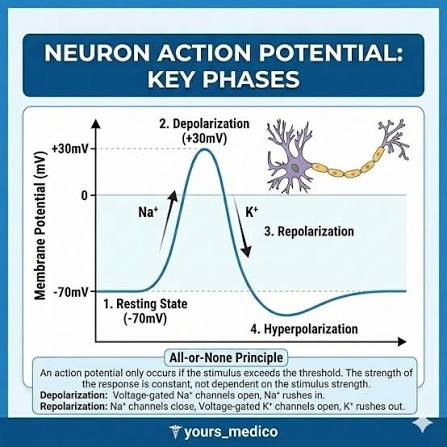
action potential
What is a refractory period?
a brief time after an action potential when the cell cannot easily fire another signal.
true or false. An AP can regenerate itself.
true
AP propagation in unmyelinated axons
occurs as a continuous wave-like movement of electrical depolarization along the length of the axon.
What prevents retrograde movement in unmyelinated axons?
inactivated sodium channels behind the zone of depolarization
What direction do action potentials travel in?
one direction toward the synaptic terminals
How do AP travel down unmyelinated axons?
the electrical current depolarizes the neighboring regions of the axon - SLOWER
How does propagation work in myelinated axons?
by myelin preventing the movement of Na and K ions through the membrane; “turns off” certain Na/K pumps where myelin is at
What are nodes of Ranvier?
interruption of myelin where there are “active” Na channels and Na/K pumps
Where does the AP occur on myelinated axons?
at nodes of Ranvier
AP at one node depolarizes the membrane to reach threshold at the next node
What do myelinated axons participate in?
saltatory conduction
What is saltatory conduction?
“leaps” to other nodes of Ranvier; FAST
What makes myelinated axons even faster?
a larger diameter axon + more myelin = fast
What are the 2 types of synapses?
electric
chemical
What are majority of synapses in the body?
chemical synapses
What are electrical synapses?
passive flow of ionic current through gap junction b/t presynaptic and postsynaptic neuron
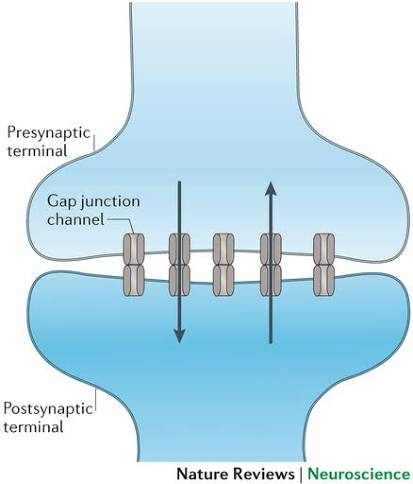
electrical synapse
gap junctions contain the ion-gated channels
What are chemical synapses?
signaling mediated by chemicals → neurotransmitters
utilize vesicles/exocytosis

chemical synapse
What is a synapse?
where communication between neurons takes place
What happens in the presynaptic cell?
AP arrives at axon terminal
Ca2+ channels open
Ca2+ enters the cell
Calcium signals to vesicles
vesicles move to synaptic membrane
docked vesicles release NTs via exocytosis
NT diffuses across synaptic cleft and binds to receptor
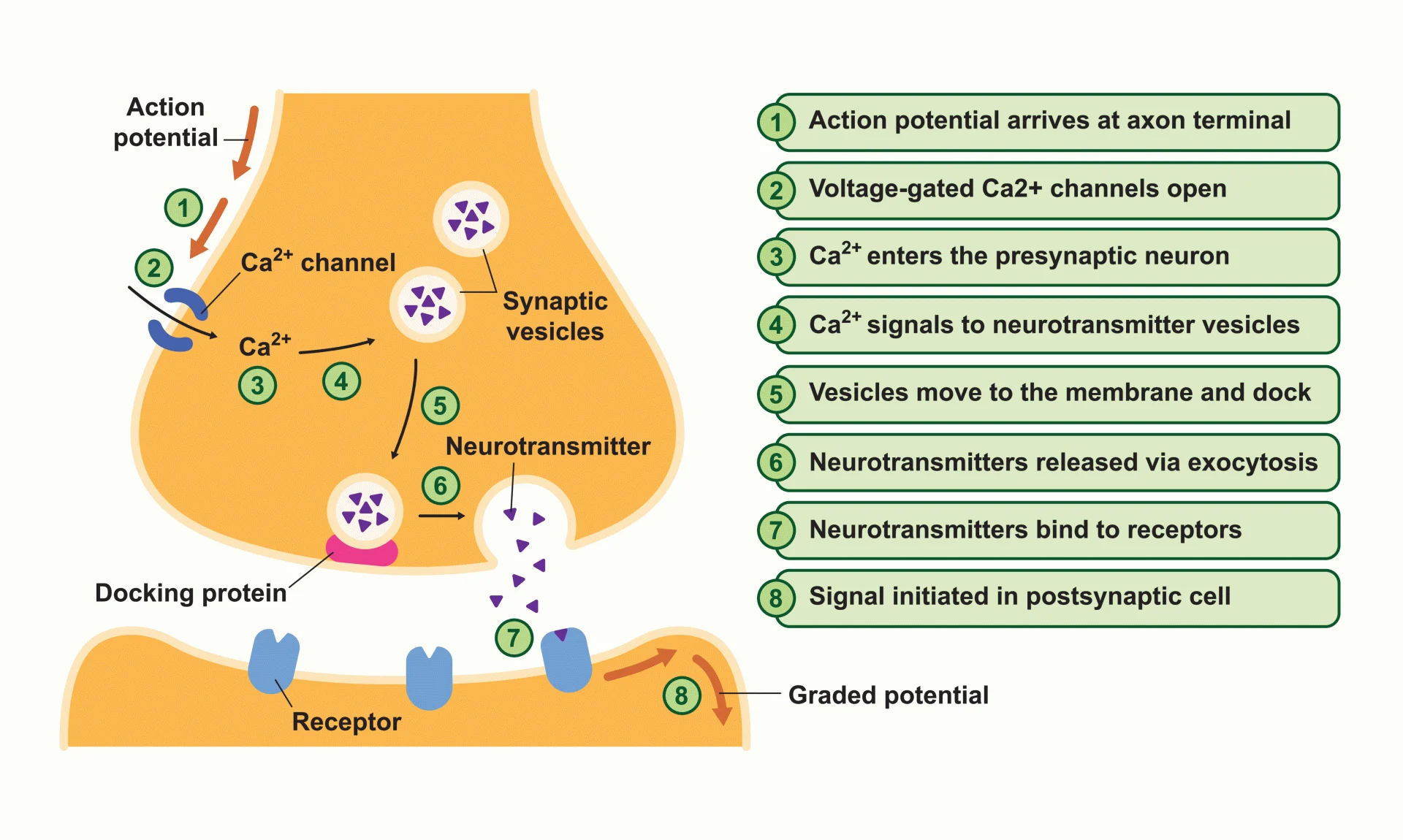
Presynaptic cell functions
What are the 2 types of synaptic transmission?
fast and slow
How quickly do fast synaptic transmission occur?
within 1 m/s
What channels do fast synaptic transmission use?
ligand-gated ion channels
Which NTs does fast synaptic transmission use?
glutamate and GABA
Which cells use fast synaptic transmission?
motor neurons
tract cell projecting to the thalamus
What is the speed of slow synaptic transmission occur?
over 100 m/s - 1 minute
What structures use slow synaptic transmission?
metabotropic receptors
linked to adjacent to guanine nucleotide-binding proteins (G proteins), second messenger system