PROKARYOTIC MICROBES: BACTERIA & ARCHAEA
 Studied by 0 people
 Call Kai
 Learn
Learn Practice Test
 Spaced Repetition
 Match
Match Flashcards
 Knowt Play
1/293

There's no tags or description
Looks like no tags are added yet.
Name | Mastery | Learn | Test | Matching | Spaced | Call with Kai |
|---|
No study sessions yet.
294 Terms
how do prokaryotes replicate
through asexual reproduction - binary fission
What is the first step in binary fission?
The chromosome replicates, forming two identical copies.
What happens to plasmids during binary fission (if present)?
Plasmids replicate independently
How are chromosomes distributed in the cell?
Each chromosome copy is partitioned to opposite poles of the cell.
What happens to plasmids after replication?
Plasmids are partitioned between the two poles.
What is the septum?
A dividing wall that begins forming in the middle of the cell.
What happens as the septum forms?
It constricts inward, separating the two cells.
How does binary fission end?
The septum fully closes and the cell splits into two identical daughter cells.
How do prokaryotic cells increase in number?
They double each generation (1 → 2 → 4 → 8 → 16).
What type of growth does doubling represent?
Exponential growth.
What does a bacterial growth curve graph show?
Viable cell numbers over time in a closed system (e.g. a flask).
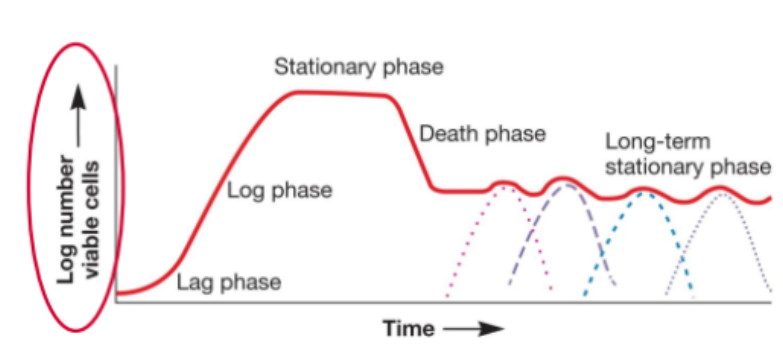
What is meant by a closed system?
No nutrients are added and waste is not removed.
What happens in the Lag Phase?
No increase in cell number; cells adapt, change gene expression, and prepare for growth.
What happens in the Log (Exponential) Phase?
Rapid cell division; cells grow at their optimum rate and numbers double regularly.
What happens in the Stationary Phase?
Cell numbers stabilise because growth rate = death rate due to nutrient depletion and waste buildup.
Why does growth stop in the stationary phase?
Limited nutrients and toxic waste accumulation.
What happens in the Death Phase?
Viable cell numbers decrease as nutrients are exhausted and toxins accumulate.
What is the Long-term Stationary Phase?
Some cells survive under stress; waves of growth and death occur as dead cells are recycled.
Why don’t cells grow forever in a flask?
Because resources are finite in a closed system.
how do you estimate the cell number in a microbial culture
Using optical density (OD)
How does OD relate to cell concentration?
More cells = higher OD.
Why does light transmission decrease as cell number increases?
Cells absorb and scatter light, preventing it from reaching the detector.
What instrument is used to measure optical density?
A spectrophotometer.
At what wavelength is OD commonly measured for microbes?
Approximately 600 nm (OD₆₀₀).
What happens to light in a dense microbial suspension?
Increased light scattering reduces light transmission.
What does the detector in a spectrophotometer measure?
The amount of transmitted light.
What does a high OD₆₀₀ value indicate?
High cell density in the culture.
: Does OD measure live cells only?
No, it measures total cell density (live and dead).
Why is OD useful in growth experiments?
It allows rapid, non-destructive monitoring of cell growth over time.
what is the viable counting method
is a cell counting method
how does the viable counting method work
Sampling the bacterial culture at various time points.
Performing dilution series and plating on agar plates.
Incubating overnight, allowing single cells to develop into colonies visible on the plate.
why do the smae species form different colony morphologyes in different media
due to different nurtients
what are the 3 factors used to decribe colony morphologies
form
elevation
margin
what are the diffrent types of form
Punctiform
Circular
Filamentous
Irregular
Rhizoid
Spindle.

what are the different type of Elevation
Flat
Raised
Convex
Pulvinate
Umbonate.

what are the differnet types of Margins
Entire
Undulate
Lobate
Erose
Filamentous
Curled.

what are the 3 sources of metabolism
energy
Electron
Carbon
what are the 2 energy source types
phototrophs
chemotrophs
What are phototrophs?
Organisms that obtain energy from sunlight.
What are chemotrophs?
Organisms that obtain energy from chemical compounds (organic or inorganic).
Give examples of inorganic energy sources.
Hydrogen, sulfates.
Give examples of organic energy sources.
carbohydrates, proteins, lipids, etc
what are the elctron source types
organotrophs
lithotrophs
how does electron source types work
helps power the electron transport chains of respiration
What are organotrophs?
Organisms that obtain electrons from organic compounds.
What are lithotrophs?
Organisms that obtain electrons from inorganic compounds.
Why is carbon important?
It is the main building block of cells.
what are the 2 main carbon source types
autotrophs
heterotrophs
What are autotrophs?
Organisms that use CO₂ from the atmosphere to build carbon compounds (primary producers).
What are heterotrophs?
Organisms that obtain carbon from organic compounds in the environment.
What type of organism is Cyanobacteria?
Photolithoautotrophs.
Why are cyanobacteria photolithoautotrophs?
Photo → energy from sunlight
Litho → electrons from inorganic compounds
Auto → carbon from CO₂
Why are cyanobacteria important?
They are the only oxygen-producing photosynthetic prokaryotes.
What type of organism is Escherichia coli?
Chemoorganoheterotroph.
Why is E. coli a chemoorganoheterotroph?
Chemo → energy from chemical compounds
Organo → electrons from organic compounds
Hetero → carbon from organic compounds
What is a quick way to remember nutritional types?
Energy source + Electron source + Carbon source
what are the common cell shapes
Cell Shapes
Rod (bacilli)
Spiral (spirilla)
Comma (vibrios)
Spherical (cocci)
Corkscrew (spirochaetes)
what are the different arrangements of cell shapes
Clusters of cocci
Chains of bacilli (Streptobacilli
Chains of cocci (Streptococci)
Pairs of cocci (diplococci).
What determines bacterial arrangement?
Plane of division and whether cells remain attached.
What arrangement results from division in one plane?
Diplococci or streptococci.
What arrangement forms from division in two planes?
Tetrads
What arrangement forms from division in three planes?
Sarcinae (cubical packets).
Which bacteria divide in random planes?
: Staphylococci
bacteria celll structures
ribosomes
cell wall
cell membrane
capsule
nucleoid
chromosomal DNA
Flagellum
cytoplasm
what is the definition of a nucleoid
Region containing the chromosome and associated proteins, generally not membrane-bound (with few exceptions).
what is the structure of a nucleoid
Typically a single closed circular double-stranded DNA molecule.
Supercoiling and nucleoid-associated proteins (distinct from histones) facilitate DNA folding. (different to histones)
what is a plasmid
Circular, extrachromosomal DNA found in bacteria, archaea, and some fungi.
what are the characteristics of a plasmid
Generally small; replicate independently of chromosomal DNA.
closed circular DNA molecule, double-stranded.
They exisit and replicate indepentently from the chromosome
Episomes (which can jump out of the cell) can integrate into the chromosome.
Inherited by the daughter during cell division.
What are conjugative plasmids?
Plasmids that enable transfer of DNA from one cell to another.
What bacteria commonly host conjugative plasmids?
E. coli, Salmonella, Citrobacter.
What phenotypic features are associated with conjugative plasmids?
: Sex pilus formation and conjugation.
What are R plasmids?
Plasmids that carry antibiotic resistance genes.
Which bacteria commonly carry R plasmids?
Pseudomonas and many other Gram-negative bacteria.
What phenotypic traits do R plasmids provide?
Antibiotic resistance (e.g. Amp, Km, Nm, Tet) and conjugation.
What are Col plasmids?
Plasmids that produce bacteriocins to kill closely related bacteria.
What is the main phenotypic effect of Col plasmids?
Colicin production (e.g. Colicin E1).
What are virulence plasmids?
Plasmids that carry genes involved in pathogenicity.
Which organism commonly carries the Ti plasmid?
Agrobacterium tumefaciens.
What phenotypic effect does the Ti plasmid cause?
Tumour formation in plants.
What are metabolic plasmids?
Plasmids that carry genes for enzymes involved in metabolism.
what phenotypic trait does the CAM plasmid provide?
Camphor degradation.
What is the bacterial cell wall primarily made of?
Peptidoglycan (murein).
Why is peptidoglycan important?
It is unique to bacteria and absent in archaea and eukaryotes.
Why is peptidoglycan a target for antibiotics?
Because antibiotics can specifically disrupt bacterial cell walls without harming host cells.
What are the main functions of the bacterial cell wall?
Maintains cell shape
Protects against osmotic lysis
Protects from toxicity
May contribute to pathogenicity
Where is the bacterial cell wall located?
Just outside the plasma membrane.
What is the structure of the bacterial cell wall like?
Rigid.
How many major cell wall types are identified by Gram staining?
Two.
What characterises Gram-positive bacteria?
Thick peptidoglycan layer
Stains purple
Why do Gram-positive bacteria stain purple?
The thick peptidoglycan layer retains the crystal violet stain.
What characterises Gram-negative bacteria?
Thin peptidoglycan layer
Outer membrane present
Stains pink/red
Why do Gram-negative bacteria stain pink/red?
They lose crystal violet and are counterstained.
what is the strucure of peptidoglycan strucutre
Mesh-like polymer formed from identical subunits(repeating sugar) in long strands
what is the arrangements of the sugars in peptidoglycan
alternating
what types of sugars are in peptidoglycan
N-acetylglucosamine (NAG)
N-acetylmuramic acid (NAM)
what is pentapeptide
holds the sugar togther, made of 5 amino acids that sticks out from the peptidoglycan sugars as a side chain - Contains alternating D- and L-amino acids.
How are peptidoglycan strands arranged?
They form a helical structure
Why are peptidoglycan strands cross-linked?
To provide strength and rigidity to the cell wall.
How are peptidoglycan strands cross-linked in E. coli?
By direct cross-linking between peptide side chains
How are peptidoglycan strands cross-linked in Staphylococcus aureus?
Via peptide bridges (indirect cross-linking).