lab practical 2: The Appendicular skeleton
 Call Kai
 Learn
Learn Practice Test
 Spaced Repetition
 Match
Match Flashcards
 Knowt Play
1/102

There's no tags or description
Looks like no tags are added yet.
Name | Mastery | Learn | Test | Matching | Spaced | Call with Kai | Chat |
|---|
No analytics yet
Send a link to your students to track their progress
103 Terms
How many bones in the appendicular skeleton?
126
The appendicular skeleton is composed of the bones of the.....?
appendages, and pectoral and pelvic girdles
What do the pectoral and pelvic girdles do?
Attach the limbs to the axial skeleton
pectoral consists of the posterior _______ and the anterior ________
clavicle scapula

Clavicle:
collar bone

What are the structures associated with the clavicle?
acromial end and sternal end

Acromial end of clavicle:
rounded lateral end

Sternal end:
flat medial end

Scapula:
shoulder blade
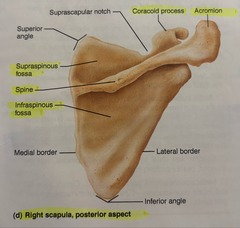
What are the structures associated with the scapula?
spine, acromion, coracoid process, glenoid cavity, supraspinous fossa, infraspinous fossa, and subscapular fossa

Spine:
Thick ridge of bone, felt through skin

Acromion:
large lateral end of spine process

Coracoid process:
anterior hook-like projection

Glenoid cavity:
large socket between the acromion and the coracoid process

Supraspinous fossa:
depression superior to the spine

Infraspinous fossa:
Depression below the spine

Subscapular fossa
Large depression on the anterior surface

Humerus:
upper arm bone

What are the structures associated with the humerus?
Head, greater tubericle, lesser tubericle, intertubercular sulcus, deltoid tuberosity, trochlea, capitulum, coronoid fossa, radial fossa, olecranon fossa, medial epicondyle, and lateral epicondyle

Head of humerus:
rounded promximal portion

Greater tubercle:
medium rounded promial portion lateral to head

Lesser tubercle:
small medial prominence near the head and the greater tubercle

intertubercular sulcus:
Groove that separates the greater and lesser tubercles

Deltoid tuberosity:
Lateral roughened area halfway down the shaft

Trochlea:
Rectangular projection on the distal end

Capitulum:
Rounded lateral projection on the distal end

Coronoid fossa:
Small medial anterior depression above the trochlea

Radial fossa:
small lateral anterior depression above the capitulum

olecranon fossa:
large distal posterior depression

Medial epicondyle:
medial projection on the distal end

Lateral epicondyle:
The lateral projection on the distal end is better seen posteriorly of the humorous

Radius:
Lateral forearm bone (thumb)

What are the structures associated with the radius?
radial tuberosity, ulnar notch, and styloid process of radius
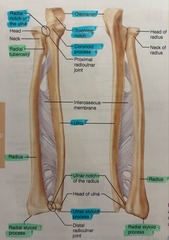
Radial tuberosity:
medial anterior prominence below the head of the raidus

ulnar notch:
medial distal depression where the ulna and radius meet
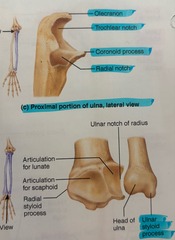
Styloid process of radius:
lateral distal prominence

Ulna:
medial forearm bone(pinky)

What are the structures associated with the ulna?
olecranon, trochlear notch, coronoid process, radial notch, and styloid process of ulna.
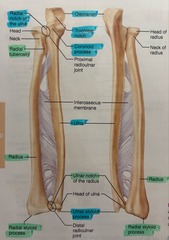
olecranon:
large hook -like proximal posterior process

trochlear notch:
depression that separates the olecranon and the coronoid process

coronoid process:
Pointy projection below the trochlear notch

Radial notch:
small depression below the coronoid process

styloid process of ulna:
small distal pointy projection at the bottom of the ulna

Carpals:
wrist bones
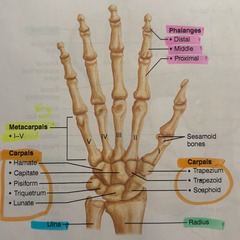
How many Carpal bones are there?
8

Metacarpals:
long bones in the meat of the hand- have rounded heads

How are the metacarpals counted?
I, II, III, IV, and V

metacarpal I being what?
thumb
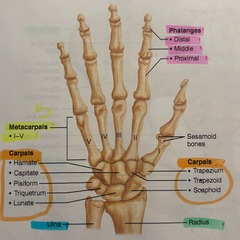
Phalanges (hand):
fingers

proximal phalanges:
largest finger bone have flat heads
middle phalanges:
medium-sized finger bones, the proximal portion is thicker than the distal
Distal phalanges:
tiny finger bones look like a lil dih

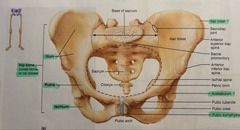
Coxal bone:
hip bone

What are the 3 bones that fused to make the hip bone?
ilium, ischium, and pubis

What are the structures associated with the coxal bones?
acetabulum, ilium, ischium, and pubis

Acetabulum:
A large depression that cradles the head of the thigh bone

Ilium:
Proximal curved portion of hip bone

What are the structures associated with the ilium?
iliac crest and greater sciatic notch

Iliac crest:
curved edge of the ilium

greater sciatic notch
large notch halfway down
ischium:
distal lateral arch surrounding the obturator foramen

what structure is associated w the ischium?
ischial tuberosity

ischial tuberosity:
Roughened portion of the ischium

Pubis:
prominent portion above the obturator foramen
What are the structures associated with the pubis?
oburatrator foramen and pubic symphysis

obturator foramen:
large distal hole

Pubic symphysis:
small medial portion between pubis portion of the hip bones

Femur:
upper leg/ thigh

What are the structures associated with the femur?
head, neck, greater trochanter, lesser trochanter, lateral condyle, medial condyle, gluteal tuberosity, linea aspera, lateral epicondyle, and medial epicondyle.

head of femur:
large rounded proximal projection

neck:
narrow projection carrying head
greater trochanter
large lateral proximal projection
lesser trochanter:
small medial projection
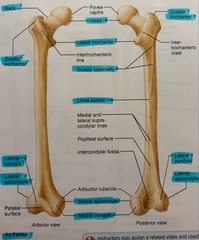
Lateral condyle:
lateral distal projections
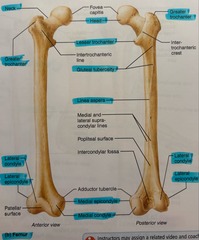
medial condyle:
medial distal projections

Gluteal tuberosity:
Posterior thin ridge of bone below greater trochanter
Linea aspera:
posterior single ridge of bone in the middle of shaft

lateral epicondyle:
small projection on the lateral condyle

medial epicondyle:
small projection on the medial condyle

Patella:
knee cap

the patella is a _______ bone.
sesmoid

Tibia:
largest lower leg bone

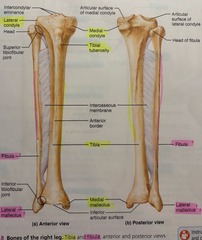
What are the structures associated with the tibia?
medial condyle, lateral condyle, tibial tuberosity, and medial malleolus

Medial condyle:
medial proximal projection on head

lateral condyle:
lateral projection on head

Tibial tuberosity:
anterior roughened surface just below head

Medial malleolus:
distal medial small pointy projectionat base

Fibula:
smaller lower leg bone

What structure is associated with the fibula?
lateral malleolus

lateral malleolus
lateral bulge of the ankle
Tarsals:
ankle bones

How many tarsal bones are there?
7
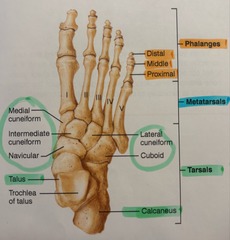
What are the structures associated with the tarsals?
calcaneous and talus

Calcaneus:
heel bone

talus:
lies between calcaneus and tibia has a flat top

Metatarsals:
long bones in the meat of the foot

How many metatarsal bones are there?
5

Phalanges (foot):
toe bones

How many phalange toes bones are there?
14
What are the different types of phalanges?
proximal, middle and distal.
