Acoustical Physics Exam 2
 Call Kai
 Learn
Learn Practice Test
 Spaced Repetition
 Match
Match Flashcards
 Knowt Play
1/76

There's no tags or description
Looks like no tags are added yet.
Name | Mastery | Learn | Test | Matching | Spaced | Call with Kai | Chat |
|---|
No analytics yet
Send a link to your students to track their progress
77 Terms
Spatial Peak Intensity
I▿SP; beams intensity at the location where it is maximum
Spatial Average Intensity
I▿SA; average intensity across the beams entire cross-sectional area

Temporal Peak Intensity
I▿TP; measuring intensity at the time of its maximal value
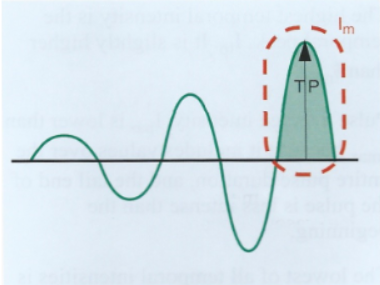
I▿m or I▿max
average intensity during the most intense half cycle
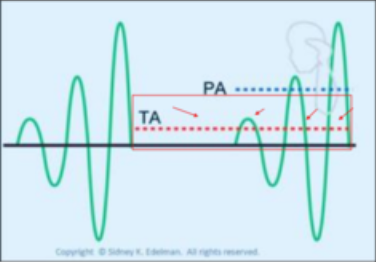
Pulse Average Intensity
I▿PA; average intensity during pulse duration
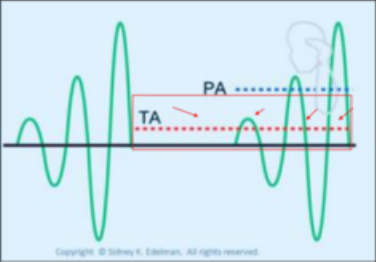
Temporal Average Intensity
I▿TA; average intensity during the entire pulse repetition period (on and off time)
Combination: Isptp
measured where intensity is maximum and the exact time of most powerful
Combination: Isppa
measured where intensity is maximum and averaged over the transit time (pulse duration)
Combination: Ispta
measured at maximum intensity and averaged over all time (transmit and receive)
Combination: Isata
measure over the entire cross section area and average over all time
Measuring intensity: SPTP
spatial peak, temporal peak; most intense
Measuring intensity: SATP
spatial average, temporal peak
Measuring intensity: SPTA
spatial peak, temporal average
Measuring intensity: SATA
spatial average, temporal average; least intense
Measuring intensity: SPPA
spatial peak, pulse average
Measuring intensity: SAPA
spatial average, pulse average
Commandments #1
respect for time and space
Commandments #2
different units if intensity are important for bioeffects
Commandments #3
units for intensity are w/cm³
Commandments #4
SPTP- most intense
SATA- least intense
Commandments #6
duty factor describes the relationship of beam intensity with time
Commandments #7
For continuous wave ultrasound (CW) pulse average and temporal average are the same, therefore; SPTA=SPPA & SATA=SAPA
Commandments #8
- When Pulsed wave (PW) and continuous wave (CW) have the same SPTP intensity, the CW has the higher SPTA intensity
- When PW and CW have the same SATP intensity, the CW has the higher SATA intensity
Commandments #9
Temporal considerations-
I▿TP, I▿m, I▿PA, I▿TA
Commandments #10
Spatial considerations-
I▿SP, I▿SA
Decibels (dB)
common unit for measuring strength of sound beams, electrical signals, and brightness
Positive decibels
reports signals that are increasing
Negative decibels
reports signals that are decreasing
Attenuation
decrease in intensity, power, and amplitude as sound travels
Attenuation is _____related to Distance
Attenuation is directly related to distance
Attenuation is _____related to Frequency
Attenuation is directly related to frequency
Attenuation is determined by two factors, what are they
Path length and frequency of sound
More attenuation equals
longer distances and higher frequencies
Less attenuation equals
shorter distances and lower frequencies
Attenuation has 3 contributions, what are they
Reflection, Scattering, and Absorption
Reflection
weakens the portion of the soundwave that continues in a forward direction
Specular Reflection
boundary is smooth, reflected in only one direction and organized
Diffused Reflection
irregular surface and radiates in more than one direction
Rayleigh Scattering
occurs when the structures dimensions are much smaller that the beams wavelength. This redirects the soundwave equally in all direction
Absorption
when ultrasonic sound gets converted into another energy form
Absorption is _____ related to frequency
Absorption is Directly related to frequency
Attenuation coefficient
the number of decibels of attenuation that occurs when sound travels 1cm
Half value layer thickness
the distance that sounds travels in a tissue that reduces the intensity of sound to ½ of its original value
Half value layer thickness depends on
depends on the medium and the frequency of sound
Transmission is critical to the ability of what
critical to the ultrasounds ability to image a structure located deep in the body
Impedance
acoustic resistance to sound traveling in a medium
any angle that isn’t 90 degrees is considered
oblique
Incidence
angle the wave strikes the boundary determines the behavior of the pulse
Normal incidence strikes the boundary at;
exactly 90 degrees
Oblique incidence
the incidence sound beam strikes the boundary at any angle other than 90 degrees
Refraction
change in direction of wave propagation when traveling from one medium to another
Refraction only occurs if two conditions are satisfied, what are they
oblique incidence and different propagation speeds
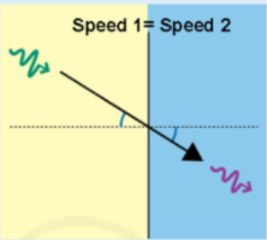
Snell’s Law

Conditions that change the angle- Trans angle = incident angle
the beam travels straight
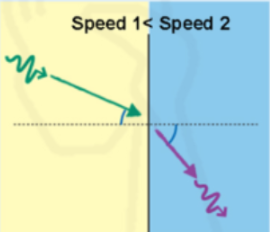
Conditions that change the angle- trans angle > incident angle
speed of medium 2 is greater than medium 1
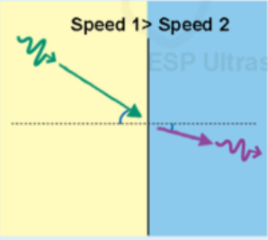
Conditions that change the angle- trans angle < incident angle
speed of medium 2 is less than medium 1
Go-return time (time of flight)
elapsed time from pulse creation to pulse reception
PRP is _____ related to depth
PRP is Directly related to depth
PRF is _____ related to depth
PRF is Inversely related to depth
13 microsecond rule
for every 13ɥs of go-return time, the object is 1cm deep in the body
The total distance is __x the reflector depth
2x the reflector depth; it has to travels there and back
Transducers
any device that converts one form of energy into another
Reverse Piezoelectric effect
PZT materials change shape when voltage is applied to them
Components of a transducer: Case
metal or plastic; protects the patient and inside the probe
Components of a transducer: Electrical shield
thin, metallic, and inside the case; helps prevent electrical noise
Components of a transducer: Acoustic Insulator
thin, cork or rubber; prevents vibration in the case from inducing an electrical voltage
Components of a transducer: PZT (active element)
the crystals; ½ s wavelength thick
Components of a transducer: Wire
electrical connection between the PZT and the ultrasound system
Components of a transducer: Matching layer
Infront of PZT, ¼ wavelength thick; increases efficiency of sound energy transfer between active elements and the body; protects the active element
Components of a transducer: Backing Material
reduces “ringing”; prevents from excessive shaking
Consequences of backing material
decreased sensitivity
wide bandwidth
Low quality factor
Curie Temp / Curie Point
temperature at which PZT is polarized
Continuous wave (CW)
constant electrical signal excites or drives the active element
Pulsed Wave (PW)
short duration spike that travels though the wire and strikes the PZT
2 characteristics of PZT that determines the frequency of sound
Speed and Thickness
Speed is ____ related to frequency
speed is directly related to frequency
Thickness is ____ related to frequency
thickness is inversely related to frequency