4.1.2.2 IMPERFECT INFORMATION
 Call Kai
 Learn
Learn Practice Test
 Spaced Repetition
 Match
Match Flashcards
 Knowt Play
1/49

There's no tags or description
Looks like no tags are added yet.
Name | Mastery | Learn | Test | Matching | Spaced | Call with Kai | Chat |
|---|
No analytics yet
Send a link to your students to track their progress
50 Terms
Why is information important for consumers in a market?
Information is essential for consumers in a market because it empowers them to make smart choices, compare prices and quality, and avoid unfair treatment (this helps to overcome information gaps)
What are informed buyers encouraged to do?
Informed buyers choose the best businesses, which forces all companies to improve quality and lower prices (leading to market efficiency)
Summarize why rational behavior assumes full information
Rational behavior assumes full information so individuals can accurately weigh all costs and benefits to make the choice that maximizes their personal satisfaction or profit
What do most agents act out of?
Self interest
What is homo-economics?
A theoretical model in economics that describes humans as perfectly rational, self-interested agents who consistently make choices to maximize their utility or profit
What are 3 aspects to homo-economics?
Calculating every cost and benefits, can compute probabilities, feel no emotion or regret
Give an example of imperfect information when buying an electric car?
- not knowing how much it's likely to cost to maintain (as well as buying it)
With imperfect information, do people over or under consume merit goods?
Under consume
With imperfect information, do people over or under consume demerit goods?
Over consume
Give 2 examples of merit goods?
vaccinations/healthcare
education/training
Give 2 examples of demerit goods?
sugary drinks/fast foods
cigarettes/vaping
Why do people over consume demerit goods and under consume merit goods? (linking to imperfect information)
They tend to ignore the long term benefits and focus on the immediate pleasure
Do people over/under emphasize short term or long term benefits?
over emphasize short term benefits
under emphasize long term benefits
Does this mean consumers are more or less rational? (over emphasizing short term benefits)
Less rational with our economic decisions
A student may spend £100 on a gig but leave feeling she has wasted her time, how is this an example of imperfect information?
She made a rational choice based on the expectation that it would've been good - but made the wrong choice (based on imperfect information)
What are information gaps?
This is where people have inaccurate, incomplete, uncertain or misunderstood data and so make potentially wrong choices in markets
Give 4 examples of imperfect information
Risks from using tanning salons
Uncertain quality of secondhand products
Addiction to painkillers and other drugs
Addiction to computer gaming and energy drinks
What is asymmetric information?
This occurs when somebody knows more than somebody else in the market
What problem does asymmetric information lead to?
Adverse selection
When may a seller know more than a buyer?
Used car market (lemons), health and life insurance, real estate/rentals
When may a buyer know more than a seller?
Health/life insurance, antique and estate sales, second hand goods
What other type of insurance does the buyer know more than the seller?
Car insurance - customers know more about themselves/their driving habits than the insurance provider
How is asymmetric information linked to mortgages?
A borrower known more about their ability to repay a loan than a lender
Give 4 examples of asymmetric information
Used vehicles
Health insurance
Borrowers and lenders
Tenants and landlords
Describe the diagram

Describe the diagram

Who came up with the idea of "the market for lemons" in the second hand car market?
George Akerlof
What is the market for lemons?
A situation where the price may not reliably signal the quality of a product, such as second-hand cars
What is the main reason for people selling second hand cars?
Because there is something wrong with the car
Give George Akerlof and economics of information order
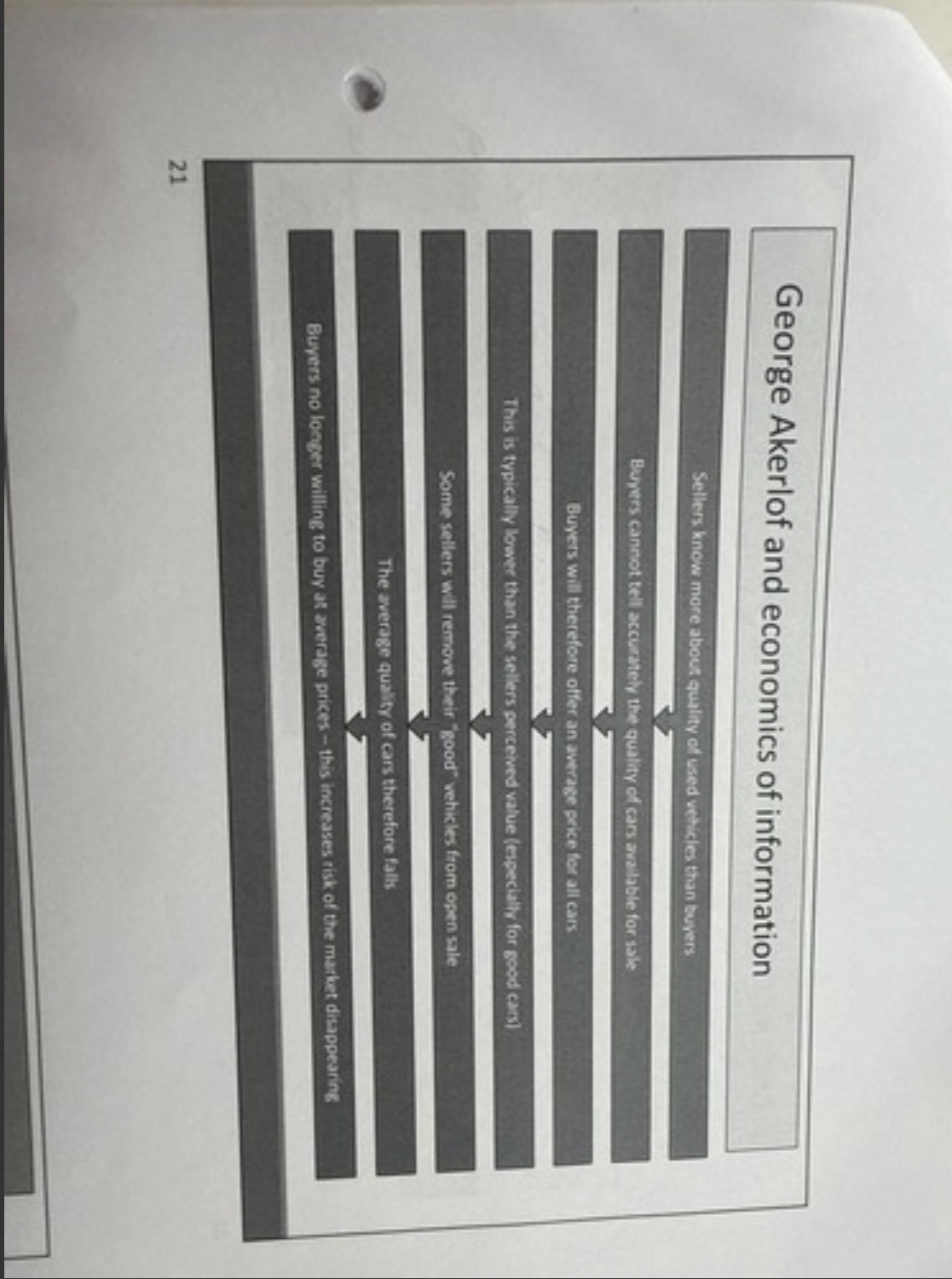
How can people overcome “the market for lemons”?
Get the AA to do a report, this removes asymmetric information, the buyer can then decrease the price accordingly
Give 2 ways that we can overcome the lemons problem
Require a full-service history including MOT test logs
Extended car warranties to lower risk of purchase
Give 5 examples of interventions to improve information
Health warnings
Nutritional labeling
Gamble aware
Industry standards
Consumer protection laws
What is the significance of information gaps/failure?
Fake news and misleading advertising damage consumer sovereignty and lead to a loss of allocative efficiency
What is bounded rationality?
The idea that humans have limited cognitive resources and are unable to make completely rational decisions (they must make decisions based on information available)
Give examples of “nudges” and “shoves”?
Nudges - recommendations
Shoves - taxes/penalties
Give a real world example of a shove?
Tax on the ULEZ zones in Bristol and London
What does consumer sovereignty mean?
Consumer surplus (power)
What is misinformation?
Passing on information that someone gently
believed was true, then they passed on, to find out it was wrong
Give an example of misinformation?
If a company believed they had X amount of sugar in their product, but this was wrong
What is disinformation?
When businesses purposely pass on incorrect information to manipulate consumers
Describe heuristics/rule of thumb
A quick mental shortcut that allows you to have a problem, or make decisions rapidly without doing a full, low analysis
If people use heuristics/rule of thumb, are they less or more rational?
Less rational - thinking slow
Give an example of heuristics/rule of thumb
Restaurants
could research restaurants online (through customer reviews, ratings, health inspection scores, menu prices)
BUT (the rule of thumb), if the restaurant is busy, people assume it must be good
Give another example of heuristics? (shopping)
Tesco online shopping - placing the same order again and again
Give an example of price-quality heuristic
Many consumers assume that higher-priced products are better quality
Give some other type of heuristics?
Familiarity, brand loyalty, availability

What are the irrational thoughts behind tanning salons?
People overestimate the short term benefits and underestimate the long term costs
What concept does “habitual purchase” link to?
Heuristics/rule of thumb