1 - Factors affecting rate of reaction
 Call Kai
 Learn
Learn Practice Test
 Spaced Repetition
 Match
Match Flashcards
 Knowt Play
1/19

There's no tags or description
Looks like no tags are added yet.
Name | Mastery | Learn | Test | Matching | Spaced | Call with Kai | Chat |
|---|
No analytics yet
Send a link to your students to track their progress
20 Terms
Why is the initial rate of reaction measured?
There are no limiting factors & it is the only point when the concentration of the reactants & products are known
What are the four factors that affect the rate of an enzyme-controlled reaction?
Temperature
pH
Enzyme concentration
Substrate concentration
What equipment is required for this practical?
Powdered skimmed milk suspension (2%)
Trypsin solution (1%)
6 test tubes & holder
Stop clock
Two 5cm3 pipettes
Colorimeter (before taking values, calibrate it with either trypsin or distilled water & set filter to complementary colour to solution; don’t use filter that is the same colour as the solution)
2 cuvettes (use the same cuvette, to ensure the wall thickness is the same & make sure it doesn’t have any scratches on it)
Distilled water
What is the method for this practical?
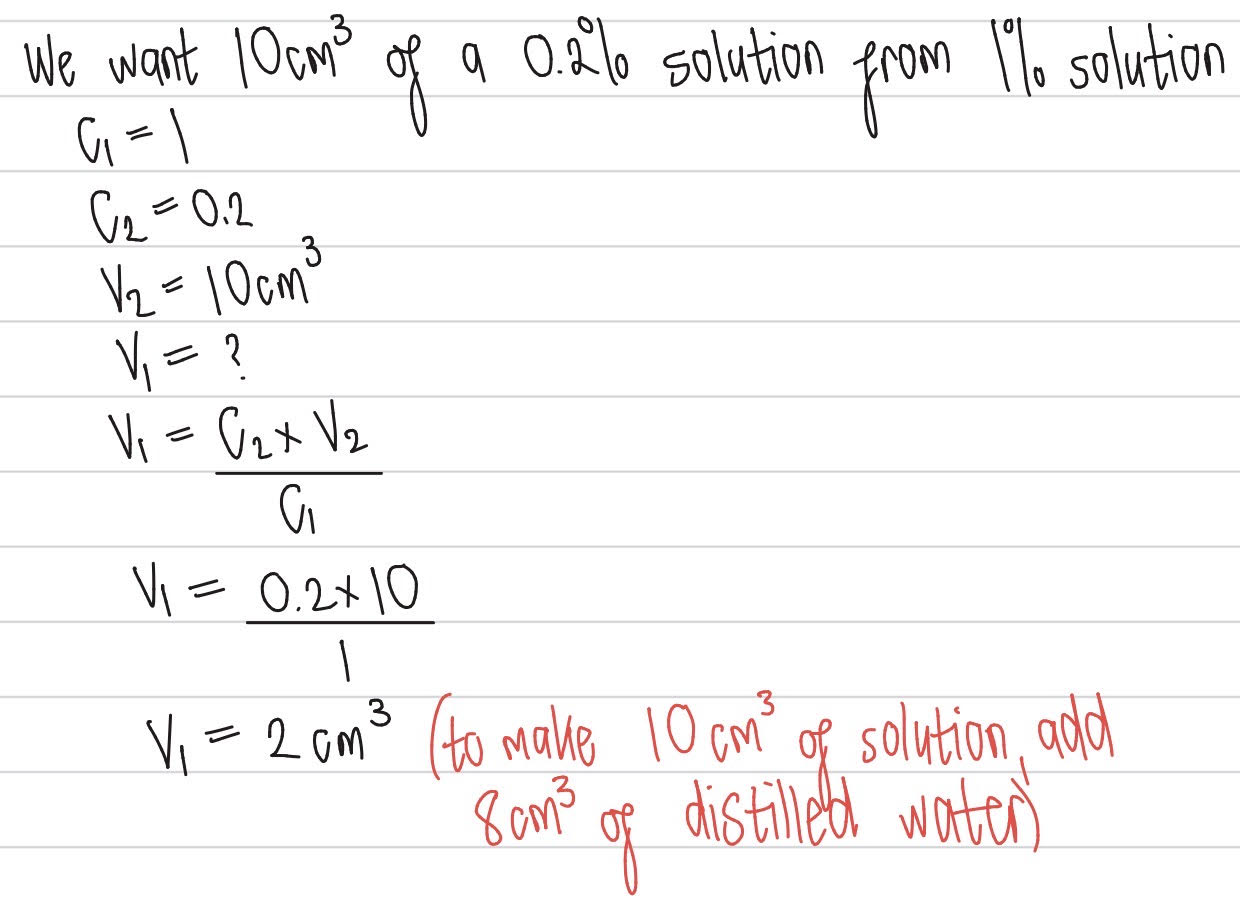
Dilute a stock solution of trypsin with distilled water to produce solutions with concentrations of 0.2%, 0.4%, 0.6%, 0.8% & 1.0%
Make a control by adding 2cm3 of trypsin solution & 2cm3 of distilled water into a cuvette. Use this to set the colorimeter absorbance to zero
To another cuvette, add 2cm3 of milk suspension & 2cm3 of the stock trypsin solution. Mix & place the solution into the colorimeter & start the stop clock
Measure the absorbance immediately & then at 15 second intervals for 5 minutes
Rinse the cuvette with distilled water & repeat for each concentration
What are some control variables for measuring enzyme activity?
Replace the trypsin solution with distilled water or boiled enzyme solution
Temperature: use a thermostatically controlled water bath & check regularly with a thermometer (add cool water if it gets too hot or add warm water if it gets too cold)
pH: use pH buffer to avoid changes & monitor regularly with a pH meter/probe
What should you include when describing control variables?
Why does it need to be controlled?
How to monitor it?
What to do if it changes?
What is the equation to measure the rate of reaction?
Rate of reaction = 1 / mean time
could multiply all values by 1,000 to avoid tricky decimals (make this clear in table & axes of graph)
mean time:
point at which graph levels off / time it took (transmission by time graph)
if there are 3 lines on the graph with different variables, there’ll be 3 different mean times
What is the risk, safety precaution & in emergency for the hazard: broken glass
Risk:
cuts from sharp object
Safety precaution:
take care when handling glass objects
keep away from edge of desk
In emergency:
elevate cuts & apply pressure
don’t remove glass from wound
seek medical assistance
What is the risk, safety precaution & in emergency for the hazard: hot liquids
Risk:
scalding & burns
Safety precaution:
handle with care & use tongs to remove boiling tubes from water bath
wear eye protection
In emergency:
run burn under cold water
seek medical assistance
What is the risk, safety precaution & in emergency for the hazard: enzymes
Risk:
allergies
Safety precaution:
avoid contact with skin/eyes (wear gloves)
wear eye protection (e.g. goggles)
In emergency:
seek assistance
What is the conclusion from this practical?
Milk contains a white protein (casein), which when broken down, causes it to turn colourless → trypsin is a protease enzyme which hydrolyses the protein
As trypsin concentration increases, the number of enzyme-substrate complexes increases, so rate of reaction increases
Rate plateaus when all substrates occupy an active site → increasing enzyme concentration will have no effect, as substrate concentration is the limiting factor
How can a colorimeter determine the rate of reaction of trypsin & milk?
As trypsin digests the proteins in milk, milk becomes more translucent & more light is transmitted through
a decrease in absorbance can be measured by the calorimeter
As absorbance increases, transmission decreases (e.g. dark/opaque solution has greater absorbance, but lower transmission)
What is the effect of enzyme concentration on enzyme activity?
As the concentration of enzyme increases, successful collisions to form enzyme-substrate complexes increase, so the rate of reaction increases to an optimum
Beyond the optimum, the rate plateaus as substrate concentration becomes the limiting factor
What is the effect of substrate concentration on enzyme activity?
Enzyme activity increases initially as substrate concentration increases (substrate concentration is the limiting factor) & higher concentration results in more successful collisions to form enzyme-substrate complexes
Beyond a certain substrate concentration, enzyme activity plateaus, as all the enzyme active sites are saturated & enzyme concentration is limiting
How is the effect of substrate concentration on enzyme activity investigated?
Prepare a simple dilution of milk/substrate concentrations
Add each solution to 1cm3 of trypsin of a fixed concentration
Record the absorbance immediately & every 15 seconds for 5 minutes
How is the effect of pH on enzyme activity investigated?
Add fixed volumes of buffer solutions with a range of pH values to 1cm3 of trypsin & 2cm3 of milk (both of a fixed concentration)
Record the absorbance immediately & every 15 seconds for 5 minutes
What is the effect of pH on enzyme activity?
Enzyme activity is highest at the optimum pH:
above or below the optimum pH, enzyme activity decreases as the unsuitable pH disrupts its tertiary structure & changes the shape of its active site, causing partial denaturation
complete denaturation may occur at extreme pH values

How is the effect of temperature on enzyme (trypsin) activity measured?
Prepare thermostatically controlled water baths with a range of temperatures
Place 2cm3 of trypsin solution & 2cm3 of milk suspension in each water bath
Leave for 5 minutes to allow the solutions to equilibrate & reach the temperature of the water bath
Mix together & record the absorbance immediately & every 15 seconds for 5 minutes
What is the effect of temperature on enzyme activity?
Increasing temperature increases enzyme activity to an optimum:
both substrate & enzyme molecules gain kinetic energy & move faster, so there are more successful collisions to form enzyme-substrate complexes
beyond the optimum temperature, enzyme activity decreases as the high temperature disrupts the tertiary structure of enzymes & denatures them

What is the equation to calculate a dilution & what do the terms represent?
C1 x V1 = C2 x V2
C1 = concentration of the stock solution
V1 = volume you need to make the new dilution
C2 = concentration that you want
V2 = volume of the concentration you want