[ CHEM1010 ] 6 - Chemical Reactions and Stoichiometry
 Call Kai
 Learn
Learn Practice Test
 Spaced Repetition
 Match
Match Flashcards
 Knowt Play
1/49

There's no tags or description
Looks like no tags are added yet.
Name | Mastery | Learn | Test | Matching | Spaced | Call with Kai | Chat |
|---|
No analytics yet
Send a link to your students to track their progress
50 Terms
Chemical change.
What type of change in matter results in new chemical substances?
A process where one or more substances are converted into one or more different substances.
How is a chemical reaction defined in terms of substance conversion?
Combustion
A chemical reaction where a substance combines with oxygen to form oxygen-containing compounds is called a _____ reaction.
Heat.
What secondary output, besides new compounds, is typically emitted during a combustion reaction?
Change in temperature
Formation of color or light
Formation of gas
Formation of a solid
List the four primary physical changes that indicate a chemical reaction has occurred.
Exothermic reaction.
What is the specific term for a chemical reaction that feels warm to the touch?
Extra heat is given away.
What occurs to heat during an exothermic reaction?
Endothermic reaction.
What is the specific term for a chemical reaction that feels cold to the touch?
Heat is taken away from the surroundings (such as your hand).
In an endothermic reaction, where is the heat taken from to make the reaction feel cold?
Reactants.
In a chemical equation, what are the starting substances located to the left of the arrow called?
Products.
In a chemical equation, what are the final substances located to the right of the arrow called?
Gas.
What does the abbreviation (g) indicate when placed as a subscript in a chemical equation?
Liquid.
What does the abbreviation (l) indicate when placed as a subscript in a chemical equation?
Solid.
What does the abbreviation (s) indicate when placed as a subscript in a chemical equation?
Aqueous (a water solution).
In the context of chemical states, what does the abbreviation (aq) represent?
The periodic table.
What tool provides the physical state of elements that are written alone in a chemical equation?
Gas.
Based on the periodic table legend, what physical state is represented by the color orange?
Liquid.
Based on the periodic table legend, what physical state is represented by the color blue?
Solid.
Based on the periodic table legend, what physical state is represented by the color white?
Mercury (Hg) and Bromine (Br).
Identify the two elements that exist in a liquid state at room temperature according to the provided periodic table.
Gas (g).
What is the standard physical state of Hydrogen (H2) in a chemical equation?
Solid (s).
What is the standard physical state of Lithium (Li) in a chemical equation?
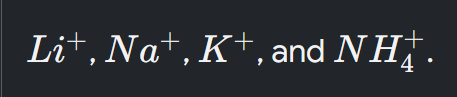
Which four ions always form soluble compounds in water with no exceptions?
Generally soluble.
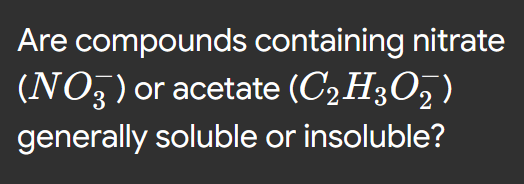
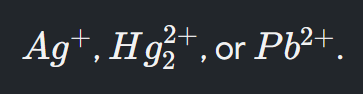
Compounds containing Cl−, Br−, or I− are insoluble when paired with which three specific metal ions?
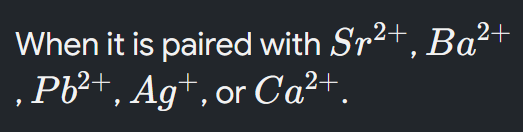
Under what conditions is a compound containing sulfate (SO42−) considered insoluble?
Insoluble.
Is Silver Chloride (AgCl) soluble or insoluble in water?
Generally insoluble.
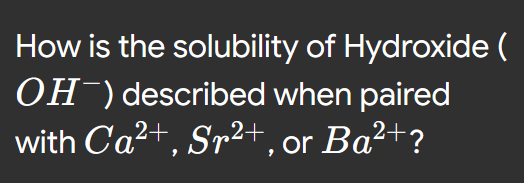
Are compounds containing hydroxide (OH−) and sulfide (S2−) generally soluble or insoluble?
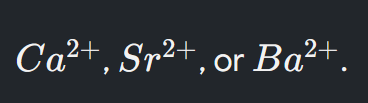
Sulfide (S2−) becomes soluble when paired with which group of metal ions besides alkali metals and ammonium?
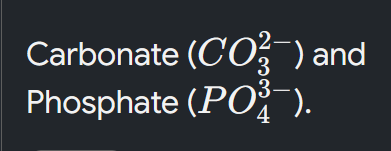
Slightly soluble.
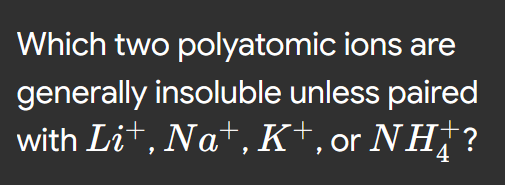
Yes.
Is Sodium Fluoride (NaF) soluble in water?
Yes.
Is Potassium Chromate (K2CrO4) soluble in water?
Lead(II) Iodide (PbI2).
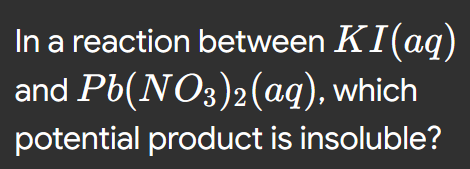
Law of Conservation of Mass.
What law states that mass cannot be created or destroyed in a chemical reaction?
Mass of the products
According to the Law of Conservation of Mass, the mass of the reactants must equal the _____.
4 carbon atoms.
If a reaction starts with 4 carbon atoms in the reactants, how many carbon atoms must be present in the products?
The coefficients.
To balance a chemical equation, which part of the chemical formula are you permitted to change?
The subscripts.
Which part of a chemical formula must never be changed when attempting to balance an equation?
Carbon dioxide (CO2) and water (H2O).
What are the two products of the complete combustion of methane (CH4)?
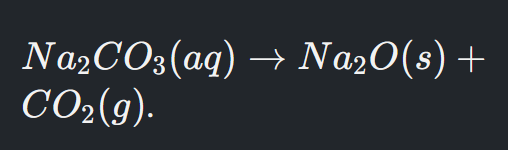
Provide the balanced chemical equation for the reaction of sodium carbonate to produce sodium oxide and carbon dioxide.
Sulfurous acid (H2SO3).
What is produced when sulfur dioxide gas reacts with water?
247.9 g
Calculating the total mass of 2 moles of Ag (2×107.9 g) and 1 mole of S (32.1 g) results in a product mass of _____.
They can be used to determine weights of reactants used and products that can be made.
Why are relative numbers of reactant and product molecules useful in chemical equations?
Yellow.
According to the provided table, what is the 'Legend' color for synthetic elements?
Generally soluble.
Are compounds containing the acetate ion (C2H3O2−) generally soluble or insoluble?
Methane (CH4) and Oxygen (O2).
In the reaction CH4+2O2→CO2+2H2O, identify the reactants.
Sodium chloride (NaCl).
In the reaction Na+Cl2→NaCl, identify the product.
Formation of gas
The formation of bubbles in a liquid during a reaction is a sign of the _____.
Formation of a solid
The appearance of a solid precipitate in a previously clear solution indicates the _____.