Functional Neuroanatomy of the Spinal Cord and Brainstem
 Call Kai
 Learn
Learn Practice Test
 Spaced Repetition
 Match
Match Flashcards
 Knowt Play
1/106

There's no tags or description
Looks like no tags are added yet.
Name | Mastery | Learn | Test | Matching | Spaced | Call with Kai | Chat |
|---|
No analytics yet
Send a link to your students to track their progress
107 Terms
What is the primary function of the spinal cord?
The spinal cord connects the brain with the peripheral nervous system and mediates sensory and motor functions.
Where does the spinal cord extend from and to in adults?
From the medulla at the foramen magnum to approximately L1-L2.
How many spinal cord segments are there?
31 spinal cord segments.
What are the two enlargements of the spinal cord and their functions?
Cervical enlargement for upper limbs and lumbosacral enlargement for lower limbs.
What is the conus medullaris?
The tapered end of the spinal cord located at L1-L2.
What is the cauda equina?
A bundle of lumbar and sacral nerve roots that continue below the conus medullaris.
What are the three types of horns in the spinal cord gray matter?
Dorsal horn (sensory), ventral horn (somatic motor), and lateral horn (autonomic).

What is the role of the dorsal root?
It carries sensory (afferent) information to the spinal cord.
What is the role of the ventral root?
It carries motor (efferent) information away from the spinal cord.
What is found in the dorsal root ganglion?
Sensory neuron cell bodies.
What is the composition of spinal nerves?
Each spinal nerve contains both sensory and motor fibers.
What is the function of ascending tracts in the spinal cord?
They transmit sensory information to higher centers in the brain.
What is the function of descending tracts in the spinal cord?
They transmit signals from higher centers in the brain to target sites.
What is a reflex arc?
A neural pathway that mediates reflex actions, involving sensory input and motor output.
What are the protective coverings of the spinal cord?
The vertebral column and meninges.

What is cerebrospinal fluid (CSF) and its function?
CSF surrounds the spinal cord and provides cushioning and protection.

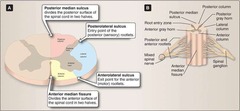
What is the anterior median fissure?
A prominent groove on the anterior surface of the spinal cord that divides it into right and left halves.
What is the significance of the lateral horn?
It contains autonomic neurons, particularly prominent in thoracic and upper lumbar levels.
What is the role of the filum terminale?
A fibrous extension of the pia mater that anchors the spinal cord to the coccyx.
What is the function of the brachial plexus?
It innervates the upper extremities and is formed by nerve roots from the cervical enlargement.
What is the lumbar plexus?
A network of nerves formed by lumbar nerve roots that innervate the lower extremities.
What is the sacral plexus?
A network of nerves formed by sacral nerve roots that innervate the lower extremities and contain parasympathetic fibers.
What is the butterfly-shaped gray matter in the spinal cord composed of?
Neuronal cell bodies organized into dorsal, ventral, and lateral horns.

What are the major ascending sensory tracts in the spinal cord?
They are organized into posterior, lateral, and anterior funiculi.
What is the role of the anterior white commissure?
It is where some sensory and motor fibers cross the midline of the spinal cord.
What is the difference between afferent and efferent fibers?
Afferent fibers carry sensory information to the spinal cord, while efferent fibers carry motor information away from it.
How does the spinal cord contribute to homeostasis?
Through reflexes and the regulation of autonomic functions.
What are the two types of fibers in the spinal nerve?
Sensory (afferent) fibers and motor (efferent) fibers.
What does a dorsal root lesion cause?
Sensory deficit.
What does a ventral root lesion cause?
Motor deficit.
What does a spinal nerve lesion cause?
Sensory and motor deficits.
What connects the two sides of the gray matter in the spinal cord?
The gray commissure.

What is the shape of the central gray matter in the spinal cord?
Shaped like a butterfly.
What are the three funiculi in each half of the spinal cord?
Dorsal (posterior), lateral, and anterior (ventral) funiculi.
What is the function of the dorsal root ganglion (DRG)?
It contains the cell bodies of primary sensory neurons.
What is the role of the brainstem?
It serves as a pathway between the spinal cord and higher brain centers and controls cranial nerve, autonomic, and integrative functions.
What are the major ascending tracts in the brainstem?
They carry sensory information toward higher CNS centers.
What are the major descending tracts in the brainstem?
They carry motor commands toward the spinal cord.
What is the function of the reticular formation in the brainstem?
It regulates arousal, autonomic functions, and motor modulation.
What cranial nerves are associated with the midbrain?
Cranial nerves III and IV, involved in eye movements and visual/auditory reflexes.
What cranial nerves are associated with the pons?
Cranial nerves V to VIII, involved in facial sensation/movement, hearing, and balance.
What cranial nerves are associated with the medulla?
Cranial nerves IX to XII, involved in swallowing, tongue movement, and autonomic control.
What is the main difference between the dorsal column and spinothalamic tract?
The dorsal column crosses in the medulla, while the spinothalamic tract crosses in the spinal cord.
What does the dorsal column-medial lemniscus pathway carry?
Fine/discriminative touch, vibration, and conscious proprioception.
What does the spinothalamic/anterolateral system primarily carry?
Pain, temperature, and crude touch.
What is the significance of the decussation point for sensory tracts?
It determines which side of the brain processes sensory information from which side of the body.
What are Rexed's laminae?
Zones in the gray matter of the spinal cord organized according to the structure and function of neurons.

What is the role of the marginal zone in the dorsal horn?
It receives sensory information about temperature and pain from the skin.
What does the substantia gelatinosa transmit?
Impulses related to pain, temperature, and light touch to the brain.
What is the nucleus proprius responsible for?
Combining sensory information of light touch, pain, and temperature.
What is the anterior white commissure?
A band of decussating axons located ventral to the gray commissure.
What is the central canal in the spinal cord?
A canal located in the gray commissure, may contain debris in adults.
What is the function of the alpha motor neuron?
To activate muscles and control voluntary movement.
What is the role of Renshaw cells?
To inhibit alpha motor neurons, providing feedback regulation.
What type of information do spinocerebellar pathways carry?
Unconscious proprioceptive information to the cerebellum.
What are the three directions in which nerve fibers run?
Ascending (sensory inputs), descending (motor outputs), and transversely (commissural fibers).
What do ascending tracts in the spinal cord primarily carry?
Sensory information from peripheral receptors to the brain.
What are the three white columns of the spinal cord called?
Posterior, lateral, and anterior funiculi.
What is the role of the fasciculus gracilis?
It contains long ascending fibers from the lower limbs and is involved in conscious proprioception.
Where is the fasciculus cuneatus located?
In thoracic segments above T6 and cervical segments (C1-C8), containing fibers from the upper limbs.
What forms the medial lemniscus?
The axons of second-order neurons in the nucleus gracilis and cuneatus that cross in the midline.
What does the posterior column medial-lemniscus system carry?
Discriminative touch, vibration, pressure, and conscious proprioception to the primary somatosensory cortex.
What infectious disease causes impairment of the posterior columns?
Neurosyphilis, specifically leading to tabes dorsalis.
What is the major pathway for voluntary motor control?
The corticospinal tract.
What are the two systems controlling motor activity?
Upper motor neuron (UMN) system and lower motor neuron (LMN) system.
What does the corticospinal tract primarily control?
Skilled movements and voluntary motor control.
Where do descending motor tracts arise from?
The cortex and brainstem.
What is the role of the anterior corticospinal tract?
Mediates postural adjustments in response to voluntary movements.
What is the significance of posturing in a comatose patient?
It can indicate the location of lesions or extent of brain damage.
How do first-order neurons in the dorsal root ganglion function?
They innervate sensory receptors like Pacinian and Meissner's corpuscles.
What happens to the axons of the first-order neuron in the spinal cord?
They ascend ipsilaterally and terminate on second-order neurons in the ipsilateral nucleus gracilis.
What is the function of the spinothalamic tract?
Carries pain and temperature sensations and crosses in the spinal cord.
What is the primary function of the rubrospinal tract?
Regulates flexor motor systems and fine movements of the limbs.
What is the role of the vestibulospinal tract?
Regulates antigravity muscles, posture, and balance.
What is the decussation of the medial lemniscus?
The crossing of second-order neuron axons in the midline to form the medial lemniscus.
What does the term 'somatotopically' refer to in the context of sensory neuron termination?
The organization of neurons in a way that reflects the spatial arrangement of the body.
What is the role of the internal capsule in motor control?
It transmits motor signals from the motor cortex to the brainstem and spinal cord.
What type of fibers are found in the lateral corticospinal tract?
Fibers that control voluntary movements of the limbs.
What is the function of commissural fibers?
Connect the left and right sides of the spinal cord.
What is the primary function of the reticulospinal tract?
Modulates autonomic functions and influences motor activity.
What is the significance of the pyramidal decussation?
It is where the corticospinal tract fibers cross to the opposite side of the body.
What does extensor posturing indicate?
A lesion at the level of the midbrain or rostral pons.
What is the result of extensor posturing?
Excessive input to spinal cord interneurons via the reticulospinal tract.
What characterizes flexor posturing?
Upper limbs flexed and lower limbs extended, indicating a lesion rostral to the red nucleus.
What remains intact in flexor posturing despite interruptions?
The rubrospinal tract and the reticulospinal tract.
What are the two essential functions of the spinal cord?
Two-way conduction pathway and intrinsic reflex center.
What type of reflex involves the somatic nervous system?
Somatic reflexes.
What type of reflex involves the autonomic nervous system?
Visceral reflexes.
What are the components of a reflex arc?
Receptor, sensory neuron, integration center, motor neuron, effector.
What is the myotatic reflex?
An involuntary monosynaptic reflex involving a two-neuronal arc.
What triggers the myotatic reflex?
A quick tap delivered to the patellar tendon.
What is reciprocal inhibition in the myotatic reflex?
Excitation of alpha motor neurons causing contraction of the homonymous muscle while inhibiting antagonist muscles.
What defines a dermatome?
The area of skin supplied by the right and left dorsal roots of a single spinal segment.
What happens if one dorsal root is sectioned?
Sensation in the corresponding dermatome is not lost due to overlapping innervation.
Which cranial nerve nuclei functions are involved in the brainstem?
Sensory, motor, and autonomic functions.
What is the major function of the brainstem?
Passage of ascending sensory and descending motor pathways.
What is the correct sequence of the major divisions of the brainstem from superior to inferior?
Midbrain → Pons → Medulla.
What is the most useful question set for predicting clinical effects of a lesion?
What information does it carry, where does it cross, and where does it terminate?
What does a lesion affecting a major ascending tract in the spinal cord interfere with?
Sensory information traveling toward the brain.
What are upper motor neurons (UMNs)?
Motor neurons in the cortex that send signals to lower motor neurons.