Disorders of calcium metabolism (TV4102, Lecture 34 Notes)
 Call Kai
 Learn
Learn Practice Test
 Spaced Repetition
 Match
Match Flashcards
 Knowt Play
1/11

There's no tags or description
Looks like no tags are added yet.
Name | Mastery | Learn | Test | Matching | Spaced | Call with Kai | Chat |
|---|
No analytics yet
Send a link to your students to track their progress
12 Terms
Discuss parturient hypocalcaemia (milk fever)
- Development of paresis and severe hypocalcaemia around calving (within 24hrs)
- Weakness, recumbency, depression of consciousness, and ultimately death
- Marked difference in incidence between herds due to breed (especially Jerseys), management and control practices/procedures
- Increased risk in older cows is associated with decreased capacity to mobilise Ca from bone
Discuss subclinical hypocalcaemia
- Episodes of subclinical hypocalcaemia, lasting 1-2 days, may occur 2-3 times, at an interval of ~9 days, during first few weeks of lactation
- May cause decreased DMI, increased risk of secondary disease conditions, decreased milk production and fertility later on in lactation
Discuss non-parturient hypocalcaemia
- Recumbency due to hypocalcaemia, but not associated with calving
- Consequence of a sudden drop in appetite (e.g. mild rumen acidosis, mastitis, oestrus activity), diarrhoea in cows grazing lush pasture or oat crops, with transport or in cows nursing multiple calves
Describe the pathogenesis of hypocalcaemia
- Ionised Ca concentration [Ca2+] in the blood must be maintained at a relatively constant value
- During the dry period Ca requirement is minimal (10-12 g Ca/day)
- Around calving there is a sudden increase in requirements producing colostrum (2-3 g Ca/kg) or milk (1.22-1.45 g Ca/kg) must withdraw 20-40 g Ca from her Ca pools each day
- When not available in the plasma pool, there is a need to withdraw/mobilise Ca from the bone, or increase the rate of Ca absorption from the diet
- These processes take 2-3 days to become fully active hypocalcaemia results if they fail
Describe calcium homeostasis
Control via interaction of three hormones;
- Parathyroid hormone (PTH)
- 1,25-dihydroxycholecalciferol (1,25DHD)
- Calcitonin

Discuss stage 1 hypocalcaemia
- Progressive over a period of 12-24 hrs
- Hyperaesthesia, with teeth grinding and muscle tremors of head and neck, stiffness of the limbs (tetany), straight hocks and 'paddling' of the feet when walking
- Sometimes aggressive
- Cows show ataxia and are reluctant to walk
- T normal to slightly elevated, HR normal or slightly increased, rumen stasis
- Increasing difficulty for affected animal to get back on its feet
Discuss stage 2 hypocalcaemia
- Commonly last from 1-12 hours
- Unable to stand, but animal remains in sternal recumbency
- Depression, dry muzzle, cold extremities, often lateral bend (S-shaped kink) in the neck then the head becomes averted against the chest
- Eyes usually dry, pupils dilated, pupillary light reflex reduced or absent
- T often sub-normal, HR slightly elevated (80-90 bpm), but intensity of heart sounds is markedly reduced
- Rumen stasis and secondary bloat are common, faeces dry, commonly covered with a thin layer of mucus
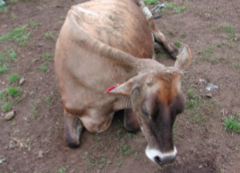
Discuss stage 3 hypocalcaemia
- Will not survive for more than a few hours without effective treatment
- Lateral recumbency, progressive loss of consciousness, coma and death
- HR significantly increased (120 bpm), heart sounds almost inaudible
- Often severely bloated and may regurgitate rumen contents, risk of aspiration pneumonia
- Rumen tympany and/or paralysis of respiratory muscles causes death in untreated animals
Discuss diagnosis of hypocalcaemia
- Response to treatment diagnostic aid
- May be confirmed by measuring serum [Ca], reduction is usually proportional to the severity of the condition
- Hypophosphataemia is frequently observed in blood samples collected from cows with milk fever
Discuss treatment of hypocalcaemia
- Animals in lateral recumbency should first be moved into sternal recumbency
- Ca borogluconate (1 g Ca/45 kg BW, IV or SC, administered over 5-10 minutes, warmed to body temperature)
- May be cardiotoxic, HR slows down and intensity of sounds increases, if arrhythmia becomes marked stop the i/v infusion (if severe 10% Mg sulphate (100-400 mL) IV may be life-saving)
- Cows often urinate and/or defaecate, passing firm faeces, immediately after getting up
Discuss prevention of hypocalcaemia
- Restrict the amount of green pasture offered to springing cows in the last 2 wks prior to calving
- Providing ad lib low-potassium hay, high fibre intake increases salivation, moves bicarbonate from the bloodstream into rumen, increasing blood acidity and absorption of Ca from the gut and resorption from bone
- Supplementing with magnesium over this period (e.g. magnesium oxide sprinkled over the supplementary feed at a rate of 50 g/cow/day)
- Feeding pre-partum cows diets that contain low Ca levels (i.e. 20 mg/kg/day) will stimulate PTH secretion
- Supplementation with a calcium and phosphorous binder (synthetic zeolite) can bind Ca and P in the rumen making it unavailable
- Provision of oral Ca at calving, dosing with large amounts of very soluble Ca (i.e. 150 g of calcium chloride daily, in the form of drenches, gels or boluses)
- Supplementing with vitamin D prior to calving increases intestinal absorption of Ca, injecting vitamin D3 (250 mg cholecalciferol) intramuscularly 2-8 days prior to calving markedly reduces the incidence of milk fever
Discuss dietary cation-anion difference (DCAD)
- Described in terms of mEq/kg of Na+ and K+ (increase), S2- and Cl- (decrease)
- Feeding anionic salts induces a strong ion acidosis (metabolic acidosis) in blood plasma
- Compensated metabolic acidosis facilitates mobilisation of Ca from bone into the blood
- Lowering blood pH allows PTH to act on its receptor (bone), release of cations (mainly Ca) from bone
- Feed low-potassium cereal hays or maize silage, ~3 kg concentrates to increase ME content of the diet with DCAD as low as possible by appropriate ration manipulation followed by anionic salts (CaCl2, MgCl2, NH4Cl, CaSO4, MgSO4, (NH4)2SO4) or use a masking agent