SERMs, SERDs, Aromatase Inhibitors, & Drugs Used in Infertility
 Call Kai
 Learn
Learn Practice Test
 Spaced Repetition
 Match
Match Flashcards
 Knowt Play
1/38

There's no tags or description
Looks like no tags are added yet.
Name | Mastery | Learn | Test | Matching | Spaced | Call with Kai | Chat |
|---|
No analytics yet
Send a link to your students to track their progress
39 Terms
What types of non-steroidal SERMS have tissue selective action?
1. Tamoxifen
2. Raloxifene
3. Tormifene
4. Clomiphene (or antiestrogen according to G & G)
What are the benefits of Selective Estrogen Receptor Modulators (SERMs)?
- act as agonists to produce beneficial estrogenic effects
- act as antagonists to prevent deleterious estrogenic effects on others
Where does Tamoxifen act as a potent estrogen antagonist?
breast cancer cells thus, useful in ER +/ PR+ breast cancer
Where does Tamoxifen act as a partial agonist?
Uterus: endometrial proliferation (increases risk of cancer)
Bone: improves density
Pituitary: lowers FSH/LH and PL
Liver: decreases LDL (no change in HDL or TG) and increases DVT risk
Where does Raloxifene act as a partial agonists and what is the effect?
ER in bone causing a dose dependent ↑ in osteoblastic and ↓ in osteoclastic activity
Where does Raloxifene act as an ER antagonist?
Endometrium: no risk of cancer
Breast: reduces cancer risk
Liver: decreases LDL (no HDL or TG) and increases thromboembolism
What is the primary clinical use of Raloxifene?
postmenopausal osteoporosis
What are the adverse effects of SERMS?
hot flashes, arthralgia, leg cramps
What are the contraindications to SERMS?
women at higher risk of thromboembolism
What are Selective Estrogen Receptor Degraders (SERDs)?
Pure ER antagonist; no estrogenic effects
What is the mechanism of action of SERDs?
causes ER to be ubiquitinated and undergo protosomal degradation
What is an example of a SERD?
FulvestRant (Full estrogen Receptor antagonist)
What is the clinical use of SERDs?
post-menopausal tamoxifen resistant ER+ breast cancer
What are the types of nonsteroidal (reversible) aromatase inhibitors?
anastrozole, letrozole, vorozole
What are the types of steroidal (irreversible) aromatase inhibitors?
exemestane
What is the mechanism of action of aromatase inhibitors?
Inhibits the CYP enzyme responsible for aromatization of androgens to estrogens
Which hormone conversions do aromatase inhibitors target?
- testosterone to estradiol
- androstenedione to estrone
Where are aromatase inhibitors most active?
peripheral tissues of post-menopausal women
What are the clinical uses of aromatase inhibitors?
- ER+ breast cancer in post-menopausal women
- follow up after tamoxifen use for 2-5 years
- precocious puberty
What are the adverse effects of aromatase inhibitors?
hot flashes, osteoporosis, vaginal dryness, and hair thinning
What is an advantage of aromatase inhibitors?
does not ↑ the risk of uterine cancer or venous thromboembolism
What are the disadvantages of aromatase inhibitors?
lack the beneficial effect of maintaining BMD; thus, given with bisphosphonates to decrease osteoporosis
What is the mechanism of action of Clomiphene?
Effectively inhibit the negative feedback effect of E2 on hypothalamus/pituitary
What are the physiologic effects of Clomiphene?
- Increased secretion of gonadotropins (FSH/LH) and estrogens
- Follicular maturation and ovulation
What is the clinical use of Clomiphene?
anovulation in an intact hypothalamic-pituitary-ovarian axis and adequate estrogen production
What are the adverse effects of Clomiphene?
multiple pregnancies, reversible hot flashes, ovarian enlargement, and visual disturbances
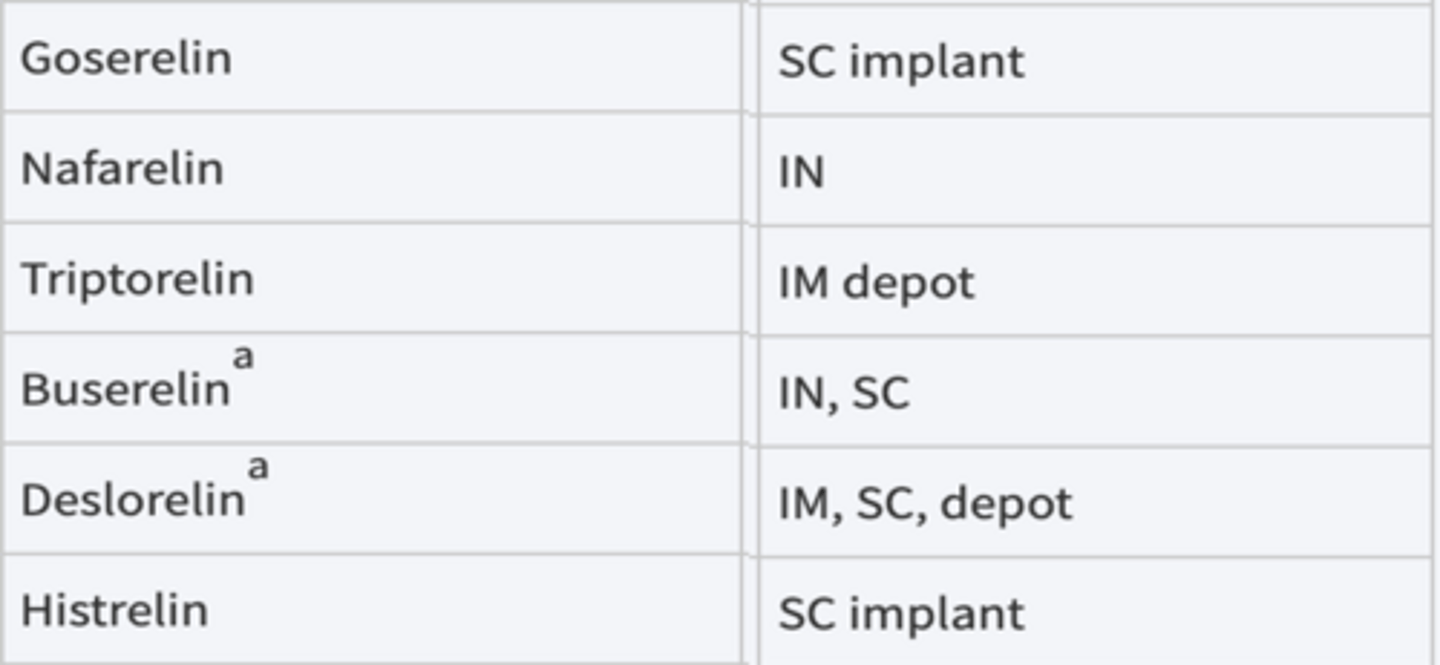
What are the types of synthetic GnRH analogs?
leuprolide and 'relins'
What is the mechanism of action of GnRH agonists on continuous administration?
Cause a transient stimulation of FSH/LH release f/b downregulation of the GnRH receptor and inhibition of FSH/LH secretion
What are the clinical uses of leuprolide and depot GnRHs?
- pharmacological castration in GnRH-dependent precocious puberty in children
- hormone responsive conditions (cancers, fibroids, endometriosis)
- prevents premature LH surge in women undergoing ART*
What are the adverse effects of GnRH agonsits?
hot flashes, vaginal dryness, osteoporosis, weight gain, decreased libido, testicular atrophy, erectile dysfunction
What is the mechanism of action of GnRH agonists on intermittenet administration?
stimulate FSH secretion in ART to facilitate follicle development and ovulation induction with hCG
How are Intermittent GnRH agonists administered?
low-frequency pulses (1/90 min) during the follicular phase
What are the types of GnRH Antagonists?
Ganirelix, Cetrorelix, Degarelix
What is the mechanism of action of GnRH Antagonists?
reversibly and competitively suppresses LH surge to prevent premature ovulation stimulation and immediately decrease gonadotropin secretion
What are the clinical uses of Ganirelix and Cetrorelix?
same as leuprolide depot injections under ART protocols
What is the clinical use of Degarelix?
advanced prostate cancer
What is the mechanism of action of Danazol?
Suppresses mid-cycle FSH/LH surge causing anovulation, endometrial atrophy, and amenorrhea over a few weeks
What is a primary use of Danazol?
Endometriosis
What are the adverse effects of Danazol?
acne, hirsutism, reduced breast size, deepening of voice, edema and weight gain