Histo class and Lab (HL) cards
 Call Kai
 Learn
Learn Practice Test
 Spaced Repetition
 Match
Match Flashcards
 Knowt Play
1/68

There's no tags or description
Looks like no tags are added yet.
Name | Mastery | Learn | Test | Matching | Spaced | Call with Kai | Chat |
|---|
No analytics yet
Send a link to your students to track their progress
69 Terms
Levels of Organization
Molecules→ Organelles→ Cells→ Tissues→ Organs→ Organ systems→ Organism
All cells and tissues come from a single cell aka
Zygote
Tissues
Group of cells with the same function and development
The steps of micrology
Fixation
Sectioning
Staining
Purpose of Staining (H&E) staining
Staining lets you see different parts of the cell/tissue
What’s H&E? What the colors mean? (Staining stuff btw)
Hematoxylin & Eosin, Purple shows nuclei, Pink shows proteins and cytoplasm
3 basic shapes of histology
Sheets, Blobs, Tubes

(LS)
Longitudinal Section
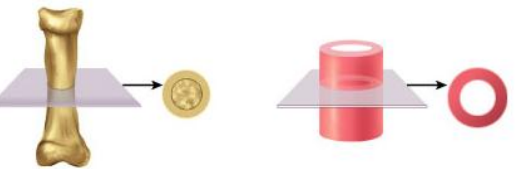
(XS)
Cross-Section
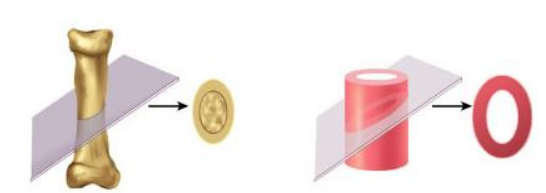
(OS)
Oblique section
4 basic classes of tissues M.E.N.C
Muscle
Epithelium
Nervous Tissue
Connective Tissues(CT)
What body plan vertebrates have?
tube-within-a-tube gooby gooby goo! Different tissues types arise from different layers of the embryo
Characteristics of Epithelial Tissues
Covers the surfaces of the body in sheets called Membranes
Inner lining of tubular structures
Secretory portion of glands

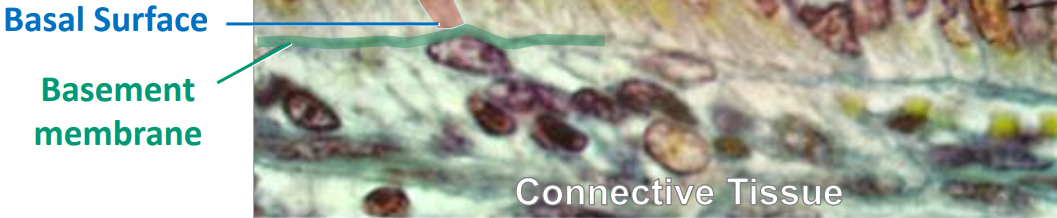
Apical Surface
Side of the surface not attached to other cells
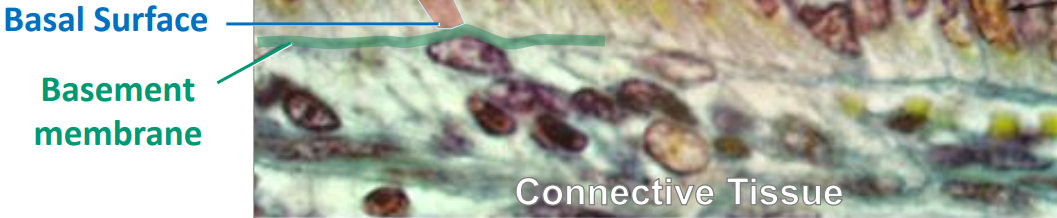
Basement membrane
connects epithelium to the connective tissues underneath
How are membranes fromed?
The closely packed epi cells have specialized junctions between each other with extra cellular fluid to make the sheets/membranes.
Epithelium has what osis and what type of healing
High rate of mitosis and regen
Avascular meaning in the Epithelium
Contains no blood vessels, Nutrients must diffuse from the underlying tissue, blood vessels on the other hand deals with endothelium
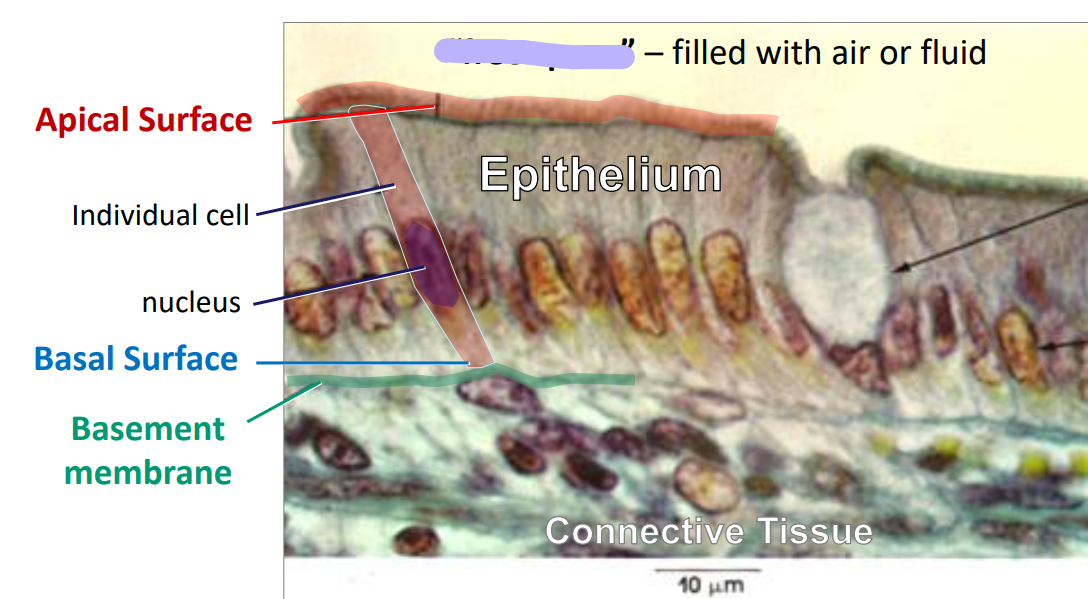
Free Space
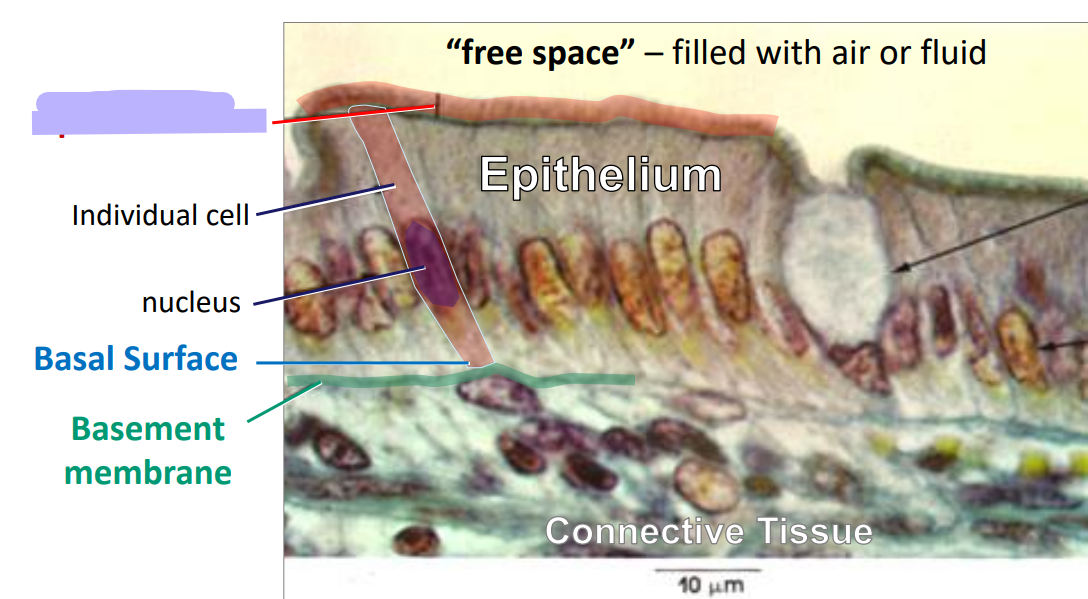
Apical Surface
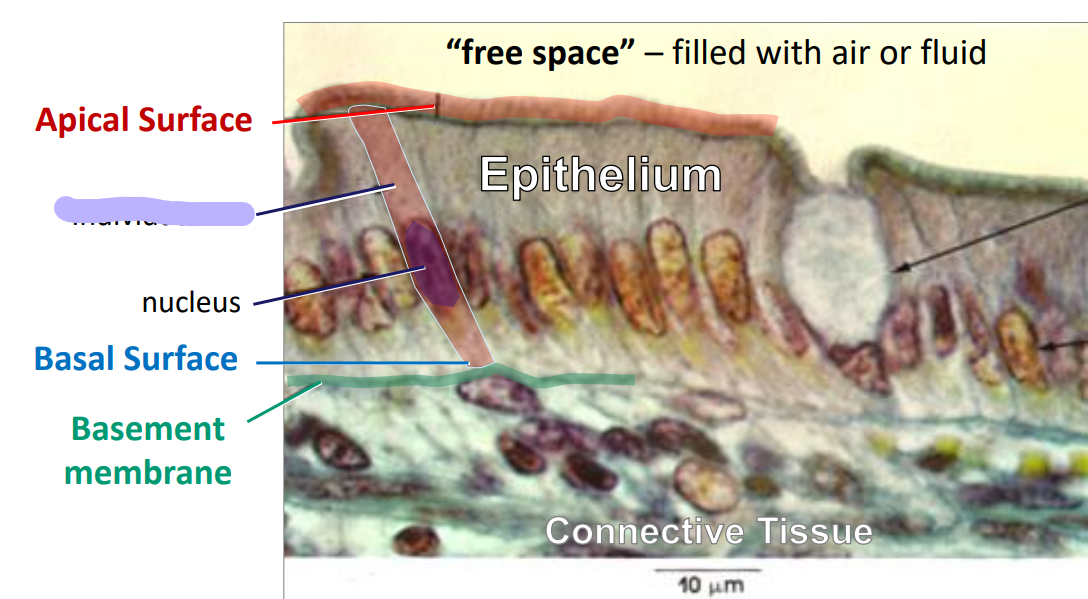
Individual Cell
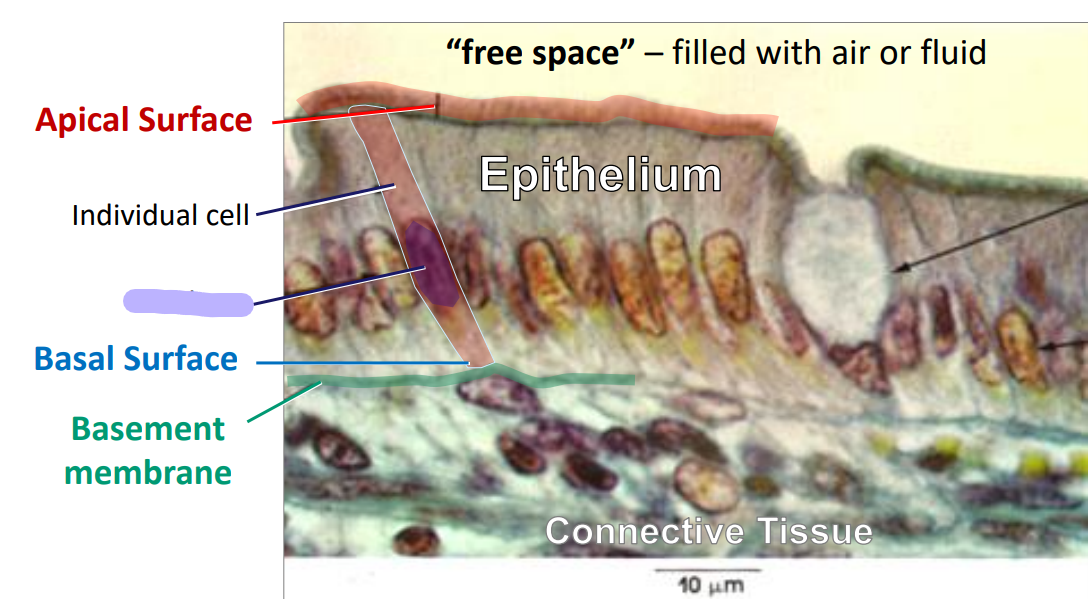
Nucleus
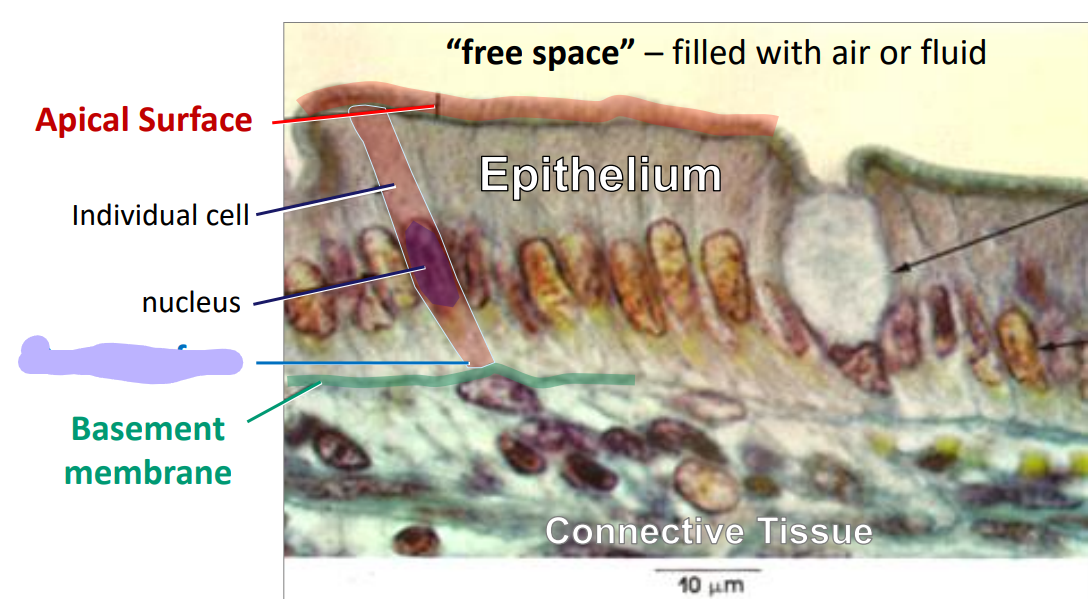
Basal Surface
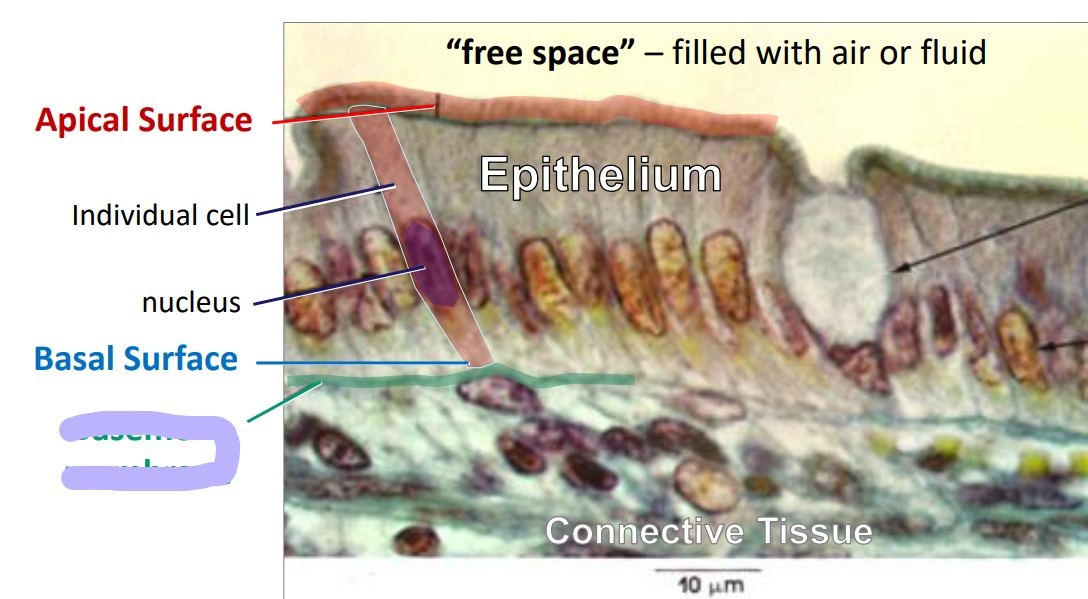
Basement Membrane

Connective Tissues
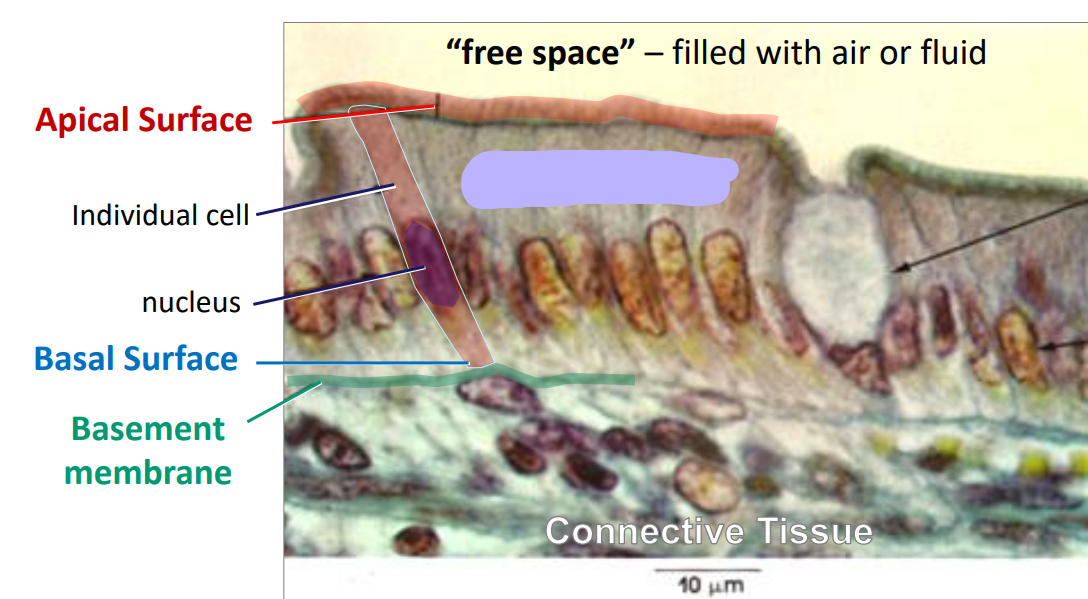
Epithelium
Epi Cells polar noinpolar?
Polar meaning organelles are not distributed evenly throughout cytoplasm
Attachment of Epithelium
Specialized junctions (Lateral)- Connect tightly packed cells and regulate communication among nearby cells
Basement membrane (Basal)- Extracellular proteins that anchor cells to underlying tissues
General functions of epithelium
Physical protection
Controls permeability, absorption & secretion
Sensation
Produce specialized secretions (Glands) ex. Sweat, Milk, Hormones, Digestive enzymes

What type of shape? (Basement membrane)
Squamous

What type of shape?
Cuboidal

What type of shape?
Columnar

What typa layering?
Simple
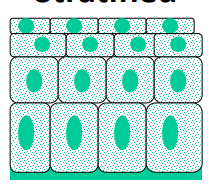
Typa layering
Stratified (2+ rows of cells)
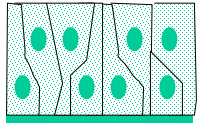
What type of layering
Pseudostratified (2+ rows that touches basement membrane)
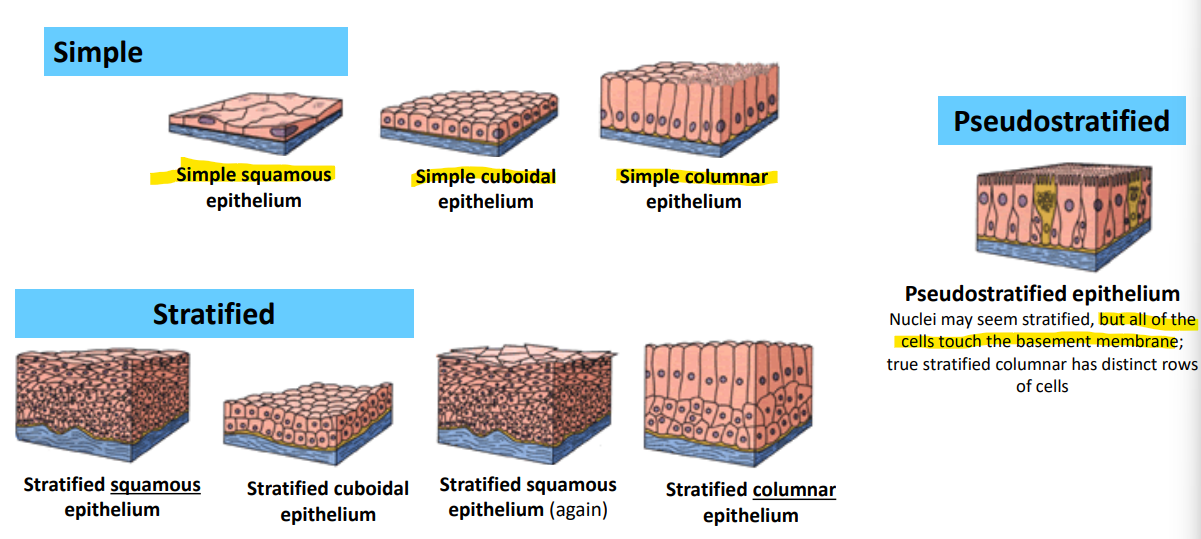
How do you classify epi layers and stuff
Classification is based on #of layers and shape of cells on the top layer (Apical surface)
Simple squamous function
Lines body cavity inside blood vessels/heart alveoli of lungs
endothelium
Lining of blood vessels
Simple Cuboidal Epithelium function
Found in Glands and ducts of kidneys, serves as limited protection secretion/and absorption
Simple columnar epithelium
Found in the lining of stomach, intestine, gallbladder, uterine tubes, Serves as protection secretion and absorption
4 Epithelial membranes in the body
Cutaneous membrane- External covering of body, skin and structures (ex: hair and sweat glands)
Mucous Membrane- Wet surfaces that ultimately connect to outside of body (ex: Respiratory tract, Digestive tract, Reproductive tubes)
Serous membrane- Does not open to outside and lines body cavity and covers outer surface of abdominal organs (ex lining of abdominal and thoracic cavities)
Endothelium- inner layer of blood vessels & heart, entire circulatory & lymphatic systems share one continuous layer of endothelium
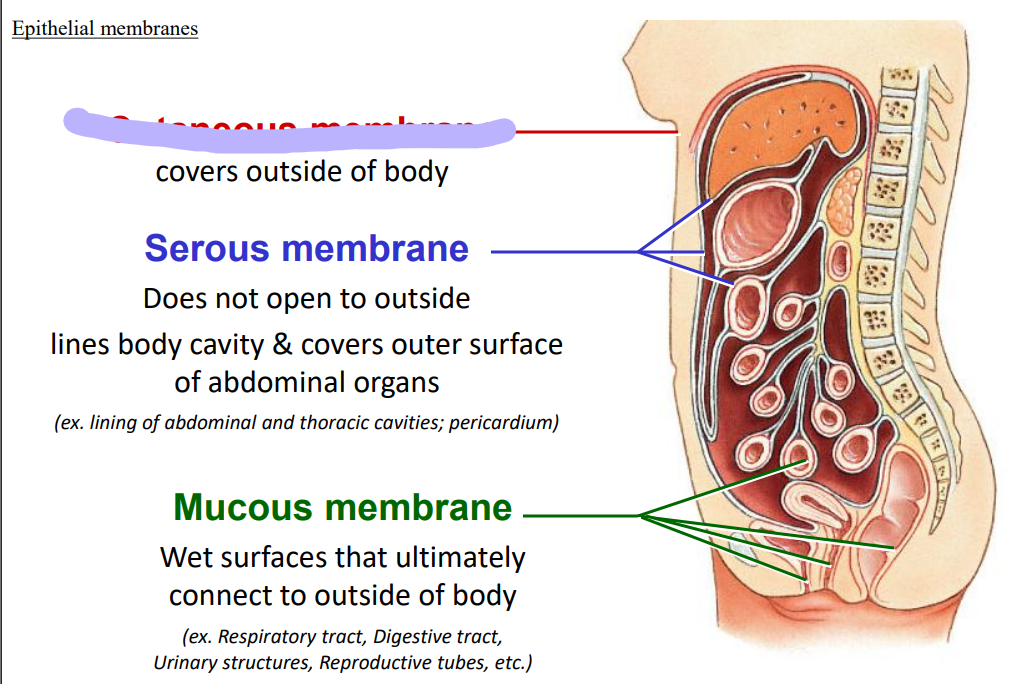
Cutaneous membrane
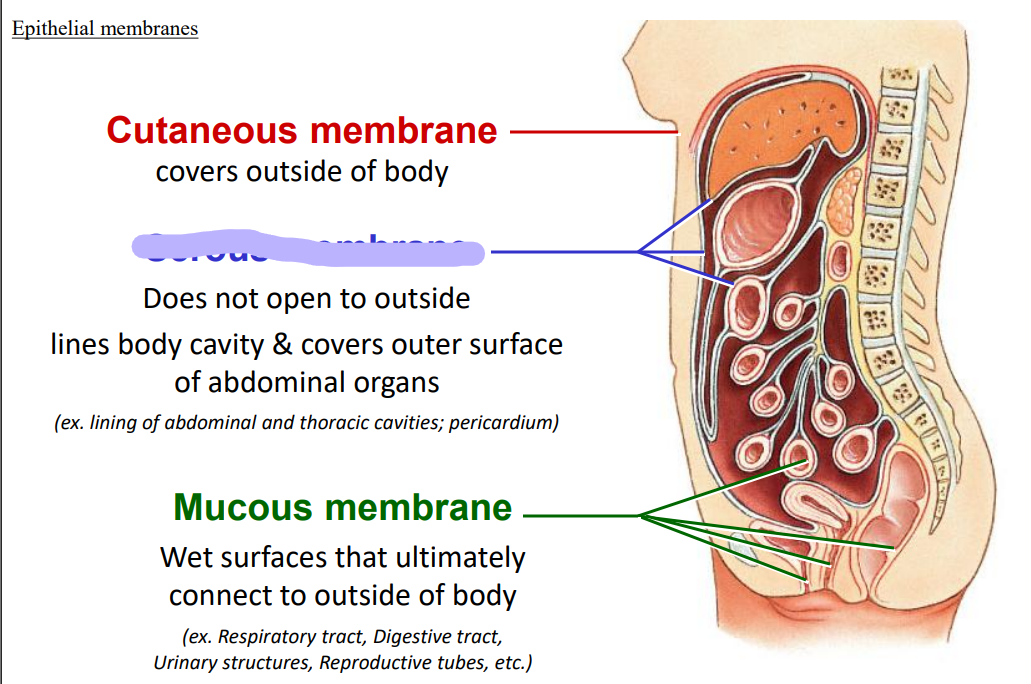
Serous membrane
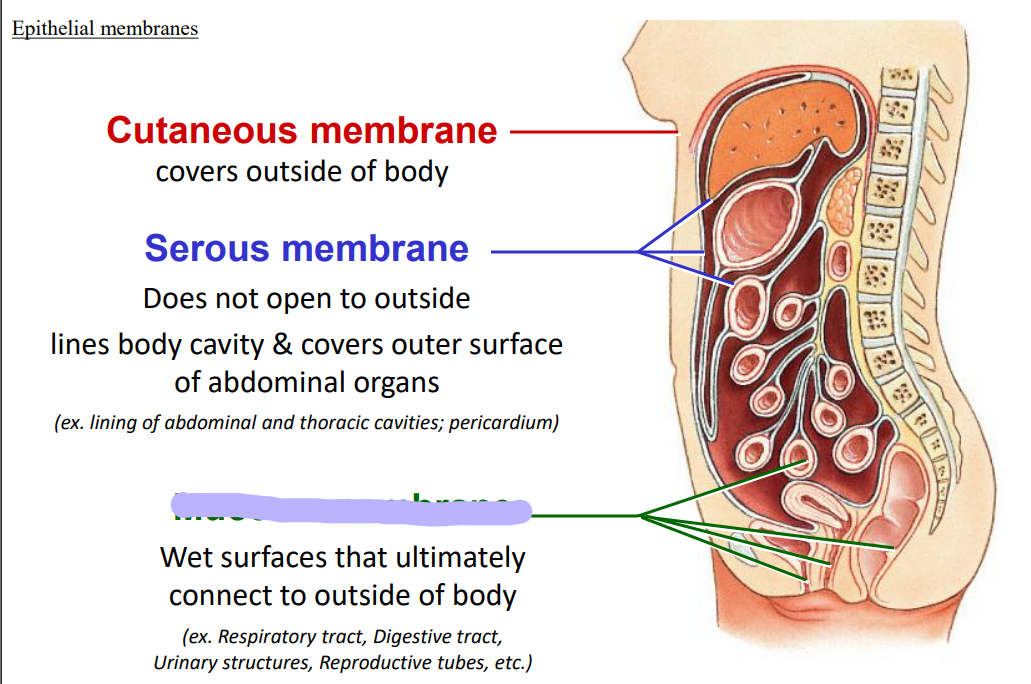
Mucous membrane
ENDOTHELIUM stats
Closed circ system(Blood never leaves vessels)
Lines the entire circulatory system
Simple squamous, for diffusion of blood and cells
ENDOCRINE glands
secrete products directly into bloodstream (e.g. Hormones) and/or interstitial fluid (ISF)
EXOCRINE glands
secrete products through ducts to surface of body (ex. sweat, digestive enzymes, milk)
What plane is this
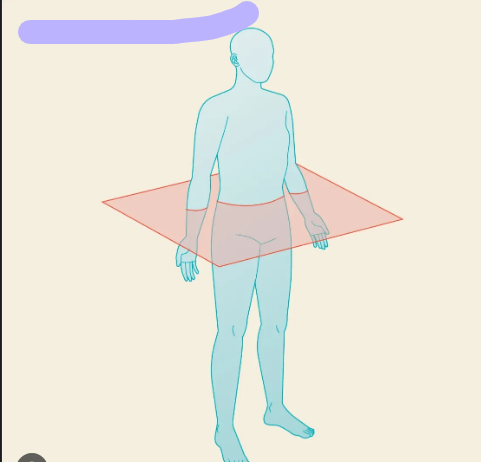
What plane is this
Transverse Plane
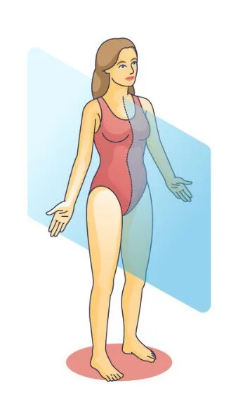
What plane is this
Sagital

Was ist das für ein Flugzeug?
Coronal/Frontal
Cranial/Caudal (Ex. The shoulders are cranial to the hips. The hips are caudal to the shoulders)
Toward the head / toward the tail
Medial / Lateral (Ex. The nose is medial to the ears. The ears are lateral(Away from) to the nose.)
Closer to the midline / farther from the midline
Ventral / Dorsal (Ex. The chest is ventral to the spine. The spine is dorsal to the chest.)
Front of the creature/ Back of creature
Anterior / Posterior
(Human ex. The chest is anterior to the spine, Animal ex. The cat's shoulders are anterior to its hips. The hips are posterior to the shoulders.)
Toward the front / toward the back (in humans, this lines up with ventral/dorsal)
For 4 legged animals: toward the head end/toward the tail end
Superior / Inferior (Ex. The neck is superior to the shoulders. The shoulders are inferior to the neck.)
Above / below
Proximal / Distal (Ex. The elbow is proximal to the wrist. The wrist is distal to the elbow.)
Another example if needed, The knee is proximal to the ankle; the ankle is distal to the knee (Using the hip as the attachment point)
Closer to where a limb attaches / farther from where it attaches (In this example, the shoulder is the attachment point)
Superficial / Deep (Ex. Skin is superficial to muscle. Bone is deep to muscle)
Closer to the skin's surface / farther below the surface
Left / Right (Ex. If you're facing someone, their right hand is on your left.)
Always refers to the subject's own left/right, not the viewer's
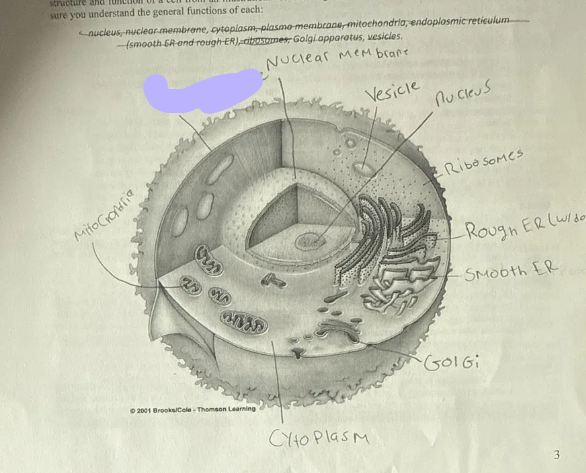
Plasma membrane- controls what goes in/out cell
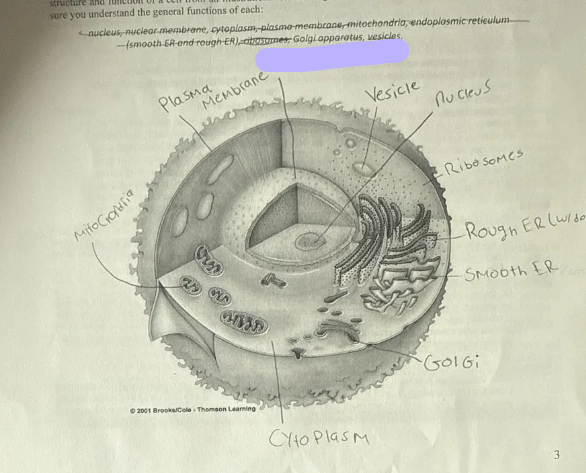
Nuclear membrane- boundary around the nucleus
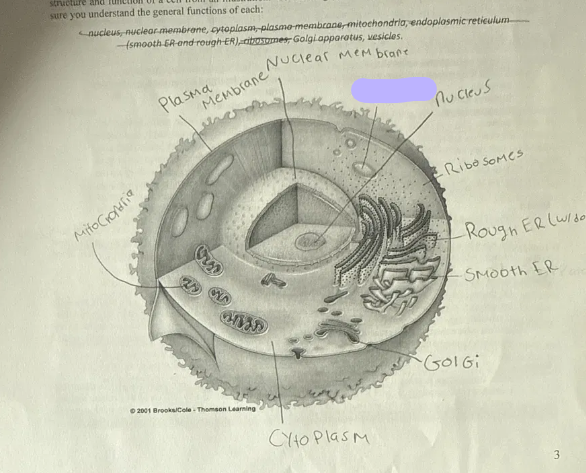
Vesicle- small sac that transports stuff around the cell
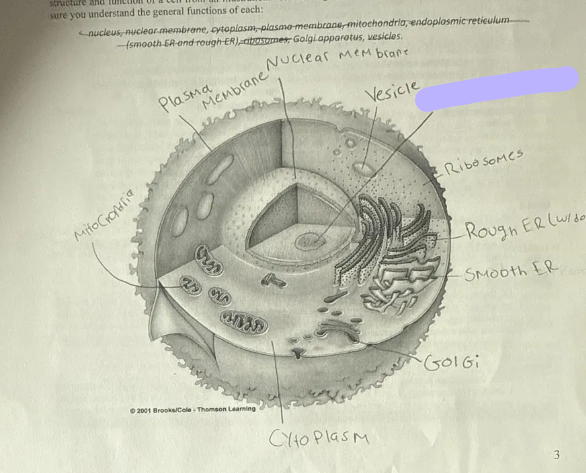
Nucleus- control center, holds DNA
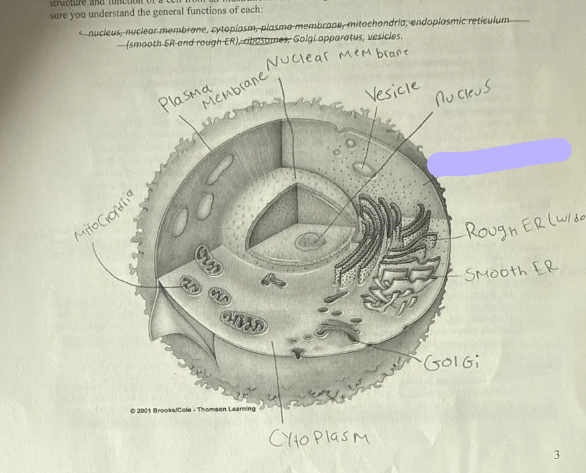
Ribosomes- build proteins
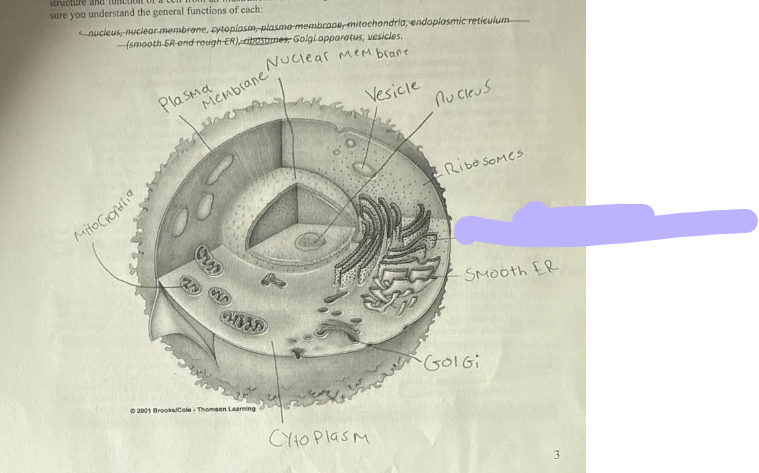
Rough ER (Dots)- has ribosomes, makes proteins
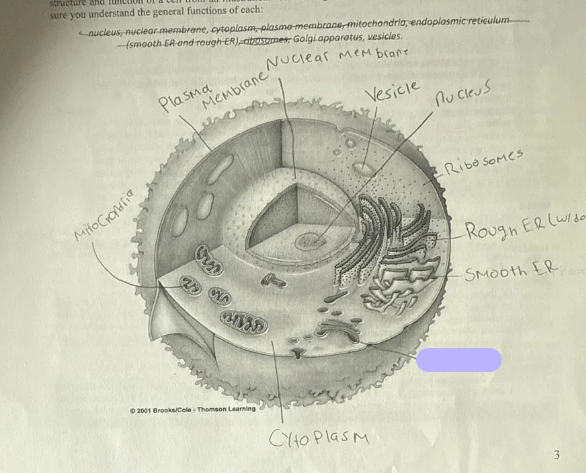
Golgi- packages and ships proteins
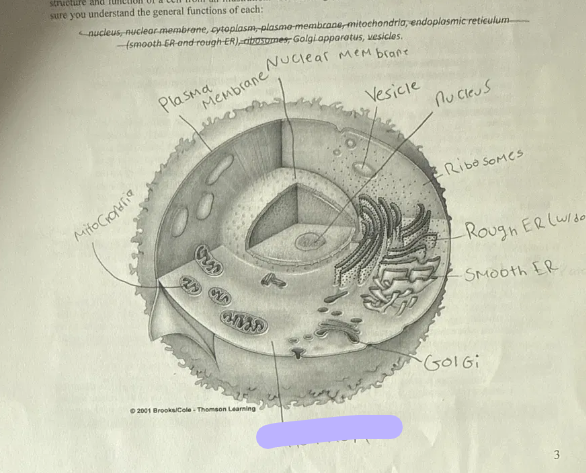
Cytoplasm- gel-like fluid filling the cell

Mitochondria- makes energy (ATP)

Smooth ER- makes lipids/detoxifies