NEURExam 3
 Call Kai
 Learn
Learn Practice Test
 Spaced Repetition
 Match
Match Flashcards
 Knowt Play
1/80

There's no tags or description
Looks like no tags are added yet.
Name | Mastery | Learn | Test | Matching | Spaced | Call with Kai | Chat |
|---|
No analytics yet
Send a link to your students to track their progress
81 Terms
Homeostasis
Maintaining a regular temperature in the body
Alleostasis
The brain is predicting that something will happen and avoids error rather than correcting errors, depends on the hypothalamus
Sex hormones
Male and female start with the same anatomy during early prenatal stage
The SRY gene produces androgens (testosterone)
Females produce more estrogens
Organizing effects (permanent)
In the first trimester, sex hormones (mainly testosterone) determines whether the body develops male or female
Organizing effects: Childhood behavior
Prenatal hormones alter the brain that influence differences between boys and girls activities and interests
Genetic and prenatal influences on sexual orientation
Sexual orientation may depend on testosterone levels during a first trimester
Stress can decrease testosterone
A gene on the X chromosome received from the mother could be linked to sexual orientation
Activating effects (temporary)
Oxytocin important for reproductive behavior, contractions, breast feeding, orgasm
Hemianopia/hemianopsia
Blindness of half-visual field b/c of damage in left or right V1 (primary visual cortex)
Cortical blindness
Total/partial loss of vision
Blindsight
Individuals have loss of vision but can unconsciously detect/react to visual stimuli
Cortical color blindness
Loss of color vision due to V4 damage, imagery and memory affected too
Visual agnosia
Inability to recognize visual information, geniculostriate , and ventral pathways
Prosopagnosia
Difficulty recognizing familiar faces, bilateral damage of fusiform areaa
Alexia/word blindness
Inability to read, damage of left fusiform area affect words recognition, they can trace words to readO
Object agnosias
Apperceptive: Inability to develop a percept (can’t copy an object)
Associative agnosia: Inability to recognize an object despise its apparent perception (can copy an object, not recognize)
Ataxia
Simultagnosia - Patients have problems to perceive more than one object at a time, due to damage in different areas (dorsal stream), can occur in patients with Balint’s syndrome - spatial attention problem
Auditory receptors
Auditory pathways
Axons leave the cochlea (auditory nerve to the medulla)
Next synapse occurs in the inferior colliculus (midbrain)
Next synapse occurs in the medial geniculate nucleus of the thalamus
Last stop is the auditory cortex (A1)
Tonotopic map
Primary auditory cortex (A1): Cells in the primary auditory cortex have a preferred tone
Neurons located to the left respond more to low frequencies vice versa
Auditory what pathway
Starts in A1, ends in anterior temporal sulcus
Auditory where pathway
Starts in A1, ends in posterior temporal cortec and parietal cortex
Temporal lobe: Superior temporal gyrus
Auditory ventral stream
Temporal lobe: Inferior temporal gyrus
Visual ventral stream
Temporal lobe: Middle temporal gyrus
Auditory and visual processes
Temporal lobe: Medial temporal region
Amygdala and hippocampus
Superior temporal sulcus
Active when looking at motion, cross modal matching
Medial temporal lobe: Insula
Connects brain and body, awareness of body, reacts the most when emotions are high
Medial temporal lobe: parahippocampal gyrus
Memory encoding, spatial navigation
Medial temporal lobe: Fusiform gyrus
Visual processing
Medial temporal lobe: Amygdala
Affective responses to sensory input, associated with fear response
Medial temporal lobe: Hippocampus
Spatial navigation, conscious memory
Ventral pathway in temporal lobe
Object recognition/developing object categories
Superior temporal sulcus function
Biological motion perception and social cognition (people’s intentions)
Amusia (Heschl’s gyrus)
Impairment to make pitch discriminations
Auditory hallucinations
Spontaneous activity in the auditory regions (perceiving noise with no noise)
Wernicke’s aphasia
Disturbed word recognition
Anterograde amnesia
Bilateral removal of the medial temporal lobe
Temporal-lobe personality (Geschwind syndrome)
Pedantic speech, paranoia, aggressive outbursts, damage of temporal lobe
Posterior parietal cortex function
Spatial information
Somatosensory (anterior parietal) cortex function
Sensory information from the body
Phantom limb experience
Homunculus (body maps), the area of the brain previously responsible for the limb receives no input, requiring neighboring brain regions to take over that area
Anosognosia
Unawareness of illness
Balint’s syndrome
Simultagnosia and optic ataxia, has issues reaching object and can only pay attention to one object at a time (posterior parietal lobe)
Neglect Syndrome
Damage to the right hemisphere causes patients to fail to attend/perceive the left side of space or their own body
The Gerstmann syndrome
Dysgraphia (problems with writing), dyscalculia (problems with numbers), problems with right-left discrimination
Apraxia
Loss of skill movement not caused by weakness (clumsiness)
Problems with sensoriomotor transformation (posterior parietal region)
You know what’s going to happen so it’s not unexpected (efference copy-corollary discharge)
Corollary discharge
The brain’s memo (efference copy) sent to sensory systems, predicting the sensory feedback a movement will cause

Somatosensory cortex
Post central gyrus

Posterior parietal cortex
Superior parietal lobule, inferior parietal lobule
Somatic nervous system
System where the brain controls movement and receives sensory information from the body (spinal nerves) and head and neck (cranial nerves)
Body
Spinal nerves
Head and neck
Cranial nerves
Autonomic nervous system
Neurons that receive information from and send commands to the heart, intestines
Sympathetic nervous system
Increases breathing/heart rate, decreases digestive activity, linked to the spinal cord, most sympathetic axons release norepinephrine
Parasympathetic nervous system
Decreases heart rate, increases digestive activity, releases acetylcholine into the organs and serotonin
Vagus nerve
Primary component of PNS
Primary motor cortex (M1)
Stimulation elicits movements
Prefrontal cortex
Movement organization and motor inhibition of automatic movements
Mirror neurons
In the premotor cortex, they are both active when we observe someone doing something and we do that same thing, important for learning, intentions empathy
Subcortical areas: Basal ganglia
Muscle memory, learning new habits, automatic responses
Basal ganglia pathways
Direct: BS → Thalamus (initiates movement)
Indirect: Terminates movement and inhibits unwanted movements
Subcortical areas: Cerebellum
Coordination
Ataxia: Resembles alcohol intoxication
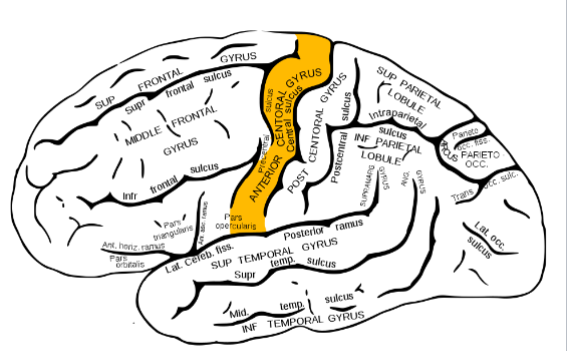
Primary motor cortex
M1

Major subdivisions of the frontal lobe
Premotor cortex - yellow, motor cortex - green, prefrontal cortex - blue
Anterior cingulate cortex ACC
PFC, contains spindle neurons, related to socialization/empathy
Dorsal ACC
Towards the back, relations to movement, attention, cognitive control, consciousness
Ventral ACC
Towards the belly, connections with default mode network, memory areas, important for self-referential thinking, emotion
PFC: Dorsolateral prefrontal cortex
Attention
PFC: Orbitofrontal cortex
Modulate physiological responses of the body
PFC: Ventromedial
Emotion regulation, decision making, controlling fear
Ventrolateral PFC
Cognitive control, inhibitory motor control, emotional regulation
Frontal lobe lesions
Disturbance of motor functions
Can’t make fine movements (primary motor cortex)
Problems with movement programming (premotor)
Problems with voluntary gaze (FEF)
Problems with corollary discharge
Broca’s aphasia (non-fluent speech, frontal lobe)
Lesions of prefrontal lobe
Problems with
Loss of behavioral spontaneity, solving problems
Rule breaking and risk taking (ACC)
Perseveration and response inhibition + associative learning + temporal memory + reduced interest in sexual behavior (DLPFC)
Abnormal sexual behavior + pseudodepression + pseudopsychopathy + rule breaking/risk taking (OFC)
The stroop test
Colored words, asses inhibitory control
Wisconsin sorting cards
Evaluate frontal lobe dysfunction

DLPFC
Reduced interest in sexual behavior, Problems with temporal memory, Perseveration and response inhibition, Problems learning from experience
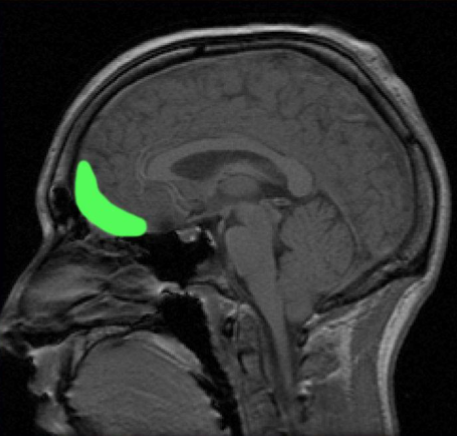
OFC
Pseudodepression, Pseudopsychopathy, Abnormal sexual behavior, Rule breaking and risk taking

ACC: Lesions
Rule breaking and risk taking
Premotor cortex
Selects movements, include’s Broca’s area, supplementary motor cortex, dorsal + ventral premotor cortex, contains mirror neurons, receives connections from parietal + other frontal areas