L1 NEUROCLIN II: Behavioural Genetics I
 Call Kai
 Learn
Learn Practice Test
 Spaced Repetition
 Match
Match Flashcards
 Knowt Play
1/43

Earn XP
Description and Tags
To be able to critically evaluate the concept of heritability in behavioural genetics: What do we mean by heritable/hereditary? What ‘things’, as psychologists, might we be interested in investigating the heritability of ? How would we investigate this?
Name | Mastery | Learn | Test | Matching | Spaced | Call with Kai | Chat |
|---|
No analytics yet
Send a link to your students to track their progress
44 Terms
heritability
an estimate of how much variance in some characteristic within some population is due to differences in heredity
heritability: range
varies between 0 and 1 (0 and 100%)
0.5 = intermediate
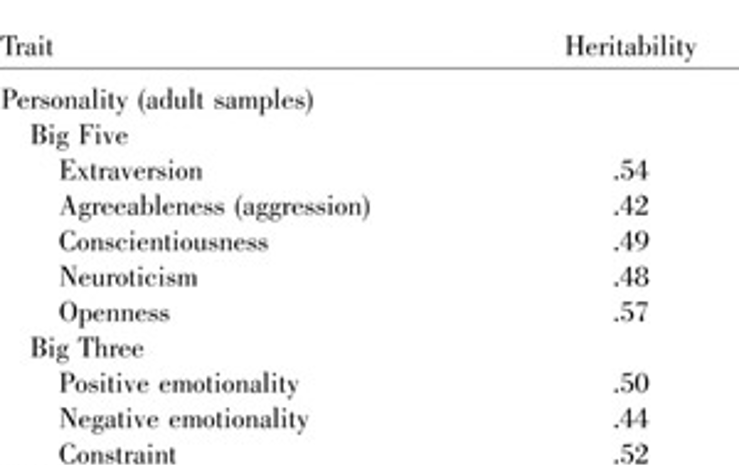
big 5
extraversion
agreeableness (aggression)
conscientiousness
neuroticism
openness
big 3
positive emotionality
negative emotionality
constraint
heritability statistic for personality traits (adult samples)
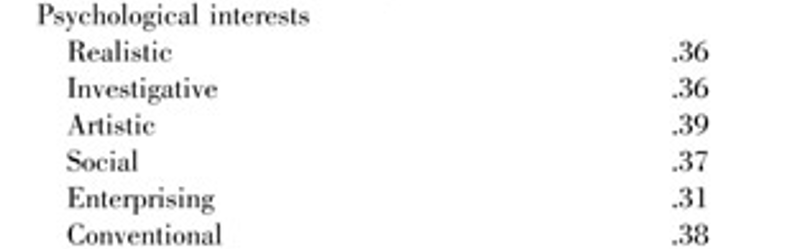
heritability statistic for psychological interests:
realistic
investigative
artistic
social
enterprising
conventional
monozygotic twins
1 egg
identical
100% shared genetic variation
if trait was completely heritable, mz twins wld score same
dizygotic twins
2 eggs
non identical
fraternal
50% shared genetic variation- same as any other siblings sharing both parents
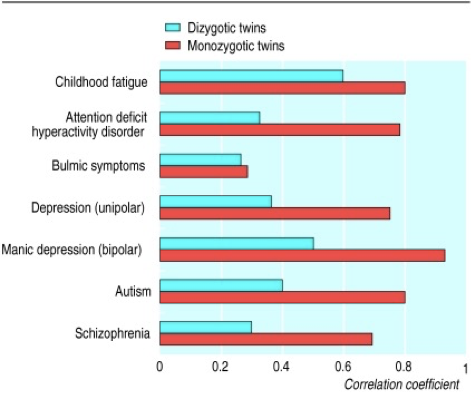
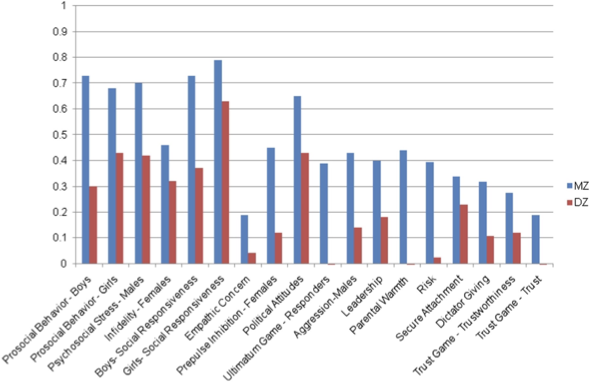
heritability graphs for mz and dz
how is heritability calculated (not actual eq)
comparing the correlation coefficients of identical and non-identical twins for a particular trait
→ know identical share all variation, non identical share half genetic variation
→ heritability is twice the difference between correlations for identical minus non identical twins
heritability ‘equation’ using mz and dz correlation coefficients
heritability = 2 x ( identical correlation coeffient - non identical correlation coefficient)
heritability = 2 x ( rmz - rdz)
what is the heritability statistic for each:
childhood fatigue
ADHD
bulimic symptoms
depression (unipolar)
manic depression (bipolar)
autism
schizophrenia
2 x (0.8 - 0.6) = 0.4
2 x (0.78 - 0.32) = 0.92
2 x (0.3-0.25) = 0.1
2 x (0.75 - 0.35) = 0.8
2 x (0.92 - 0.5) = 0.84
2 x (0.8 - 0.4) = 0.8
2 x (0.7 - 0.3) = 0.8
variance equation
Vp = A2 + C2 + E2
Vp = A2 + C2 + E2
explain each variable
V = variance of a trait
A = genetic component
C = common or “shared” environment (anything in the env that makes traits similar across twin pairs)
E = the “non-shared” environment (anything in the environment that makes traits dissimilar across twin pairs)
rmz =
A2 + C2
rdz =
½ A2 + C2
A2 =
2(rmz - rdz)
additive genetic influence (heritability)
what does heritability look at
variance (differences) between individuals
what is heritability specific to
the population in which it is calculated
what does high heritability not imply
that the environment does not alter the trait, particularly for the individual
sharing highly similar environment → heritability estimates will be high
heritability of general cognitive ability
increases linearly from childhood to young adulthood
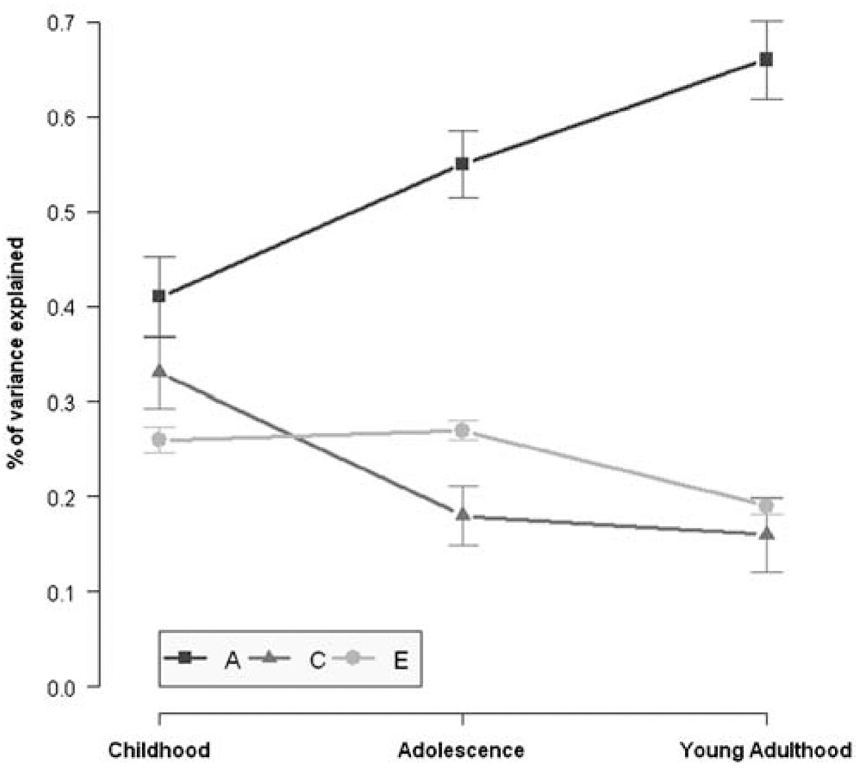
complexities with heritability according to Flynn, (2001)
multiplier effect
multiplier effect
if genetic or prenatal influences produce even a small increase in some activity, the early tendency will change the environment in a way that magnifies the tendency (Flynn, 2001)
complexities with interpretations of behavioural genetics
change with age
change over time
multiplier effect
tobacco use + heritability
example of heritability complexity
Pinel said tobacco use heritability estimate 65%
but then
2-3 ppl admitted to smoking in the 1003 lecture
how can it be genetic → have genes changed? probs not
need the environment of smoking no matter how genetically predisposed you are
nicotonic receptor gene variants influence susceptibility to heavy smoking
environment + genes- risk taking, substance use, addictive personality, peer pressure/antisocial peer group
misrepresentations in popular media
genetics research often overgeneralised outside of population statistics taken in, heritability stats shown as proof of geneticism with disregard to shared environment or associative nature
eg. independent report on michael gove holding talks with iq genes e.g. saying genes account for 70% of a child’s cognitive abilities
dangerous, eugenics, misrepresentative, social sensitivity
→ behavioural genetics CANNOT tell us about an individual
does not account for up to 70% of childs abilities, but 70% of variation in abilities within that population can be attributed to heritability
tests with knowledge components not cognitive
lots of routes for heritability peer groups etc
this cannot be inferred from behavioural genetics analysis- that believe any child from background can achieve
heritability values that are:
high
intermediate
low
0.6
0.4
0.2