Late classical prescribed statues
 Call Kai
 Learn
Learn Practice Test
 Spaced Repetition
 Match
Match Flashcards
 Knowt Play
1/39

Earn XP
Description and Tags
Name | Mastery | Learn | Test | Matching | Spaced | Call with Kai |
|---|
No analytics yet
Send a link to your students to track their progress
40 Terms
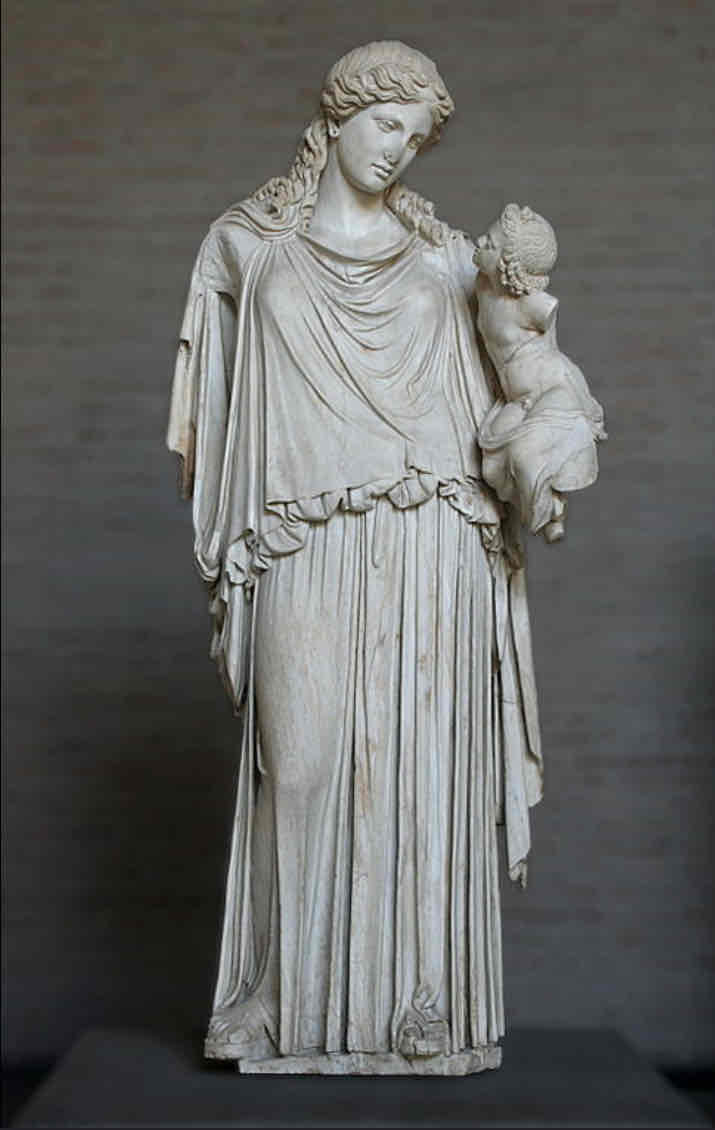
Eirene and Ploutos
Height? Date? Material? Location?
Height: 2.01m, over life size
Date: 375-370 BC
Material: Roman marble copy of lost bronze original
Location: The original bronze statue was set up in the Agora of Athens
Who made Eirene and Ploutos?
Kephisodotos
What do the names Eirene and Ploutos mean? Who is who?
Eirene (peace) is bearing Ploutos (wealth) in her arms.
Eirene and Ploutos
Why was this statue made? What was its purpose?
It was set up in the Agora of Athens following a peace agreement between Sparta and Athens.
Eirene and Ploutos
What values and ideals was Kephisodotos communicating to his Greek audience through this statue?
Wealth
Peace
Didactic: Idealised image of motherhood in the eyes of the contemporary viewer
Eirene and Ploutos
In what ways has Kephisodotos humanised these two gods? (Anthropormorphism)
Eirene’s shoulders and hips are inclined towards the baby → intimate and naturalistic display of love
Ploutos responds to Eirene’s attention by turning his head towards his mother making their eyes interlock
Posture of familiarity with Eirene holding the baby on her hip
Eirene and Ploutos
What makes this statue aesthetically pleasing?
Idealised image of motherhood, shows a narrative→ e.g. the contrapposto pose angles the hips and shoulders of the mother towards the baby while the baby turns his head in response to the attention
Detailed and intricate drapery makes it highly naturalistic→ e.g. The modelling lines used on the upper drapery of the peplos and himation creates a caternary shape and shows how the drapery curves and reacts to Eirene’s movement and figure. Wet drapery technique seen on the knee and thigh. Typical of the 4th century.
Display of sculptor’s techne→ e.g. It is a group composition, contrapposto pose is dynamic
Eirene and Ploutos
What makes this statue less aesthetically pleasing?
The baby’s head is abnormally small and out of proportion
The lower peplos appears doughy and thick due to fluting
Eirene and Ploutos → Scholarly quotes
What does Boardman say about this statue?
‘Her maternal concern is indicated by the poise of her head’
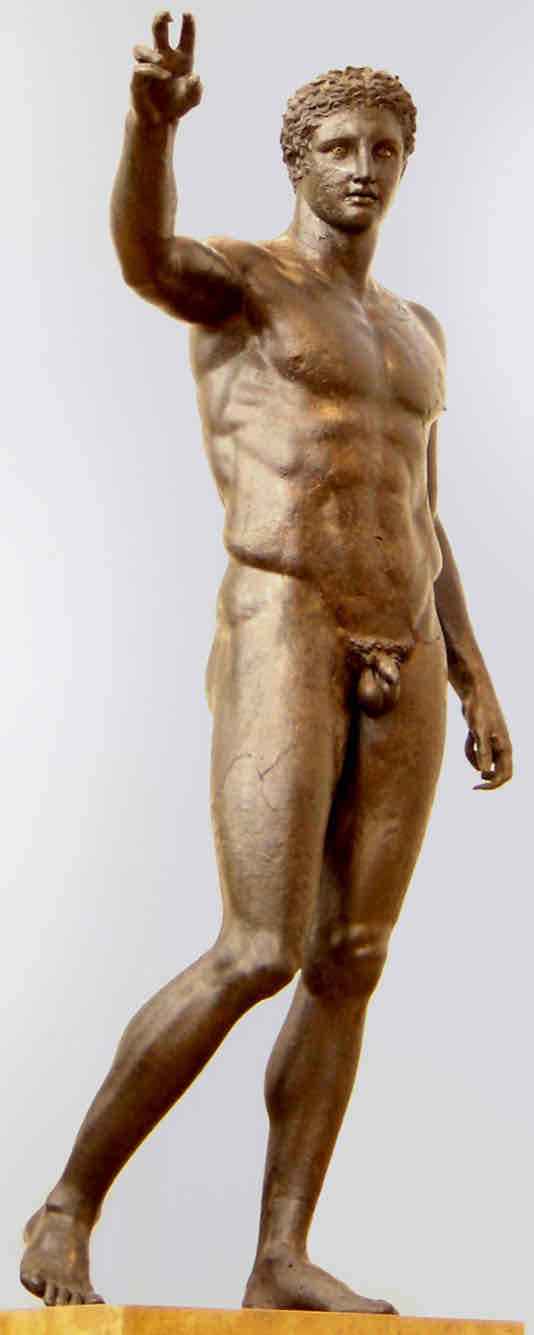
The Antikytheran Youth
Height? Date? Material? Location?
Height: 1.94m, slightly larger than life size
Date: c.340 BC
Material: Bronze original with inlaid eyes
Location: Found in a wreck off the island of Antikythera by sponge divers in 1900
What is the debate about the Antikytheran Youth?
Critics are not sure if the statue is depicting Perseus holding the head of the Gorgon or Paris about to give the golden apple to Aphrodite.
Antikytheran Youth
What features point to this statue being Perseus?
The statue’s emphatically muscular physique suits the hero who was renowned for his heroic feats e.g the muscular torso and exaggerated abdominal muscles. The tense back muscles suggest he’s holding a heavy head with fingers curved gripping snakes.
Antikytheran Youth
What features point to this statue being Paris?
The shape of his right hand e.g the fingers are curved around the missing prop suggesting it is a small circular object. His thoughtful solemn gaze upon the apple may signify the severity of his decision.
The Antikytheran Youth
What makes this statue aesthetically pleasing?
The in-laid eyes display the sculptors techne as he is able to work skillfully with different mediums. The eyes are also very emotive and naturalistic
The extended arm breaking the frontal plane with the head turned towards his hand. The use of the contrapposto pose creating a reverse ‘S’ curve. The whole body seems to curve and react to the prop in his hands exemplifying its significance.
Facial expression e.g. pursued lips, furrowed brows
Shine of the bronze e.g advanced medium, display of wealth, lost wax casting method
Robust burly nature of the muscles e.g taut abdominals, defined iliac crest
The Antikytheran Youth
What makes this statue less aesthetically pleasing?
Exaggerated anatomy e.g. elongated arms and smaller head
Loss of prop: fundamental part of statue’s narrative
The Antikytheran Youth → Scholarly Quotes
What does Woodford say about this sculpture?
She describes how breaking the frontal plane ‘gives the figure a more intimate relationship with the space surrounding it’
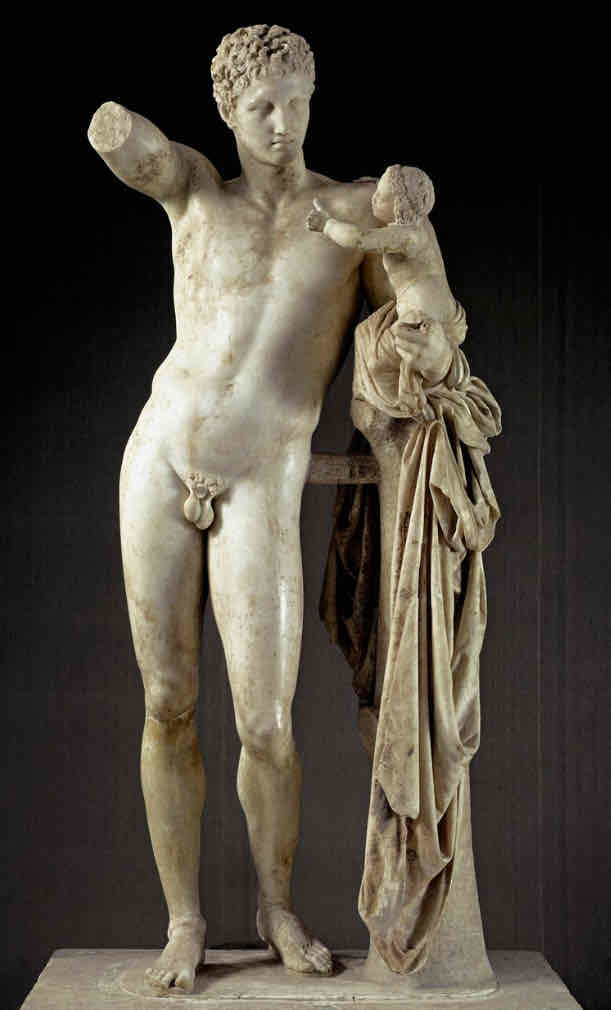
Hermes and Dionysus
Height? Date? Material? Location?
Height: 2.11m, over life size
Date: 343 BC
Material: Marble Roman or Hellenistic copy? OR Marble original
Location: The archeological museum of Olympia
Who created Hermes and Dionysus?
Praxiteles
What is the context behind Hermes and Dionysus?
When Zeus revealed himself to his mortal lover Semele she was at once incinerated by his divine radiance. Zeus rescued their unborn child, Dionysus, by sweeping him within his own thigh. After Dionysus’ 2ND BIRTH Zeus ordered Hermes to hide the baby from his jealous wife Hera.
This sculpture depicts the messenger as he carried the baby to the mountain of nymphs. In this sculpture Hermes teases Dionysus by dangling grapes out of the baby’s reach.
Hermes and Dionysus
What makes this statue aesthetically pleasing?
Relatable human activity, despite being gods: a sibling teasing another sibling with food e.g Hermes relaxed lighter teasing arm, their heads are turned towards each other in brotherly affection
Polykleitos’ Contrapposto has been adapted to create the Praxitelean ‘s’ curve which enhances the narrative e.g. Hermes right hip juts out to the right moving the figure further away from the baby teasingly
Subtle smooth integrated musculature displays techne. Praxiteles would polish the marble to make it shine and have light reflect off the statue.
Hermes and Dionysus
What makes this statue less aesthetically pleasing?
Tree stump support (low tensile strength of marble) and it undermines the sculpture’s in the round nature
The head of baby Dionysus is abnormally small
It’s fractured nature with the arm of Hermes broken off takes away from the narrative
Hermes and Dionysus→ Scholarly Quotes
What does Woodford say about Hermes and Dionysus?
‘relaxed, languid pose’
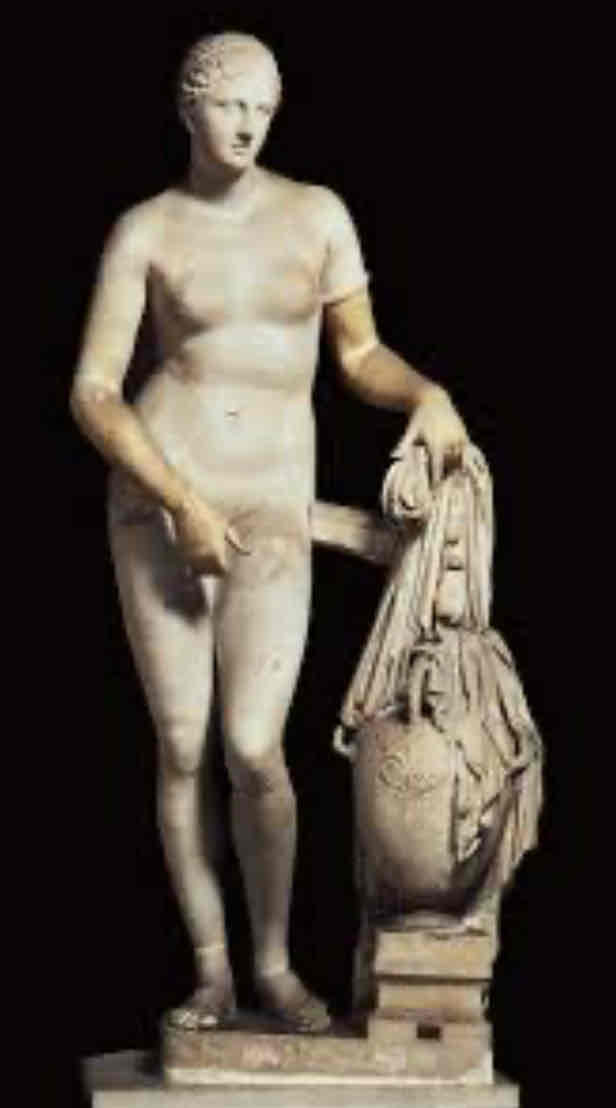
Aphrodite of Knidos
Height? Date? Material? Location?
Height: 2.04m
Date: c.350-330 BC
Material: Roman Marble copy of lost marble statue
Location: It was set up in a tholos at the Temples of Aphrodite at Knidos
What did the Aphrodite of Knidos do first?
This was the first monumental Greek representation of a female nude.
Who sculpted the Aphrodite of Knidos?
Praxiteles. It was supposedly based of a women called Phryne
Aphrodite of Knidos
How and why was this statue commissioned?
According to the Elder Pliny Praxiteles received a commission from the citizens of Kos for a statue of Aphrodite.
Praxiteles then created two versions- one fully draped, and the other completely nude.
The nude which was rejected by the people of Kos was purchased by the citizens of Knidos and set up in an open-air round temple (a tholos) that permitted viewing of the statue from all sides
Aphrodite of Knidos
What makes her aesthetically pleasing?
Contemporary audiences would appreciate the modest pose e.g. the slight curve of her spine inwards causing her to crouch, the right hand positioned over her groin, her two thighs pressed together
Her nudity is justified through the narrative of her taking a bath e.g. hair up in a fillet, lackadaisical arm dropping the drapery onto the hydria,
Smooth rounded planes of the marble e.g. calves, buttocks, hips, breasts
Calm serene facial expression e.g. oval face, curved eyebrows, pursued lips
Adapted contrapposto pose giving her the praxitelean ‘s’ curve shows techne e.g. jutted out right hip
Aphrodite of Knidos
What makes her less aesthetically pleasing?
The use of marble which has a low tensile strength means she requires a bridge support and the support of the hydria and drapery. The sculpture is reliant on them to stay up right.
Fractured nature due to marble means she has had to have been glued back together e.g. at the knees and top of her left arm
Aphrodite of Knidos→ Scholarly Quotes
What does Woodford say about this sculpture?
‘The limp inert drapery and the rigid water-jar contrast with the soft living body of the goddess’
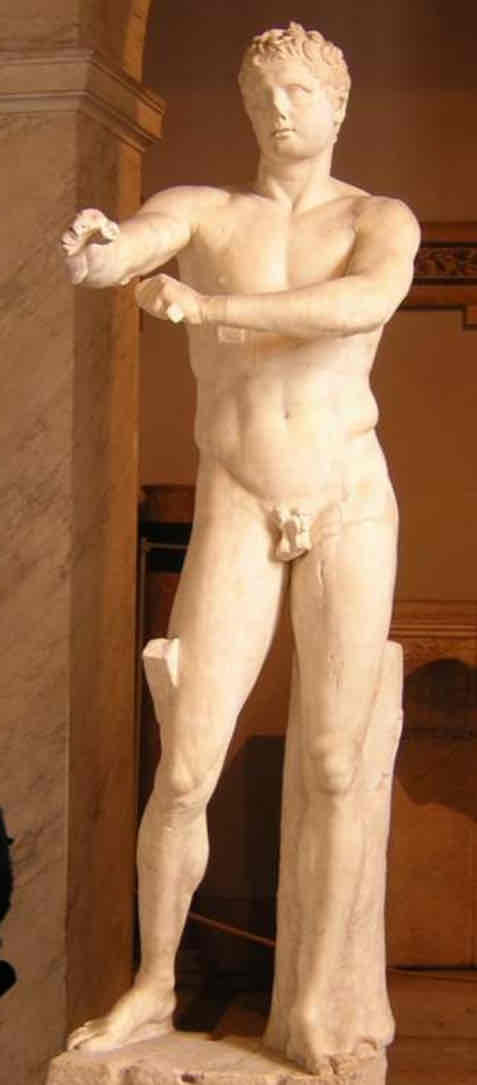
Lysippos’ Apoxyomenos
Height? Date? Material? Location?
Height: 2.05m
Date: c.330 BC
Material: Roman copy of a lost bronze original
Location:
What activity is Lysippos’ Apoxyomenos doing?
Apoxyomenos means ‘the man scraping himself’. Athletes in Ancient Greece would rub themselves down with oil before exercise and afterwards scrape oil, dirt and sweat off together with a scraper or strigil.
Lysippos’ Apoxyomenos
What makes this statue aesthetically pleasing?
It breaks the frontal plane and is in the round which shows techne and makes him more lifelike e.g. right action arm thrusted forward
The wiry Lyssipian ‘s’ curve created by the adapted contrapposto gives him a casual pose
Tired worn out facial expression enhances the narrative as it suggests the athlete has just finished his exercise e.g. the plump oval face and chin, tilted head, defined eyelids, unruly hair → also shows age differentiation and youth
Idealised male athletic figure e.g. defined abdominals and iliac crests made smooth through rounded planes
Lysippos’ Apoxyomenos
What makes this statue less aesthetically pleasing?
2.05m, he is over life size, unrealistic
Elongated legs due to 1:7 head to body ratio
Support stump
Fractured nature
Lysippos’ Apoxyomenos → Scholarly Quotes
What does Woodford say about this statue?
‘visually exciting from a multitude of viewpoints’
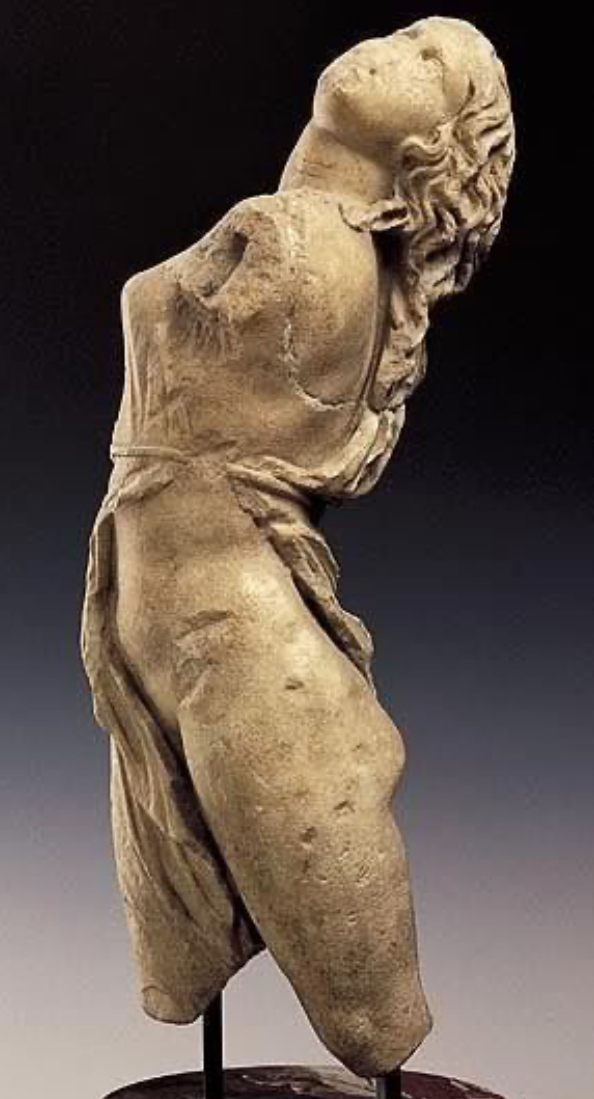
UNPRESCRIBED
Raging Maenad
Height? Date? Material?
Height: 0.45M
Date: c.350 BC
Material: lost marble original
UNPRESCRIBED
Raging Maenad
Who made this statue?
Skopas
UNPRESCRIBED
What is aesthetically pleasing about Skopas’ Raging Maenad?
Catenary on upper drapery
Transparency over breasts
Head turned and raised looking up into the sky
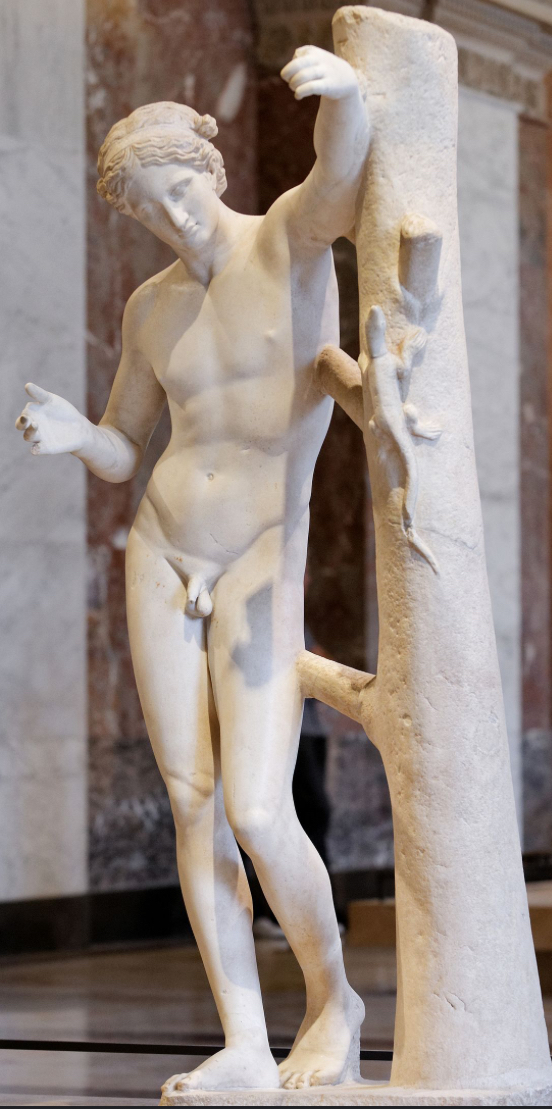
UNPRESCRIBED
Apollo the Lizard Slayer
Height? Date? Material?
Height: 1.49M
Date: original is dated to 350 BC
Material: Roman marble copy of a lost bronze original
UNPRESCRIBED
Who sculpted Apollo the Lizard Slayer?
Praxiteles
UNPRESCRIBED
What makes Praxiteles’ Apollo the Lizard-Slayer aesthetically pleasing?
The adapted contrapposto with the fine balance of tense vs relaxed limbs to produce the Praxitelean ‘s’ curve
Smooth polished marble on his androgynous underdeveloped muscles→ Shows age differentiation
Turned and tilted head with a serene controlled facial expression
Killing a lizard= A display of arete