CH4.5 Nervous Tissue
 Call Kai
 Learn
Learn Practice Test
 Spaced Repetition
 Match
Match Flashcards
 Knowt Play
1/12

Earn XP
Description and Tags
Vocabulary flashcards covering the structure, cellular components, functions, locations, and histological identification of nervous tissue.
Name | Mastery | Learn | Test | Matching | Spaced | Call with Kai | Chat |
|---|
No analytics yet
Send a link to your students to track their progress
13 Terms

Neurons
Excitable branching cells that respond to stimuli and transmit electrical signals from sensory receptors to effectors (muscles and glands).
Glial cells (Neuroglia)
Nonexcitable supporting cells in nervous tissue that support and protect neurons.
Cell body
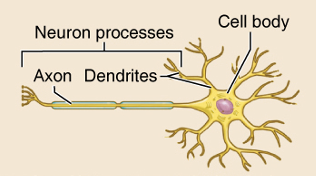
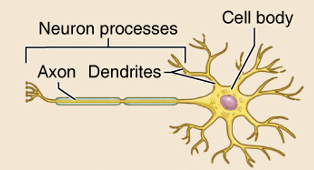
The nucleus-containing main portion of a neuron from which cell processes like axons and dendrites extend.

Dendrites
Neuron processes that extend from the cell body to receive incoming stimuli and signals.

Axon
A neuron cell process that conducts electrical signals away from the cell body toward other cells or effectors.
Excitable
The functional characteristic of neurons that enables them to respond to stimuli and transmit electrical signals.
Locations of Nervous Tissue
Brain, spinal cord, and nerves.

Nervous Tissue
Neurons transmit electrical signals from sensory receptors to effectors (muscles and glands); supporting cells support and protect neurons.
Have branching cells and


Label Neuron Structure
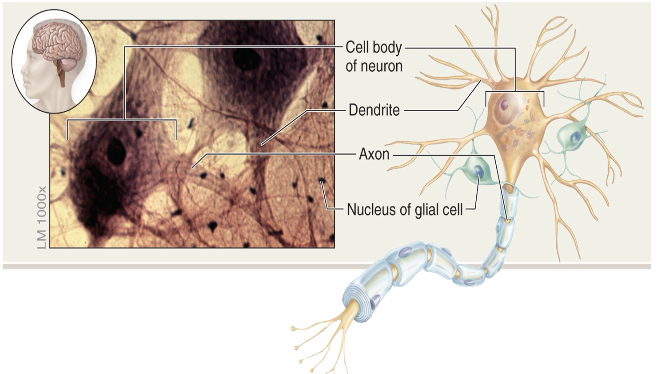
Neuron consisting of a cell body with branching dendrites and an extending myelinated axon.

Identify the tissue
Photomicrograph depicting neurons with prominent cell bodies and extending processes alongside smaller dark nuclei of supporting neuroglial cells.


Identify the type of cell (neuron or glial) in the nervous tissue image provided.
1: Glial (neurogligal cell)
2: Neuron (nerve cell)
3: Glial

Which of the following images is nervous tissue?
C

Which of the following images is nervous tissue?
A