Constitutional and Administrative Law and EU Law; Legal System; Public Order
 Call Kai
 Learn
Learn Practice Test
 Spaced Repetition
 Match
Match Flashcards
 Knowt Play
1/45

There's no tags or description
Looks like no tags are added yet.
Name | Mastery | Learn | Test | Matching | Spaced | Call with Kai | Chat |
|---|
No analytics yet
Send a link to your students to track their progress
46 Terms
Types of privilege in parliamentary proceedings and when they apply
Absolute privilege - protects what is said in parliamentary proceedings or debate.
applies when there is a close connection between the speech and parliamentary proceedings.
extends to proceedings in committees of the House. An MP is therefore protected from being sued for defamation, prosecuted for breach of the Official Secrets Act, or held in contempt of court for disobeying a court order not to name a party in a case.
Qualified privilege - protects fair and accurate reports of parliamentary proceedings.
Cabinet minister requirement
Required by convention to be a member of the House of Commons or House of Lords, otherwise they cannot be accountable to Parliament.
If MP sued for defamation…
Qualified privilege - If an MP is sued for defamation, they may be able to rely on qualified privilege by arguing that what they said was in the public interest.
This protects them unless the claimant can prove malice.
Malice requires the claimant to prove that the defendant did not believe what they said or wrote was true, or was reckless as to whether it was true.
Reports of parliamentary proceedings by media
Newspapers and other media are protected by qualified privilege if they publish a fair and accurate report of parliamentary proceedings. The report does not have to be word-for-word. It can be a selective summary, provided it appears fair and accurate to the reasonable reader and avoids gratuitous and irrelevant comments: Curistan v Times Newspapers
MP in contempt of parliament - what needs to be done?
If an MP is suspended for 10 sitting days or more, is convicted and receives a custodial sentence, or is convicted of an offence relating to financial allowances, the Speaker must inform the MP’s constituency.
If 10% of the electorate in that constituency sign a recall petition, the MP must stand for re-election.
(Recall of MPs Act 2015)
Communications between constituents and MPs - protected?
Parliamentary privilege does not automatically apply to communications between constituents and MPs.
Court held that where there is no connection to proceedings in Parliament, there is no privilege - Rivlin v Bilainkin
Can courts question Acts of Parliament?
Under the sovereignty of Parliament, the courts will not question an Act of Parliament or investigate the procedure by which it was passed.
House of Lords - power to veto?
Money Bills?
Public Bills that begin in the House of Commons can be delayed by the Lords for a maximum of 1 year.
Money Bills (concerned with taxation or public spending) must receive Royal Assent no later than one month after being introduced in the House of Lords, meaning the Lords cannot delay them for more than 1 month
Lords can veto bills that enact major constitutional reforms or extend the lifetime of Parliament beyond 5 years (both houses debate equally)
Private Bills (affecting particular individuals, organisations, or localities) still require approval of both Houses
NB cf. Private Member’s Bill = a public Bill, just introduced by a backbench MP or peer rather than the Government.
The Parliament Acts do not apply to private Bills or Bills that were introduced in the Lords.
Act of State
Act of State is an ancient prerogative power which holds that UK government actions taken against foreign citizens outside the UK are not actionable. This was not changed by the Crown Proceedings Act 1947.
Treaties does government need permission?
Becoming party to a treaty is a prerogative power, so the Government does not need Parliament’s permission.
BUT an Act of Parliament is required if the treaty alters the law within the UK.
Can Government can make prerogative laws
The Government can make prerogative laws known as Orders in Council without the agreement of Parliament.
Type of delegated legislation
some Acts of Parliament give government ministers (usually secretary of state) power to make Orders in Council - used for important matters, such as constitutional changes.
What happens if UK legislation breaches the Convention?
Where a UK court or the ECtHR has found UK legislation to breach the Convention:
the Government may, if there are compelling reasons, make a remedial order changing UK law. This is delegated legislation made by minister, and must be approved by Parliament under the affirmative procedure.
Alternatively, the Government can introduce a Bill.
The Government is not compelled to amend the offending legislation, and if it decides not to, an aggrieved litigant would have to take his or her case to the ECtHR to obtain redress.
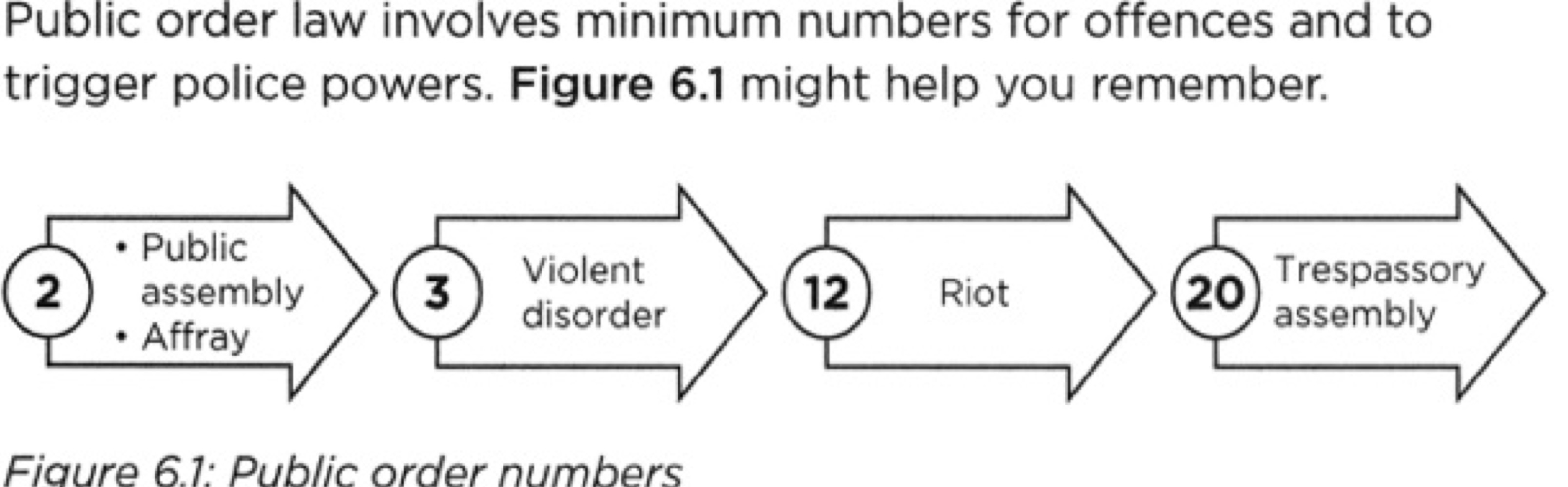
Public order law - offences and min numbers
Breach of the peace
Breach of the peace means an act done or threatened which actually harms a person, or in their presence their property, or is likely to cause such harm, or puts someone in fear of such harm being done
ORconduct that has the natural consequence of provoking others to violence.
Binding over to keep the peace - requirement
Court must be satisfied that Breach of the peace has occured and there is a real risk of violence in the future.
civil remedy, but with a criminal standard of proof.
The court must identify the specific conduct or activity from which the individual must refrain.
Usually the order would not exceed 12 months and the defendant can be asked to pay a specified sum if they break the order (a recognisance). If they refuse to be bound over, they can be imprisoned for up to six months.
New protest-related offences and conditions
concealing identity at a protest,
carrying a pyrotechnic such as a firework at a protest, and
climbing upon a war memorial.
Conditions may also be imposed on processions and assemblies near places of worship.
The Crime and Policing Act 2025 added offences
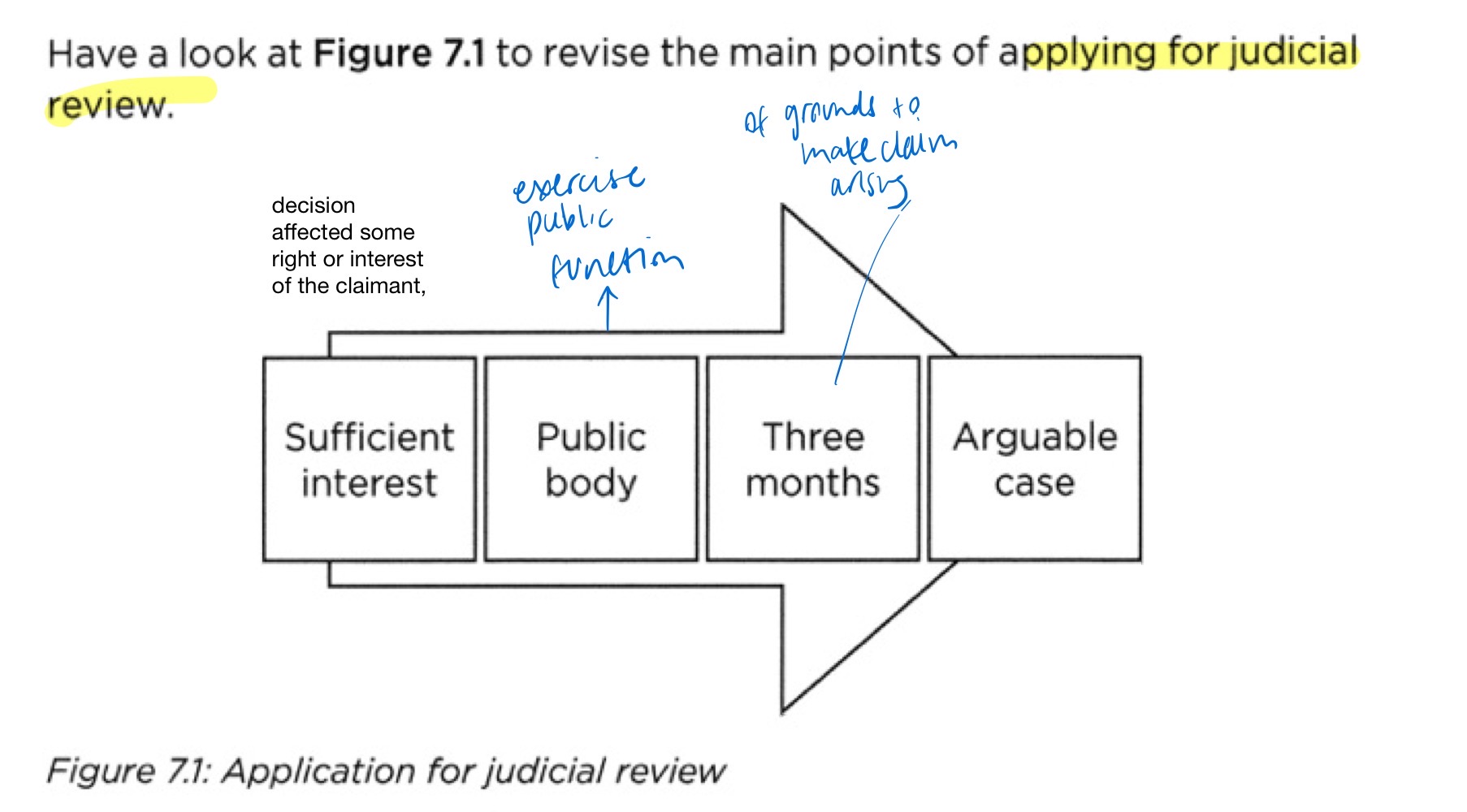
Judicial review requirements (and time limits)
When might the court refuse a judicial review remedy?
Permission will be granted if:
sufficient interest (decision affected some right or interest of C)
against public body / exercising public function
within time limits
the claim is arguable and it has a reasonable prospect of success
Time limits:
general - claim form filed not later than 3 months after the grounds to make the claim first arose
planning decisions - 6 weeks
Human Rights Act claims - 1 year
When might the court refuse a judicial review remedy?
In judicial review, the court has discretion whether to grant a remedy. The court may refuse a remedy if the claimant has acted unreasonably, if a remedy would now be ineffective, or if granting one is not in the public interest.
Grounds of illegality in judicial review
Illegality includes:
misunderstanding the law
improper purpose
taking into account irrelevant considerations or failing to take into account relevant considerations
fettering of discretion
unauthorised delegation
error of fact
Grounds of procedural impropriety in judicial review
Procedural impropriety includes
requirement to consult,
natural justice (apparent bias; right to fair hearing)
legitimate expectation (procedural; substantive)
JR - Substantive legitimate expectation rules
There must be
a clear and unequivocal undertaking
given to a particular group or individual.
However, a substantive legitimate expectation may not arise if the public authority can show sound policy reasons for making the decision and the decision is not unfair to the claimants.
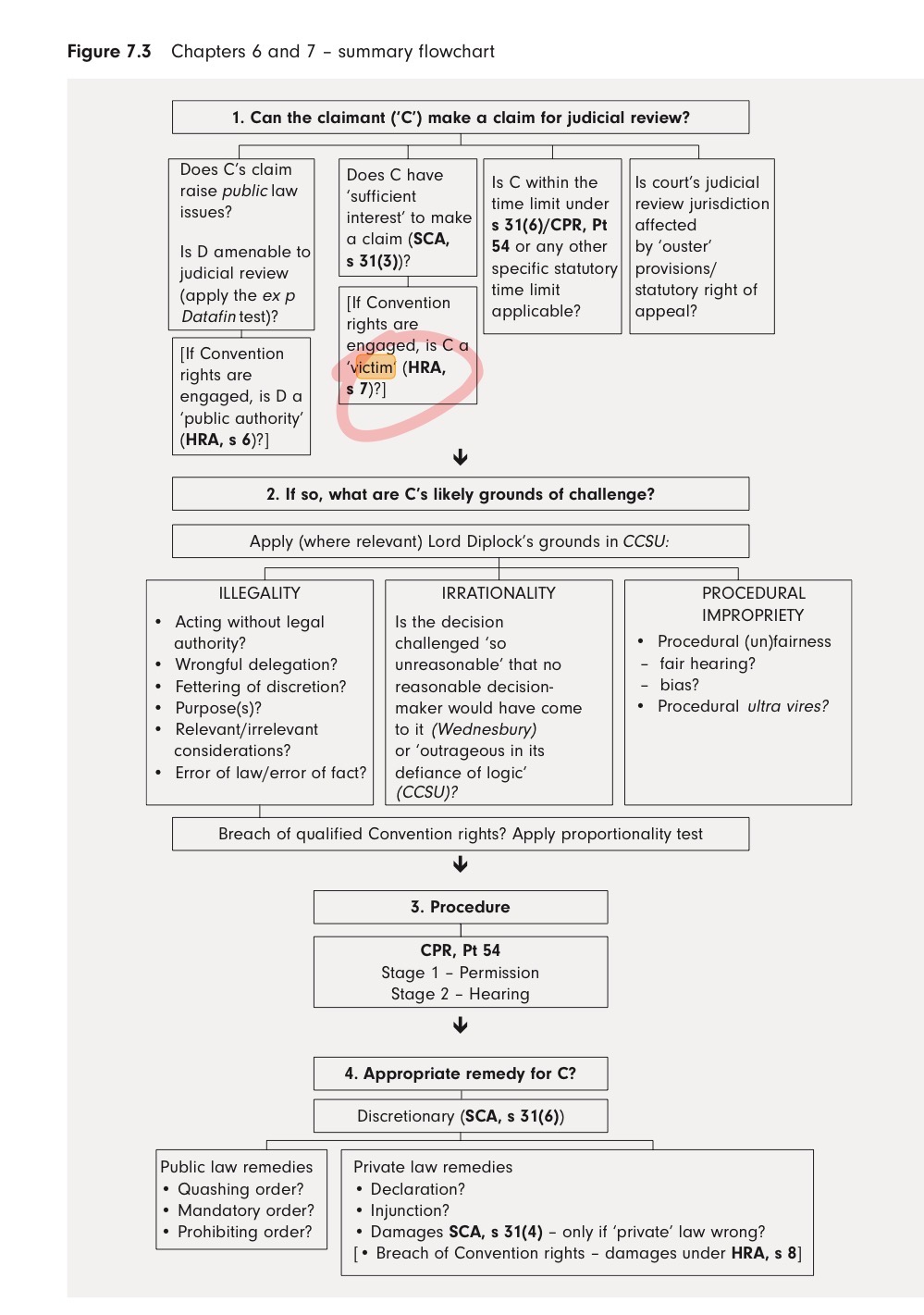
Flowchart
Can C make claim for judicial review?
C’s likely grounds of challenge
Article 8 Right to Privacy vs art 10 freedom of expression
The court first asks whether Article 8 is engaged by considering whether the claimant had a reasonable expectation of respect for their private life in the circumstances. This is an objective question and takes account of all the circumstances, including the claimant’s attributes, the nature of the activity, the place where it happened, the nature and purpose of the intrusion, absence of consent, the effect on the claimant, and the circumstances and purposes for which the information reached the publisher.
Test of whether Article 8 has been engaged at all has to be answered first (whether the claimant had a reasonable expectation of respect for her private life in the particular circumstances) This is an objective question and takes account of all the circumstances of the case, including
the attributes of the claimant
the nature of the activity being engaged in
the place at which it happened
the nature and purpose of the intrusion
the absence of consent
the effect on the claimant and the circumstances in which, and purposes for which, the information reached the hands of the publisher.
If the claimant has a reasonable expectation of privacy, then Article 8 will be engaged; then the court must carry out a balancing exercise -
second question, how to strike the balance between the claimant’s right to privacy and the publisher’s right to publish.
At that stage, the question of whether the publication of those private facts would be considered highly offensive to an objective, reasonable person might be relevant.
relevant question: does publication contribute to a genuine debate of general interest/public interest?
Standing to sue under HRA
Section 7 of the HRA 1998 states that a claimant can bring proceedings for breach of a Convention right only if they are a ‘victim’ of the breach. This means that an individual or organisation must be directly and personally affected.
Pressure groups will not be victims under s 7 and therefore cannot bring claims for breach of Convention rights
The proportionality test
The proportionality test is used when the state seeks to justify interfering with a qualified Convention right. It ensures a fair balance between pursuing a legitimate aim and protecting Convention rights.
Bank Mellat case - Supreme Court set out the following four-part test:
(i) whether the objective of the measure complained of is sufficiently important to justify the limitation of a fundamental right;
(ii) whether the measure is rationally connected to the objective;
(iii) whether a less intrusive measure could have been used; and
(iv) whether, having regard to these matters and to the severity of the consequences, a fair balance has been struck between the rights of the individual and the interests of the community.
Can damages be awarded in judicial review?
In judicial review, damages are only available if the claimant can establish that their private law rights have been infringed. Damages are not available purely for infringement of a public law right. (ex p Maguire)
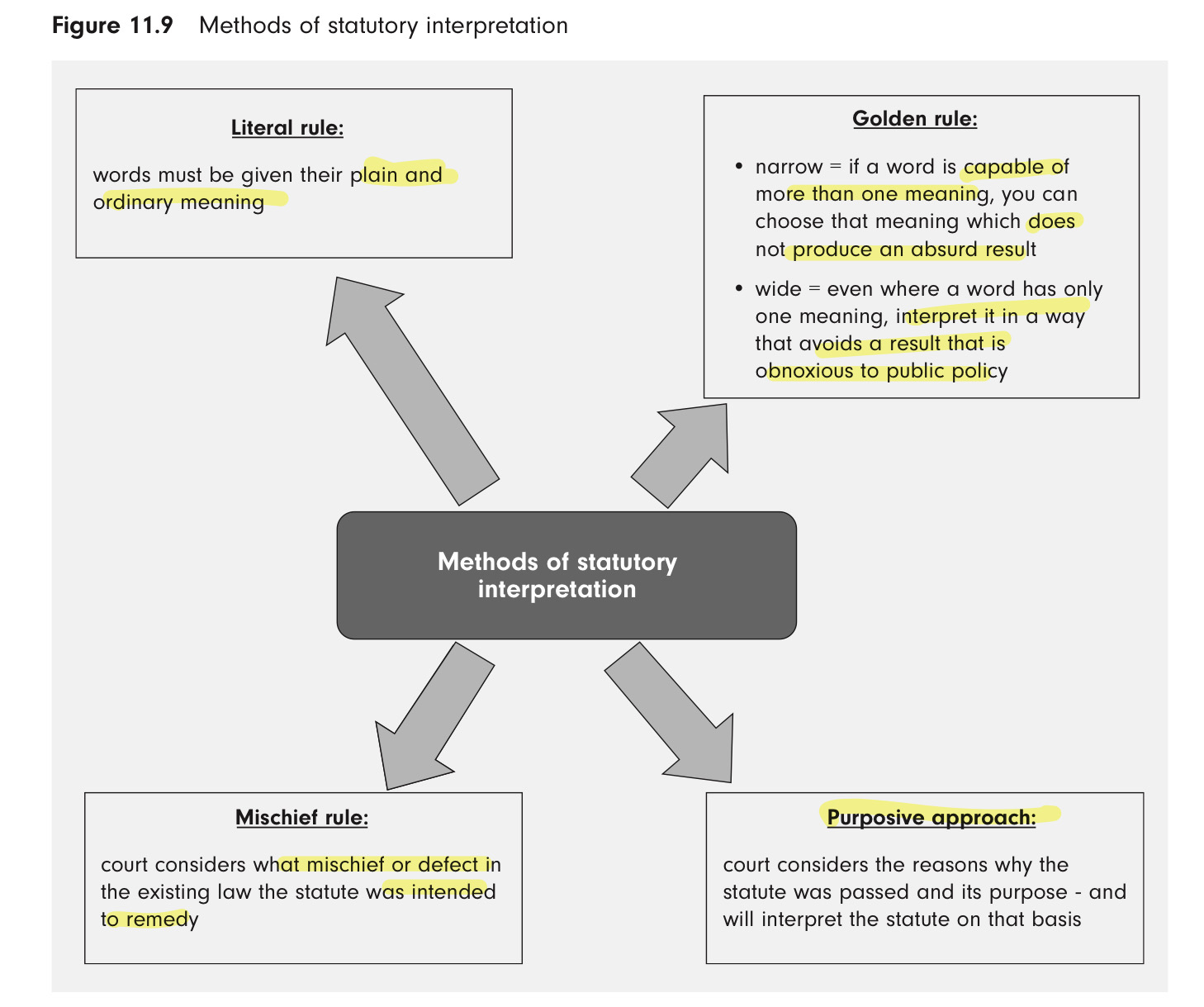
Statutory Interpretation Rules/methods of statutory interpretation
Literal Rule
Mischief Rule
Purposive Approach
Golden rule - allows the court to depart from the ordinary meaning of statutory words to avoid an absurd result.
narrow = if a word is capable of more than one meaning, you can choose that meaning which does not produce an absurd result
wide = even where a word has only one meaning, interpret it in a way that avoids a result that is obnoxious to public policy
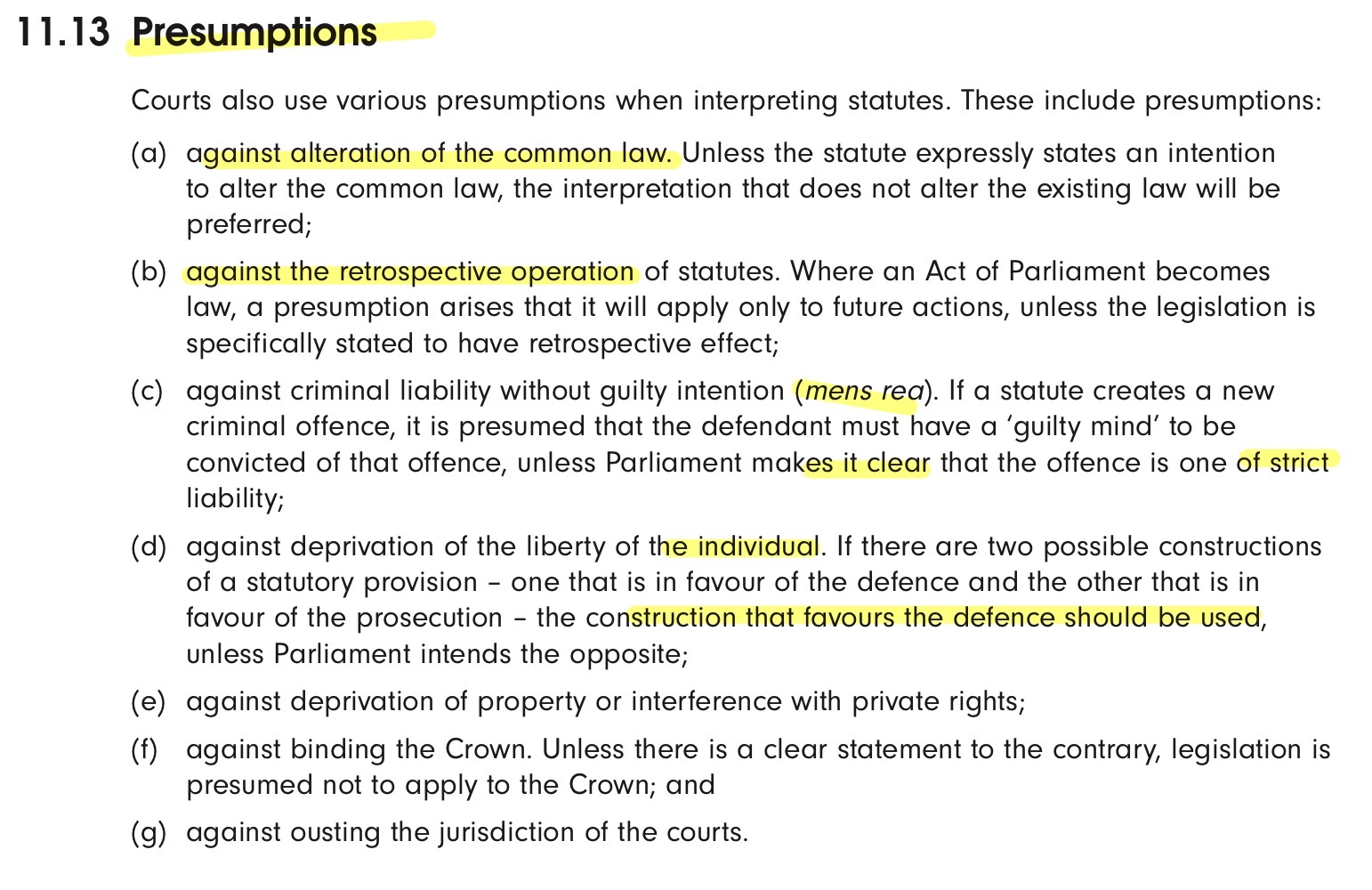
Statutory interpretation - presumptions
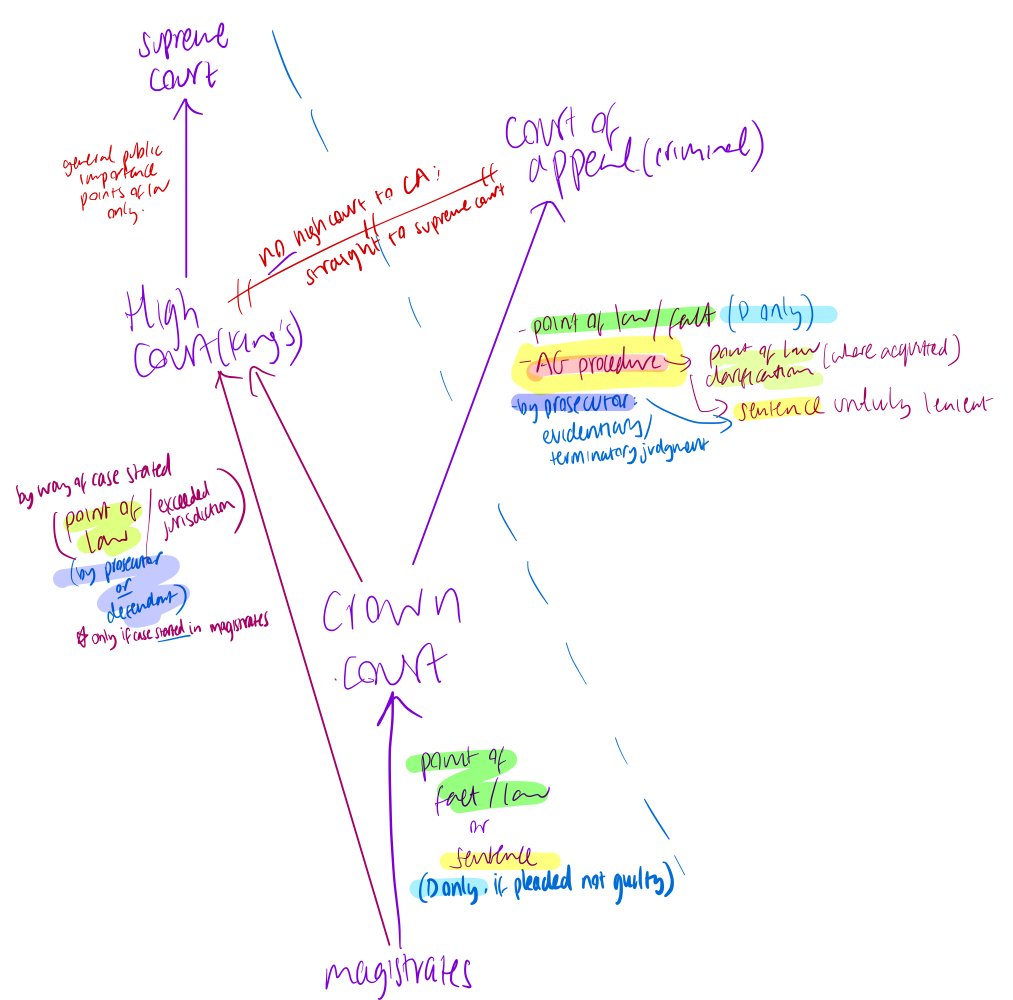
Criminal appeals
see flowchart
appeal by way of case stated:
appeal brought on the basis that an order, judgment or other decision may be wrong in law or made in excess of jurisdiction (legal argument only).
appeal by way of case stated - Either party may appeal against a magistrates/crown court decision; *crown>high court route of appeal is only available if a Crown Court case is itself an appeal from the magistrates' court.
no criminal appeal from high court to court of appeal; straight to supreme court (but only granted if point of law of general public importance)
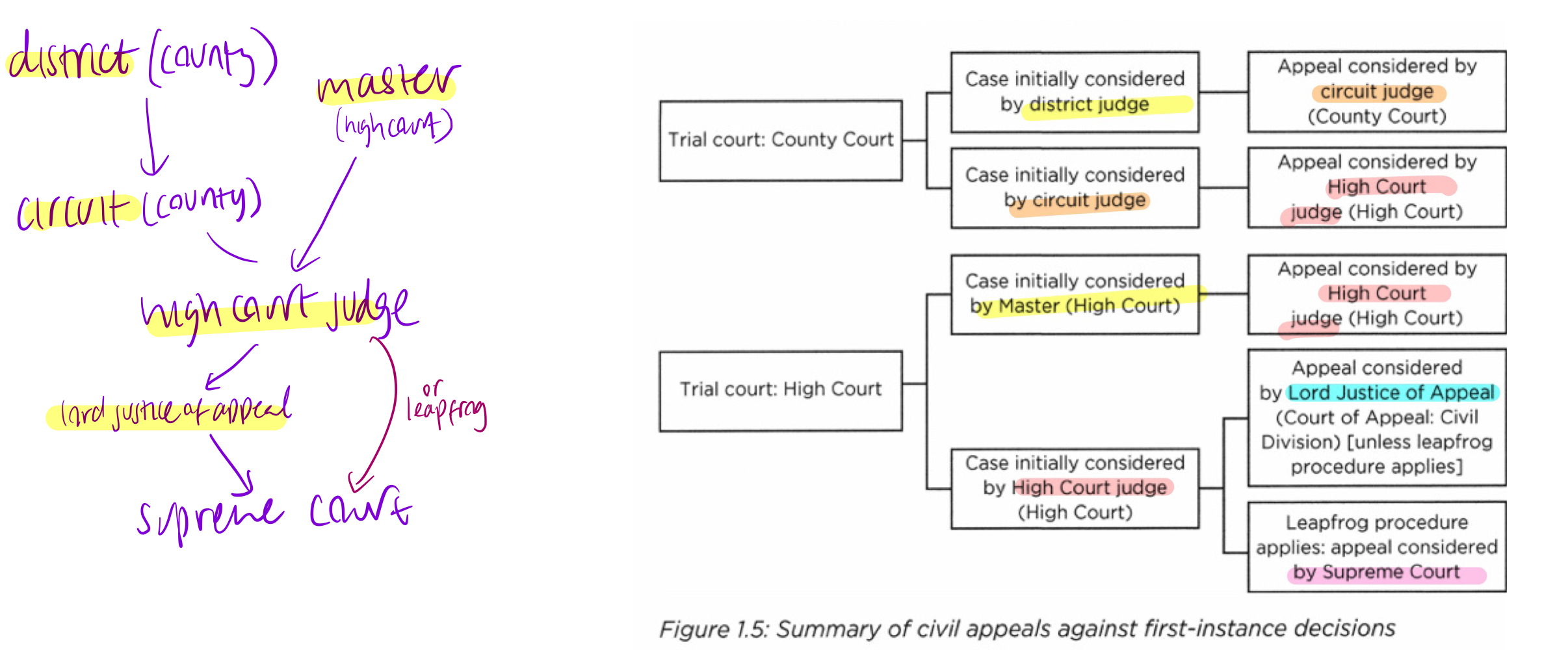
civil appeals
criteria? which judge? how many levels of appeal?
when does leapfrog procedure apply?
permission to appeal (almost always required) can be obtained from 1st instance OR relevant appellate court
given where there is a realistic prospect of success or where there is some compelling reason why the appeal should be heard.
The general rule is that appeals will be considered by the next level of judge in the judicial hierarchy (NOT NEXT COURT)
general rule - usually only one level of CIVIL appeal (UNLESS case raises important point of principle or practice)
when does leapfrog procedure (high court to supreme) apply?
point of law of general public importance; AND
at least one of the following is satisfied:
issues of national importance OR
the result is of particular significance OR
the benefits of early consideration by the Supreme Court outweigh the benefits of consideration by the Court of Appeal
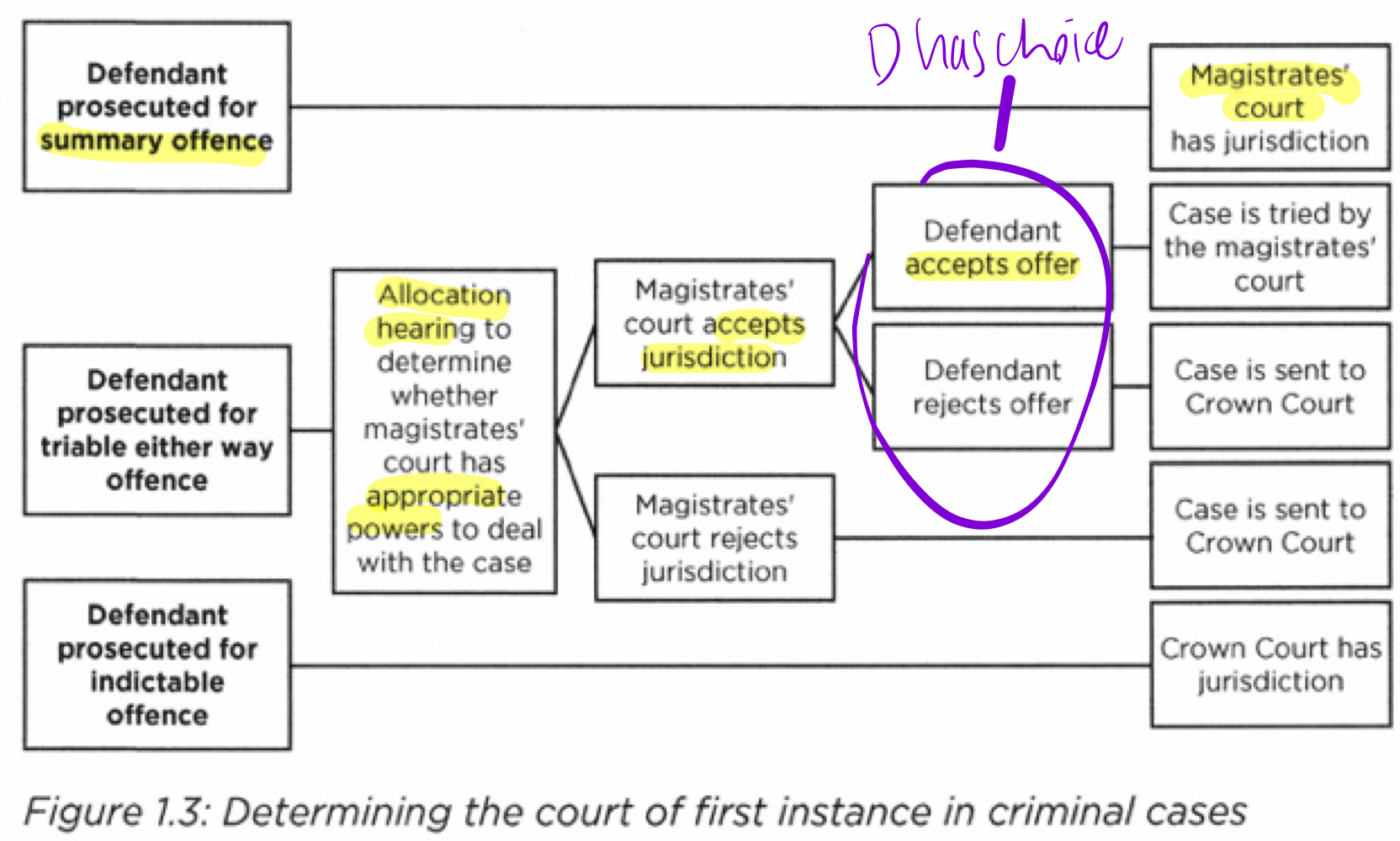
When determining whether the magistrates court has jurisdiction to hear a triable either way offence, the magistrates will consider:
When determining whether the magistrates court has jurisdiction to hear a triable either way offence, the magistrates will consider:
the seriousness of the offence
any relevant prior convictions
whether the sentencing powers they have are likely to be sufficient to deal with the case
(mag can only order a custodial sentence of up to 6 months (or up to 12 months in total if multiple triable either way offences)
Public order law - scope + human rights context
Scope: public processions, public assemblies, trespassory assemblies, breach of the peace, obstruction, public order offences
_
Human rights context:
• freedom of expression and peaceful assembly protected
• can be restricted for prevention of disorder or crime
_
Exam approach: identify whether facts involve:
• procession
• assembly
• trespassory assembly
• breach of peace
• specific criminal offence
Public procession - requirements & exceptions police can impose what conditions?
Definition: Moving demonstration involving more than one person, in a place to which the public has access or on a highway
_
Notice: 6 days in advance - organisers must give written notice to police (stating date, time, route and organisers’ names), except not required if:
• not reasonably practicable
• common or customary event
• funeral
_
Police may impose conditions if reasonably believes:
• risk of serious public disorder
• serious property damage
• serious disruption to community life
• purpose is to intimidate others
_
Conditions may restrict:
• route; or
• entry into any public place
_
Ban: if conditions insufficient to prevent serious public disorder, chief officer may apply to local council for order prohibiting all public processions in district/part of district for max 3 months (Home Secretary consent required)
_
Offence: failure to notify / disobeying police conditions
Public assembly -
definition
police powers
can it be banned?
Definition: Static demonstration of 2+ persons in a public place wholly or partly open to the air
_
Notice: no statutory duty to notify police
_
Police may impose conditions if reasonably believes:
• risk of serious public disorder
• serious property damage
• serious disruption to community life
• purpose is to intimidate others
_
Conditions may restrict:
• place of assembly
• maximum duration
• maximum number of persons
_
Ban: no statutory power to ban all public assemblies in a district
_
Offence: disobeying police conditions \d;
Public procession v public assembly -
key differences]
Procession:
• moving demonstration
• highway / place public has access
• no statutory minimum number
• organisers usually must notify police
• conditions on route / entry into public places
• possible 3-month ban on all processions in district
_
Assembly:
• static demonstration
• 2+ persons
• public place wholly/partly open to air
• no statutory duty to notify
• conditions on place / duration / numbers
• no statutory power to ban all assemblies
_
Exam point: processions are treated as greater public order risk, so police powers are stronger
“Serious disruption to life of community” definition
includes:
• noise that intimidates / harasses / causes alarm or distress
• significant delay to time-sensitive product
• disruption of access to essential goods/services (money, food, water, energy, fuel)
• disruption to communications
• disruption to place of worship
• disruption to transport facility
• disruption to educational institution
• disruption to health services
Trespassory assembly -
definition
order limits?
offence
Assembly of 20+ persons on land in open air where:
• public has no right / limited right of access
• occupier likely has not given permission
• assembly may cause serious disruption to community life; or
• significant damage to land/buildings/monuments of historic, architectural, archaeological or scientific importance
*must prove trespass; peaceful reasonable use of highway is not trespass
_
Order: chief officer may apply to local council for order prohibiting all trespassory assemblies in district (Home Secretary consent required)
• max 4 days
• max 5-mile radius from specified centre
Effect:
• organisers and participants commit offence
• police may stop people proceeding to trespassory assembly
Breach of the peace -
definition
when can police act?
police powers (and limits)
Core idea: must provoke violence imminently
1.An act done/threatened which:
• actually harms a person
• harms property in that person’s presence
• is likely to cause such harm or
• puts someone in fear of such harm being done
2.Conduct with natural consequences of provoking others to violence
_
Police can act before violence occurs if:
• honestly and reasonably believe real risk of breach of peace; in sense that:
• close proximity both in place and time
_
Power to detain if evidence there could be imminent violence. Can take reasonable steps:
• ban procession
• disperse assembly
• enter private premises
• detain people
• prevent people travelling
• remove provocative signs/emblems
_
Human rights limit: protest should be permitted if it does not cause violence
_
Offensive speech: not enough by itself if it does not tend to provoke violence
_
Kettling (mass detention) - lawful if reasonable and proportionate to prevent violence
_
NB common law concept, duty to maintain peace of the realm
Breach of peace -
enforcement options (incl. binding over)
Enforcement options -
• arrested and released without charge
• bound over to keep the peace
• prosecuted for obstruction of police officer/highway
_
Binding over: civil remedy with criminal standard of proof.
Court must be satisfied:
• breach of peace occurred; and
• real risk of violence in future
_
Order: defendant must refrain from specific conduct/activity (max 12 months)
If break order, recognisance (pay a specific sum) required;
refusal to be bound over may lead to imprisonment up to 6 months
Public order offence -
obstruction of police officer + highway
Obstruction of police officer: refusing reasonable direction of police officer who is lawfully trying to prevent breach of peace
_
Obstruction of highway: wilful obstruction of highway without lawful excuse (includes pavement)
small peaceful protest may be lawful if highway not actually blocked
Public order offences - list all of them
General: offences designed to control public order problems
_
Can be committed: in public or private place
_
Mens rea: intent must be proved for each offence
_
Most serious to least serious:
• riot
• violent disorder
• affray
• fear/provocation of violence
• harassment, alarm or distress
• aggravated trespass
• public nuisance
• newer acts - locking on, tunneling, obstruction of major transport works, interference w key national infrastructure, concealing identity at protest, carrying firework at protest, climbinb on war memorial
_
Key numbers:
• 2 = public assembly
• 3 = violent disorder
• 12 = riot
• 20 = trespassory assembly
Riot vs. violent disorder
Riot:
• 12+ persons present together
• use or threaten unlawful violence
• for common purpose (no need preplanned; just need to support each other in violence)
• conduct causes person of reasonable firmness present at scene to fear for safety
_
threats alone insufficient; must use unlawful violence for common purpose
_
Violent disorder:
• 3+ person
• use or threaten unlawful violence (no need common purpose)
• causes person of reasonable firmness present at scene to fear for safety
_
Violent disorder vs. riot:
• only requires 3 people, not 12
• no common purpose required
• threats of violence can be enough
BOTH include violence against property
Affray
• 1 or 2 persons acting together
• use or threaten unlawful violence (words alone are not enough)
• causes person of reasonable firmness present at scene to fear for safety
_
Key point: envisages at least offender, victim and bystander
_
Reasonableness: court looks at all circumstances to decide whether bystander fear was reasonable
_
affray does not cover violence against property alone (cf. riot & violent disorder)
Fear or provocation of violence - elements
Person subjected to threatening, abusive or insulting:
• words or behaviour; or
• writing, sign or visible representation
+
Intent:
• to cause that person to believe that unlawful violence will be used against them or
• to provoke the immediate use of unlawful violence.
_
Timing: violence need not be instantaneous, but there must be proximity in time and causation
Harassment, alarm or distress
2 Elements:
Using threatening, abusive or insulting:
• words or behaviour
• writing, sign or visible representation; or
• disorderly behaviour.
+
Words/behaviour must be within hearing or sight of person likely to be caused harassment, alarm or distress
_
no need intended violence (cf. fear or provocation of violence)
_
Question of fact: whether someone likely to be harassed/alarmed/distressed depends on circumstances
Swearing at police less unlikely an offence
Aggravated trespass - definition + police power
Trespass on land with intent to disrupt, obstruct or intimidate persons engaged in lawful activity
_
aka must prove:
• trespass and
• D engaged in acts to disrupt lawful activity
_
Not enough: mere trespass alone
_
Police power: may direct ppl to leave land
_
activity disrupted must be lawful under UK law (e.g. preparing weapons for war)
Public nuisance
Intentionally or recklessly:
• causing/create risk of serious harm to public; or
• obstructing public in exercise/enjoyment of a right
_
Mens rea: intentional or reckless
Serious Disruption Prevention Orders -
when imposed?
conditions
When: person has committed 2+ protest-related offences within last 5 years
_
How imposed: after conviction / on application by chief officer
_
Duration: max 2 years
_
Conditions may cover:
• residence
• travel
• association with other persons
• internet use