Classical Conditioning: Key Concepts and Examples in Psychology
 Studied by 0 people
 Call Kai
 Learn
Learn Practice Test
 Spaced Repetition
 Match
Match Flashcards
 Knowt Play
1/19

There's no tags or description
Looks like no tags are added yet.
Name | Mastery | Learn | Test | Matching | Spaced |
|---|
No study sessions yet.
20 Terms
Classical Conditioning
Learning procedure in which associations are made between a natural stimulus and a learned, neutral stimulus.
Natural Stimulus
One that causes an automatic response.
Neutral Stimulus
Doesn't cause the automatic response.
Acquisition
The process of developing a learned response.
Unconditioned Stimulus (UCS)
A natural stimulus that triggers a response automatically and reflexively.
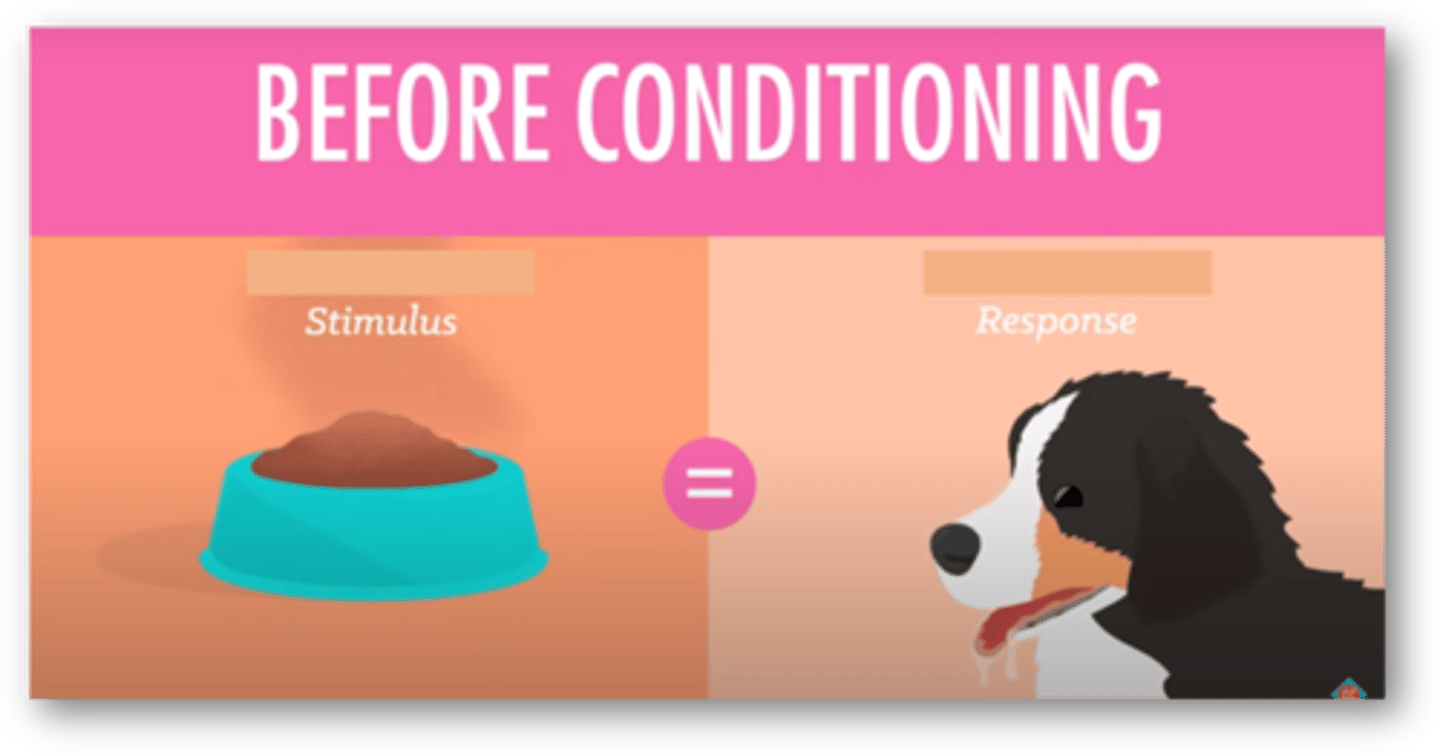
Example of UCS
Meat.
Unconditioned Response (UCR)
The automatic response to the unconditioned stimulus.
Example of UCR
Salivation.
Conditioned Stimulus (CS)
A previously neutral stimulus that, through learning, has gained the power to cause a conditioned response.
Example of CS
Bell.
Conditioned Response (CR)
The response to the conditioned stimulus.
Example of CR
Salivation.
Extinction
The gradual weakening and eventual disappearance of the conditioned response.
Spontaneous Recovery
Occurs when a previously extinguished conditioned response suddenly reappears after a period of no training.
Generalization
A conditioned response occurs to stimuli that are similar to the conditioned stimulus.
Discrimination
Occurs when stimuli similar to the conditioned stimulus do not produce a conditioned response.
Higher-Order Conditioning
The conditioned stimulus in one conditioning experience is paired with a new neutral stimulus creating a 2nd conditioned stimulus.
One-trial Conditioning
If the consequences are extreme enough, something can be learned even if the individual has only been exposed to the condition once.
One-trial Learning
Learning is a process that occurs in a single trial.
Counter Conditioning
Replacing a negative response with a positive response.