Principles of Phylogeny and Origins of Photosynthetic Life
 Call Kai
 Learn
Learn Practice Test
 Spaced Repetition
 Match
Match Flashcards
 Knowt Play
1/10

Earn XP
Name | Mastery | Learn | Test | Matching | Spaced | Call with Kai | Chat |
|---|
No analytics yet
Send a link to your students to track their progress
11 Terms
What key adaptation permitted plants to colonize land?
Adapt to dry, high light conditions, develop transport systems for water and nutrients, develop structural support, and find new ways to disperse reproductive cells and progeny
What structures were formed as a key adaptation to colonize land?
Cuticle, spores, stomata, pigments, and a mutually beneficial association with fungi (mycorrhizae) that promotes nutrient uptake from the soil
What are cuticles?
A waxy coating that slows water loss

What are spores?
Feature thick sporopollenin walls that protect spores against drying out and decay (desiccation resistance)
What do stomata do?
Closable openings that regulate water vapor and CO2 going in and oxygen going out
What are the presence of spores in the sporopollenin wall?
Wind-blown spores are present and thick while swimming spores are absent.
What pigment evolved in streptophytes?
Chlorophyll b
Which pigment is in all photosynthetic organisms?
Chlorophyll a
Accessory photosynthetic pigments
Absorb light in different wavelengths than chlorophyll a (reaction center). Ex: chlorophyll b and carotenoids; can help increase photosynthetic efficiency
flavonoids protect from uv exposure
can serve as a private communication channel with pollinators
What are mycorrhizae?
Association with fungi that provide nutrients to plants
ectomycorrhizal fungi wrap themselves around the plant, increasing surface area for water and mineral absorption
vesicular arbuscular mycorrhizal fungi grow into root cells and exchange water and nutrients
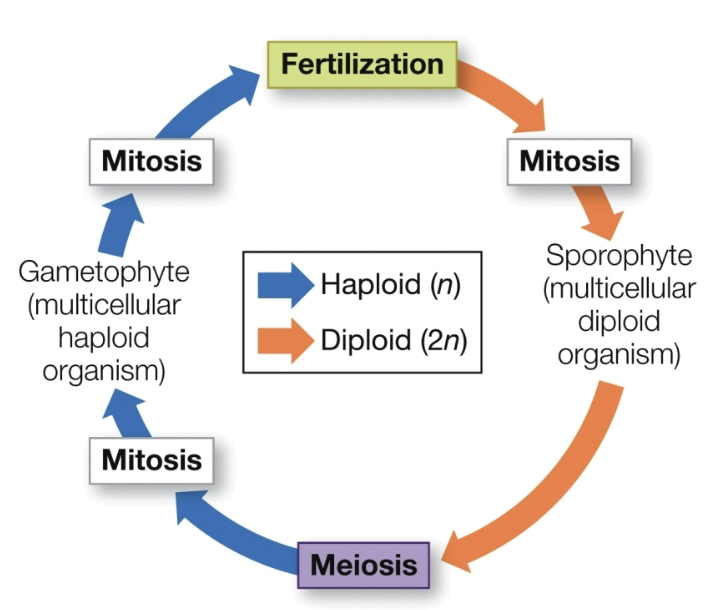
Land plants have alternation of generations
Refers to the fact that there are both haploid and diploid multicellular stages. this life cycle is a synapomorphy for the land plant clade
spores grow via mitosis to produce haploid multicellular gametophytes, which make gametes in gametangia
two types of gametangia: antheridia and archegonia
antheridia - make sperm
archegonia - make eggs
eggs are fertilized to make diploid zygotes