Econ chapter 8

0.0(0)
Studied by 0 people
call kaiCall Kai
Locked
learnLearn
examPractice Test
spaced repetitionSpaced Repetition
heart puzzleMatch
flashcardsFlashcards
GameKnowt Play
Card Sorting

1/38

encourage image

There's no tags or description

Looks like no tags are added yet.

Last updated 6:07 PM on 8/25/26
Name
Mastery
Learn
Test
Matching
Spaced
Call with Kai
Chat

No analytics yet

Send a link to your students to track their progress

39 Terms

1
New cards
Injections
money flowing in (EX: investment, government spending, export spending)
2
New cards

Leakages

- money flowing out (Ex: savings, taxes, import spending)

3
New cards

Circular flow of income

illustrates how money, goods, and services circulate between different sectors of an economy.
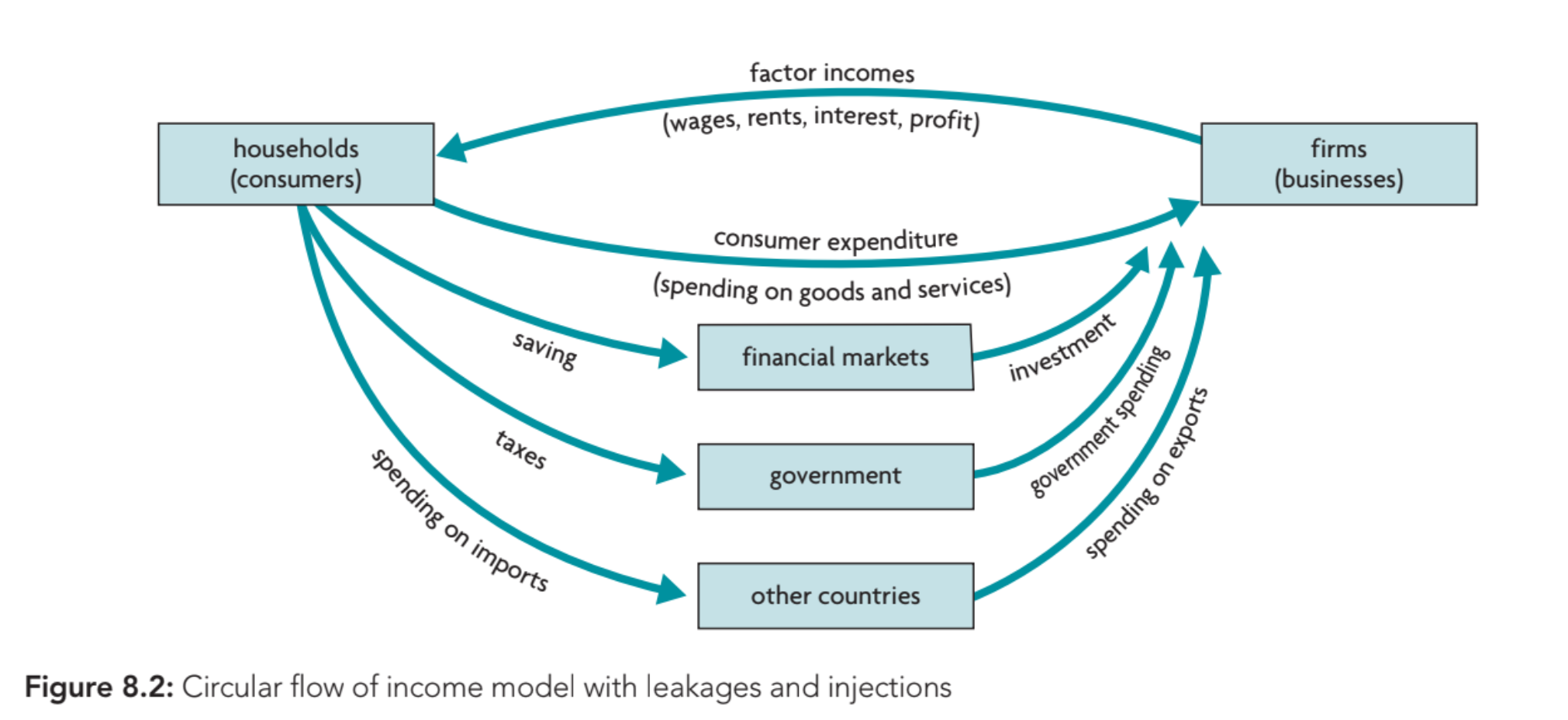
<p>illustrates how money, goods, and services circulate between different sectors of an economy.</p>
4
New cards
National income accounting
economy’s national income or the value of output
5
New cards

Expenditure approach

adds up all spending on goods and services within a economy over a time period (Measures GDP)

6
New cards

Income approach

way of measurement that adds up all incomes earned within an economy over time (including wages, rent interest and profits)

7
New cards

Output approach

way of measuring that uses the sum of the total value of all final goods and services produced within an economy over a period of time
8
New cards
Total spending (GDP calculation)
Consumption spending (C), + Investment spending (I), + Government spending (G), + Net Exports (exports minus imports) = GDP
9
New cards
GDP
Gross domestic product, total monetary value of all final goods and services produced within a country in a time period
10
New cards
GNI
Gross national income, total domestic and foreign output claimed by a country’s residents (calculated as GDP+net income from abroad)
11
New cards
Nominal value
the money value or value measured in terms of prices at the time
12
New cards
Real value
measure of value that takes into account changes in price over time
13
New cards
GDP per capita
total GDP of that country divided by population (also useful as a summary measure of standard of living)
14
New cards
Distinction between GDP and per capita
Differing population sizes across countries, and population growth
15
New cards
Purchasing power parties (PPP’s)
amount of a country’s currency that is needed to buy the same quantity of local goods and services
16
New cards
Price index
measure of average prices in one period relative to average prices in base year
17
New cards
GDP deflator formula
nominal GDP/real GDP x100
18
New cards
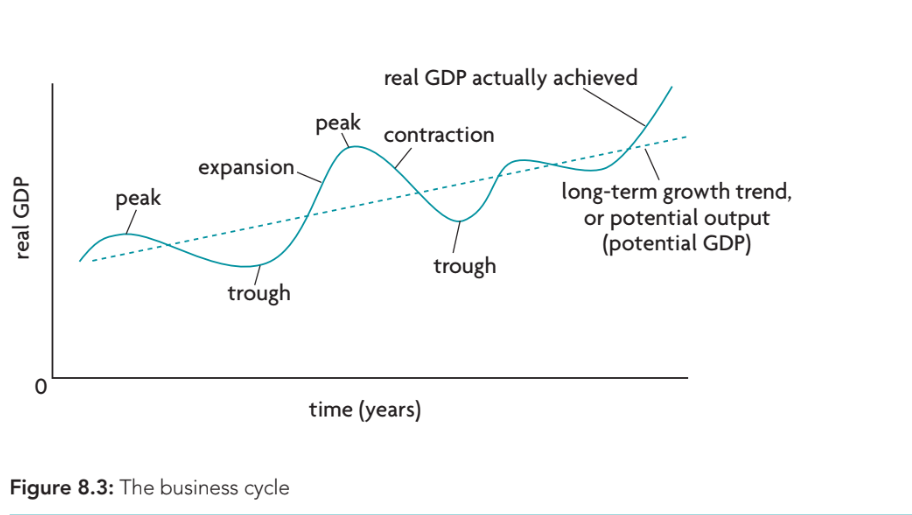
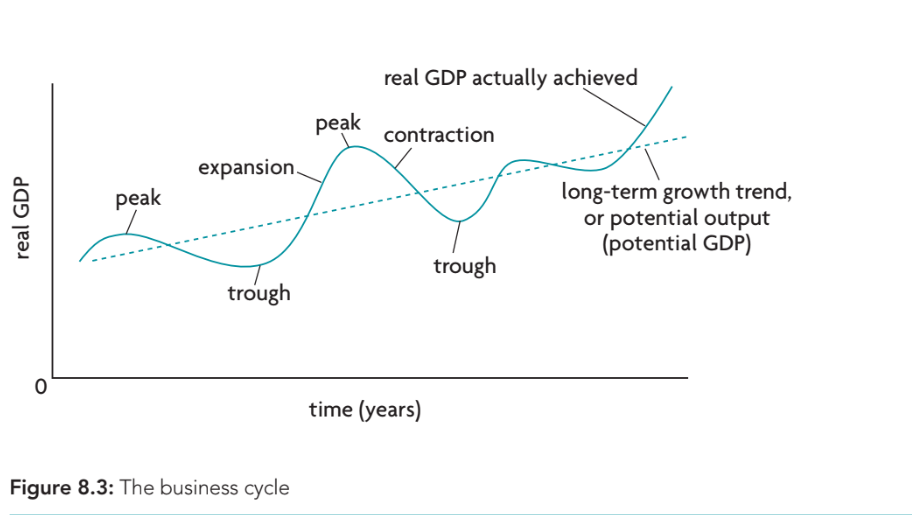
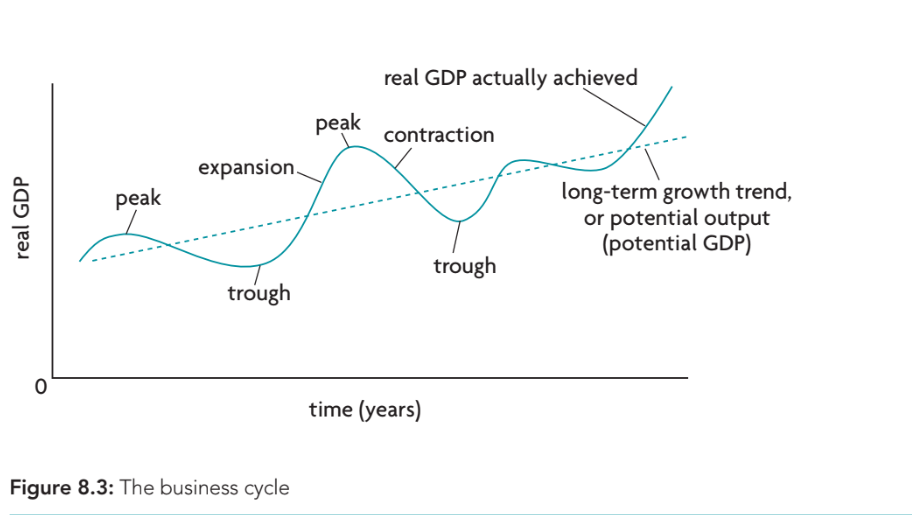
Business cycle
the natural recurring fluctuations of economic activity over time, marked by alternating periods of growth and contraction
19
New cards
Business cycle phases
Expansion, peak, contraction, trough
20
New cards
Expansion (Business cycle)
occurs during positive growth in real GDP, employment of resources increases, and general price level of economy begins to rise (inflation)
21
New cards
Peak (Business cycle)
represents the cycle’s maximum real GDP, and marks the end of expansion, unemployment of resources has fallen substantially, and general price levels may be rising rapidly
22
New cards
Contractions (Business cycle)
the economy begins to experience falling real GDP (negative Growth) and growing unemployment of resources, and increases in price level may slow down. If contraction lasts 6 months or more it is a recession
23
New cards
Trough (Business cycle)
the cycle’s minimum level of GDP. Widespread unemployment but is followed by a new period of expansion.
24
New cards
Long-term growth trend (potential output)
shows how output grows over time when cyclical fluctuations are ironed out
25
New cards

Full employment

when unemployment is equal to the natural rate of unemployment

26
New cards

Natural rate of unemployment

the lowest level of unemployment an economy can sustain without causing inflationary pressure, representing a state of equilibrium in the labour market. It consists primarily of structural and frictional unemployment

27
New cards
GDP gap
when GDP lies above or below potential GDP (calculated by actual GDP minus potential GDP)
28
New cards

Why GDP and GNI don’t accurately measure the ‘true’ value of output

 do not include non-marketed outputs, don’t include underground markets, do not take into account quality improvements in goods and services, don;t account for negative externalities, don’t account depletion of natural resources, differing domestic price levels

29
New cards

Why GDP/GNI can’t accurately measure economic well-being

make no distinction in composition of output, cannot reflect health, education and life expectancy achievements, provide no info on distribution of income, don’t take into account leisure or quality of life

30
New cards
Happy Planet Index
measure of sustainable well-being and takes into consideration life expectancy, personal well-being, and are all adjusted for inequalities and ecological footprint.
31
New cards
Ecological footprint
impact on the environment of each individual in a society on average
32
New cards
National income (aggregate output)
total amount of output (allows us to assess an economy’s performance over time
33
New cards
3 ways to measure national income value
expenditure approach, income approach, output approach
34
New cards
Consumption
all purchases by households on final goods and services in a year
35
New cards
Investment spending
includes spending by firms on capital goods (buildings, machinery, etc.), new construction
36
New cards
Government spending
purchases by the government of factors of production, including labor services
37
New cards
Net exports
The value of exports minus imports
38
New cards
Alternative measures of well-being
OECD Better life index, Happiness index, Happy Planet Index
39
New cards
Happiness index
a metric used to measure the subjective well-being, satisfaction, and quality of life in a population, and ranks countries using surveys