Kin 320 - Motor Development
0.0(0)
Studied by 1 person Call Kai
 Learn
Learn Practice Test
 Spaced Repetition
 Match
Match Flashcards
 Knowt Play
Card Sorting
1/27

Earn XP
Description and Tags
Last updated 5:07 AM on 12/12/22
Name | Mastery | Learn | Test | Matching | Spaced | Call with Kai | Chat |
|---|
No analytics yet
Send a link to your students to track their progress
28 Terms
1
New cards
physical literacy
\- the ABC’s of movement
\- being able to throw, run, kick
\- encourages children to be healthier in the long run
\- being able to throw, run, kick
\- encourages children to be healthier in the long run
2
New cards
motor competence
\- proficiency to execute a skill
3
New cards
motor development
\- the process through which a child acquires movement patterns and skills
4
New cards
pattern
\- basic movement involved in the performance of the task
\- how you’re actually performing
\- how you’re actually performing
5
New cards
skill
\- emphasizes the accuracy, precision, and economy of performance
\- more about the outcome
\- more about the outcome
6
New cards
motor development (children)
\- development of motor skills normally complete by 6 or 7 years of age
7
New cards
mountain of motor development
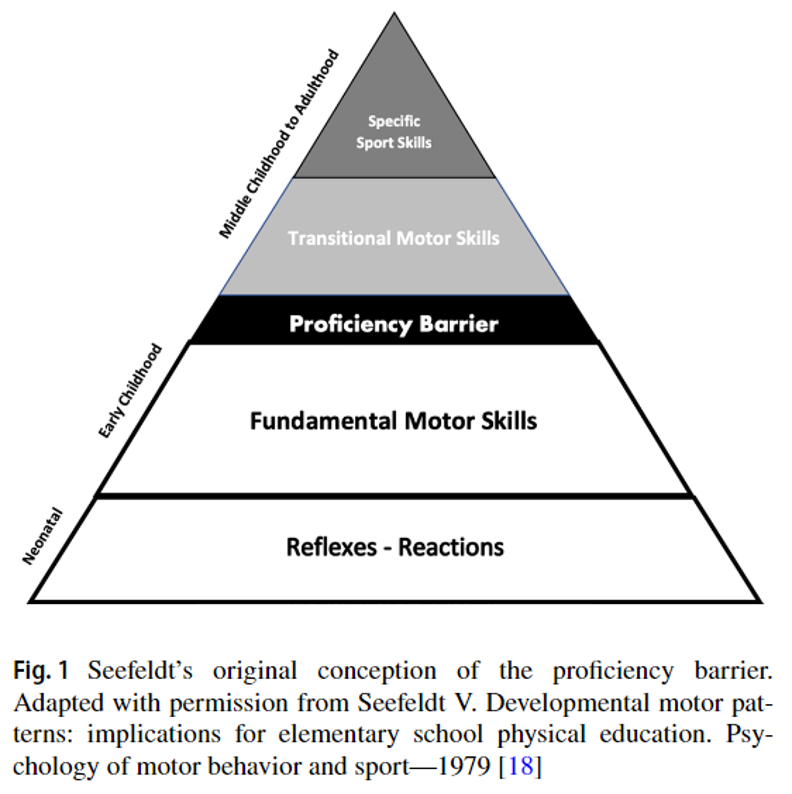
\- 1980 Seefeldt proposed the idea of a proficiency barrier
\- children need to engage in and practice skill-specific experiences consistently throughout childhood
\- children with more advanced skill levels were 2.5 times more likely to meet the MVPA guideline than lower skilled children
\- children need to engage in and practice skill-specific experiences consistently throughout childhood
\- children with more advanced skill levels were 2.5 times more likely to meet the MVPA guideline than lower skilled children
8
New cards
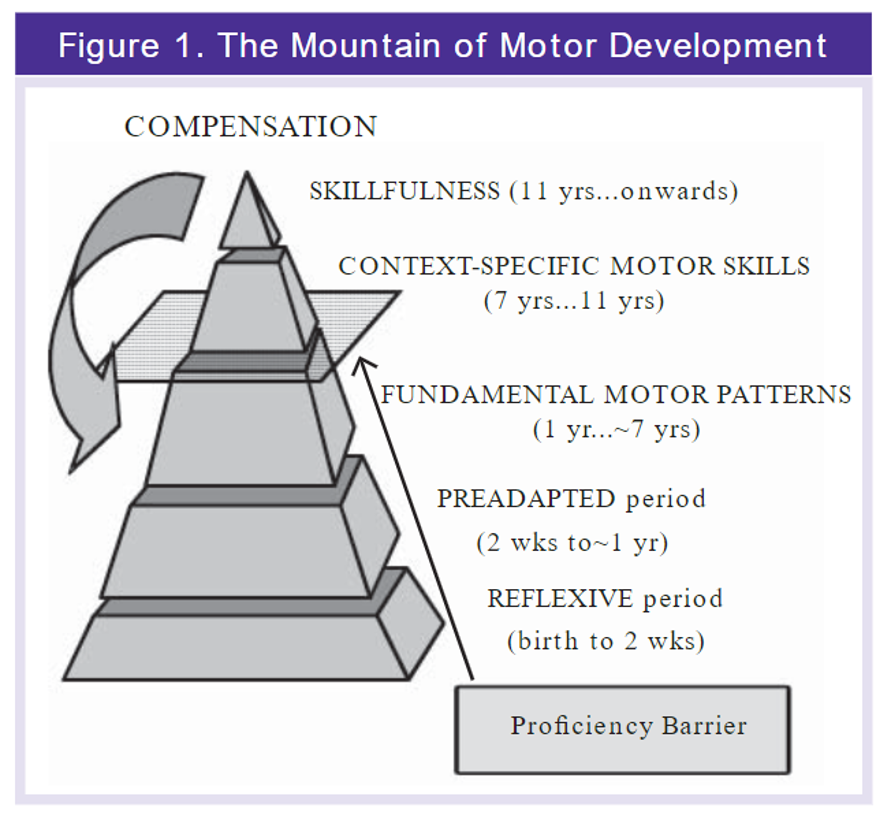
mountain of motor development 2 (periods)
1) reflexive
2) preadapted
3) fundamental motor patterns
Proficiency barrier
4) context-specific
5) skillful
6) compensation
2) preadapted
3) fundamental motor patterns
Proficiency barrier
4) context-specific
5) skillful
6) compensation
9
New cards
mountain of motor development 2
\- mountain displays the journey of motor development through lifelong progression and adaption
\- changes can be attributed to the development of the body, environment and motor skills
\- the mountain is universal and unique to everyone
\- changes can be attributed to the development of the body, environment and motor skills
\- the mountain is universal and unique to everyone
10
New cards
reflexive period
\- characterized by:
1) survival
2) interaction with an environment
\- physical activity in two movements: spontaneous and reflexive
1) survival
2) interaction with an environment
\- physical activity in two movements: spontaneous and reflexive
11
New cards
spontaneous movements
\- not elicited by particular stimulus
12
New cards
reflexive movement
\- motor responses to specific stimuli
\- primitive reflexes necessary for survival
\- posture reflexes change in orientation relative to the environment
\- primitive reflexes necessary for survival
\- posture reflexes change in orientation relative to the environment
13
New cards
preadapted period
\- characterized by:
1) independent function
\- feed oneself
\- move through the environment
1) independent function
\- feed oneself
\- move through the environment
14
New cards
fundamental patterns period
\- characterized by the development of:
1) locomotor patters
2) object control
\- object projection control of an object
\- object interception/deflection object is moving within the environment
1) locomotor patters
2) object control
\- object projection control of an object
\- object interception/deflection object is moving within the environment
15
New cards
context-specific period
in addition to perform a skill this period is characterized by:
\- learning rules and context-specific knowledge associated with motor skill
impacted mostly by cultural, familial, and social constraints (income, smaller town)
\- urban vs rural impacts sport opportunity
\- different cultures have different national sports
some exceptional children can pass this stage as early as 4 or 5 years of age
\- learning rules and context-specific knowledge associated with motor skill
impacted mostly by cultural, familial, and social constraints (income, smaller town)
\- urban vs rural impacts sport opportunity
\- different cultures have different national sports
some exceptional children can pass this stage as early as 4 or 5 years of age
16
New cards
skillful period
characterized by:
\- apply context-specific skills to a variety of situations
\- psychological efficiency
\- onset of puberty
\- difference in size, lean mass, fat mass
\- apply context-specific skills to a variety of situations
\- psychological efficiency
\- onset of puberty
\- difference in size, lean mass, fat mass
17
New cards
compensation period
characterized by:
\- adaption or compensation to body changes (aging or injury)
\- injury - training non-dominant limb
\- elderly some physiological factors can be retrained others cannot
\- adaption or compensation to body changes (aging or injury)
\- injury - training non-dominant limb
\- elderly some physiological factors can be retrained others cannot
18
New cards
motor competence assessment tools
\- test of gross motor development-3
\- Canadian Assessment of Physical Literacy
\- PLAY tools
\- Canadian Assessment of Physical Literacy
\- PLAY tools
19
New cards
PLAY tools
\- playfun
\- test of 18 fundamental motor skills
\- test of 18 fundamental motor skills
20
New cards
factors (motor development)
\- age (older - motor competence increases)
\- sex
\- health impairments
\- SES
\- sex
\- health impairments
\- SES
21
New cards
sex differences (motor development)
\- males have greater motor competence for running and object control skills
\- females have been found to have higher balance and locomotor motor competence
\- could be reflexive of gender-stereotypes in sport
\- females have been found to have higher balance and locomotor motor competence
\- could be reflexive of gender-stereotypes in sport
22
New cards
gender stereotypes
\- males participate in sports with more perceived masculine traits
\- females have greater participation in perceived feminine sports
\- children as young as 8 years of age are aware of and influenced by gender stereotypes
\- females may have greater social latitude in physical activities
\- females have greater participation in perceived feminine sports
\- children as young as 8 years of age are aware of and influenced by gender stereotypes
\- females may have greater social latitude in physical activities
23
New cards
title 9
\- 1970s
\- American legislation declared females have the same opportunities that males do
\- American legislation declared females have the same opportunities that males do
24
New cards
parental influence
\- family has the longest influence on a child’s development impact can be through
\- role model
\- support/expectations
\- gender-stereotypes
\- role model
\- support/expectations
\- gender-stereotypes
25
New cards
role model
\- mother’s current PA participation is correlated with daughter’s motor competence
\- mothers who purchase more sport equipment have children who report higher motor competence
\- mother is more of the role model for motor competency
\- mothers who purchase more sport equipment have children who report higher motor competence
\- mother is more of the role model for motor competency
26
New cards
support/expectations
\- support from parents is associated with childhood engagement in PA
\- parents with high expectations provide more PA opportunities
\- parents with high expectations provide more PA opportunities
27
New cards
sex difference (sport influence)
\- informal sport = males > females
\- organized sport = males > females
\- organized sport = males > females
28
New cards
sex differences (enjoyment)
\- males are more likely to enjoy physical education compared to females and the gap between sexes
\- males with low perceived motor competence stay stable over time with enjoyment, but females decrease in their enjoyment of physical education
\- males with low perceived motor competence stay stable over time with enjoyment, but females decrease in their enjoyment of physical education