2.2G Hybridization

0.0(0)
Studied by 1 person
call kaiCall Kai
learnLearn
examPractice Test
spaced repetitionSpaced Repetition
heart puzzleMatch
flashcardsFlashcards
GameKnowt Play
Card Sorting

1/7

flashcard set

Earn XP

Description and Tags

Last updated 8:45 PM on 1/25/24
Name
Mastery
Learn
Test
Matching
Spaced
Call with Kai

No analytics yet

Send a link to your students to track their progress

8 Terms

1
New cards

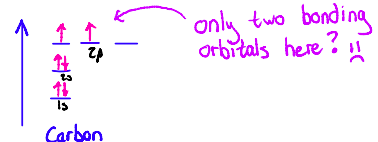
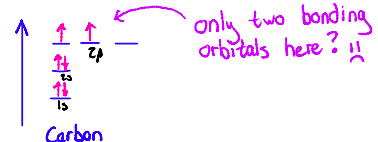
Tell me about the Theoretical and Experimental Structures of Methane. Why is the problem between the structure of carbon and methane?

Experimental evidence shows that carbon is tetrahedral

All four C–H bonds are the same

To get methane, carbon would need to have four identical orbitals

Each orbital would hold 1 electron and form one σ-bond

However...
<p>Experimental evidence shows that carbon is<strong><span> </span><span style="color: yellow">tetrahedral</span></strong></p><p>All four C–H bonds are the same</p><p>To get methane, carbon would need to have <strong><span style="color: blue">four identical orbitals</span></strong></p><p>Each orbital would hold 1 electron and form one σ-bond</p><p>However...</p><p><img src="https://knowt-user-attachments.s3.amazonaws.com/ae1edf9a-47af-43ce-9894-9d42937fdf62.jpeg"></p>
2
New cards

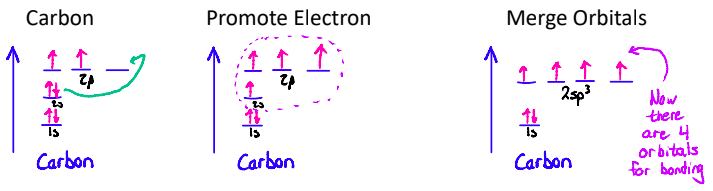
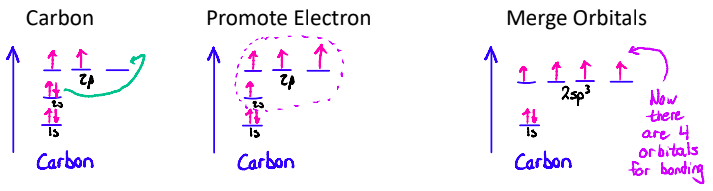
What is Hybridization? What does it involve? Where does it occur?

the mixing atomic orbitals to form new hybrid orbitals for bonding.

  • involves promoting electrons and merging orbitals in order to get new orbitals, whose shapes match experimental evidence.

  • Hybridization can occur in any covalently bonded molecule.
<h2 collapsed="false"><em><span style="color: blue">the mixing atomic orbitals to form new hybrid orbitals for bonding. </span></em></h2><ul><li><p>involves <strong><span style="color: red">promoting electrons and merging orbitals</span></strong> in order <mark data-color="red">to get new orbitals</mark>, whose shapes match experimental evidence. </p></li><li><p>Hybridization can occur in <strong><span style="color: purple">any covalently bonded molecule.</span></strong></p></li></ul><h1 collapsed="false"><img src="https://knowt-user-attachments.s3.amazonaws.com/8342ce82-e9e6-4286-9a40-35f993c57c02.jpeg"></h1>
3
New cards

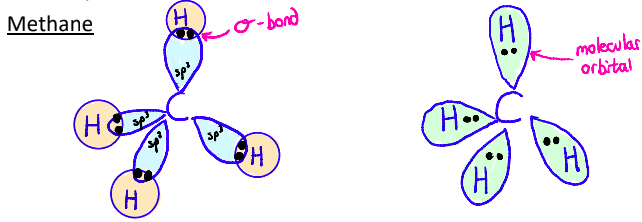
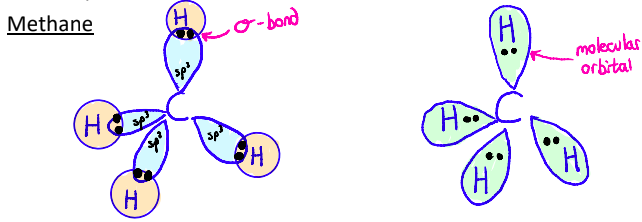
Tell me about sp3 orbitals

  • Hybridization gives a model that matches bond geometry

  • sp3 orbitals have 25% s-character and 75% p-character

  • 109.5° apart from one another

<ul><li><p>Hybridization gives a model that<strong><span style="color: green"> matches bond geometry </span></strong></p></li><li><p>sp<sup>3</sup> orbitals have <strong><span style="color: yellow">25% s-character and 75% p-character </span></strong></p></li><li><p><strong><span style="color: blue">109.5° apart</span></strong> from one another<img src="https://knowt-user-attachments.s3.amazonaws.com/c3bd5568-9af7-4f63-bfc3-d8f31c77b8d2.jpeg"></p></li></ul>
4
New cards

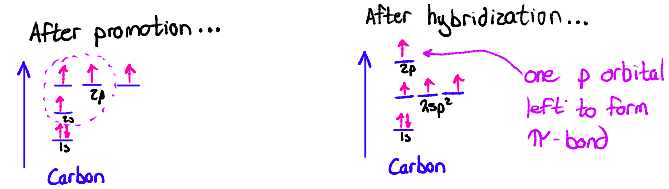
Tell me about Ethene and how it relates to hybridization.

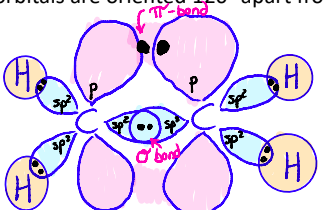
π-bonds form via side-to-side overlap of p-orbitals

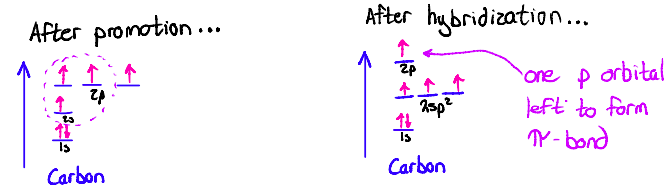
If a double bond is present, a p-orbital must still remain after hybridization
<p>π-bonds form via <strong><span style="color: blue">side-to-side overlap of p-orbitals</span></strong></p><p>If a <mark data-color="red">double bond is present</mark>, a <strong><span style="color: red">p-orbital must still remain</span></strong> after hybridization</p><p><img src="https://knowt-user-attachments.s3.amazonaws.com/5b854e3b-ec76-412f-a821-5d9862112400.jpeg"></p>
5
New cards

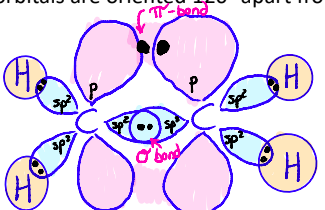
Tell me about sp2 orbitals

sp2 look like sp3 but are shorter and wider

sp3 orbitals are oriented 120° apart from one another
<p><mark data-color="yellow">sp<sup>2</sup> look like sp<sup>3</sup></mark> but are <strong><span style="color: yellow">shorter and wider</span></strong></p><p>sp<sup>3</sup> orbitals are oriented <strong><span style="color: blue">120° apart</span></strong> from one another</p><p><img src="https://knowt-user-attachments.s3.amazonaws.com/af73f4a1-b243-4d57-a972-21c7502d3d62.jpeg"></p>
6
New cards

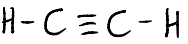
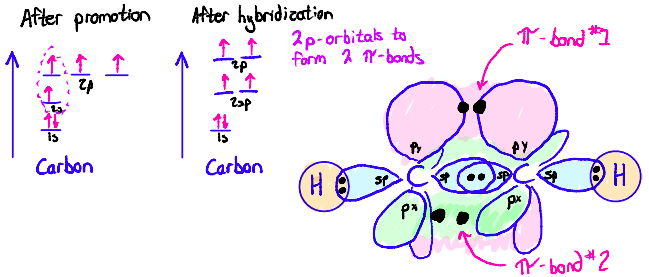
sp orbitals

7
New cards

Shortcut for Determining Hybridization

Steps

  1. Look at atom in molecule

  2. Count the number of electron domains

2 E.D. = sp

3 E.D. = sp2

4 E.D. = sp3

5 E.D. = sp3d

6 E.D. = sp3d2

8
New cards

What do the superscripts (exponents) tell you?

how many of each orbital was used in hybridization