Exam 2: Study guide and practice questions
 Call Kai
 Learn
Learn Practice Test
 Spaced Repetition
 Match
Match Flashcards
 Knowt Play
1/89

There's no tags or description
Looks like no tags are added yet.
Name | Mastery | Learn | Test | Matching | Spaced | Call with Kai |
|---|
No analytics yet
Send a link to your students to track their progress
90 Terms
What are the major features of prokaryotic cells?
Do NOT contain membrane-bound organelles nor nuclear membrane
Much smaller then eukaryotic cells
Usually have stiff cell wall
Common shapes: rod, spiral, spherical
Contain a nucleoid region with SINGLE, CIRCULAR chromosome DNA
Do NOT contain true nucleus (with nuclear membrane/envelope)
Its cytoplasm may contain food granules and ribosomes
Where in the cell is the site of protein synthesis?
Ribosomes
What primarily determines the shape of animal cells, which lack cell walls?
Cytoskeleton (especially microfilaments/actin filaments)
What are the important functions of the cytoskeleton?
Shape, support, movement
What is nucleolus?
In eukaryotic cells, nucleolus is inside the nucleus. It is the site of ribosome synthesis. It contains rDNA (ribosomal DNA) genes, newly synthesized pre-rRNA, ribosomal proteins
In prokaryotic cells, nucleolus lies in cytoplasm in nucleoid region, not covered by nuclear membrane
Where is the site of lipid production?
Smooth ER
Ribosomes are the site of synthesis of what organic molecules?
Proteins
Which cellular organelle packages enzymes and forms lysosomes?
Golgi apparatus
How does a cell rid itself of defective or malfunctioning organelles? (digestion)
Lysosomes carry out the process of autophagy
Which organelle “buds off” Golgi apparatus?
Vesicles
What are the similarities between mitochondria and chloroplasts?
Both contain their own DNA
Both have ribosomes
Both have 2 sets of plasma membrane
Which pair of organelles is responsible for supplying energy to eukaryotic cells?
Mitochondria and Chloroplasts
The ____ portion of cell membrane is responsible for the isolating function of the membrane, while the _____ portion regulates exchange and communication with the environment
The LIPID portion of cell membrane is responsible for the isolating function of the membrane, while the PROTEIN portion regulates exchange and communication with the environment
Which component accounts for the fluid aspect of the fluid mosaic model of the plasma membrane?
Lipids
What is the function of the recognition proteins?
Recognition proteins are a type of membrane protein that are glycoproteins (carbohydrate covalently bonded to protein) that function as identification tags in cell-cell recognition
In general, which plasma membrane component is largely responsible for moving substances across the membrane, communicating with other cells, and identifying other cells?
Proteins
Which of the following groups includes carrier and channel proteins?
Transport proteins
Recognition proteins
Attachment proteins
Receptor proteins
1 - Transport proteins
Which of the membrane proteins are responsible for connecting cells to one another? (intercellular joining)
Adhesion/junctional proteins
Which of the membrane proteins are responsible for conveying external messages such as those sent by a hormone signal?
Receptor proteins
The blood plasma of a man who drinks saltwater will become _____ to his red blood cells whereas the red blood cells will be ______ to the blood plasma
The blood plasma of a man who drinks saltwater will become HYPERTONIC to his red blood cells whereas the red blood cells will be HYPOTONIC to the blood plasma
The process in which white blood cells engulf bacteria is termed _____
Phagocytosis
Describe the first and second law of thermodynamics
Energy can neither be created nor destroyed, but can change form (i.e. law of conservation of energy)
Total entropy (disorder) of an isolated system always increases over time for spontaneous, irreversible processes (heat naturally flows from hot to cold, never spontaneously from cold to hot. It introduces entropy, meaning systems tend toward disorder and energy spreads out over time. In short, you cannot break even, and the universe gets messier)
What is an enzyme and mode of action of an enzyme?
Enzymes are macromolecules (usually proteins) that is a catalyst (speeds up) for chemical reactions.
Mode of action is the process by which it binds to a specific substrate at its active site to form an enzyme-substrate complex, lowering the activation energy required for a reaction
How do cells control enzyme activity?
Cells regulate enzyme activity to maintain homeostasis through several mechanisms: allosteric regulation (binding molecules to sites other than the active site), feedback inhibition (product inhibits its own production), covalent modification (e.g., phosphorylation), compartmentalization (storing enzymes in specific organelles), and controlling enzyme synthesis/degradation
What are some factors that affect enzyme activity and how?
Poisons and drugs: inhibit enzyme by competing with the natural substrate for the active site (this occurs either by competitive or noncompetitive inhibition)
Environmental conditions: temperature (high temp —→ denatures protein structure), pH, salts, presence of coenzymes
What are the 3 components of modern cell theory?
Every living organism is made of one or more cells
The smallest organisms are single cells, and cells are functional units of multicellular organisms
All cells arise from preexisting cells
All cells share common features:
Plasma membrane - phospholipid bilayer, polar hydrophilic head and nonpolar hydrophobic tails
Cytoplasm - contains cytosol (fluid)
All cells use DNA as hereditary blueprint
All cells use RNA to copy the blueprint and to guide the construction of proteins
All cells obtain raw materials and energy from their environment (ex: building blocks of bio molecules - C, H, O, N, P, minerals, etc.)
Unlike animal cells, plant cells are surrounded by _________ and contains a __________ which maintains turgor pressure and fills with water to prevent cell from wilting
Unlike animal cells, plant cells are surrounded by CELL WALL and contains a CENTRAL VACUOLE which maintains turgor pressure and fills with water to prevent cell from wilting
Unlike plant cells, some animal cells contain ________
Centriole (organizes microtubules)
What is the role of the cytoskeleton?
Provides shape, support, and movement
Organelles are attached to network of protein fibers that make up cytoskeleton
What are the 3 types of fibers that make up the cytoskeleton?
Microtubules (thick)
Structure: Fat, spiral hollow tubes. Polymer of tubulin proteins (alpha and beta)
Function: MOTILITY, major component of cilia and flagella
Typically found in centrosome, near nucleus
Intermediate filaments (medium-sized)
Structure: rope-like
Function: support nuclear envelope, cell-cell junctions (ex: skin cells tightly holding together)
Microfilaments (thin)
Structure: extremely thin filaments like twisted pearl necklace
Function: maintain cell shape, intracellular traffic control, support for microvilli in intestinal cells
Important for muscle contraction
Centrioles
short hollow cylinders, composed of 27 microtubules arranged into 9 overlapping triplets
one pair per animal cells
typically located in centrosome, region near nucleus
separate during mitosis to determine plane of division
Cilia and Flagella
Both move the cell through fluid or move fluid through the cell
Both are slender extensions of plasma membrane
Cilia motion —→ oars on the side of rowboat
oviducts of female mammals, respiratory tract (trachea)
Flagellum motion —→ engine on motorboat
sperm cells
Describe the nucleus and its components
Nucleus is the control center of eukaryotic cell
Nucleus contains:
Nuclear envelope - double membrane perforated with nuclear pores. Pores allow free passage of water, ions, small molecules, and regulated passage of proteins, ribosomes, RNA via nuclear pore complex (i.e. gatekeeper proteins) that line each pore
Chromatin - contains DNA and proteins.
During cell division, chromatin becomes long strands called chromosomes which contain genes that are blueprint for proteins. mRNA (messenger RNA) is the copies of these blueprints, RNA must leave nucleus via nuclear envelope
Nucleolus - site of RIBOSOME SYNTHESIS.
Nucleolus consists of ribosomal RNA, proteins, DNA
What are ribosomes? Where are they located? What are they made of?
Site of protein synthesis in the cell
Composed of rRNA (made in nucleus) and proteins
Non-membrane bound
Location may be:
On the rough ER —→ makes proteins in ER, Golgi, Plasma membrane, Lysosome, or proteins for general secretion outside the cell
Freely in the cytoplasm (called free ribosomes) ——> makes proteins to be in the cytosol, nucleus, mitochondria, etc. (within the cell)
What are peroxisomes? How do they differ from lysosomes?
Similar to lysosomes
membrane-bound vesicles that contain enzymes
both only in eukaryotes
However, they differ in that:
Function: Lysosomes act as the cell's "garbage disposal" for recycling components. Peroxisomes act as metabolic, detoxifying centers, often producing and breaking down hydrogen peroxide
Enzymes: Lysosomes contain hydrolytic enzymes (active at low pH). Peroxisomes contain oxidative enzymes
Specific roles: Peroxisomes are crucial for breaking down very-long-chain fatty acids. Lysosomes are central to autophagy and phagocytosis
The cell’s membrane system includes:
plasma membrane
nuclear membrane
endoplasmic reticulum
golgi apparatus
lysosomes
vesicles
vacuoles
________ are membranous sacs that transport substances among the separate regions of the membrane system
Vesicles
What is the Endoplasmic Reticulum?
Smooth ER vs. Rough ER?
• The endoplasmic reticulum (ER) is a series of interconnected membranes that form a labyrinth of interconnected flattened sacs and channels within the cytoplasm
• All the proteins and phospholipids of cell membranes are synthesized in the ER
Smooth ER: has no ribosomes, detoxifies drugs, and synthesizes lipids like steroid hormones made from cholesterol
Rough ER: is studded with ribosomes and produces proteins destined for other membranes or for secretion
Golgi apparatus
•The Golgi apparatus sorts, chemically alters, and packages important molecules
•The Golgi apparatus modifies some molecules, making glycoproteins; it breaks some proteins into smaller peptides
•It synthesizes some polysaccharides used in plant cell walls, such as cellulose and pectin
•It separates various proteins and lipids received from the ER according to their destinations
•It packages the finished molecules into vesicles that are then transported to other parts of the cell or to the plasma membrane for export
Secreted proteins, like antibodies, are made in the rough ER, travel through Golgi, and then are exported through the plasma membrane
Lysosomes
•Lysosomes serve as the cell’s digestive system
•Digestive proteins are made in the rough ER, travel through the Golgi, and are packaged in membrane-enclosed vesicles as lysosomes
•A lysosome fuses with a food vacuole and digests food into basic nutrients
What are vacuoles? What is a type of vacuole commonly found in mature plant cells?
Vacuoles serve many functions, including water regulation, support, and storage
•Most cells contain one or more vacuoles, which are sacs of cell membrane filled with fluid containing various molecules
•Many freshwater organisms possess contractile vacuoles composed of collecting ducts, a central reservoir, and a tube leading to a pore in the plasma membrane that carries excess water out of the organism
•Plant central vacuoles, which occupy three-quarters or more of the volume of many plant cells, are used in several ways:
•To maintain water balance
•To store hazardous wastes, nutrients, or pigments
•To provide turgor pressure on the cytoplasm to keep cells rigid
What is Endosymbiont Theory? What is the evidence for it?
Theory: Biologists believe that both mitochondria and chloroplasts evolved from prokaryotic bacteria that became incorporated into the cytoplasm of other prokaryotic cells
Evidence:
•Both mitochondria and chloroplasts are about the size of prokaryotic cells (1–5 micrometers in diameter)
•Both have a double membrane; the outer possibly coming from the host cell and the inner from the guest cell
•Both have enzymes to synthesize ATP
Both possess DNA and ribosomes
Mitochondria
•All eukaryotic cells have mitochondria that capture energy stored in sugar by producing high-energy ATP molecules
•They function as the “powerhouses of the cell”
•Mitochondria extract energy from food molecules
•The extracted energy is stored in high-energy bonds of ATP
•The energy extraction process involves anaerobic (“without oxygen”) and aerobic (“with oxygen”) reactions
Mitochondria has 2 membranes
•The inner membrane is folded into cristae
•The intermembrane space lies between inner and outer membranes
•The matrix space is within the inner membrane
Chloroplasts
•Chloroplasts are the sites of photosynthesis
•Chloroplasts are specialized organelles surrounded by a double membrane
•The outer membrane separates the organelle from the cytoplasm
•The inner membrane encloses the fluid stroma and contains stacked, hollow, membranous sacs (grana) made of individual thylakoids
•The thylakoid membranes contain the green pigment chlorophyll and other pigments, which capture sunlight and make sugar from CO2 and water (photosynthesis)
Plastids
Plants use plastids for storage
•Plastids are found only in plants and photosynthetic protists
•They are surrounded by a double membrane
•Plastids are storage containers for various molecules, such as pigments or starch
Describe the fluidity of plasma membranes
•Membranes are held together mainly by weak hydrophobic interactions
•Most of the lipids and some proteins can move sideways within the membrane
•Rarely, a lipid may flip-flop across the membrane, from one phospholipid layer to the other
•Membranes rich in unsaturated fatty acids are more fluid than those rich in saturated fatty acids
•Membranes must be fluid to work properly
•The steroid cholesterol has different effects on the membrane fluidity of animal cells at different temperatures
•At warm temperatures (such as 37ºC), cholesterol restrains movement of phospholipids
•At cool temperatures, it maintains fluidity by preventing tight packing
A variety of ______ form a mosaic within the membrane.
What are the 6 types?
Proteins:
Receptor: trigger cellular responses upon binding of specific molecules, such as hormones, sent by other cells
Recognition: are glycoproteins that serve as identification tags on the surface of a cell
Enzymatic: are proteins that promote chemical reactions that synthesize or break apart biological molecules
Attachment: anchor the cell membrane to the inner cytoskeleton, to proteins outside the cell, and to other cells
Transport: 2 types —→ These proteins regulate the movement of hydrophilic molecules through the plasma membrane
Channel: form channels whose central pores allow specific ions or water molecules to pass through the membrane
Carrier: have binding sites that can temporarily attach to specific molecules on one side of the membrane and then move them through the membrane to the other side
Fluid vs Solute vs Solvent
Concentration
Gradient
•A fluid is a substance whose molecules can flow past one another and, therefore, have no defined shape
•A solute is a substance that can be dissolved (dispersed as atoms, ions, or molecules) in a solvent
•A solvent is a fluid capable of dissolving a solute
•The concentration of a substance defines the amount of solute in a given amount of solvent
•A gradient is a physical difference in temperature, pressure, charge, or concentration of a particular substance in a fluid between two adjoining regions of space
Why do gradients cause molecules to move from one place to another?
•Gradients of concentration or pressure cause molecules or ions to move from one region to another in a manner that tends to equalize the difference
•Cells use energy and cell membrane proteins to generate concentration gradients of various molecules and ions dissolved in their cytoplasm
But why?
•Molecules and ions in solution are in constant random motion
•An increase in temperature increases the rate of this random motion
•Random motion produces a net movement from regions of high concentration to regions of low concentration by a process called …………….
diffusion
What are the 2 types of movement across plasma membrane?
•Passive transport is the diffusion of substances across cell membranes down concentration gradients
•Energy-requiring transport is transport that requires the use of cellular energy, substances diffuse across the membrane against concentration gradient
What is passive transport? What are the different types?
1. Simple diffusion: Substances move down their concentration gradients across a membrane
•Molecules that move across membranes by simple diffusion include water, oxygen, carbon dioxide, and lipid-soluble molecules like alcohol and vitamins A, D, and E
2. Facilitated diffusion
•Water soluble molecules like ions, amino acids, and sugars diffuse down their concentration gradients with the aid of channel and carrier transport proteins
3. Osmosis is the diffusion of water across selectively permeable membranes
•Water diffuses from a region of high water concentration to one of low water concentration across a membrane
In osmosis, does the number of solutes on either side change? What about the concentration?
In osmosis, the total number of solute particles on either side of a semipermeable membrane does not change because the solute cannot pass through the membrane.
However, the concentration of solutes changes on both sides as water moves from areas of lower concentration to higher concentration, aiming to equalize the concentration (equilibrium) on both sides.
Tonicity
Hypertonic vs Hypotonic vs Isotonic
Tonicity is the ability of a surrounding solution to cause a cell to gain or lose water
The tonicity of a solution depends on its concentration of solutes that cannot cross the membrane relative to that inside the cell
•When cells are placed into a hypertonic solution, they shrivel, owing to water loss
•When cells are placed into a hypotonic solution, they swell, owing to water entry
•Cells in isotonic solutions remain unaffected
How does osmosis explain the flow of water from the cytoplasm of plants into their central vacuole?
•Water flows into plant cytoplasm because it is more concentrated than the extracellular fluid
•Water flows into the vacuole because its contents are more concentrated than the cytoplasm
•Water pressure within the vacuole is called turgor pressure
What is active transport? Does it move particles along or against its electrochemical gradient?
•During active transport, membrane proteins use cellular energy to move molecules or ions across plasma membranes AGAINST their concentration gradients
•Active transport proteins span the entire membrane
•They often have a molecule binding site and an ATP binding site
•When the high-energy third phosphate of bound ATP is released, some of its stored energy is donated to the protein to move molecules against gradients
•Active transport proteins are often referred to as pumps
Cotransport
•Cotransport occurs when active transport of a solute indirectly drives transport of other substances
•The “downhill” diffusion of solute is coupled to the “uphill” transport of a second substance against its own concentration gradient
•Plant cells use proton pumps to generate a hydrogen proton gradient across the cell membrane.
•A cotransporter couples the movement of hydrogen proton back down its concentration gradient to the active transport of sucrose into the cell
•This is how plants load sucrose into their veins for transport around the plant body
Bulk transport via vesicle vs. movement through membrane
•Small molecules and water enter or leave the cell through the lipid bilayer or via transport proteins
•Large molecules, such as polysaccharides and proteins, cross the membrane in bulk inside vesicles —→ occurs via endocytosis or exocytosis
What is endocytosis? What are the 3 types?
•Endocytosis
•Cells engulf particles or fluids by endocytosis
•The engulfed particles are transported within the cell inside vesicles
•There are three types of endocytosis
•Pinocytosis (“cell drinking”) moves liquids into the cell
•Receptor-mediated endocytosis moves specific molecules into the cell
•Phagocytosis (“cell eating”) moves large particles into the cell
What is exocytosis?
•Exocytosis
•Exocytosis moves material out of the cell
•Cells use energy to dispose of undigested particles of waste or to secrete substances into the extracellular fluid by exocytosis
•Vesicles containing the material to be expelled move to the cell surface, where they fuse with the cell membrane, allowing their contents to diffuse into the outside fluid
What is a cell junction? What are the types of cell junctions? What types of cells are they found in?
Cell junction —→ Neighboring cells in tissues, organs, or organ systems often adhere, interact, and communicate through direct physical contact
Plasmodesmata (plant cell) —→ Plasmodesmata are channels that perforate plant cell walls. Through plasmodesmata, water and small solutes (and sometimes proteins and RNA) can pass from cell to cell
Tight junctions (animal cell) —→ •membranes of neighboring cells are pressed together, preventing leakage of extracellular fluid. Examples include the skin and the urinary bladder
Desmosomes (animal cell) —→ aka anchoring junctions. fasten cells together into strong sheets. Examples include the skin, intestine, and urinary bladder
Gap junctions (animal cell) —→ aka communicating junctions. provide cytoplasmic channels between adjacent cells
Describe how living things use the energy of sunlight to create the low-entropy conditions of life
•The highly organized low-entropy systems of life do not violate the second law of thermodynamics because they are achieved through a continuous influx of usable light energy from the sun
•In creating kinetic energy in the form of sunlight, the sun also produces vast entropy as heat
How is energy transported within cells? What is the principal energy carrier in cells?
•Energy-carrier molecules are high-energy, unstable molecules that are synthesized at the site of an exergonic reaction, capturing some of the released energy
•These high-energy molecules then transfer the energy to an endergonic reaction elsewhere in the cell
•ATP is the principal energy carrier in cells
(Diagram showing interconversion of ADP and ATP)
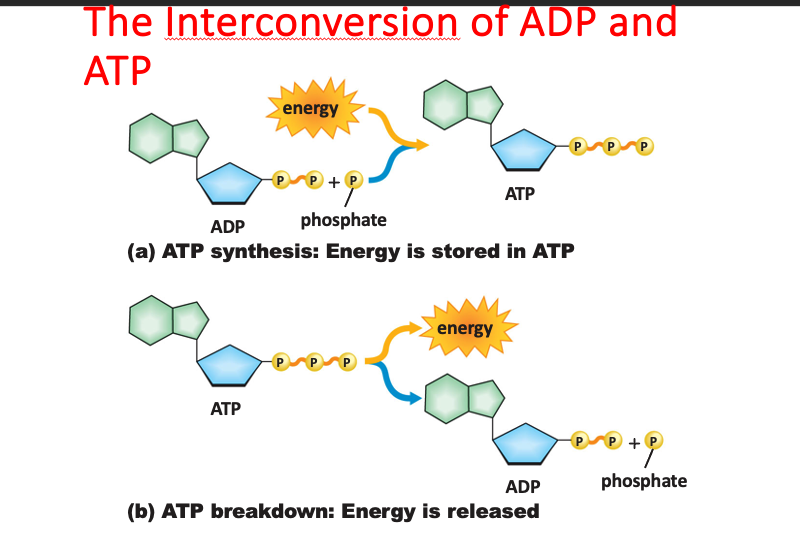
Describe the role of ATP as an energy-carrier molecule
•ATP is the principal energy carrier in cells
•Adenosine triphosphate (ATP) is the most common energy-carrying molecule
•ATP is composed of the nitrogen-containing base adenine, the sugar ribose, and three phosphates
•Energy is released in cells during glucose breakdown and is used to combine the relatively low-energy molecules adenosine diphosphate (ADP) and phosphate (P) into ATP
•Energy is stored in the high-energy phosphate bonds of ATP
•The formation of ATP is an endergonic reaction
•At sites in the cell where energy is needed, ATP is broken down into ADP + P and its stored energy is released this is an exergonic reaction
•This energy is then transferred to endergonic reactions through coupling
•Unlike glycogen and fat, ATP stores energy very briefly before being broken down
What is the other energy carrier besides ATP? How does it work?
•Electron carriers also transport energy within cells
•ATP is not the only energy-carrier molecule in cells
•Energy can be transferred to electrons in glucose metabolism and photosynthesis
•Electron carriers like nicotinamide adenine dinucleotide (NAD+) and flavin adenine dinucleotide (FAD) transport high-energy electrons
•Electron carriers donate their high-energy electrons to other molecules, often leading to ATP synthesis
Formation of ATP is ________ reaction
ATP breakdown into ADP + P and the release of stored energy is ________ reaction
endergonic
exergonic
What is a coupled reaction?
•In a coupled reaction, an exergonic reaction provides the energy needed to drive an endergonic reaction
What is metabolic pathway? What is catabolic pathway vs. metabolic pathway?
•In a metabolic pathway, a specific molecule is altered in a series of steps to produce a product
•Each step is catalyzed by a specific enzyme, a macromolecule that speeds up a specific reaction
•Catabolic pathways release energy by breaking down complex molecules into simpler compounds
•Cellular respiration, the breakdown of glucose in the presence of oxygen is an example of a pathway of catabolism
•Anabolic pathways consume energy to build complex molecules from simpler ones
•For example, the synthesis of protein from amino acids is an anabolic pathway
What is a catalyst? What are 3 important properties in all catalysts?
•Catalysts speed up the rate of a chemical reaction without themselves being used up
1.They speed up reactions by lowering the activation energy required for the reaction to begin
2.They speed up only exergonic reactions
3.They are not consumed or changed by the reactions they promote
What are enzymes? What are the 2 attributes that differentiate them from nonbiological catalysts?
•Enzymes are composed primarily of protein synthesized by living organisms and may require small nonprotein helper molecules called coenzymes in order to function
•Enzymes orient, distort, and reconfigure molecules in the process of lowering activation energy
2 attributes:
1.Enzymes are very specific for the reactions they catalyze
2.Enzyme activity is regulated
Each enzyme has a pocket called an ________ into which one or more reactant molecules, called _______, can enter
•Each enzyme has a pocket called an active site into which one or more reactant molecules, called substrates, can enter
What are the 3 main steps of enzyme catalysis?
1.Both the shape and the charge of the active site allow substrates to enter the enzyme only in specific orientations
2.Upon binding, the substrates and active site change shape to promote a reaction
3.When the reaction between the substrates is finished, the product(s) no longer properly fit into the active site and drift away
Thanks to a series of chemical transformations, each catalyzed by a different enzyme, the energy stored in sugar is released gradually during its breakdown
Some energy is lost as _______, while some is harnessed to power endergonic reactions that lead to _________
Thanks to a series of chemical transformations, each catalyzed by a different enzyme, the energy stored in sugar is released gradually during its breakdown
Some energy is lost as heat, while some is harnessed to power endergonic reactions that lead to ATP synthesis
The sum of all the chemical reactions inside a cell is its _________
The sum of all the chemical reactions inside a cell is its metabolism
How do cells control enzyme synthesis/availability?
Cells regulate enzyme synthesis:
Genes that code for specific proteins are turned on and off according to metabolic need
An increase in substrate can trigger increased enzyme production, leading to decreased substrate levels
How do cells control enzyme activity? Explain:
Inactive form
Competitive vs. Noncompetitive inhibition
Allosteric regulation and feedback inhibition
•Some enzymes are synthesized in inactive form
•For example, the protein-digesting enzymes pepsin and trypsin are inactive when synthesized, but become activated in the stomach under acidic conditions (pepsin) or in the small intestine under alkaline conditions (trypsin)
Some enzymes are inhibited
•In competitive inhibition, a substance that is not the enzyme’s normal substrate binds to the active site of the enzyme, competing with the substrate for the active site
•In noncompetitive inhibition, a molecule binds to a site on the enzyme distinct from the active site
•Small regulator molecules can bind to enzymes and enhance or inhibit activity by allosteric regulation
•Enzymes that undergo allosteric regulation have a special regulatory binding site on the enzyme that is distinct from the enzyme’s active site and similar to a noncompetitive inhibitor site
•Allosteric regulation can either increase or decrease enzyme activity, whereas noncompetitive inhibition only reduces activity
•Feedback inhibition is a negative feedback type of allosteric inhibition that causes a metabolic pathway to stop producing its product when quantities reach an optimum level
•An enzyme near the beginning of a metabolic pathway is inhibited allosterically by the end product of the pathway
What are some factors that affect enzyme activity and how? Explain:
Poisons and drugs
Environmental conditions
•Drugs and poisons often inhibit enzymes by competing with the natural substrate for the active site
•This process occurs either by competitive or by noncompetitive inhibition
•Some inhibitors bind permanently to the enzyme
•Some nerve gases and insecticides permanently block the active site of acetylcholinesterase
•Arsenic, mercury, and lead bind permanently to the non-active sites of various enzymes, inactivating them
Environmental conditions: pH, salts, temperature, presence of coenzymes
Enzyme structure is distorted (denatured) and function is destroyed when pH is too high or low
•Salts in an enzyme’s environment can also destroy function by altering structure
•Salt ions can bind with key amino acids in enzymes, influencing three-dimensional structure and destroying function
Low temp slows down molecular movement, high temp changes shape and denatures enzyme tertiary shape
Photosynthesis
•Photosynthesis is the process by which solar energy is trapped and stored as chemical energy in the bonds of a sugar
Plant organelles/components of organelles:
Chloroplasts
Stoma
Stroma
Thylakoid
Chlorophyll
Rubisco
Cuticle
Mesophyll
Chloroplasts: Chlorophyll-containing organelles, most of which are contained in leaf cells. They have double membranes enclosing a fluid called the stroma
Stroma: •Reactions of the Calvin cycle that capture carbon dioxide and produce sugar occur in the stroma
Stoma/Stomata: Leaves obtain CO2 for photosynthesis from the air through pores in the epidermis called stomata
Cuticle: •The outer surface of both epidermal layers is covered by the cuticle, a transparent, waxy, waterproof covering that reduces the evaporation of water from the leaf
Thylakoid: •Embedded in the stroma are disk-shaped membranous sacs called thylakoids.•The light-dependent reactions of photosynthesis occur in and adjacent to the membranes of the thylakoids
Chemical formula for photosynthesis
6CO2 + 6H2O + (light energy, sunlight) —→ C6H12O6 + 6O2
Photosynthesis uses sunlight to convert carbon dioxide and water to glucose, with oxygen as by-product
(Diagram of Photosynthesis showing Light Reaction and Calvin Cycle)
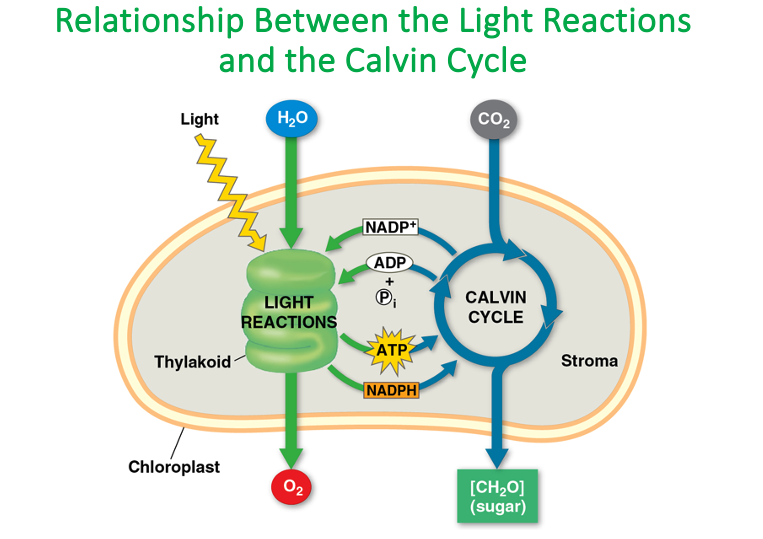
During the light reactions, _________ and other molecules embedded in the chloroplast thylakoid membranes capture sunlight energy and convert some of it into chemical energy stored in the energy-carrier molecules _________ and _________
In the reactions of the Calvin cycle (dark reaction, light independent reaction), enzymes in the _________ use CO2 from the air and chemical energy from the energy-carrier molecules to synthesize a _________ that will be used to make _________
During the light reactions, chlorophyll and other molecules embedded in the chloroplast thylakoid membranes capture sunlight energy and convert some of it into chemical energy stored in the energy-carrier molecules ATP and NADPH.
In the reactions of the Calvin cycle (dark reaction, light independent reaction), enzymes in the stroma use CO2 from the air and chemical energy from the energy-carrier molecules to synthesize a three-carbon sugar that will be used to make glucose
Explain the components of Light Reaction in Photosynthesis:
Capture of light in chloroplasts
Light reactions occur in thylakoid membranes
Capture of light in chloroplasts
Visible light has wavelengths strong enough to alter biological pigment molecules such as chlorophyll a
•Chlorophyll a is a key light-capturing pigment molecule in chloroplasts, absorbing violet, blue, and red light
•Green light, however, is reflected, which is why leaves appear green
•Chloroplasts also contain accessory pigments, that absorb additional wavelengths of light energy and transfer them to chlorophyll a
•Chlorophyll b absorbs blue and red-orange wavelengths of light missed by chlorophyll a
•Carotenoids are accessory pigments that absorb blue and green light, and appear yellow or orange to our eyes because they reflect these colors

