Week 5: Financial instruments
 Call Kai
 Learn
Learn Practice Test
 Spaced Repetition
 Match
Match Flashcards
 Knowt Play
1/17

There's no tags or description
Looks like no tags are added yet.
Name | Mastery | Learn | Test | Matching | Spaced | Call with Kai | Chat |
|---|
No analytics yet
Send a link to your students to track their progress
18 Terms
What is a financial instrument
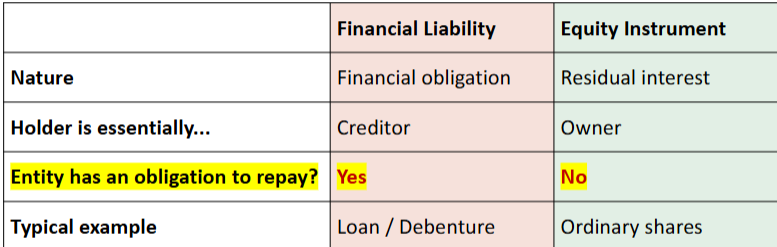
Any contract that gives rise to a financial asset for one entity and a financial liability/equity instrument for another entity
For example: You (company A) lend your friend (company B) $100.
You have a financial asset because your friend owes you $100.
Your friend has a financial liability because they owe you $100.
purchaser of debenture(gives money): one with financial asset
issuer of debenture(takes money): one with financial liability
What is a financial asset
finanical asset is something that gives you cash/ a right to receive cash
includes cash
equity instrument (shares) of another company (ie. you bought shares for cash)
contractual right to receive cash or another financial asset from another entity

Financial liability
contractual obligation to deliver cash or another financial asset
or exchange financial instruments under potentially unfavourable conditions

What is an equity instrument
any contract that evidences a residual interest in the assets of an entity after subtracting liabilities
holders of equity=business owners
they share business profit and risk, investment returns depends on performance, value they get is uncertain
How can a company raise finance
Through borrowing or through equity(shares)
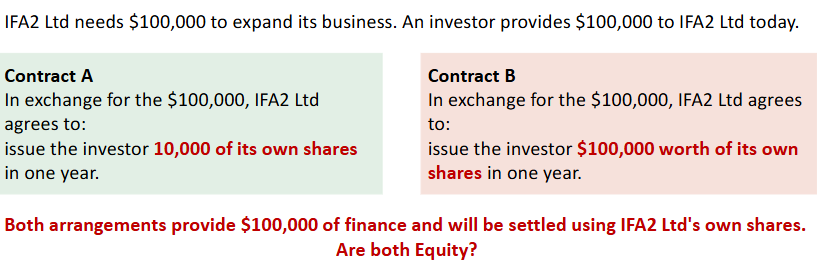
is it debt or equity
A
get a fixed number of shares
how much holder gets depends on share price
holder bears equity risk
no obligation to deliver fixed financial value therefore equity
B:
fixed value of 100k
number of shares adjusts
therefore financial liability

debt vs equity pros and cons
Debt: doesn’t reduce ownership, but repayment obligation and financial risk
Equity: no contractual requirement to pay back, but dilutes ownership
forms of financial instruments
Basic (Non-derivative) financial instruments
instruments that derive value from market: Cash, accounts receivable/payable, loans, debentures, ordinary shares
Derivative financial instruments
derive value from underlying item and needs very little or no initial investment that is settled at future date
eg. Forward contracts, call & put options, interest rates/currency swaps
call option: option to buy at certain price
put option: option to sell at certain price
Preference shares and why do companies prefern them
mix of debt and equity
Higher preference than ordinary shares.
Limited voting rights
Offer more predictable returns (cumulative)
Non participating
WHY DO THEY PREFER THEM
Can raise funds without diluting control (cuz don’t have voting rights)
More flexible than debt
Can attract different investors
Ordinary notes: compound financial instrument (contain both equity and liability componenet)
Ordinary note: a debt instrument under which the issuer borrows funds and has a contractual obligation to pay interest and repay the principal in cash.
Convertible note and why companies and investors prefer them
gives the holder the option to convert the debt into the issuer's ordinary shares at end of contract period.
Allows company to raise finance without diluting ownership cuz don’t have to issue ordinary shares immeditably
Company needs to pay a lower interest rate than straight debt
May reduce need for future cash repayment (ie. can just convert to shares rather than paying principal)
WHY INVESTORS PREFER:
Receive interest while holding notes like debtholders
Has ability to participate in share price growth in future
Can convert into shares if conversion becomes attractive
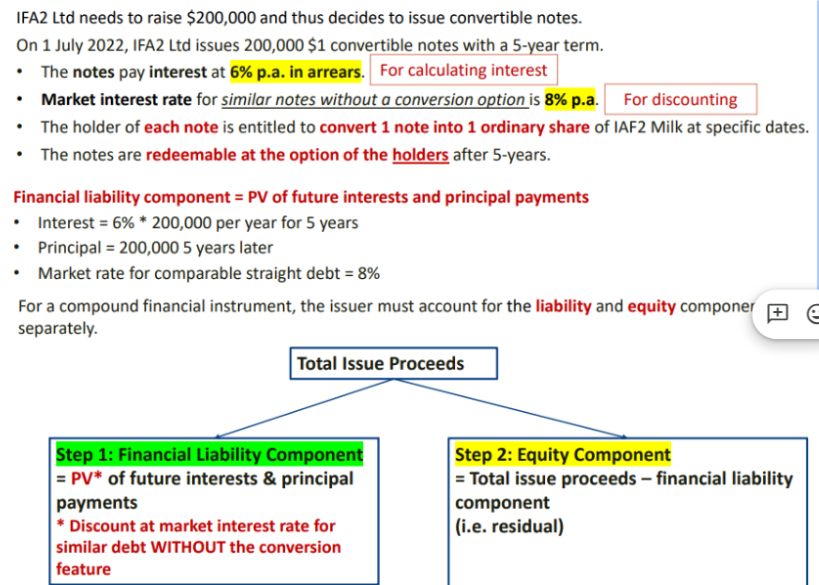
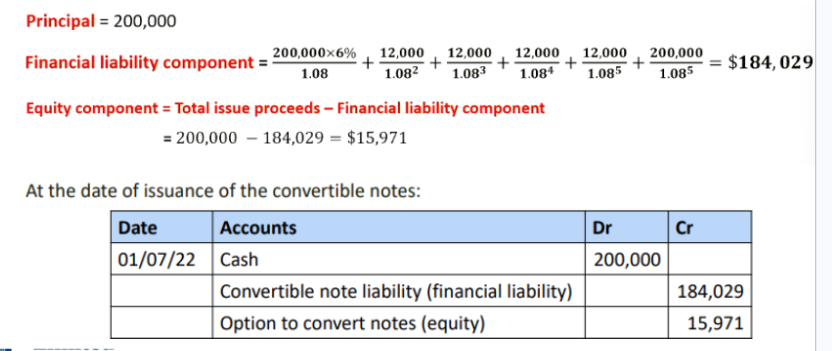
How to treat compound financial instrument
handle liability first then equity
liability is pv of future interest payments and principal (discount at market interest rate for similar debt with no conversion feature)
equity: total issue proceeds-financial liability component.
Recognising financial assets and libailities
initial measurement: generally fair value
There could be transactions costs when purchasing financial assets:
o Fair value through P&L (FVTPL): transacƟon costs → expense
o Other categories (i.e. amorƟsed cost, FVOCI): transacƟon costs → added to iniƟal carrying
amount
Subsequent measurement
Amortised cost
Fair value through oci
Fair value through p&l
how to determine subsequent measurement of asset
1) ask why does the entity hold the financial asset
• Hold to collect contractual cash flows
• Hold to collect AND sell
• Other (e.g. trading)
2) Ask what cash flow does the asset generate does it pass SPPI test (solely payments of principal and interest)
then the subsequent measurment method u use depends on these things
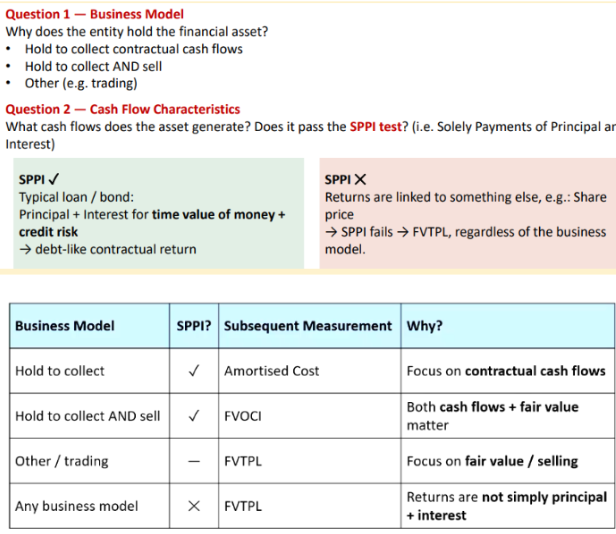
amortised cost method

subsequent measurment for equity instruments
dont need test
if its held for trading use FVTPL
If not held for trading : Entity may make an irrevocable election at initial recognition to
present changes in FV in OCI
Impairment
if you hold it for long term there can be impairment

measurement of liabilities
initial measurment: generally at fair value
FVTPL: FV of consideration received
Amortised cost: FV of consideration received minus transaction costs when issue the financial liability
