hypermetropia & astigmatism
 Call Kai
 Learn
Learn Practice Test
 Spaced Repetition
 Match
Match Flashcards
 Knowt Play
1/14

There's no tags or description
Looks like no tags are added yet.
Name | Mastery | Learn | Test | Matching | Spaced | Call with Kai | Chat |
|---|
No analytics yet
Send a link to your students to track their progress
15 Terms
mindmap of hypermetropia - summary
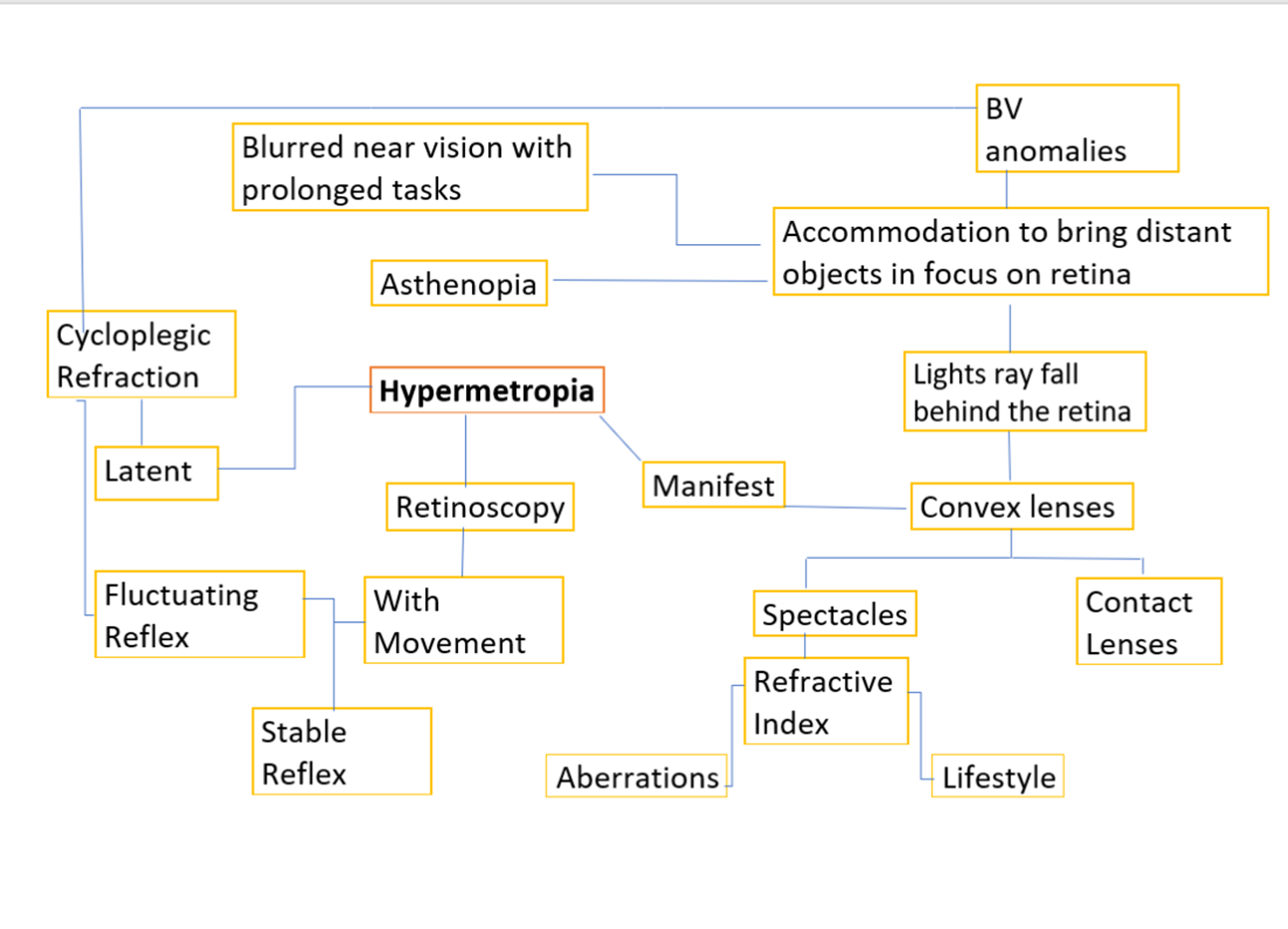
what is the reason for an unaccommodated hypermetropic eye
•eye is too weak to suit it’s axial length
•The eye’s far point - is behind the retina.
•If the deficiency can be made up by an effort of accommodation, the far point can be brought conjugate with the retina and distance objects will then be seen clearly .
define manifest hypermetropia
•That amount of hypermetropia that is exhibited through the maximum plus refraction
•i.e. indicated by the maximum plus lens that provides the optimum distance visual acuity .
define latent hypermetropia (3)
Hypermetropia that is masked by accommodation and is not revealed by non cycloplegic refraction
A cycloplegic agent is often necessary to uncover the full amount of hypermetropia
Latent hypermetropia may account for several dioptres, especially in children whom cycloplegic refraction is necessary to ascertain the full magnitude of refractive error.
what are the symptoms of uncorrected hypermetropia (5)
•Can be asymptomatic usually if the hypermetropia <1 DS.
•Pre-presbyopic patients with hypermetropia may report blur manifested mainly during reading or prolonged near activities.
•When the stimulus at any distance exceeds the available accommodation, a blur in the clarity of the vision results.
•Headaches (frontal).
•Asthenopia.- uncomfortable vision, tired eyes.
define ‘regular’ astigmatism
•the meridians having the maximum and minimum refractive powers are separated by an angle of 90 degrees.
explain what ‘with the rule astigmatism’ is
If in regular astigmatism the steepest measured meridian is approximately vertical at 90 °
explain what ‘against the rule’ astigmatism is
If the steepest meridian in regular astigmatism is approximately horizontal at 180°
explain what oblique astigmatism is
If the steepest meridian in regular astigmatism is neither horizontal nor vertical
what are the sx of uncorrected astigmatism (4)
•Asthenopia.
•Headaches (frontal and associated with the visual task.
•Low amounts of astigmatism < 0.75DC asthenopia symptoms at far and near.
•High degree astigmatism > 0.75DC near asthenopia, reduce vision for distance and near targets.
describe irregular astigmatism
the maximum and the minimum powered meridians are separated by an angle, other than 90 degrees
this is relatively uncommon and found as a result of a secondary cause. E.g. corneal scarring , Keratoconus
what are the purposes of spectacle prescription (2)
Improvement of vision, relief of asthenopic or subsidence of headache - Hypermetropia , Myopia and Astigmatism
Treatment of disturbances of the eye’s structure or visual system that might worsen or induce other anomalies - anomalies' indicated by insufficient /inefficient accommodation, vergence or binocular sensory fusion.
what considerations need to be taken for spectacle prescribing (5)
Minimum essential information to decide which lens power to be prescribed :
•Uncorrected monocular and binocular distance vision.
•Distance refractive correction for each eye.
•Best corrected monocular and binocular distance visual acuity.
•Details of any binocular vision anomalies.
•Working distance for any essential tasks.
what considerations would you need to explain to px’s when adapting to an astigmatic prescription
•Astigmatic corrections that have any significant change in either power or axis position, or if newly initiated tend to greatly increase the difficulties associated with patient acceptance
•Patients suffer disorientation due to the perceived alterations of the elements making up judgements of linear space
•If the axis is altered , the patient may perceive marked tilting of the floor and the walls.
-may take them some time to get used to it
what may large changes in cyl or axis indicate
•may indicate marked changes in the corneal curvature e.g. keratoconus