BIOS242 Exam 3 Review Flashcards
 Call Kai
 Learn
Learn Practice Test
 Spaced Repetition
 Match
Match Flashcards
 Knowt Play
1/45

There's no tags or description
Looks like no tags are added yet.
Name | Mastery | Learn | Test | Matching | Spaced | Call with Kai | Chat |
|---|
No analytics yet
Send a link to your students to track their progress
46 Terms
Host Defenses
Innate and acquired immunological defenses.
Innate Immune Response
The body's immediate, non-specific defenses against pathogens, including physical barriers, phagocytic cells, and inflammatory responses.
Acquired Immune response
A specific immune response developed over time, characterized by the production of antibodies and memory cells following exposure to pathogens.
Physical barriers
The first line of defense in the immune system that includes skin, mucous membranes, and secretions that prevent pathogen entry.
Microbiota barrier
A defensive mechanism provided by the diverse community of microorganisms living in and on the body, which helps to prevent pathogen colonization and infection.
Chemical barriers
Substances produced by the body, such as enzymes and antimicrobial peptides, that help inhibit pathogen growth and promote a healthy environment.
First line of defense
A surface protection composed of anatomical and physiological barriers that keep microbes from penetrating sterile body compartments.
Barriers that block invasion at the portal of entry
Does not involve recognition of foreign substances
General in action
Second line of defense
A cellular and chemical system that comes immediately into play if infectious agents make it past the surface defenses.
Nonspecific
Internalized system of protective cells and fluids
Inflammation and phagocytosis
Acts rapidly at the local and systemic levels
Phagocytosis
The process by which certain cells, such as macrophages and neutrophils, engulf and digest pathogens or debris to protect the body from infection.
Inflammation
A biological response to harmful stimuli such as pathogens or injury, characterized by redness, heat, swelling, and pain, aimed at removing the injurious stimuli and initiating the healing process.
Fever
An elevated body temperature that occurs as part of the immune response to infection, helping to enhance the activity of immune cells and inhibit the growth of pathogens.
Antimicrobial products
Substances that kill or inhibit the growth of microbes, including bacteria, viruses, and fungi, and are often used in medical and personal care applications to prevent infections. Examples such as antibiotics, antiseptics, and disinfectants.
Third line of defense
Includes specific host defenses that must be developed uniquely for each microbe through the action of specialized white blood cells.
Acquired on an individual basis as each foreign substance is encountered by lymphocytes
Produces unique protective substances and cells that can come into play if the microbe is encountered again
Provides long-term immunity

B cells
A type of white blood cell that plays a crucial role in the adaptive immune response by producing antibodies specific to antigens, aiding in the neutralization and elimination of pathogens.

T cells
A type of lymphocyte that plays a central role in cell-mediated immunity, these cells recognize and attack infected or cancerous cells, and help coordinate the immune response.
Neutrophils

Phagocytic
Found in blood
First to respond
Increase during bacterial infections
Basophils

Function in inflammatory events
Usually found in low numbers
Eosinophils

Active in protozoal and helminth reactions
Usually found in low numbers
Elevated in allergic reactions
Mast cells

Found in the tissues
Similar to basophils
Contain histamine

Monocytes
Blood phagocytes that rapidly leave the circulation; mature into macrophages and dendritic cells

Macrophages
Large phagocytic cells; high capacity for killing microbes and cleaning up dead cells; antigen-presenting cells

Dendritic cells
Reside in tissues and MPS; process foreign matter and present it to lymphocytes; antigen-presenting cells
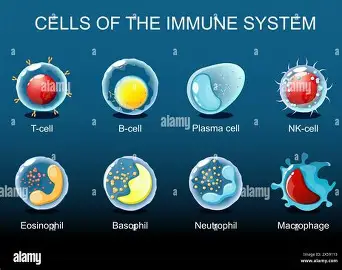
Natural killer (NK) cells
A type of lymphocyte that plays a crucial role in the immune response by detecting and destroying abnormal cells, such as virus-infected or cancer cells, without requiring prior sensitization.
Phase 1 of phagocytosis
Chemotaxis by phagocyte
Phagocytes must move to the site of injury
They follow the trails of chemicals released by damaged tissues
Phase 2 of phagocytosis
Adhesion of bacteria
Phagocytic cell PPRs (Pattern recognition receptors) recognize and bind microbial PAMPs (Pathogen-associated molecular patterns)
Phase 3 of Phagocytosis
Engulfment into phagocytic vacuole
Phase 4 of phagocytosis
Phagosome
Phase 5 of phagocytosis
Phagolysosome formation
Phase 6 of phagocytosis
Killing and destruction of bacterial cells
Phase 7 of phagocytosis
Release of residual debris
Not all the debris is released
Some debris is shown to T cells
Classical Pathway

A complement activation pathway triggered by antigen-antibody complexes, leading to opsonization and lysis of pathogens.
Lectin Pathway

A complement activation pathway initiated by the binding of lectins to specific carbohydrates on pathogen surfaces, which activates complement proteins.
Alternative Pathway
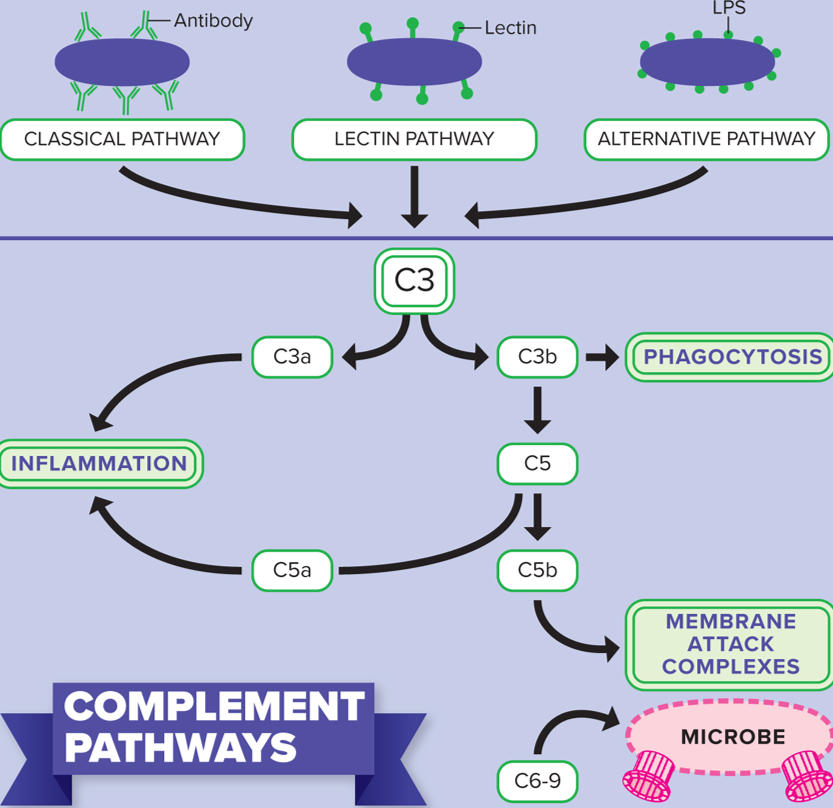
A complement activation pathway that is triggered by the spontaneous activation of complement proteins on pathogen surfaces, leading to opsonization and inflammation.
Adaptive Immunity: Specificity
Response can be focused on a single antigen
Adaptive Immunity: Diversity
Always at least one cell that can react against any antigen
Adaptive Immunity: Inducibility
Only turned on when triggered
Adaptive Immunity: Clonality
Generates millions of cells with the same specificity.
Adaptive Immunity: Tolerance
Does not react with self antigens
Adaptive Immunity: Memory
Rapid mobilization of lymphocytes preprogrammed to recall their first engagement with the antigen
Antigen
Molecules that can be seen and identified by the immune system
Epitope
Specific region of an antigen that is recognized by the immune system.
Hapten
Small molecule that must bind to a carrier molecule; enhances immunogenicity.
B cell maturation
Bone marrow
B cells binding and location
Bind to antigens and are found in the blood with their cell receptor
B cell activation requirement
Help from helper T cells
Maturation of B cells
Mature into plasma cells once activated, they then start to secrete antibodies.